Pairs with the Adjacency / Synergy Map — a ready-to-use strategy tool. Included in the The Adjacency Expansion Casebook →
Buried in a routine quarterly letter to shareholders, Netflix wrote a sentence no streaming executive was supposed to write. Not that it was losing to HBO, or Disney, or Amazon. It wrote: 'We compete with (and lose to) Fortnite more than HBO.'1 That line, filed in January 2019, is the whole story in one breath. Netflix had stopped thinking of itself as a video company fighting other video companies. It had started measuring its real enemy: the hours of your evening, no matter what was eating them.
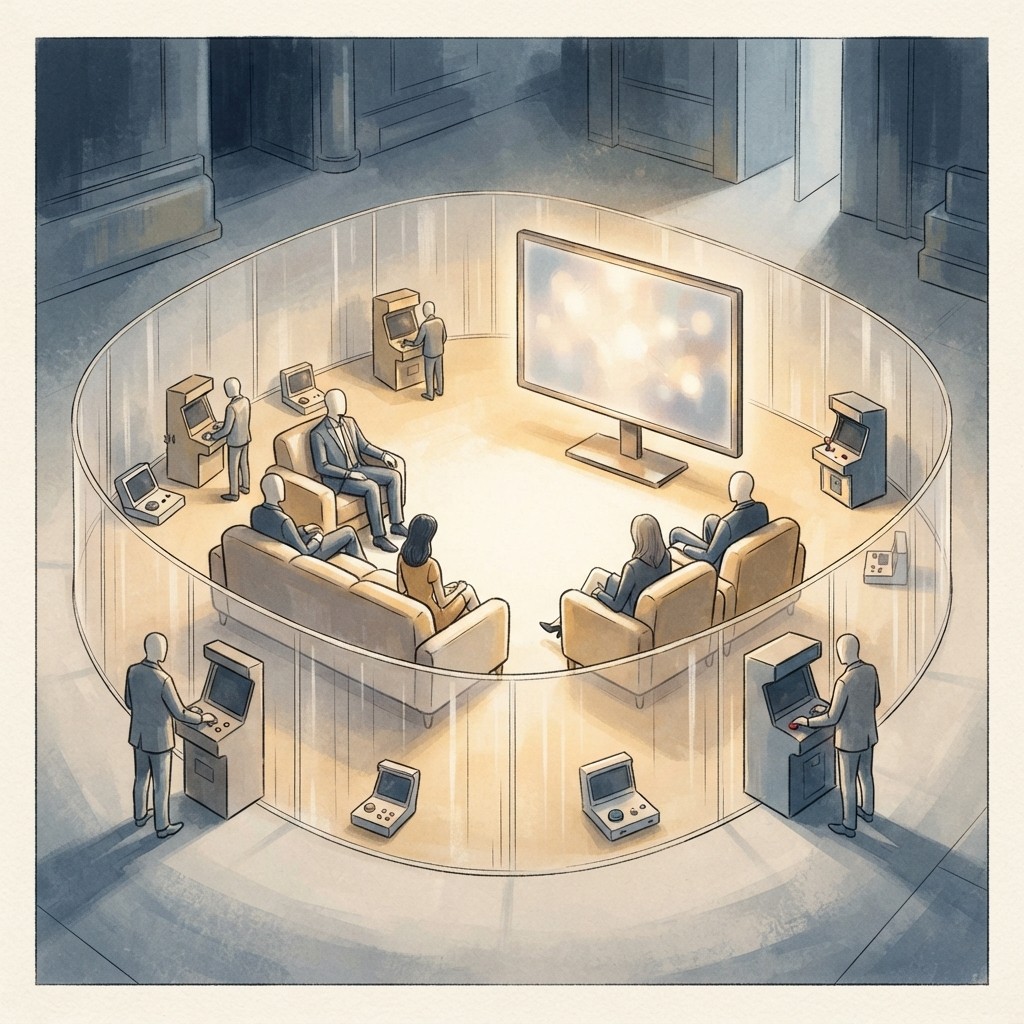
The official story is that Netflix decided to become a games company. It is the wrong story. Netflix did not move into gaming to make games - it moved into gaming to make sure nothing else was making off with the attention it had spent twenty years and tens of billions of dollars capturing. The games are real. The motive was a fence.
“We compete with (and lose to) Fortnite more than HBO.”1
The enemy was the gap, not the rival
A subscription business has one quiet killer: the empty stretch. You finish a season, there's nothing new for months, and your thumb starts wandering to another app. That wandering is where cancellations are born. Netflix's own framing of why it built games was almost embarrassingly plain - games are 'a strategy to keep subscribers engaged in between seasons of their favorite shows.'3 Read that again. Not to win the games market. Not to open a revenue line. To occupy the gap. The strategic problem wasn't Fortnite the product; it was the silence between episodes that Fortnite could fill. Gaming was the patch over that hole.
This is also why the games cost nothing extra. They are bundled into the standard subscription, with no separate charge - which only makes sense if the goal is to make leaving feel slightly more expensive, not to sell anything new. A feature you give away for free isn't a business. It's a moat. And the moat Netflix wanted was around the decision to cancel.
| The official story | What the structure says | |
|---|---|---|
| The goal | Become a games company | Suppress churn between seasons |
| How it's sold | A new growth frontier | Bundled free, no separate charge |
| What it competes with | Other game publishers | The empty gap in your evening |
| Success measured by | Game revenue | Whether you stay subscribed |
Netflix had been edging toward this for years
The 2021 hire of a games-development VP from Facebook, reporting to Netflix's COO, looked like a beginning.2 It wasn't. Netflix had been testing the same instinct for years: a Stranger Things mobile tie-in back in 2017, then the choose-your-own-path interactive film Black Mirror: Bandersnatch in 2018.8 Both were experiments in the same direction - turn passive watching into something you do, something that holds you a little longer. What changed in 2021 wasn't the idea. It was the decision to formalize it into a division, with a budget and an org chart, and to bundle real mobile games into the app at no charge.2
Five years in, almost nobody is playing
Here is where the defensive bet meets the scoreboard. By September 2023, Netflix games drew about 2.2 million average daily users.4 Against roughly 247 million subscribers, that is under one percent playing on any given day - and that's after the game library had tripled.4 Daily players had peaked at 2.7 million in January 2023 and sagged to 1.45 million by March.4 The much-quoted 'tripling' of engagement was tripling off a sliver. Netflix wasn't building a flywheel; it was bouncing along a floor. A fence is only worth building if people are inside it, and almost no one had walked in.
The deeper problem is what the games are up against. Netflix's core product commands roughly two hours of viewing per paid membership per day.5 That's the bar. A mobile puzzle game launched from the same app has to pull attention away from a two-hour-a-day habit the company spent a fortune engineering. The fence was being built right next to a wall that already worked. No wonder the people on the other side rarely climbed over.
Isn't it too early to call it a miss?
The fair objection is that gaming is a marathon and Netflix is still early - it has even started describing gaming as a 'new growth initiative' in its filings, alongside advertising.5 Building a games operation takes a decade, the argument goes, and judging it at five years is impatient. There's truth in that. But two signals cut against the optimism. First, the strategic restlessness: Netflix brought in a games-industry veteran as President of Games in 2024, and the executive who architected the original push - having cycled through three different titles - left the company in March 2025.7 That's not the rhythm of a confident bet compounding; it's the rhythm of a reset.
Second, and more telling: the urgency that justified the fence has faded. In 2024 Netflix posted $39 billion in revenue, up about 16%, on roughly 278 million average paying memberships.6 The core machine is healthier than it was when it confessed to losing against Fortnite. A churn hedge matters most when churn is the threat. When the wall is holding fine on its own, the fence beside it stops looking like insurance and starts looking like a hobby that hasn't earned its keep.
Adjacency moves come in two flavors that look identical from the outside: the bet that's meant to become a business, and the bet that's meant to protect one. Netflix's gaming push is the second kind - a churn hedge dressed in product clothes. The trap is that defensive bets get judged by offensive yardsticks. Game downloads and player counts feel like the scoreboard, but they aren't: the only number that matters for a retention play is whether the people who play are less likely to cancel. If you launch an adjacency to defend the core, measure the defense - not the adjacency. Otherwise you'll either celebrate a 'tripling' that's tripling off nothing, or kill a feature that was quietly doing its one real job.
Netflix didn't move into gaming because it wanted to make games. It moved in because it had glimpsed its true competitor - not a network, but the entire economy of attention - and games were the cheapest available wall to throw up in the gaps. The instinct was sound. The execution, five years on, is a fence almost nobody stands behind, defending a wall that no longer needs much defending. The lesson isn't that adjacency is folly. It's that a hedge has to be priced against the thing it hedges - and when your core grows into a $39 billion fortress, the moat you dug for it can quietly become beside the point.
When a company expands beside its core
Adjacency / Synergy Map
A one-page canvas for an adjacency play: the new business next door, the shared assets that justify entering it, the synergies that actually transfer versus the ones that evaporate on contact, and the dis-synergies nobody put on the deck. Blank to test your own expansion; filled as the worked example showing where the story's 'natural adjacency' was real and where it was wishful.
Included, filled and blank, in the The Adjacency Expansion Casebook. See the set → · Preview the blank →
Sources
Where this comes from — the filings, records, and reporting behind it.
- 1Netflix's Q4 2018 shareholder letter contains the verbatim line 'We compete with (and lose to) Fortnite more than HBO,' establishing gaming as an attention competitor predating the formal gaming division by ~3 years.
- 2Netflix hired Mike Verdu from Facebook (where he was VP of AR/VR content) on July 14, 2021, as VP of Game Development, reporting to COO Greg Peters, to formally launch the Netflix gaming division. Games were to be included at no extra charge.
- 3Netflix's stated rationale for gaming, as of 2021 launch, was that 'games are a strategy to keep subscribers engaged in between seasons of their favorite shows' — a churn and retention rationale, not a standalone revenue play.
- 4As of September 2023, Netflix games had ~2.2 million average daily users and ~70.5 million total downloads — less than 1% of Netflix's 247.15 million subscribers playing daily, even as the library tripled. Daily users peaked at 2.7 million in January 2023 and dipped to 1.45 million in March 2023.
- 5Netflix's Q3 2024 SEC shareholder letter (Form 8-K) explicitly lists gaming as a 'new growth initiative' alongside ads, and confirms ~two hours per day average engagement per paid membership for its core video product — the baseline gaming must compete against.
- 6Netflix reported full-year 2024 total revenues of $39.0 billion (up ~16% YoY), with 277.7 million average paying memberships — the core business scale that makes gaming financially immaterial as a standalone contributor.
- 7Mike Verdu, the architect of Netflix's gaming strategy, left the company in March 2025 after cycling through VP of Game Development → VP of Games → VP of Gen AI in Games. Alain Tascan (ex-Ubisoft, EA, Epic) had already been hired as President of Games in 2024, signaling a strategic reset.
- 8Netflix's earliest gaming-adjacent moves predate the 2021 formal launch: a Stranger Things mobile tie-in game in 2017 and the interactive film Black Mirror: Bandersnatch in 2018. The 2021 milestone was the formal division launch, not the origin of gaming activity.
More like this — beyond Netflix
New Strategically analyses as they publish: the defining moves in business, checked against the record. No noise, and one click to leave.