Pairs with the Adjacency / Synergy Map — a ready-to-use strategy tool. Included in the Adjacency Expansion Casebook →
“When does the business next door belong to you?”
In December 2017, Disney announced it would buy most of 21st Century Fox in an all-stock deal worth $52.4 billion in equity, about $66.1 billion all in. The press release led with X-Men and Avatar and The Simpsons, but buried just below the marquee names was the part that actually mattered: Fox's 30% of Hulu, which would hand Disney a controlling stake, plus a faster path into direct-to-consumer streaming and a piece of Sky in Europe.16 Eighteen months later the same deal closed at a number nobody had said out loud at the start. The headline price had climbed to $71.3 billion in equity.2 Somewhere in between, a streaming bet quietly turned into something much heavier — and much of the reason was a rival who never won.
The story everyone tells is that Disney spent $71 billion for Fox's library and its superheroes. That sentence gets two things wrong at once. The library was not the spine of the deal, and $71 billion was neither the announced price nor the true cost. Both numbers drifted in the retelling, and the gap between them is where the real strategy lives.
The deal was about the pipes, not the contents
Read the original 2017 announcement and the logic is plainly a streaming logic, not a content-shopping spree. The single most consequential asset named was Fox's 30% of Hulu — the slice that would tip Disney into majority control of a platform it already part-owned. Alongside it: an explicit aim to accelerate direct-to-consumer and international streaming, and a stake in Sky across Europe.6 The IP was the cargo. The distribution control was the road. Years later, defending the deal on an analyst call, Bob Iger said it cleanly: the acquisition was done 'through the lens of streaming,' and 'it came with control of Hulu, and ultimately ownership of Hulu.'7 The streaming rationale wasn't reverse-engineered to save face. It was on the page from day one.
“In late 2017, when we announced initially that we were acquiring assets from 20th Century Fox, we specifically mentioned that we were doing so through the lens of streaming... it came with control of Hulu, and ultimately ownership of Hulu.”7
So the thesis is this: Disney did not overpay for a film library. It paid a coherent price for streaming control — and then a bidding war it didn't start dragged that price up by roughly $19 billion and bolted a declining cable business onto a forward-looking bet. The genius of the original deal and the burden of the final one are two different decisions, separated by one rival's cash.
How $52 billion became $71 billion in six months
Here is the part the round-number headlines erase. The December 2017 offer was an all-stock deal at roughly $28 a share. On June 13, 2018, Comcast made an unsolicited all-cash bid of $65 billion. Within a week, Disney amended its agreement to $38 a share in cash or stock — an equity value of about $71.3 billion, which Fox's board itself called 'a significant increase over the purchase price of approximately $28 per share' from December.3 Disney's counter was a roughly 10% premium over Comcast's number, and the amendment said in plain terms that it was superior to Comcast's proposal.23 Comcast never matched dollar for dollar and never came close to winning. It simply forced the price up and walked away, having cost Disney tens of billions without spending a cent.
| Dec 2017 offer | Jun 2018 amended | Mar 2019 at close | |
|---|---|---|---|
| Equity value | $52.4B | $71.3B | ~$71B |
| Total transaction value | $66.1B | ~$85.1B | — |
| Per-share consideration | ~$28 (all stock) | $38 (cash or stock) | $51.572626 |
| What moved it | — | Comcast's $65B cash bid | New Fox spinoff adjustment |
Even '$71 billion' undersells it. Disney's own June 2018 Form 8-K put the total transaction value at about $85.1 billion once roughly $13.8 billion of assumed net debt is counted.2 And the famous '$38 a share' never actually changed hands. Because Fox spun off the broadcast-and-news 'New Fox' before closing, the share count was adjusted by a 'Distribution Adjustment Multiple' of 1.357190, so the real per-share merger consideration at the March 2019 close was $51.572626.4 Three numbers, all technically correct, all telling a different story about how much was really committed.
The part of Fox Disney was forced to sell, and the part it shouldn't have wanted
Two facts puncture the 'Disney bought Fox's everything' story. First, Disney did not get to keep Fox's sports. The DOJ filed an antitrust suit and required Disney to divest all 22 Fox Regional Sports Networks as a condition of closing. Disney sold 21 of them, plus Fox College Sports, to Sinclair Broadcast Group at an enterprise value of $10.6 billion.5 The 'sports assets' people imagine Disney scooped up were on the auction block before the ink dried. Second, and more damning, the bulk of what Disney actually retained was the wrong half of the media business. Years later, the activist investor Nelson Peltz's proxy materials cited a MoffettNathanson estimate that about 67% of Fox's pro-forma EBITDA at the time of acquisition came from linear TV networks — FX, National Geographic, international cable — the very asset class in secular decline.8
That is the accidental acquisition hiding inside the intentional one. Disney set out to buy streaming control and a library of franchises. What it paid an inflated price to own was, by EBITDA, two-thirds a cable bundle — profitable on the day of purchase, structurally shrinking every day after. The streaming engine was the reason for the deal; the linear networks were the freight that came chained to it.
But Iger says the deal paid off — isn't he right?
The honest counter is Iger's own scorecard. He points to Avatar sequels, to a haul of Emmy wins, to the IP that fed Disney+ and Hulu, and says the deal delivered.7 That's not nothing — control of Hulu and a deep franchise vault genuinely strengthened Disney's streaming hand, exactly as the 2017 filing promised. The fair read is that the original strategic logic was sound. But notice what the defense quietly skips. It measures the trophies and ignores the price. A deal can be strategically right and still financially overpaid, and those are separate ledgers. Disney got the Hulu control it wanted — it just paid roughly $19 billion more than its own first offer to get it, and inherited a linear-TV business it has spent years trying to figure out how to shed. The vision was clear. The check was bloated by a rival who never had to win to make Disney lose.
A bidding war doesn't change your strategy — it changes your math, and the two are easy to confuse afterward. Disney's reason to buy Fox (control the streaming pipes, own Hulu outright) was the same at $52 billion and at $71 billion. What Comcast altered was not the logic but the bill, adding roughly $19 billion to a deal whose stated rationale never moved. When you find yourself defending an acquisition, ask the two questions separately: Was the thesis right? And did you overpay to execute a right thesis? The most expensive mistakes look like successes precisely because the thesis was sound — the trophies on the shelf distract from the freight in the basement and the premium on the receipt.
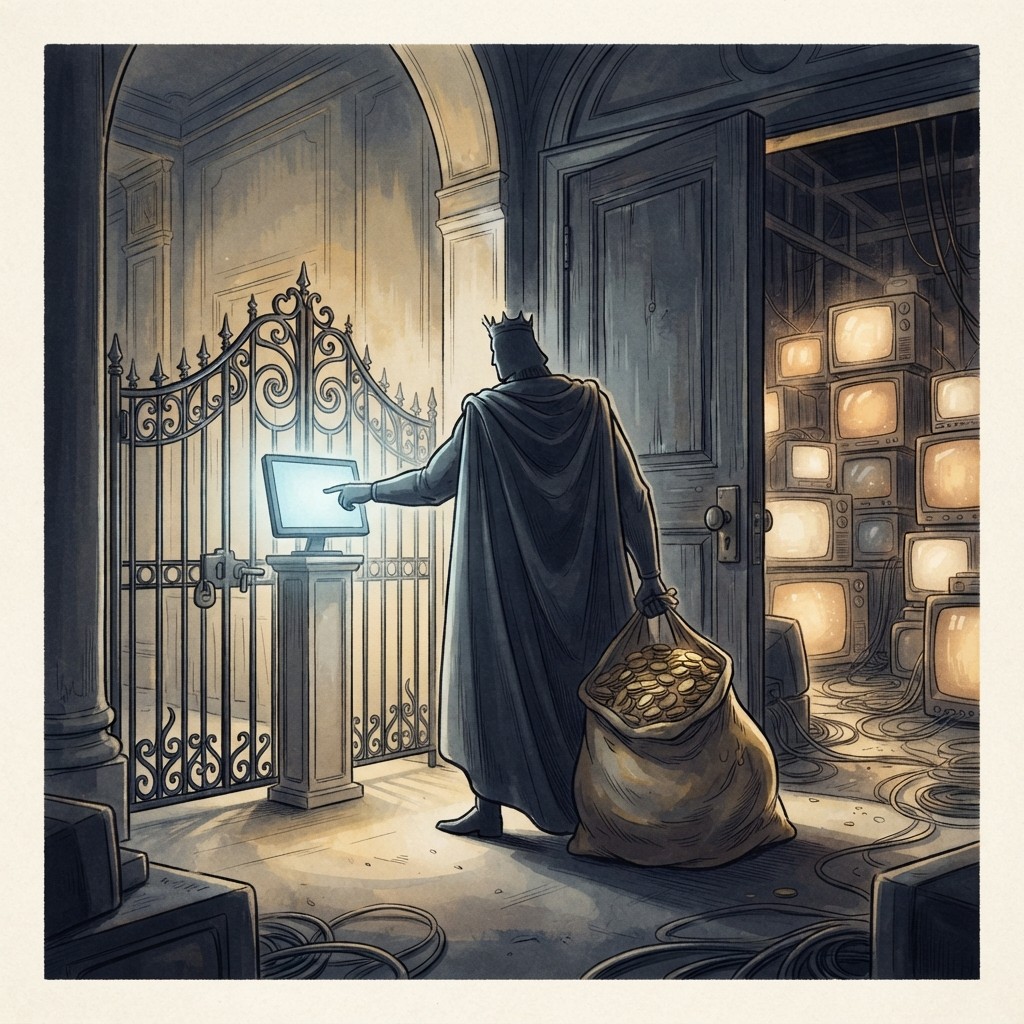
Disney walked into 2017 with a clean idea: stop renting your path to the viewer, own it, and own Hulu. It walked out of 2019 having executed that idea — and having paid for it with an extra $19 billion, a portfolio of regional sports it had to sell, and a cable business that was the majority of the EBITDA and the minority of the future. The deal everyone calls a content grab was really a streaming bet, and the streaming bet was really an accidental cable acquisition wearing a franchise's face. Disney bought the right thing. It just bought a great deal of the wrong thing along with it — and let a rival who never won set the price.
Adjacency / Synergy Map
A one-page canvas for an adjacency play: the new business next door, the shared assets that justify entering it, the synergies that actually transfer versus the ones that evaporate on contact, and the dis-synergies nobody put on the deck. Blank to test your own expansion; filled as the worked example showing where the story's 'natural adjacency' was real and where it was wishful.
Included, filled and blank, in the Adjacency Expansion Casebook. See the set → · Preview the blank →
Sources
Where this comes from — the filings, records, and reporting behind it.
- 1Disney's original December 14, 2017 offer valued 21CF at $52.4 billion equity / $66.1 billion total transaction value in an all-stock deal, including X-Men, Avatar, The Simpsons, FX and National Geographic; Hulu stake to become a controlling interest.
- 2On June 20, 2018, Disney amended its agreement to $38/share (cash or stock), implying total equity value of ~$71.3 billion and total transaction value of ~$85.1 billion (assuming no tax adjustment); Disney also assumed ~$13.8 billion net debt. The amendment explicitly stated this was superior to Comcast's unsolicited June 13, 2018 proposal.
- 321st Century Fox's board confirmed the amended Disney price of $38/share 'represents a significant increase over the purchase price of approximately $28 per share included in the Disney Merger Agreement when it was announced in December 2017,' and that the amended agreement was superior to Comcast's proposal of June 13, 2018.
- 4The acquisition closed March 20, 2019. The actual per-share merger consideration at closing was $51.572626—not $38—because Fox distributed New Fox shares pre-closing, adjusting consideration via a Distribution Adjustment Multiple of 1.357190 under the Merger Agreement. Total equity value at closing was approximately $71 billion.
- 5The DOJ required Disney to divest all 22 Fox Regional Sports Networks as a condition of closing, filing a civil antitrust lawsuit June 27, 2018. Disney subsequently sold 21 RSNs and Fox College Sports to Sinclair Broadcast Group at a total enterprise value of $10.6 billion (purchase price $9.6B net of minority interests); the transaction closed August 23, 2019.
- 6Disney's stated strategic rationale from the original December 2017 announcement included: acquiring Fox's 30% Hulu stake to create a controlling interest, accelerating direct-to-consumer and international streaming capabilities, and adding Fox's 39% stake in Sky across Europe.
- 7Bob Iger stated on a November 2024 analyst call: 'In late 2017, when we announced initially that we were acquiring assets from 20th Century Fox, we specifically mentioned that we were doing so through the lens of streaming... it came with control of Hulu, and ultimately ownership of Hulu.' Iger cited Avatar and 60 Emmy wins as proof of deal value.
- 8Activist investor Nelson Peltz's 2024 proxy filing cited a MoffettNathanson estimate that ~67% of Fox's pro-forma EBITDA at time of acquisition came from linear TV networks (FX, National Geographic, and International Cable Channels, excluding RSNs), directly undercutting the streaming-asset framing of the deal.
Weighing outside help with a decision like this? Hiring a commercial due diligence provider
More like this — beyond Disney-Fox
New Strategically analyses as they publish: the defining moves in business, checked against the record. No noise, and one click to leave.