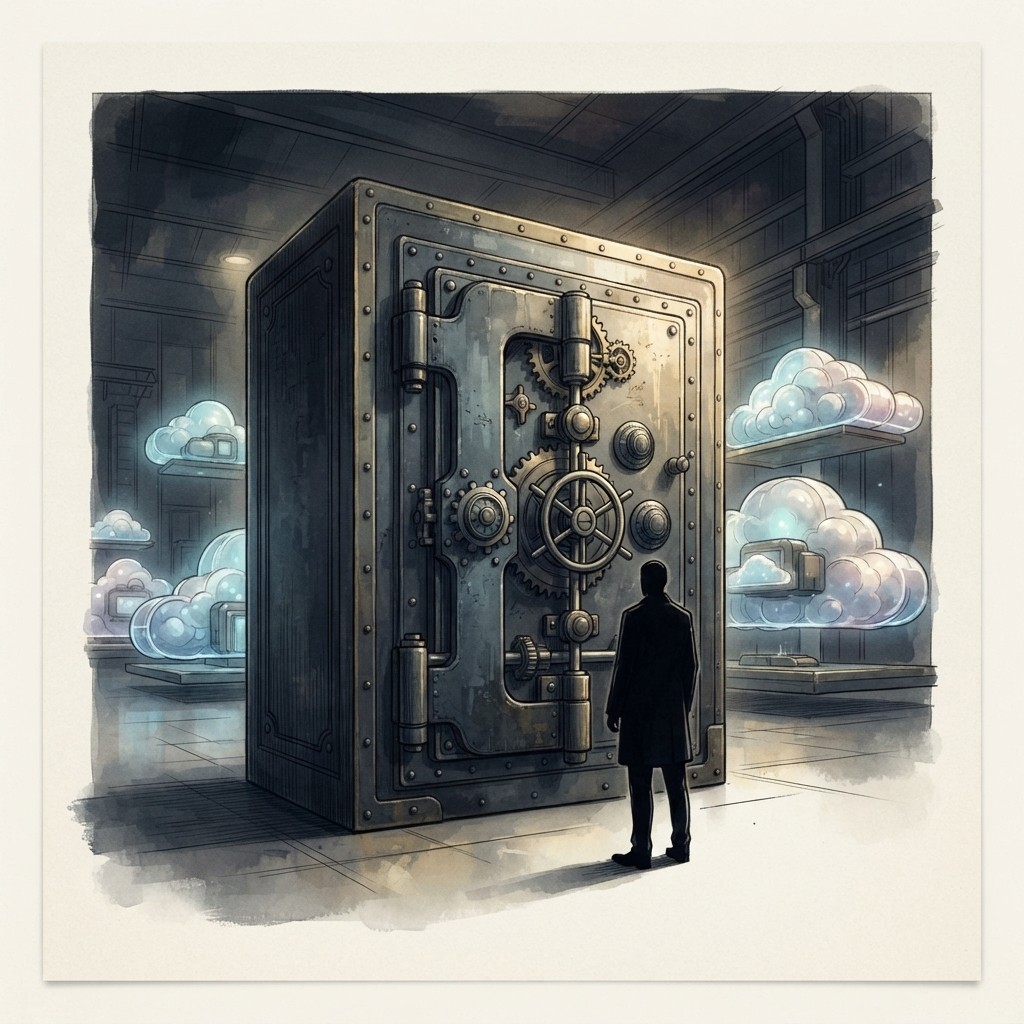
He didn't miss the cloud. He saw it coming clearly enough to mock it in public and write checks for it in private — because the cloud was a worse business than the one he was already running.
Pairs with the Counterfactual Timeline Builder — a ready-to-use strategy tool. Included in the Counterfactual Casebook →
“What did the decision you did not take actually cost?”
Around 2008, the most powerful database salesman alive stood up and called the future of computing 'complete gibberish.' Larry Ellison said the word 'cloud' was 'insane,' that he had 'no idea what anyone is talking about,' and that the whole thing was hype.1 The line is usually filed under famous wrong predictions, right next to 'nobody needs more than 640K of memory.' But Ellison was not confused. He understood the cloud perfectly. He understood it well enough to know exactly what it threatened - and to stall for as long as he could before it arrived.
The official story is that Oracle was a dinosaur that didn't see the cloud coming and got caught flat-footed. The truer story is that Oracle saw it coming with total clarity, dismissed it loudly in public, and held its enormously profitable database franchise back from commoditization for as long as the market would let it. The lateness was real. The blindness was an act.
“It's not water vapor! All it is, is a computer attached to a network.”2
Read that line twice, because almost everyone has it backwards. The internet remembers Ellison calling the cloud 'water vapor.' He said the opposite: it is not water vapor - it's just a computer on a network, which is to say it's real, it's concrete, and it's nothing new.2 That was the whole point of the rant. He wasn't denying the cloud existed. He was deflating the idea that it was a revolution, because a revolution would mean the thing his company sold - the on-premise license, the seat in the corporate data center - was about to become a utility someone else metered. A man who calls something 'water vapor' doesn't see it. A man who insists it's 'just a computer attached to a network' sees it exactly, and would prefer you didn't.
What Ellison was actually protecting: follow the money the dismissal was guarding, and the 'blind spot' turns into a balance sheet
To understand the dismissal, follow the money it was guarding. Oracle's business for thirty years was selling perpetual database licenses plus support contracts to enterprises that ran the software on their own machines. That model has a beautiful property: the customer pays a large sum up front and then pays again, every year, for support - and it is extraordinarily hard to leave, because your most critical data lives inside Oracle's tables. The cloud breaks the front half of that deal. In a cloud world you don't buy a license; you rent a service by the month, and the moment everything is rented by the month, price becomes visible, switching gets easier, and the fat up-front check disappears. Ellison's problem was never that he misunderstood the cloud. It was that the cloud was a worse business for Oracle than the one Oracle already had. Calling it gibberish bought time for the cash machine to keep running.
When an incumbent loudly dismisses the thing that will eventually eat its lunch, the easy read is arrogance or ignorance. Often it's neither. A franchise throwing off huge, sticky, high-margin revenue has a rational interest in slowing the transition - not stopping it (that's impossible) but delaying it, so the new lower-margin model arrives after the old one has been milked dry. The tell is whether the 'blind' incumbent quietly builds or buys the replacement while mocking it in public. Oracle did exactly that.
The catch-up Oracle bought instead of built: when the giant finally moved, it didn't invent its way in — it shopped
Here is the part the 'change of heart' narrative misses entirely. When Oracle finally moved, it didn't invent its way into the cloud - it wrote checks. Its own infrastructure platform did go live: on October 20, 2016, as 'Oracle Bare Metal Cloud Services,' only rebranded to Oracle Cloud Infrastructure two years later.3 But the cloud applications - the actual software businesses customers wanted to rent - came from outside. That same month, Oracle agreed to buy NetSuite for roughly $9.3 billion.4 And NetSuite was not some internal Oracle skunkworks. It had been founded back in 1998 and had spent, in its own founder's words, 'eighteen years to develop a single system for running a business in the cloud.'5 Oracle's press release described NetSuite as 'the very first cloud company.'4 Sit with that phrase. By calling its acquisition the first cloud company, Oracle was admitting, in a federal filing, that it was not.
Six years later, Oracle ran the same play at a far bigger scale. In January 2022 it tendered for Cerner, the electronic-health-records giant, at $95.00 a share - a total transaction valuation the SEC filing pins precisely at $28,477,199,240, just over $28.5 billion.6 (The press loves to round it to 'twenty-eight billion'; the primary document is sharper.) Cerner gave Oracle an enormous, captive base of hospital data to host - exactly the kind of mission-critical, hard-to-move workload that suits Oracle's database-and-infrastructure stack. The pattern is unmistakable. Oracle's cloud is, in large part, a portfolio of other people's cloud companies, bolted onto an infrastructure layer Oracle did build late but built deliberately for the workloads it already owned.
| Infrastructure (IaaS) | Cloud applications | |
|---|---|---|
| How Oracle got it | Built late, deliberately (2016 launch) | Bought - NetSuite, Cerner |
| Origin | In-house, for owned workloads | Independent companies, decades old |
| The admission | Rebranded to 'OCI' only in 2018 | Press release: NetSuite was 'the very first cloud company' |
| What it defends | The database franchise's data gravity | Sticky, mission-critical software seats |
But didn't it work? Isn't the cloud business booming now?: the growth is real, but read the segment against the company before you call it a turnaround
The fair objection is that none of this matters because the catch-up succeeded. And the growth numbers are genuinely good: in fiscal Q4 2024, Oracle's cloud revenue - infrastructure plus applications - hit $5.3 billion, up 20%, with infrastructure alone up 42% and total remaining performance obligations swelling 44% to $98 billion.7 An AI build-out that needs raw compute has handed Oracle's infrastructure a tailwind it didn't have to manufacture. So the pivot is real, and it's in the financials, not just the analyst decks. But headline cloud growth flatters the picture, and the same filings say so plainly. In that same quarter, total company revenue grew only 3% year over year to $14.3 billion, because on-premise license revenue - the old cash machine - fell 15% to $1.8 billion.8 The cloud is growing fast off a smaller base while the legacy franchise it replaced is shrinking. That is the math of a delayed transition finally happening, not a company that out-innovated its rivals. The hold-back bought years; it did not buy escape velocity from the transition itself.
When a company trumpets a 42% growth rate, ask three questions before you believe the story: 42% of what base, against what shrinkage elsewhere, and toward what total? Oracle's IaaS line growing 42% is true and impressive - and its total revenue growing 3% the same quarter is also true. Both numbers come from the same earnings release. A fast-growing segment inside a slow-growing company is the signature of a transition mid-flight, not a turnaround complete. The growth rate tells you the direction; the total tells you the distance left to travel.
So strip the legend away. Oracle was not a giant asleep at the wheel that woke up just in time. It was a giant that saw the road perfectly, decided it preferred the old route, and drove the toll-rich highway as long as the gates stayed open - then bought its way onto the new road when it finally had to. Ellison's 'gibberish' was never a failure of vision. It was a calculated dismissal that protected billions in license revenue for the better part of a decade. The bill came due anyway, the way it always does. Oracle just made sure it arrived last - and brought a checkbook.
Other companies that fought the future on purpose
Counterfactual Timeline Builder
A one-page canvas that runs two histories side by side: what actually happened, and the alternative that died at the fork. You pin the divergence point, trace each branch forward, and name the assumption that decided which one came true. Blank, it disciplines hindsight into a testable counterfactual instead of a what-if; filled, it shows the story's road-not-taken with enough rigor to argue about.
Included, filled and blank, in the Counterfactual Casebook. See the set → · Preview the blank →
Sources
Where this comes from — the filings, records, and reporting behind it.
- 1Larry Ellison publicly called cloud computing 'complete gibberish' and 'insane,' saying he had 'no idea what anyone is talking about,' at an Oracle financial analyst meeting circa 2008, later also at Oracle OpenWorld 2008 per CNET (September 26, 2008).
- 2Ellison's 'cloud' rant included the line 'It's not water vapor! All it is, is a computer attached to a network,' and he blamed venture capitalist 'nitwits on Sand Hill Road' for the hype — meaning the widely-circulated 'water vapor' attribution inverts what he actually said.
- 3Oracle's cloud infrastructure was made generally available on October 20, 2016, under the name 'Oracle Bare Metal Cloud Services'; it was rebranded as Oracle Cloud Infrastructure only in 2018 at Oracle OpenWorld — meaning references to 'OCI' before 2018 are anachronistic.
- 4Oracle announced a definitive agreement to acquire NetSuite — described in Oracle's own press release as 'the very first cloud company' — on July 28, 2016, for approximately $9.3 billion ($109.00 per share in cash).
- 5NetSuite was founded in 1998 and had been developing cloud-based ERP for 18 years before Oracle acquired it; its founder Evan Goldberg described it as having 'worked for 18 years to develop a single system for running a business in the cloud.'
- 6Oracle's tender offer to acquire Cerner was priced at $95.00 per share with a total transaction valuation of $28,477,199,240 (~$28.5 billion), filed with the SEC on January 19, 2022.
- 7For Oracle's full fiscal year 2024, total revenues were $53.0 billion (up 6%); Q4 FY2024 cloud revenue (IaaS + SaaS) was $5.3 billion, up 20%, with IaaS specifically up 42% and Total Remaining Performance Obligations up 44% to $98 billion.
- 8For Oracle's fiscal Q4 2024, on-premise license revenues fell 15% YoY to $1.8 billion, confirming the structural migration away from legacy license revenue even as total revenue grew only 3% YoY to $14.3 billion — the cloud growth headline masks modest overall top-line expansion.
Weighing outside help with a decision like this? Hiring a commercial due diligence provider
More from Stratrix
Strategy Decision Cases
879 strategic decisions with dated outcomes, ranked by how often each kind holds.
24 decision typesSee which decisions hold →The Strategist’s Craft
The methods behind the job: the planning cycle, initiative charters, decision rights, the memo that gets a yes.
Methods and templatesStart with the craft →Weekly email
Stratonomics, every Tuesday
One data story every Tuesday: what happened, what it means, and the figures you can quote. Free.
More like this — beyond Oracle
New Strategically analyses as they publish: the defining moves in business, checked against the record. No noise, and one click to leave.