Pairs with the Adjacency / Synergy Map — a ready-to-use strategy tool. Included in the The Adjacency Expansion Casebook →
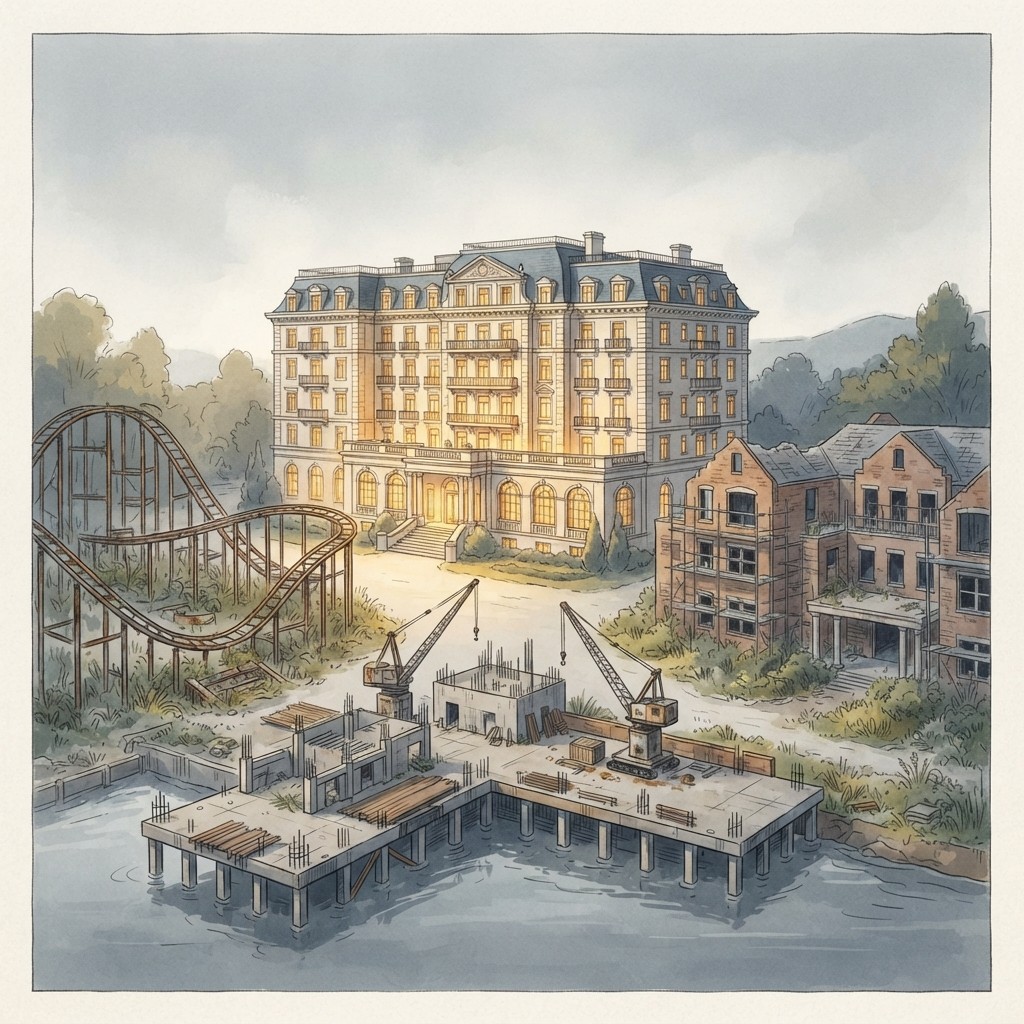
In 1976, the company that runs your business-trip hotel was selling roller-coaster rides. Marriott built two Great America theme parks that year - one in Gurnee, Illinois, one in Santa Clara, California1 - and for a stretch in the late twentieth century it also ran senior-living communities, an airline-catering and food-distribution arm, and a timeshare empire. The story everyone tells about Marriott is the story of a hotel company that grew brave: it bet beyond its core and won. Look at what it actually kept, and a different company appears.
The official version is that Marriott diversified boldly and built an empire. The truer version is that Marriott diversified repeatedly and unwound almost all of it - parks, distribution, senior living, even timeshare - until what remained was the one thing it had quietly been perfecting the whole time: managing other people's hotels for a fee.
Here is the thesis, plainly. Marriott's edge never came from the adjacency bets. It came from ruthless recommitment to an asset-light lodging model - and the only 'expansion beyond the core' that ever stuck wasn't beyond the core at all. It was slicing the core into more brands.
It was never just a root beer stand - and never just a hotel chain
The founding myth compresses Marriott into a charming origin: a root beer stand that grew up. The reality is that J. Willard Marriott was running a serious food-service operation long before the first room key. By 1952 his Hot Shoppes generated $19.7 million in sales across 45 restaurants in nine states plus airline catering, and it had been running in-flight catering for an airline since 1937 - one of the first such services in the country.8 The company only opened its first hotel, the Twin Bridges Motor Hotel in Arlington, Virginia, in January 1957.1 So Marriott didn't start as a hotel company that diversified. It started as a diversified company that found, decades in, a single business worth concentrating on. That sequence matters - because the instinct to operate in many lines was there from the beginning, and so was the eventual discipline to cut.
The exits were messier than the legend admits
Tidy retrospectives say Marriott 'sold its theme parks in 1984' and moved on, a clean strategic pivot. The paper trail is less clean. The Gurnee park did sell to Bally Manufacturing, parent of Six Flags, in 1984. But the Santa Clara park went first to the City of Santa Clara, and its operating rights weren't conveyed to Kings Entertainment Company until 1989 - five years after the supposed break.7 A clean pivot is a story; a half-decade unwind is what really happens when a company climbs out of a business it shouldn't have entered. The detail is the point: getting out of an adjacency is slow, expensive, and rarely as decisive as the highlight reel.
And the unwinding wasn't finished in the 1980s. It was still happening twenty years later. As late as fiscal 1999, Marriott International ran three real segments: Lodging at 81% of sales, Distribution Services at 13%, and Senior Living Services at 6%.2 That is not a hotel company with a hobby. That is a company with nearly a fifth of its revenue outside lodging, deep into the late 1990s.
Then it cut. By the FY2003 10-K, Senior Living Services and Distribution Services had been reclassified as discontinued operations, and the company had reorganized into lodging-only segments: Full-Service, Select-Service, Extended-Stay, Timeshare, and a synthetic-fuel tax line.3 In the space of a few years, the non-lodging adjacencies simply disappeared from the operating model. The bold diversifier turned out to be a serial divestor.
| Expansion | Fate | Was it really adjacent? |
|---|---|---|
| Theme parks (1976) | Exited mid-1980s; CA rights lingered to 1989 | No - capital-heavy, off-core |
| Distribution Services | Discontinued operations by FY2003 | No - low-margin, off-core |
| Senior Living Services | Discontinued operations by FY2003 | No - operationally different |
| Timeshare | Spun off as Marriott Vacations, 2011 | Partly - but separated out |
| Brand proliferation | Kept and multiplied | Yes - it IS the core |
The only adjacency that stuck wasn't an adjacency
Run down the list of Marriott's 'expansions beyond the core' and almost every one was reversed. Parks: gone. Distribution: gone. Senior living: gone. Even timeshare, which looked like the most natural lodging adjacency of all, was filed away for separation - Marriott submitted a Form 10 in June 2011 to spin its vacation-club business into a stand-alone public company, Marriott Vacations Worldwide.6 The one move that compounded instead of being cut was the move that wasn't a diversification at all: launching Courtyard in 19831 and, from there, multiplying the number of hotel brands aimed at every traveler and price point. That is not expansion beyond the core. It is the core, subdivided - and it works because each new flag plugs straight into the same machine of management contracts, franchising, and loyalty.
Why did brand proliferation stick when the genuine adjacencies didn't? Because it rides the asset-light model instead of fighting it. Marriott's FY2021 10-K describes the company as 'a worldwide operator, franchisor, and licensor' and is blunt about the strategy: 'Consistent with our focus on management, franchising, and licensing, we own very few of our lodging properties.'4 A new hotel brand demands almost no balance sheet from Marriott - owners and franchisees supply the buildings - so each brand is nearly pure fee income layered onto fixed central infrastructure. A theme park or a senior-living community, by contrast, demanded capital, specialized operations, and risk that had nothing to do with collecting fees on rooms. The adjacencies asked Marriott to become a different kind of company. Brand proliferation only asked it to be more of what it already was.
“Consistent with our focus on management, franchising, and licensing, we own very few of our lodging properties.”4
Even Marriott's biggest swing fits the pattern. The 2016 Starwood deal is remembered as a $13.6 billion acquisition, but the SEC-filed merger documents make clear that $13.6 billion was the value excluding Starwood's timeshare business, which was carved out and spun to ILG; the full per-share consideration, counting that carve-out, came to $85.36 - a deal materially larger than the headline.5 Notice the shape: Marriott bought a pile of hotel brands and loyalty members, and the part that didn't fit the fee-on-rooms model - the timeshare - was severed in the same breath. The target G&A synergies were raised to a $250 million run-rate5, the prize being a bigger network feeding the same asset-light machine. Marriott didn't acquire to diversify. It acquired to concentrate.
Wasn't the diversification smart while it lasted?
The fair objection is that this reads too neatly in hindsight. Distribution and senior living weren't follies; they were real, sizable businesses that contributed cash for years, and exiting them at the right moment is itself a kind of skill. Maybe the adjacencies funded the patient build-out of the lodging model and earned their keep before being retired. That's partly true - a fifth of revenue doesn't sit on the books for nothing. But it cuts the other way too. The honest counter to the legend isn't that the bets were stupid; it's that they were temporary, and the company's actual genius was knowing what to keep. The durable value compounded in the part Marriott never let go of and kept replicating. The adjacencies were rented; the lodging fee model was owned. A company is defined less by what it tries than by what it refuses to give up.
Diversification headlines are cheap; persistence is the real signal. When you study a company's strategy, ignore the press releases about bold new ventures and trace which businesses survive a full cycle of pressure. Marriott entered parks, distribution, senior living, and timeshare - and exited or spun off every one, while quietly multiplying hotel brands that plugged into a single asset-light fee engine. The lesson for operators: an adjacency only earns its place if it rides your existing machine instead of demanding a second one. If a new line forces you to become a different kind of company - new capital intensity, new operations, new risk - it will probably be the thing you sell back later. Expand into businesses that make your core stronger, not businesses that merely make your revenue bigger.
Marriott looks, from a distance, like a company that wandered everywhere - the parks, the catering carts, the retirement homes, the timeshare clubs. Up close it is the opposite: a company with the rare discipline to let go of nearly everything it tried, and to recommit, again and again, to the one model that compounded. The empire wasn't built by going beyond the core. It was built by refusing to. The most expensive lesson in its history is also the simplest - the adjacency that lasts is the one that was never really an adjacency.
When companies discover what they actually are
Adjacency / Synergy Map
A one-page canvas for an adjacency play: the new business next door, the shared assets that justify entering it, the synergies that actually transfer versus the ones that evaporate on contact, and the dis-synergies nobody put on the deck. Blank to test your own expansion; filled as the worked example showing where the story's 'natural adjacency' was real and where it was wishful.
Included, filled and blank, in the The Adjacency Expansion Casebook. See the set → · Preview the blank →
Sources
Where this comes from — the filings, records, and reporting behind it.
- 1Marriott International's official corporate history confirms the Twin Bridges Motor Hotel in Arlington, Virginia opened in January 1957 as the company's first hotel; the first international property, the Paraiso on Acapulco Bay, opened in 1969 as the company's 11th hotel; Courtyard launched in 1983; two Great America theme parks opened in 1976 in Gurnee, IL and Santa Clara, CA and were sold in 1984.
- 2Marriott International's FY1999 10-K filed with the SEC describes three business segments — Lodging (81% of sales), Senior Living Services (6%), and Distribution Services (13%) — confirming the company was operating materially outside lodging as late as fiscal year 1999.
- 3Marriott International's FY2003 10-K (covering fiscal year ended January 3, 2003) shows that Senior Living Services and Distribution Services were reclassified as discontinued operations, and that the company had refocused into five lodging-only segments: Full-Service, Select-Service, Extended-Stay, Timeshare, and Synthetic Fuel — confirming the retreat from non-lodging adjacencies.
- 4Marriott International's FY2021 10-K states the company is 'a worldwide operator, franchisor, and licensor of hotel, residential, and timeshare properties' and confirms the asset-light model: 'Consistent with our focus on management, franchising, and licensing, we own very few of our lodging properties.'
- 5The amended Marriott-Starwood merger agreement, filed as an 8-K exhibit with the SEC on March 21, 2016, values Starwood at $13.6 billion excluding its timeshare business (Vistana), with Starwood shareholders receiving $21.00 cash plus 0.80 shares of Marriott stock per share. Total per-share value including the ILG timeshare spin-off consideration was $85.36. Targeted annual G&A synergies were raised to $250 million run-rate.
- 6Marriott International filed a Form 10 with the SEC on June 28, 2011 to spin off its vacation club business as Marriott Vacations Worldwide Corporation, a separate publicly traded company — confirming that timeshare was itself eventually separated from the lodging management core.
- 7The Gurnee, IL Great America park was sold to Bally Manufacturing (parent of Six Flags) in 1984. The Santa Clara, CA park was sold first to the City of Santa Clara (1984–85) and the operating rights were not conveyed to Kings Entertainment Company until 1989, making the 'sold in 1984' shorthand inaccurate for the California asset.
- 8Hot Shoppes, Inc. generated $19.7 million in sales in 1952 from 45 restaurants across nine states plus DC and airline catering operations, before it entered lodging. In 1937 Hot Shoppes began one of the first U.S. in-flight catering services for Eastern Air Lines at Hoover Field. The company went public in 1953 at $10.25 per share, raising $2.5 million for a one-third interest.
More like this — beyond Marriott
New Strategically analyses as they publish: the defining moves in business, checked against the record. No noise, and one click to leave.