Pairs with the Adjacency / Synergy Map — a ready-to-use strategy tool, filled for DuPont. Included in the The Adjacency Expansion Casebook →
In July 1802, a French émigré named E.I. du Pont stood on the banks of Brandywine Creek in Delaware, having just paid $6,740 for ninety-five acres, and hired workmen to build mills that ground a single dangerous product: black gunpowder.2 By the end of 1804 he had sold 39,000 pounds of it, much of it to the federal government and to John Jacob Astor's fur traders.2 Two centuries later, the company that bore his name would be cut into three pieces by lawyers and bankers, none of whom had any interest in gunpowder at all.6 In between sits the most celebrated reinvention story in American industry. The trouble is that most of it didn't happen the way the legend says.
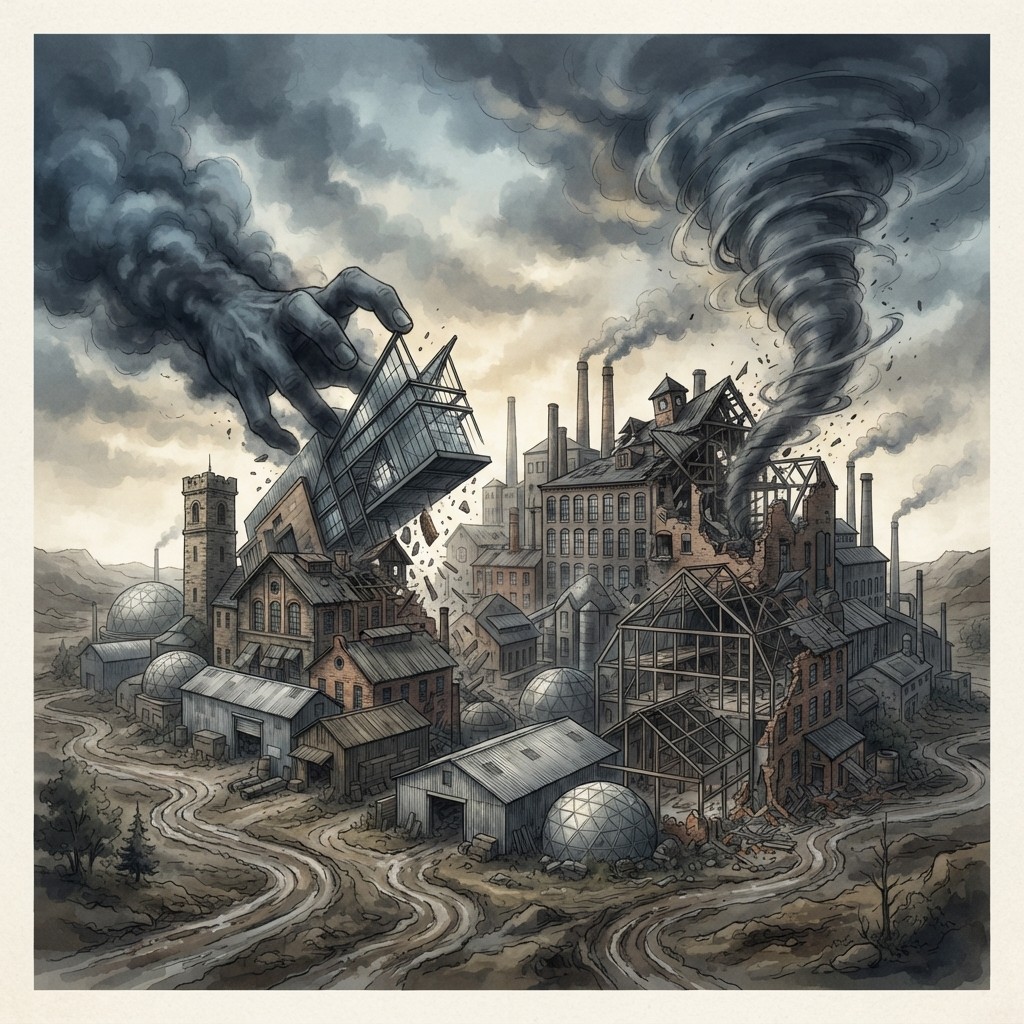
The official story is that DuPont is a masterclass in voluntary reinvention - a company that saw each future coming and walked toward it: powder to chemicals, chemicals to materials, materials to a clean, focused specialty business. The record tells a colder story. Almost every great pivot in DuPont's history was triggered by an outside force - a court order, a war that ended, an accident at a lab bench, an activist with a spreadsheet. DuPont didn't keep choosing reinvention. It kept getting cornered into it, and then narrating the escape as strategy.
The first pivot arrived as a court order
By the early twentieth century DuPont was not a chemicals company. It was an explosives empire, the dominant force in American powder, and it had built one of the country's earliest industrial research laboratories - the Experimental Station, established in 1903 - largely to defend and extend that empire.3 Then the government noticed. A 1912 antitrust suit under the Sherman Act ended in a 1913 court order that carved two new companies, Hercules and Atlas, out of DuPont's powder business.3 The split wasn't a tidy halving of market share; the court divided the business by product, with DuPont keeping single-base nitrocellulose powders and Hercules taking double-base.3 A company that lives inside the legend of foresight should notice the shape of this moment: the first great diversification of DuPont's history was not a strategy. It was a punishment.
“Production of military explosives employed only 400 workers and accounted for less than 2% of total sales.”8
Here is the mechanism that drives the whole two centuries, and it is not glamorous. Explosives are a feast-and-famine business: war creates colossal demand, peace destroys it overnight. DuPont sold 4 million barrels of powder to the federal government during the Civil War alone.2 But by 1939, military explosives employed just 400 workers and made up less than 2% of total sales8 - a once-dominant business that had quietly become a rounding error. A company whose flagship product swings that violently with geopolitics has to find something steadier to sell or die in the trough. The research lab built to serve gunpowder became, by accident of survival, the engine that replaced it.
The famous inventions, sorted by how much was actually planned
This is where the legend is strongest and the truth most uneven. DuPont's interwar research did produce real, deliberate breakthroughs: neoprene synthetic rubber in 1931, and nylon, introduced commercially in 1938 after Wallace Carothers first synthesized the polymer at the bench in 1935.5 Those were planned bets on polymer chemistry paying off. But the company's other signature material tells a different story. Teflon was not invented; it was stumbled into. Roy Plunkett discovered PTFE by accident at DuPont's Jackson Laboratory in 1938, and the company didn't even trademark the 'Teflon' name until 1945 - seven years later.4 By 1948 it was producing roughly 2 million pounds a year.4 The lesson isn't that DuPont got lucky. It's that DuPont's genius was rarely in choosing the future. It was in industrializing whatever the bench coughed up, planned or not.
| Pivot | The visionary story | The actual trigger |
|---|---|---|
| Out of pure explosives | Saw chemicals coming | 1913 antitrust court order + collapsing post-war powder demand |
| Into polymers (nylon, neoprene) | Bet on the materials age | Planned research - the rare genuine foresight |
| Teflon | Engineered a wonder material | Accidental lab discovery in 1938, named in 1945 |
| Into wartime giant | Strategic scale-up | WWII demand: 37,000 workers, 4.5 billion lbs of explosive |
| Three-way breakup | Streamlined for focus | Merger-of-equals and activist-driven restructuring |
Then came the war that proves the point hardest. World War II turned the shrunken explosives business inside out: DuPont employed as many as 37,000 workers and produced 4.5 billion pounds of explosive, and in 1943 was tapped to design, build, and operate the Hanford Site plutonium plant for the Manhattan Project.8 This is not a company strolling toward its destiny. It is a company being handed national emergencies and reorganizing itself around each one - powder when there's a war, polymers when there isn't, plutonium when the government knocks.
The last reinvention was run by bankers, not chemists
The pattern held right to the end of DuPont as an independent firm. In December 2015 it agreed to an all-stock merger of equals with Dow Chemical - the agreement dated December 11, 2015 - which became legally effective on August 31, 2017, forming the awkward hybrid DowDuPont.67 But the merger was never the point. It was a staging area. The combined entity was assembled specifically to be torn apart along cleaner lines: agriculture, materials science, and specialty products.7 In 2019 it split into three public companies - Dow Inc. spun off April 1, Corteva on June 1, and the rump renamed DuPont de Nemours that same day, keeping the specialty businesses.6 A 217-year-old chemistry company ended its independent life as a transaction structure: merge to split, split to focus. The chemists who once ran toward neoprene had been replaced by the people who run toward a sum-of-the-parts valuation.
Isn't being shocked into greatness still greatness?
The fair objection is that this read is too cynical. Plenty of companies got antitrust orders, surplus capacity, and accidental discoveries - and most died anyway, or limped along as a husk of one product. DuPont survived two centuries, and survival at that scale is not luck; it is a capability. So even if every pivot was triggered from outside, the thing worth admiring is that DuPont was always positioned to capitalize: it had built the research lab, the manufacturing depth, the institutional patience to industrialize whatever the moment demanded.3 That's true, and it's the honest version of the company's strength. But notice what it concedes. The skill being praised is not foresight - it is adaptability under duress. DuPont didn't see the future; it built the muscles to absorb whatever future was forced on it. That's a real and rare capability. It is simply a different one than the legend sells, and confusing the two is how companies talk themselves into thinking they steered when they were really pushed.
The durable lesson of DuPont's 200 years isn't 'pick the right adjacency.' It's that the companies which survive shocks are the ones whose capabilities - research depth, manufacturing scale, institutional patience - are general enough to be repointed at a market they didn't choose. When the antitrust order, the war's end, the accidental discovery, or the activist arrives, you don't get to plan. You get to deploy whatever you already built. So build the muscle, not the prophecy. But don't let the survival story curdle into a foresight myth - because a company that believes it always steered will stop building the muscle that actually saved it, right up until the shock it can't absorb.
DuPont's two-century arc reads, in the standard telling, as a series of bold leaps. Stand close to the record and the leaps look more like recoveries - each one a stumble that the company was strong enough to turn into a step. A court took its monopoly; it built chemicals. Peace drained its powder; it built polymers. A bench accident handed it Teflon; it built a brand around a substance nobody set out to make. And in the end, bankers handed it a breakup, and it built three companies out of one.6 The genius was never knowing where to go. It was being strong enough to land wherever it was thrown - and disciplined enough, for a very long time, not to mistake the landing for the jump.
When the trigger comes from outside the building
Adjacency / Synergy Map
A one-page canvas for an adjacency play: the new business next door, the shared assets that justify entering it, the synergies that actually transfer versus the ones that evaporate on contact, and the dis-synergies nobody put on the deck. Blank to test your own expansion; filled as the worked example showing where the story's 'natural adjacency' was real and where it was wishful.
Included, filled and blank, in the The Adjacency Expansion Casebook. See the set → · Preview the blank →
Sources
Where this comes from — the filings, records, and reporting behind it.
- 1E.I. du Pont de Nemours & Company articles of partnership were signed April 21, 1801; E.I. du Pont settled on Brandywine Creek on July 19, 1802, and hired workmen to build powder mills; first black powder was marketed two years later (1804).
- 2The Eleutherian Mills gunpowder mill site was used for manufacture of explosives from 1802 to 1921; E.I. du Pont purchased the 95-acre site for $6,740; by end of 1804 DuPont had sold 39,000 pounds of powder; the federal government and John Jacob Astor's American Fur Company were early regular customers; during the Civil War the firm sold 4 million barrels of powder to the federal government.
- 3DuPont's Experimental Station was one of the earliest (not the first) industrial research laboratories in the United States, established in 1903; the 1912 antitrust suit under the Sherman Act led to the 1913 court-ordered creation of Hercules Powder Company and Atlas Powder Company; DuPont retained single-base nitrocellulose powders while Hercules held double-base powders.Wikipedia, DuPont ↗ · 2024
- 4Teflon (PTFE) was discovered accidentally by Roy J. Plunkett at DuPont's Jackson Laboratory in 1938, not intentionally invented; DuPont trademarked 'Teflon' in 1945; by 1948 DuPont was producing approximately 2 million pounds of Teflon per year.
- 5DuPont introduced neoprene synthetic rubber in 1931 and nylon commercially in 1938 (Wallace Carothers synthesized the polymer in the lab in 1935; 1935 is not the commercialization date). The Dow-DuPont merger was legally effective August 31, 2017.
- 6DowDuPont was formed December 9, 2015 via an all-stock merger-of-equals agreement between The Dow Chemical Company and E.I. du Pont de Nemours and Company; the merger became legally effective August 31, 2017; DowDuPont then separated into three public companies: Dow Inc. (spun April 1, 2019), Corteva (spun June 1, 2019), and DuPont de Nemours (renamed June 1, 2019), retaining specialty products.
- 7The merger agreement between Historical DuPont and Historical Dow was dated December 11, 2015 (amended March 31, 2017); the three intended independent companies were to cover agriculture (Corteva), materials science (Dow), and specialty products (New DuPont).
- 8In 1939, production of military explosives by DuPont employed only 400 workers and accounted for less than 2% of total sales; during World War II DuPont employed as many as 37,000 workers and produced 4.5 billion pounds of explosive; DuPont also played a major role in the Manhattan Project in 1943, designing, building, and operating the Hanford Site plutonium-producing plant.Wikipedia, DuPont ↗ · 2024
More like this — beyond DuPont
New Strategically analyses as they publish: the defining moves in business, checked against the record. No noise, and one click to leave.