Pairs with the Vertical-Integration Assessment — a ready-to-use strategy tool. Included in the Vertical Integration Casebook →
“What must you own, and what can you safely buy?”
Buy a Uniqlo HEATTECH undershirt and you are holding the output of a fabric contract negotiated years in advance, with a chemicals giant, for a garment that will be on the shelf next winter and the winter after that and the one after that. There is no trend in it. There is no season it expires. That is the whole point. In the 2010 fall/winter season alone Uniqlo sold 80 million HEATTECH items worldwide4—not because the design was new, but because it never had to be.
The official story is that Uniqlo won by inventing LifeWear: simple, high-quality clothing instead of fashion. It's a good story, and it's backwards. LifeWear is a slogan that was formally articulated only around 2012–20136. The thing it describes—the ability to make a plain grey crewneck better and cheaper than anyone else—was bolted into the company a quarter-century earlier, in a decision nobody outside Yamaguchi noticed at the time.
“In 1987, we switched to a specialty retailer of private-label apparel (SPA) model that combined manufacturing and retailing, letting us offer products that customers really wanted.”7
The slogan came in 2012. The advantage came in 1987.
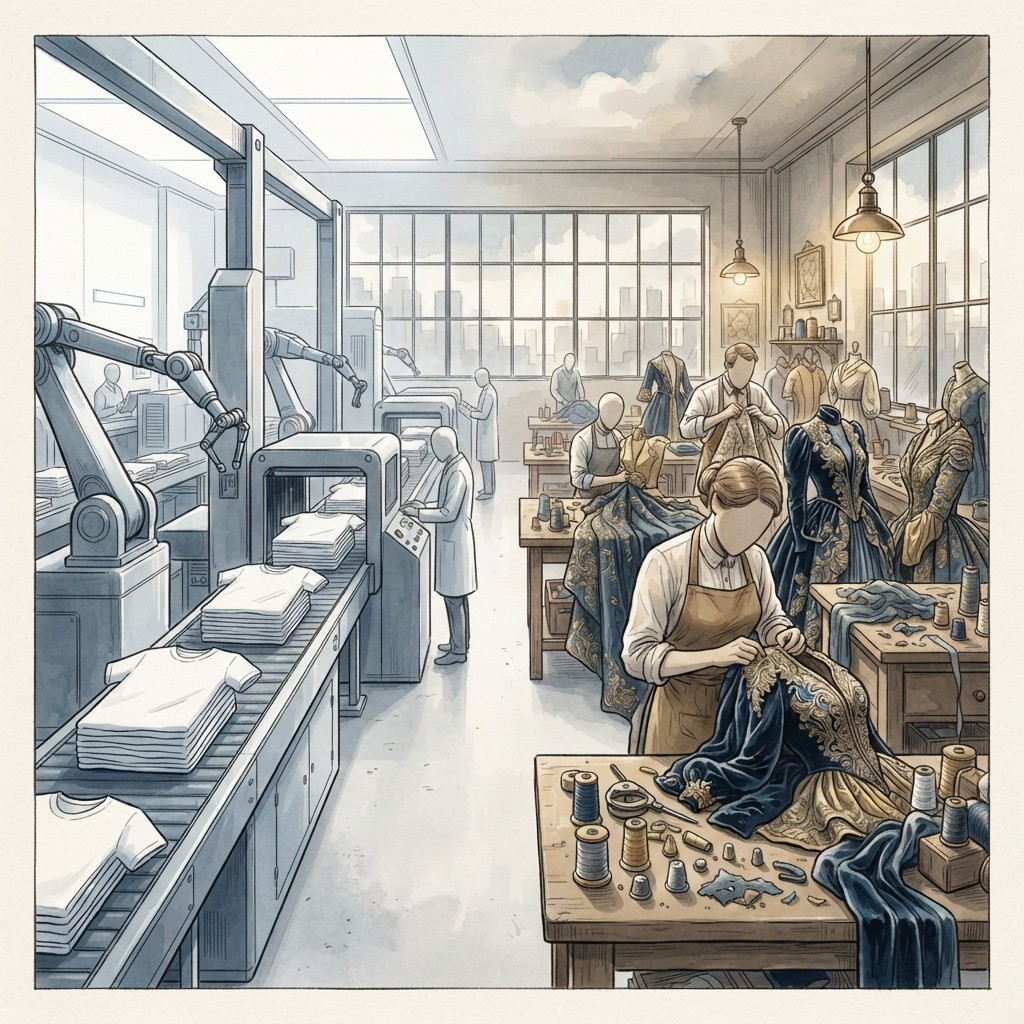
Here is the timeline that the LifeWear narrative quietly skips. Uniqlo opened its first store in Hiroshima in 1984 as a 'casual wear warehouse'—a bulk-buying operation that resold other people's clothes cheaply. That model hit its ceiling within two years3. So in 1987 the company did something far more consequential than naming a philosophy: it rebuilt itself as the manufacturer of what it sold. Specialty store retailer of Private-label Apparel—SPA—meant Uniqlo now controlled the entire chain, from planning and design to material procurement to the price tag at the register4. The thesis of this company is not LifeWear. It is that Uniqlo isn't a clothing brand that happens to make basics—it's a manufacturing system whose cheapest, best output happens to be basics, and the slogan was reverse-engineered to describe what the machine was already good at.
Why basics are cheaper to make than trends—structurally, not just luckily
The reason this matters is causal, not cosmetic. A trend-driven retailer like Zara wins by guessing fast: design hundreds of new looks, make small batches, restock the hits, write off the misses. Speed and variety are the asset; the model is built to absorb the cost of being wrong, because most of fashion is wrong. Uniqlo's SPA architecture is built for the opposite bet. Because a HEATTECH crewneck is permanent, Uniqlo can commit to a fabric year-round, in enormous volume, against multi-year supply agreements—the kind it signs with Toray, whose formal five-year-target partnership began in 20065. Volume that large, ordered that far ahead, with no obsolescence risk, is the cheapest unit of apparel manufacturing that exists. That is the engine under a 53.9% gross margin and ¥500.9 billion in operating profit in FY20241. The basics aren't a marketing posture. They are the only product that fully exploits the model.
| Fast fashion (Zara / H&M) | Uniqlo SPA | |
|---|---|---|
| Core bet | Guess trends fast, absorb the misses | Perfect a permanent product, scale it |
| Product life | Weeks; designed to expire | Years; designed to repeat |
| Fabric sourcing | Short, reactive orders | Long-range commitments (e.g., Toray) |
| Where the margin comes from | Markup on scarcity and newness | Volume + zero obsolescence |
| What's hard to copy | The speed | The whole upstream system |
Look at how HEATTECH evolved and you see the model's real trick: it improves a thing without changing what it is. Uniqlo refines HEATTECH every year against roughly 70,000 annual customer comments4—warmer, thinner, less static—while keeping it the same permanent product on the same shelf. The result is a category that grew from 1.5 million units in 2003 to 130 million by 20128. A trend retailer would have killed and replaced HEATTECH a dozen times by now. Uniqlo just kept sharpening the same knife, and the cost of sharpening fell every year as the volume climbed.
Couldn't H&M just sell better basics too?
The fair objection is that 'sell good basics' sounds laughably easy to copy. There is no patent on a plain T-shirt, no secret in a crewneck. Any rival could announce tomorrow that it, too, makes durable everyday clothing instead of fashion—and several have tried. The honest answer is that they can copy the positioning in a press release and still fail, because the positioning isn't the moat; the operating model underneath it is. To match Uniqlo's economics on a basic, a trend retailer would have to unlearn its core competence—the rapid, reactive, small-batch cycle that is its entire reason for existing—and rebuild itself around long-horizon fabric commitments, deep supplier integration, and the patience to perfect one product for a decade. That's not a marketing pivot. It's a corporate transplant. A company optimized to be fast cannot, at the same time, be optimized to be permanent. Uniqlo chose permanent in 1987 and has been compounding the advantage ever since—visible now in record UNIQLO Japan profit and surging North America and Europe results that Fast Retailing itself attributes to 'growing customer support for LifeWear'2. The slogan travels. The machine that makes it true does not.
When a company's success gets explained by its brand philosophy—LifeWear, 'Think Different,' 'Just Do It'—be suspicious. The slogan is almost always the last thing to arrive, articulated years after the real advantage was already built and proven. Ask instead: what operating decision made this possible, and when was it made? For Uniqlo the answer is a 1987 switch to vertical integration, not a 2012 turn of phrase. The test for whether a competitor can copy you is brutally simple: can they adopt your positioning without rebuilding their entire upstream model? If yes, you have a slogan. If no—if your advantage is welded to the way you actually produce—you have a moat. Uniqlo's basics are cheap to imitate and nearly impossible to out-produce, and that gap is the whole business.
Uniqlo is a company that figured out how to win at fashion by refusing to play it. The trend retailers race to be first; Uniqlo decided to be permanent, and built the manufacturing system that makes permanence cheap. The genius was never LifeWear—a phrase that showed up a generation late to take credit for work already done. The genius was a quiet decision in 1987 to stop reselling other people's clothes and start owning the wire from fiber to shelf. Everyone can see the basics. Almost nobody can build the machine that makes them, and that is exactly why the slogan is safe to share.
When the advantage isn't where the marketing points
Vertical-Integration Assessment
A make-vs-buy assessment for a single stage of the value chain: rate the forces that argue for owning it and the forces that argue for renting it, then read the verdict off the gap. Blank to run on a stage you're deciding now; filled as the worked example showing why the story's company pulled a stage in-house — or pushed it out.
Included, filled and blank, in the Vertical Integration Casebook. See the set → · Preview the blank →
Sources
Where this comes from — the filings, records, and reporting behind it.
- 1In FY2024 (year ended August 31, 2024), Fast Retailing reported consolidated revenue of approximately ¥3.057 trillion (+12.2% YoY) and consolidated operating profit of ¥500.9 billion (+31.4% YoY), with consolidated gross profit margin of 53.9%.
- 2UNIQLO Japan recorded revenue of ¥932.2 billion (+4.7% YoY) and operating profit of ¥155.8 billion (+32.2% YoY) in FY2024, a record annual performance for the segment. UNIQLO North America and UNIQLO Europe both generated large increases in revenue and profit, attributed to 'growing customer support for LifeWear.'
- 3In 1984, Fast Retailing opened the first UNIQLO store in Hiroshima as a 'casual wear warehouse.' The bulk-buying model reached its limit in two years. In 1987, the company switched to a Specialty store retailer of Private label Apparel (SPA) model combining manufacturing and retailing—a decade before 'LifeWear' was named.
- 4The SPA model gives UNIQLO control over the entire business process from planning and design to material procurement and sales. HEATTECH products have been refined each year based on approximately 70,000 annual customer comments. In the 2010 fall/winter season, 80 million HEATTECH items were sold worldwide.
- 5UNIQLO started marketing HEATTECH in 2003. The Toray–UNIQLO formal strategic partnership—with agreed five-year targets—began in 2006, not 2003. In November 2015, a third-stage strategic partnership agreement was signed covering 2016–2020.
- 6The LifeWear concept was officially formalized in 2012, but the philosophy it describes had been present in Uniqlo's product decisions since the first store opened in 1984. LifeWear is described as 'simple, high-quality clothing designed to improve everyone's life,' as formally articulated by Tadashi Yanai.
- 7Fast Retailing's Integrated Report 2025 reconfirms the 1987 SPA adoption date: 'In 1987, we switched to a specialty retailer of private-label apparel (SPA) model that combined manufacturing and retailing, letting us offer products that customers really wanted.' Design and manufacturing of own products began in 1987.
- 8HEATTECH launched in 2003 as a joint development with Toray that converts body moisture to heat. What began selling 1.5 million units in 2003 grew to 130 million units by 2012. The Toray–Uniqlo working relationship on materials began in the late 1990s, initially for polyester fleece fibers, predating HEATTECH.
Weighing outside help with a decision like this? Hiring a post-merger integration consultant
More like this — beyond Uniqlo (Fast Retailing)
New Strategically analyses as they publish: the defining moves in business, checked against the record. No noise, and one click to leave.