Pairs with the Turnaround Diagnosis Worksheet — a ready-to-use strategy tool, filled for IBM. Included in the The Turnaround Casebook →
In 1990, IBM posted revenues of nearly $69 billion and net earnings of $6 billion - the most profitable run in its history.2 Two years later it announced a net loss of about $5 billion, the largest any U.S. company had ever recorded in a single year.1 The same machine that printed money had, almost overnight, become the machine that burned it. The board fired the CEO and went looking for an outsider. What it found - and what it has kept finding ever since - was not a new idea. It was the same old reflex.
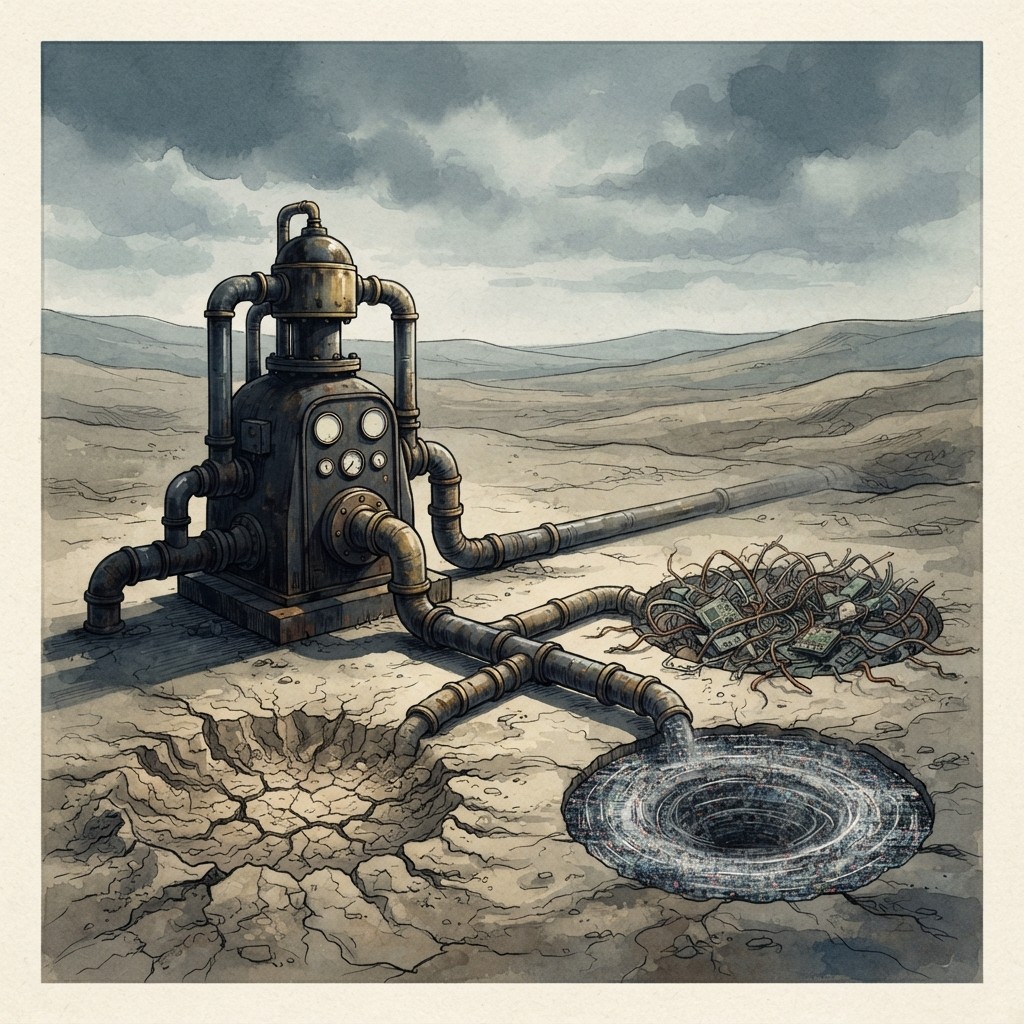
The official story is that IBM is a master of reinvention: mainframes to services, services to cloud, each transformation a feat of strategic vision. The truer story is that IBM has run one play three times - ride a captive installed base until it cracks, then pivot under duress - and called the panic foresight.
The mainframe was a tollbooth that forgot it was a tollbooth
Strip away the engineering romance and the early-1990s IBM was a beautifully simple business. Mainframes were the source of almost half its revenues and 70 to 80% of its profits, and the proprietary technology behind them produced gross margins above 50%.4 Once a corporation built its operations on an IBM mainframe, leaving meant rewriting everything - so IBM didn't just sell hardware, it sold a base it could meter for years. That is a wonderful position to hold and a terrible position to depend on, because the day a cheaper architecture arrives, the captive base doesn't drift away politely. It collapses. Revenue grew unabated through 1990 and then fell off a cliff, taking CEO John Akers with it.2 The lock-in that looked like a moat turned out to be a single point of failure.
Gerstner didn't have a vision. He had a customer's grudge.
Into the wreckage walked Louis Gerstner - the first outsider CEO in IBM's history, fresh from running RJR Nabisco and, before that, eleven years as a senior executive at American Express.3 He is often described as a man with no technology background, and that misses the point entirely. Gerstner had spent over a decade as one of IBM's biggest customers, on the buying side of the very lock-in IBM was selling. His insight was not a leap of imagination; it was the obvious complaint of every CIO who had ever been over-charged for a box and left to wire it together alone. Customers didn't want more hardware. They wanted someone to make the whole tangle work. So Gerstner pointed IBM at services and integration - selling the glue rather than the parts. It was the right pivot. It was also a pivot that only happened because the company had already lost five billion dollars and run out of alternatives.
“IBM lost about $5 billion in 1992 - more than any U.S. company had ever lost in a single year.”1
Then services became the new mainframe
Here is where the pattern reveals itself. The services business Gerstner built became, over two decades, exactly what the mainframe had been - a large, sticky, slowly fossilizing base. And it began to decay the same way. The managed infrastructure services arm fell from $21.8 billion in revenue in 2018 to $20.28 billion in 2019, then to $19.35 billion in 2020.8 Running data centers for other companies was becoming a commodity, undercut by public-cloud providers the way commodity servers had once undercut the mainframe. IBM's response rhymed with 1993: buy a future and cut the past. It acquired Red Hat for approximately $34 billion at $190 per share, closing in July 2019,5 and on November 3, 2021 it spun off the declining services business as Kyndryl, distributing 80.1% of the new company's shares to its own stockholders.6 A clean amputation of the limb that was no longer growing.
| Mainframes | Services | Hybrid cloud | |
|---|---|---|---|
| The captive base | Locked-in hardware customers | Outsourced infrastructure contracts | Red Hat / hybrid-cloud platform |
| What triggered the pivot | $5B loss in 1992 | Revenue falling to $19.35B by 2020 | — |
| The pivot | Hardware to services under Gerstner | Buy Red Hat, spin off Kyndryl | — |
| Foresight or duress? | Duress | Duress | TBD |
By 2022 hybrid cloud was $22.4 billion in revenue, growing 11% as reported and representing 37% of IBM's total.7 The story sells itself as the third great reinvention. But notice the structure underneath: a new captive platform, a high-margin position customers find hard to leave, a base IBM will ride for as long as it can. The script is identical. Only the product changed.
Isn't surviving a hundred years the whole point?
The fair objection is that this reading is too cynical. Most companies that dominate one technology era simply die when it ends - the graveyard is full of firms that owned a category and could not let go of it. IBM is still here, larger than almost any contemporary, having survived a loss that should have killed it. Surely reacting well to crisis is itself a kind of genius? It is - and that is precisely the more honest claim than 'visionary reinvention.' The skill IBM has actually demonstrated is not seeing the future early; it is recognizing, faster than its peers, when a profit engine has died, and being willing to cannibalize it. That is rare and valuable. But it is also reactive by definition. A company that pivots only after a $5 billion loss or three straight years of decline is not steering ahead of the curve - it is braking hard at the edge of it, repeatedly, and surviving on reflexes. The danger of that skill is the same each time: the captive base feels safe right up to the moment it isn't, and reflexes only work if the crash comes slowly enough to react to.
The thing that makes an installed base profitable - customers who can't easily switch away - is the same thing that makes the base lethal when the technology beneath it turns commodity. Lock-in cuts both ways: it lets you meter the base for years, and it lulls you into riding it until the cliff. IBM has monetized three such bases and pivoted off all three, but never early - each turn arrived after the numbers had already broken. The lesson for any business sitting on a high-margin captive position: the time to build the next base is while the current one is still printing money, not after it stops. Reflexes are not a strategy. They are just what you have left when foresight runs out.
IBM is celebrated as the company that reinvented itself again and again. The more useful truth is that it did the same thing again and again - found a base it could lock customers into, charged a fat margin until something cheaper arrived, then turned, hard, only when the floor gave way. Three times now the turn has worked. Hybrid cloud is base number four, and somewhere out there is the architecture that will commoditize it too. When it arrives, IBM will likely survive the way it always has: not by seeing it coming, but by being very good at the brake.
Turnaround Diagnosis Worksheet
A worksheet that forces a turnaround down to first principles: is this a cash problem, a cost problem, or a strategy problem — and which one will kill you first. It separates the bleeding you must stop this week from the rebuild that takes years. Blank to triage your own situation; filled as the worked example tracing how the story's leader sequenced survival before revival.
Included, filled and blank, in the The Turnaround Casebook. See the set → · Preview the blank →
Sources
Where this comes from — the filings, records, and reporting behind it.
- 1IBM lost $5 billion in 1992 — the largest single-year corporate loss in U.S. history at that time — as reported by IBM and covered contemporaneously.
- 2IBM's revenues grew unabated through 1990, when the company posted revenues of nearly $69 billion and net earnings of $6 billion, after which a quick and sharp decline led to the ouster of CEO John Akers and the hiring of Louis Gerstner in 1993.
- 3Louis V. Gerstner had been chairman and CEO of RJR Nabisco for four years and a top executive at American Express for 11 years; he was the first outsider CEO in IBM's history.
- 4Mainframes were the source of almost half of IBM's revenues and 70–80% of its profits in the early 1990s, and their proprietary technologies produced gross margins in excess of 50%.
- 5IBM acquired all issued and outstanding common shares of Red Hat for $190.00 per share in cash, representing a total equity value of approximately $34 billion; the transaction closed July 9, 2019.
- 6On November 3, 2021, IBM completed the separation of its managed infrastructure services business into a separate publicly traded company, Kyndryl Holdings, Inc., structured as a spin-off via a pro rata distribution of 80.1% of Kyndryl's outstanding shares to IBM stockholders.
- 7IBM's total hybrid cloud revenue was $22.4 billion in 2022, growing 11% as reported (17% adjusted for currency), representing 37% of IBM's total revenue.
- 8The managed infrastructure services business later spun out as Kyndryl was in steady decline before the separation: from $21.8 billion in annual revenue in 2018 it fell 7% to $20.28 billion in 2019, and a further 4.6% to $19.35 billion in 2020, per IBM SEC filings.
More like this — beyond IBM
New Strategically analyses as they publish: the defining moves in business, checked against the record. No noise, and one click to leave.