Pairs with the Market-Entry Gambit Canvas — a ready-to-use strategy tool. Included in the Market-Entry Gambit Casebook →
“How fast can this actually be done?”
In May 2018, Walmart announced it was paying about $16 billion for roughly 77% of Flipkart — one of the largest foreign retail investments India had seen.1 The number was designed to be remembered. It worked. To this day it gets repeated as a single clean fact: Walmart bought Flipkart for sixteen billion dollars. But read the company's own SEC filing and a different figure jumps out. Of that $16 billion, only about $2 billion was new money put into Flipkart.1 The rest went somewhere else entirely.9
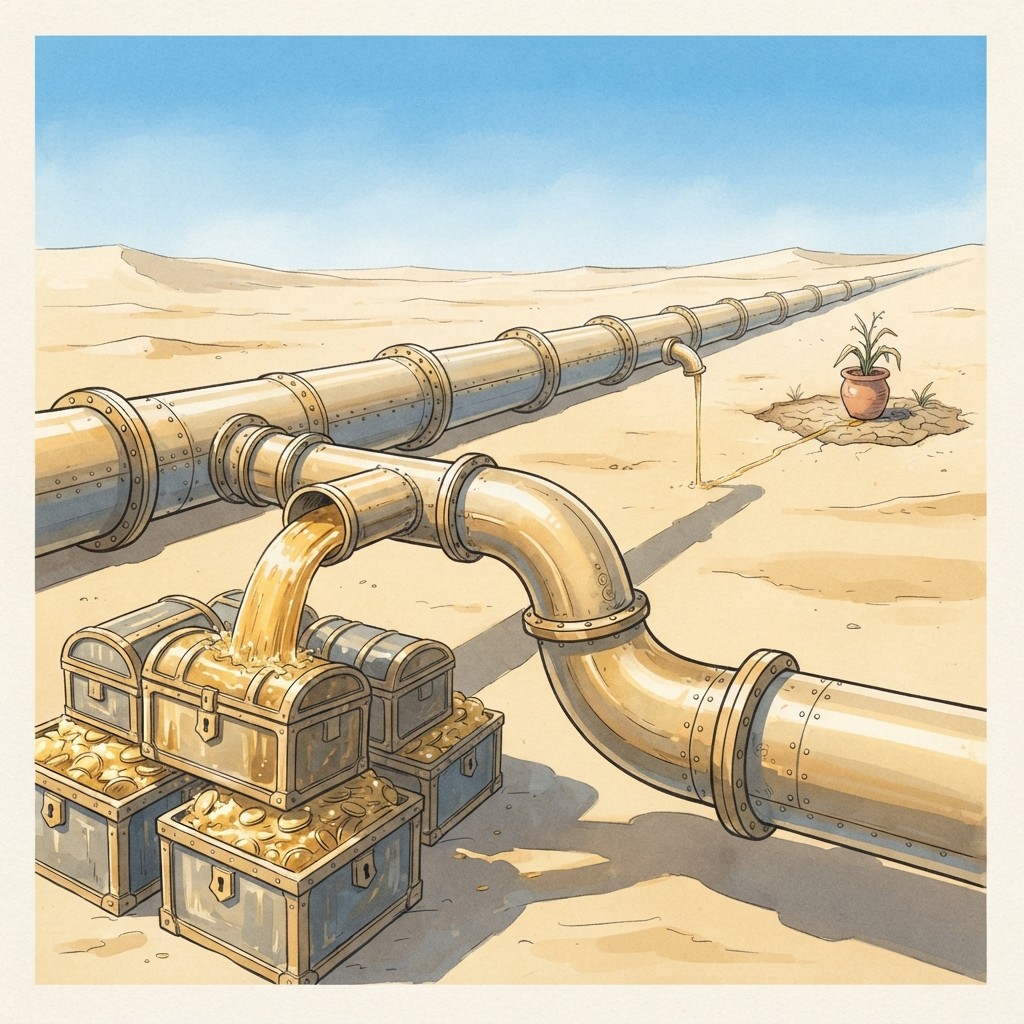
The official story is that Walmart bought India's leading e-commerce company. The truer story is that Walmart bought out India's e-commerce investors. The headline funded a company; the fine print funded an exit.
“The investment includes $2 billion of new equity funding.”1
Where the other fourteen billion actually went
Here is the part the headline buries. A $16 billion deal sounds like $16 billion landing in a company's bank account, ready to fund warehouses, drivers, and price wars. That's not what happened. Walmart's filings set the new primary equity investment in a contractual band of no less than $2 billion and no more than $5 billion, with an option to buy up to $3 billion more shares within a year of closing.2 The secondary consideration — cash paid to existing shareholders for their stock — was documented in the same filing at approximately $14 billion.9 Money that left through the cap table the moment it arrived. Among the sellers was SoftBank, which had put roughly $2.5 billion into Flipkart only nine months earlier and walked away with about $4 billion — a figure SoftBank's own CEO disclosed publicly at the time of the deal.10 That is the spine of this deal: most of the famous number was a payout to early backers, not fuel for the business Walmart said it was here to win with.
| What the number suggests | What the filing says | |
|---|---|---|
| Money into Flipkart's operations | ~$16 billion | ~$2 billion of new equity |
| Money to existing shareholders | — | ~$14 billion (secondary) |
| Stake acquired | Control | ~77% initial stake |
| What it funded | Warehouses, price wars, scale | Mostly an investor exit |
When an acquisition is reported as one giant number, ask the unglamorous question: how much of it is primary — new money into the business — versus secondary, cash handed to people leaving the table? The two look identical on a press release and behave nothing alike. Primary capital buys runway. Secondary capital buys someone else's patience. Walmart's $16 billion was overwhelmingly the second kind. The split is almost never in the headline, and it is almost always the whole story.
The 75% step-up Walmart paid for the privilege of entering
Now the price. Just nine months before Walmart wrote its check, SoftBank's August 2017 round had valued Flipkart at roughly $11–12 billion. The Walmart deal set the value at $20.8 billion — about a 75% jump over the figure the market had agreed on barely three quarters earlier.6 Walmart was not paying for new performance; it was paying for the door. Flipkart was still loss-making, and the premium was the cost of skipping the decade Amazon was spending to build India from the ground up. Investors did the math instantly. On the day of the announcement, Walmart's own market capitalization fell by roughly $8 billion — half the deal's headline price wiped out in a single session — and NYU valuation professor Aswath Damodaran wrote publicly that the odds were against Walmart given what it had paid for a business that lost money.8
The Indian company that wasn't quite Indian
And then there is the detail that quietly undercuts the entire framing of a foreign giant pouring billions into India. Flipkart was founded in Bengaluru in 2007 by Sachin and Binny Bansal — two IIT Delhi graduates and former Amazon employees — as an online bookstore.5 But the entity Walmart actually bought, Flipkart Private Limited, was domiciled in Singapore, and most of its shareholders were non-residents of India. That structure has teeth: an academic analysis of the deal concluded that only an insignificant portion of the $16 billion actually constituted foreign direct investment flowing into India.7 So the deal celebrated as a landmark Indian investment was, on paper, mostly money moving between non-resident shareholders through a Singapore holding company. The flag on the building in Bengaluru and the flag on the cap table were not the same flag.
The human story tracked the structural one. Sachin Bansal sold out entirely at close. Binny Bansal stayed on after the deal — and then, on November 13, 2018, just months after the transaction closed, resigned from the executive team following an allegation of serious personal misconduct.5 The founders did not ride off together into a tidy sunset. One cashed out, one was gone within a season, and the company they built changed owners while still bleeding money.
But didn't Walmart just buy the only path into the world's biggest market?
The fair objection is that a market-entry gambit is supposed to cost a premium — that's what entering late costs. India was the prize no global retailer could ignore, Amazon was already entrenched, and buying the leading domestic platform was arguably the only way in at scale. On that logic, $16 billion for instant pole position in a country of a billion-plus consumers is not reckless; it's the price of the ticket. And the premium-versus-build tradeoff is real: building a Flipkart from scratch would have taken a decade Walmart didn't have. The honest counter, though, is that Walmart kept paying. Years after the original deal, in the six months ended July 2023, it spent another $3.5 billion buying out remaining shareholders like Tiger Global and Accel and settling PhonePe obligations, lifting its stake to about 80%.4 A gambit that keeps requiring more capital to consolidate ownership is not yet a victory — it is an open position. The ticket bought entry. Whether it bought a market is a question the cap table is still answering.
A late entrant buying the local leader feels like buying time. Sometimes it is. But check who actually receives the money. If the bulk of the price flows to departing investors rather than into the operations you need to win, you've purchased a controlling stake and a balance-sheet hole at once — and you may still owe more later to tidy up the ownership. The cleanest tell that a 'market-entry' deal is really a 'liquidity event for somebody else' is the gap between the headline number and the primary-investment line. Read that line first.
Walmart wanted India, and India does not come cheap or simple. What it actually bought in 2018 was a controlling slice of a loss-making, Singapore-incorporated platform at a 75% markup, with most of the famous $16 billion flowing out to the investors who got there first — and a tab it was still settling five years later.4 The number was always the easy part of this story. The hard part is the one the headline was built to hide: a market-entry gambit is only as good as the business the money actually reaches, and most of this money never reached the business at all.
When the headline number hides the real deal
Market-Entry Gambit Canvas
A one-page canvas for staging an entry into a market you don't own yet: the beachhead you take first, the wedge that gets you in cheaply, the sequence that turns a foothold into a position, and the incumbent's likely counter-move. Blank to plan your own entry; filled as the worked example showing how the story's challenger picked its landing spot and walked the rest in.
Included, filled and blank, in the Market-Entry Gambit Casebook. See the set → · Preview the blank →
Sources
Where this comes from — the filings, records, and reporting behind it.
- 1Walmart will pay approximately $16 billion for an initial stake of approximately 77 percent in Flipkart Private Limited; the investment includes $2 billion of new equity funding; remaining shareholders post-deal include Binny Bansal, Tencent, Tiger Global, and Microsoft.
- 2On May 9, 2018, Walmart entered a Share Issuance and Acquisition Agreement with Flipkart Private Limited (Singapore) and a Share Purchase Agreement with certain Flipkart shareholders; the primary equity investment range was contractually set at no less than $2 billion and no more than $5 billion; Walmart also retained an option to purchase up to $3 billion in additional shares within one year of closing.
- 3The Flipkart transaction closed in Walmart's third quarter of fiscal year 2019 (i.e., August 2018), after receiving regulatory approval from India's Competition Commission of India (CCI).
- 4Walmart paid $3.5 billion during the six months ended July 31, 2023, to acquire additional Flipkart shares from non-controlling interest holders (including Tiger Global and Accel) and to settle the liability to former PhonePe noncontrolling interest holders, raising its stake to approximately 80%.
- 5Flipkart was founded in October 2007 in Bengaluru by Sachin Bansal and Binny Bansal — IIT Delhi alumni and former Amazon employees — as an online bookstore; Binny Bansal resigned from the Flipkart executive team on November 13, 2018 (post-deal close) following an allegation of 'serious personal misconduct.'
- 6The $20.8B Flipkart valuation implied by the Walmart deal represented a roughly 75% increase over Flipkart's prior valuation of $11–12 billion set at SoftBank's August 2017 investment; SoftBank received approximately $4 billion from its $2.5 billion investment made just nine months earlier.
- 7Because Flipkart was registered in Singapore and most shareholders were non-residents of India, only an insignificant portion of the $16 billion consideration constituted genuine FDI inflow into India.
- 8At announcement, Walmart investor reaction was immediately negative: Walmart's market capitalization dropped approximately $8 billion on the day of the deal announcement; NYU valuation professor Aswath Damodaran publicly argued the odds were against Walmart given what it paid for a loss-making Flipkart.
- 9The secondary share purchase price paid to existing Flipkart shareholders was approximately $14 billion in cash, with the remainder of the ~$16 billion total constituting the primary share issuance (new equity into Flipkart).
- 10SoftBank CEO Masayoshi Son publicly stated that SoftBank's $2.5 billion Flipkart investment made in August 2017 was worth around $4 billion at the time of the Walmart deal.
Weighing outside help with a decision like this? Hiring a commercial due diligence provider
More like this — beyond Walmart
New Strategically analyses as they publish: the defining moves in business, checked against the record. No noise, and one click to leave.