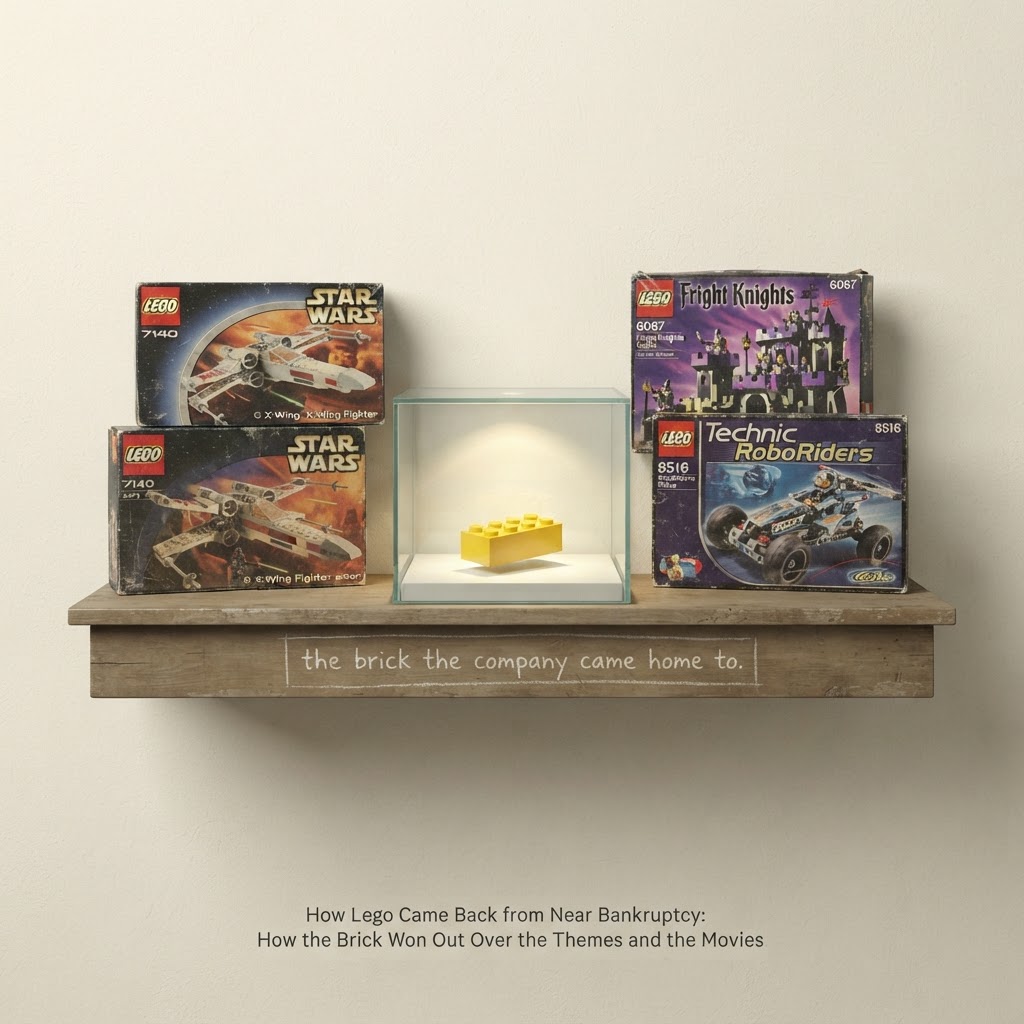
Pairs with the Adjacency / Synergy Map — a ready-to-use strategy tool, filled for Lego. Included in the Adjacency Expansion Casebook →
“When does the business next door belong to you?”
In 2004 the most beloved toy company on earth lost DKK 1,931 million in a single year1 — more than double what it had lost the year before, and a number that would have closed the doors of almost any company that posted it. Lego did not close. It also did not, as the legend insists, innovate its way out. It did something far less flattering and far more instructive: it walked back, item by item, out of nearly everything it had spent the 1990s walking into. The brick that built the comeback was the same brick it had nearly abandoned trying to become something bigger.
The official story is a triumph of reinvention: a brilliant young CEO arrives, fires up the innovation engine, and saves a dying brand. Almost every beat of that is wrong. The savior was an insider, not an outsider. The crisis was caused by innovation, not solved by it. And the company was never legally near bankruptcy at all — it was carried by a family rich enough to absorb a loss no shareholder vote would have tolerated.
“When I became CEO in 2004, Lego was in the middle of a serious crisis. Had the company not been owned by a wealthy private family, it would have been technically insolvent.”6
The thing that nearly killed Lego was innovation
Through the 1990s Lego did exactly what every strategy deck tells a maturing brand to do: it expanded into adjacencies. Electronics. Amusement parks. Interactive video games. Jewelry. Education centers. Franchise alliances around movie tie-ins.8 Each move looked defensible on its own — the brand was strong, the logo was trusted, why not extend it? But the adjacencies shared a quiet poison: every one of them pulled engineering, capital, and management attention away from the only thing the company actually knew how to do better than anyone, which was make a small plastic brick that snaps to another small plastic brick. By 2003 the company was, in Wharton's phrase, 'virtually out of cash,'8 and revenue had collapsed from DKK 9,601 million in 2002 to DKK 6,792 million in 2003.3 The growth strategy had eaten the core.
The turnaround was a controlled demolition
Here is the move the hagiographies skip. When Knudstorp took over in October 20041 — an insider who had joined in 2001 and presented the crisis report that prompted his own appointment, not a consultant parachuted from outside58 — he did not launch a flurry of new products. He subtracted. Operating costs were cut by DKK 1,523 million in a single year, a 20% reduction, and roughly 1,000 jobs went with them.19 The four Legoland theme parks — the splashiest adjacency of all — were classified as discontinuing activities and sold in July 2005 to Merlin Entertainments, backed by Blackstone, for around £250 million (roughly $460 million at the time).1710 The jewelry, the lifestyle products, the sprawling SKU catalogue: pared back toward the brick.8 The strategy was not 'do more clever things.' It was 'stop doing almost everything except the one thing.'
| The legend | The record | |
|---|---|---|
| What saved it | A burst of innovation | Cost cuts and adjacency exits1 |
| The CEO | Outsider consultant | Insider since 2001, 2nd non-family CEO125 |
| The danger | Bankruptcy filing | Insolvency only without family capital6 |
| The Legoland parks | A growth asset | Sold to fund the retreat7 |
| Direction of travel | Expansion | Contraction back to the core8 |
And it worked, on the timeline that matters. The net loss of DKK 1,931 million in 2004 became a DKK 505 million profit in 2005 and a DKK 1,430 million profit by 20063 — a two-year swing of more than DKK 3 billion driven not by a hit product but by the brutal arithmetic of cutting costs faster than revenue fell, then letting a refocused core grow back. Even the discipline wasn't flawless: Knudstorp outsourced much of Lego's production to Flextronics in 2006 as a cost-cutting measure, encountered serious production difficulties and component shortages, and the partnership was terminated within two years.11 The turnaround was a sequence of corrections, not a single masterstroke.
The asset on the balance sheet that no rival could buy
Now the part that makes Lego's comeback almost impossible to copy. Every cost cut, every park sale, every reversal took time — and time costs money you are currently losing. A publicly listed company posting a DKK 1,931 million loss with revenue in free-fall would have faced an activist board, a forced sale, or a fire-sale of the very assets that were supposed to fund recovery, all on a quarterly clock. Lego faced none of that, because the Kirk Kristiansen family owned it outright. The 'near-bankruptcy' was real on a balance sheet but not in a courtroom: the family's private capital was the bridge that let a slow, painful retreat play out without a market panic forcing a faster, dumber one.6 The decisive enabling condition of the turnaround was not strategy. It was ownership structure.
When you read a turnaround story, ask who paid for the time. Disciplined cost-cutting and refocusing on the core take quarters to bite — and a company losing money every one of those quarters needs a financier willing to absorb the bleed without yanking the wheel. For Lego that financier was a family that could not be voted out, panicked, or short-sold. The lesson isn't 'be privately held.' It's that the same recovery plan succeeds under patient capital and fails under impatient capital, and the structure of who owns you determines which one you get. The strategy was replicable. The shareholder wasn't.
Isn't a brand that retreats just a brand that gave up?
The fair objection is that this reads too neat — that 'they just cut costs and sold the parks' undersells real creative work, because Lego clearly did get smarter about which products to make, not only fewer of them. That's true, and it matters: the refocusing wasn't blind shrinkage, it was a rediscovery of what the brick was actually for. But notice that even the smartest product calls only paid off because the adjacencies were cleared away first — you cannot rebuild a core you are still bleeding to fund six side businesses. The honest version isn't 'innovation didn't matter.' It's that innovation followed contraction, and could not have preceded it. The harder objection is luck: the brand equity that made the brick worth returning to was a century-old gift Knudstorp inherited, not one he built. A weaker brand cutting just as hard would have cut its way into oblivion. Lego had something to retreat to. That is the part no operating manual can hand you.
The Lego story is taught backwards. It is filed under reinvention when it belongs under restraint — the rare case where the winning move was to un-grow, to sell the theme park and keep the brick, to subtract until the math worked again. The company nearly died not from a failure of imagination but from too much of it, pointed everywhere except home. Its comeback wasn't a leap into the new. It was the discipline to walk all the way back to the one thing it should never have left — bought, quietly, with the patience of an owner no public market could supply.
When the smart move is to do less
Adjacency / Synergy Map
A one-page canvas for an adjacency play: the new business next door, the shared assets that justify entering it, the synergies that actually transfer versus the ones that evaporate on contact, and the dis-synergies nobody put on the deck. Blank to test your own expansion; filled as the worked example showing where the story's 'natural adjacency' was real and where it was wishful.
Included, filled and blank, in the Adjacency Expansion Casebook. See the set → · Preview the blank →
Sources
Where this comes from — the filings, records, and reporting behind it.
- 1LEGO Group 2004 Annual Report: net loss including discontinuing activities was DKK 1,931 million in 2004 vs. DKK 935 million in 2003; toy sales were DKK 6,704 million in 2004 vs. DKK 7,196 million in 2003; total turnover including Legoland parks was DKK 7,934 million in 2004; operating costs were cut by DKK 1,523 million (20% reduction from 2003 level); workforce reduced by approximately 1,000 people; Legoland Parks were classified as discontinuing activities with intent to sell in 2005.
- 2LEGO Group 2003 Annual Report: the 2003 loss-before-tax was DKK 1,498 million; global sales fell by 29% below 2002 levels (partial text: 'sales dropped by approx. 35%' in the US specifically); DKK 1.4 billion revenue figure referenced alongside a DKK 2 billion drop.
- 32006 Annual Report five-year income statement table confirms: Net profit/(loss) for the year was DKK 1,430m (2006), DKK 505m (2005), DKK -1,931m (2004), DKK -935m (2003), DKK 326m (2002); revenue was DKK 7,823m (2006), DKK 7,050m (2005), DKK 6,315m (2004), DKK 6,792m (2003), DKK 9,601m (2002).
- 4Jørgen Vig Knudstorp was named CEO in September 2004, having joined the LEGO Group in 2001; he was the second non-family CEO (not the first—Vagn Holck Andersen served 1973–1979); he sold control of four LEGOLAND theme parks for nearly $460 million; the 2003 loss exceeded $300 million.
- 5LEGO's official biography of Knudstorp confirms he joined in 2001 and was appointed President and CEO in 2004.
- 6Knudstorp stated in his own words: 'When I became CEO in 2004, Lego was in the middle of a serious crisis. Had the company not been owned by a wealthy private family, it would have been technically insolvent.'
- 7Lego sold its four Legoland theme parks to Merlin Entertainments (controlled by Blackstone) for approximately £250 million (~$460 million USD) in July 2005; KIRKBI retained a ~25–30% stake in Merlin as part of the deal; the sale was explicitly intended to resolve short-term debt and refocus on falling toy sales, per Knudstorp at the time.
- 8Knowledge at Wharton (citing author David Robertson's book-length case study): By 2003 the company was 'virtually out of cash,' lost $300 million that year, with a projected loss of up to $400 million in 2004; Kjeld Kirk Kristiansen stepped aside as CEO, handing the role to Knudstorp after an internal strategic report; LEGO's 1990s expansion included electronics, amusement parks, interactive video games, jewelry, education centers, and franchise alliances.
- 9LEGO Group cut production and operating costs by DKK 1,523 million in 2004 — a 20% reduction of their 2003 level — and reduced the workforce by approximately 1,000 people.
- 10Lego sold its theme parks business to Merlin Entertainments for about £250 million in July 2005; the contemporaneous reported USD value was around $460 million.
- 11Knudstorp outsourced production to Flextronics in 2006 under his 'Shared Vision' rescue plan to cut costs; the arrangements did not run according to plan due to production difficulties and start-up problems causing component shortages; the partnership was terminated in 2008 — two years after it began.
- 12Jørgen Vig Knudstorp was the second person from outside the Kirk Kristiansen family to lead LEGO — the first being Vagn Holck Andersen between 1973 and 1979.
Weighing outside help with a decision like this? Hiring a commercial due diligence provider
More like this — beyond Lego
New Strategically analyses as they publish: the defining moves in business, checked against the record. No noise, and one click to leave.