Pairs with the Crisis Response Playbook — a ready-to-use strategy tool. Included in the Crisis Response Casebook →
“What is one more quarter of not acting worth?”
In 2021, Ford parked thousands of brand-new pickups in the infield of the Kentucky Speedway — finished trucks, missing one thing each: a chip the size of a fingernail.8 The same scene played out across the industry. Plants idled, dealer lots emptied, and a part that cost a few dollars held a $40,000 vehicle hostage. The story everyone told was simple: COVID broke the supply chain. It's a comfortable story, because it makes nobody responsible. It is also wrong.
The official story is that a once-in-a-century pandemic struck a healthy supply chain and shattered it. The real story is that the chain was already cracked — and the automakers handed the hammer over themselves. At the start of the pandemic, carmakers predicted sales would collapse, so they canceled their chip orders. Foundries, indifferent to who paid, simply re-pointed that freed-up capacity at laptops, webcams, and game consoles — products that were suddenly in a buying frenzy. When auto demand snapped back faster than anyone forecast, the cars came back to the front of the line and found it empty.8
Here is the thesis in one line: the chip shortage was not a supply shock that happened to an industry — it was a forecasting failure that traveled up a brittle, hyper-concentrated supply chain and got amplified at every step. COVID pulled the trigger. The gun had been loaded for years.
The crisis was structural before anyone had heard of the virus
When the U.S. Department of Commerce surveyed the industry and published its findings in early 2022, it didn't find a chain that had been blindsided. It found one running flat out: fabs operating above 90% utilization from the middle of 2020 onward, with wafer production capacity itself — the most expensive, slowest thing to build — as the hard bottleneck.1 A chain already pinned at the redline has no slack to absorb a surprise. Crucially, the survey named a root cause that has nothing to do with the virus and everything to do with how the industry runs: producers don't always have a clear sense of demand.1 That is not a pandemic problem. That is an information problem the industry had built into itself.
The concentration made it worse. Over three decades, the U.S. share of global semiconductor manufacturing fell from roughly 40% in 1990 to about 12% by 2022, as production migrated to a handful of Asian fabs.9 Taiwan alone came to produce more than 60% of the world's chips and more than 90% of the most advanced ones.9 When supply gets that geographically thin, a single fire, drought, or lockdown isn't a local event — it's a global one. Efficiency had quietly become fragility, and nobody had repriced the risk.
How a small demand wobble became a giant order famine
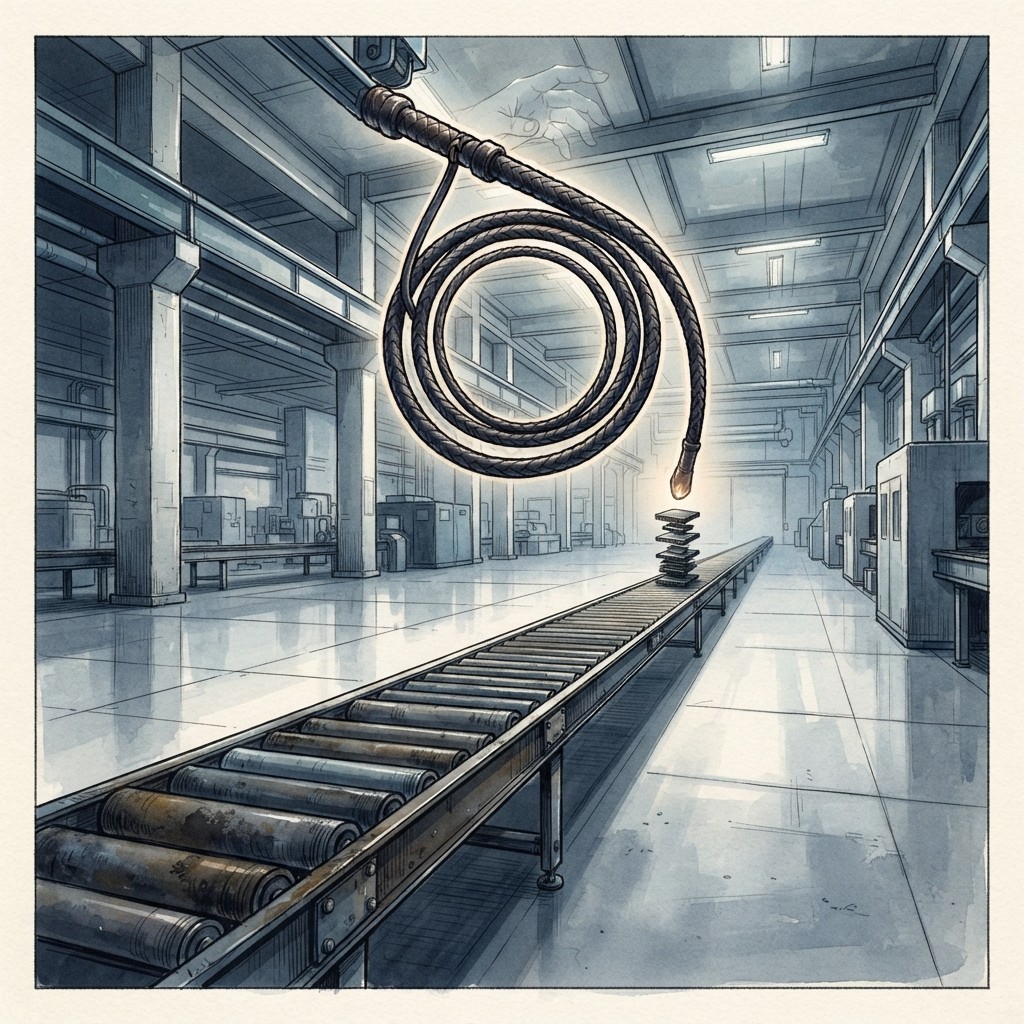
The mechanism that turned a temporary auto slump into a years-long famine has a name: the bullwhip effect. A modest flick at the consumer end of a supply chain becomes a violent crack by the time it reaches the factories at the far end, because each link over-corrects for the one before it. The chip shortage is the textbook case. Once burned by empty allocation, automakers and their Tier 1 suppliers stopped ordering what they needed and started ordering what they feared they'd be denied. By 2022, McKinsey found OEMs and suppliers placing chip orders sufficient to build roughly 120 million cars — against forecast annual sales of about 83 million.7
Sit with that gap. Buyers were deliberately ordering 10–20% above genuine need, purely to secure their place in the queue.7 But everybody did it at once, which meant the demand signal the foundries received was a phantom — inflated by panic, not consumption. The foundries planned capacity against the phantom. The shortage didn't end when consumer demand was met; it dragged on because the system was chasing a number that consumers were never going to buy. The bullwhip wasn't a side-effect of the shortage. For its final stretch, it was the shortage.
| The COVID story | What actually happened | |
|---|---|---|
| Trigger | Pandemic broke the chain | Automakers canceled their own orders, then panicked |
| State of the chain | Healthy until 2020 | Fabs already above 90% utilization, wafer-capped |
| Demand signal | External shock | Phantom orders for ~120M cars vs. ~83M sales |
| Root cause | Bad luck | Concentration plus a chronic failure to read demand |
“We expect supply tightness to persist throughout 2021 and into 2022.”5
TSMC's response tells you why the shortage couldn't simply be fixed by spending money. The company raised its 2021 capital budget to about $30 billion and laid out plans to invest $100 billion over three years.5 That is the most aggressive capacity build in the industry's history — and even so, its own CEO was telling customers the tightness would run well into the next year. A leading-edge fab is not a factory you spin up in a quarter. It is a multi-year, multi-billion-dollar construction project that lands its first usable wafers long after the crisis that justified it has peaked. The fabrication model cannot flex on the timescale of a demand swing. That mismatch is the permanent vulnerability.
What it actually cost — and why the headline number lies a little
The figure that stuck in the public mind is $210 billion in lost auto-industry revenue. It's worth knowing where it came from before repeating it. That number is an AlixPartners forecast issued in September 2021 — and it was the firm's third revision that year, having started at $60.6 billion in January and climbed to $110 billion in May.2 In other words, the famous number is itself a product of the same escalating panic that drove the crisis: a forecast that kept chasing a moving target. The physical damage is easier to trust. S&P estimated the deficit cut more than 10 million vehicles from 2021 production alone, and industry analysts put the total cut at roughly 19.6 million units across 2021 to 2023.6 Whatever the dollar figure, the lost cars were real.
For decades, carrying near-zero inventory looked like pure genius: every dollar tied up in stockpiled parts is a dollar not earning returns. But that math only works if you ignore the tail risk — and the chip shortage was the tail arriving. The lesson isn't 'hoard everything.' It's that resilience is a real cost that lean operators systematically price at zero, right up to the moment a single $3 component strands a $40,000 truck in a speedway parking lot. The phantom 120-million-car order book was just-in-time logic running in reverse: a system that kept no buffer suddenly trying to buy all the buffer at once. Price the buffer in calm times, or buy it at panic prices in a crisis.
Wasn't this just bad luck nobody could have foreseen?
The honest objection is that hindsight is cheap. No single planner could have known a pandemic would hit, that automakers would misjudge the rebound, and that three things would compound at once. Fair. But the defense doesn't actually rescue the COVID story — it confirms the structural one. A resilient system is precisely one that survives shocks it didn't predict. The chip chain wasn't resilient: it ran at the redline, it concentrated leading-edge production into one island, and it relied on demand signals the industry itself admitted it couldn't read clearly.1 You don't need to predict the specific spark when you've stacked the kindling this high. The shock was external; the flammability was a choice, made one efficiency decision at a time over thirty years.
The policy response acknowledges exactly this. The CHIPS and Science Act, signed in August 2022, put $52.7 billion behind semiconductor incentives — including $39 billion in direct manufacturing subsidies and a 25% tax credit on equipment — and barred recipients from expanding capacity in China for a decade.3 It is the first serious attempt to treat geographic concentration as the strategic risk it always was. But the same physics that prevented a quick fix in 2021 applies to the cure: greenfield fabs take years. The subsidies were authorized in 2022; the capacity they fund arrives slowly. Until it does, the West remains exposed to a near-identical shock — the kindling is still stacked, just with a fire crew now being trained somewhere down the road.9
The chip shortage gets remembered as the thing the pandemic did to us. It is more useful to remember it as the thing we did to ourselves, slowly, by treating resilience as waste and demand-forecasting as solved. A virus didn't conjure a $3 part out of existence. A supply chain optimized to the edge of its own tolerances met a surprise it had no slack to absorb, and then amplified that surprise into a famine by panicking in unison. The fab takes years. The forecast was always wrong. The concentration was decades in the making. COVID just happened to be holding the match.
Crisis Response Playbook
A playbook for a crisis already in motion: who decides, which plays fire on which trigger, and what gets said to whom. It replaces panic and the all-hands meeting with a pre-agreed sequence each person can run alone. Blank to pre-load before a crisis hits; filled as the worked example reconstructing the plays the story's team ran — and the ones they should have.
Included, filled and blank, in the Crisis Response Casebook. See the set → · Preview the blank →
Sources
Where this comes from — the filings, records, and reporting behind it.
- 1The U.S. Department of Commerce's semiconductor supply chain RFI (September 2021, results published January 2022) found that from Q2 2020 through 2021 semiconductor fabs operated at over 90% utilization; the primary bottleneck was wafer production capacity; and the two biggest themes respondents cited were demand higher than originally forecast and COVID-19-related shutdowns.
- 2AlixPartners forecast the chip shortage would cost the global automotive industry $60.6 billion in January 2021, revised to $110 billion in May 2021, and again to $210 billion in September 2021 — with the September figure attributing the escalation partly to COVID-19 lockdowns in Malaysia and the Delta variant.
- 3The CHIPS and Science Act was signed into law by President Biden on August 9, 2022; it appropriates $52.7 billion for semiconductor incentives including $39 billion in manufacturing subsidies and a 25% investment tax credit for manufacturing equipment, with recipients barred from expanding in China for 10 years.
- 4NIST (the administering agency) confirms the CHIPS and Science Act was signed August 9, 2022, providing the Department of Commerce with $50 billion for semiconductor incentive programs and R&D.
- 5TSMC's CEO C.C. Wei said in April 2021 that the company expected chip supply tightness to persist throughout 2021 and into 2022, and that TSMC increased its 2021 CapEx budget to ~$30 billion; TSMC planned to invest $100 billion over three years to expand capacity.
- 6Pandemic-era chip deficits cut automotive production by more than 10 million units in 2021 alone, per S&P. A separate figure from Applied Energy Systems citing industry analysts puts total auto production cuts at 19.6 million units between 2021 and 2023. The earlier (mid-2021) AlixPartners figure of 3.9 million lost vehicles for full-year 2021 should be treated as a mid-year forecast, not a final tally.
- 7McKinsey documented the bullwhip effect in the chip shortage: by 2022 OEMs and Tier 1 suppliers were placing orders for chips to outfit ~120 million new cars against forecast annual vehicle sales of ~83 million — meaning deliberate over-ordering of 10–20% above need to secure allocation, systematically distorting demand signals.
- 8At the start of the pandemic, automakers incorrectly predicted sales would drop, canceled chip orders, and were unprepared to meet demand when auto sales rebounded; chip manufacturers had already committed capacity to the IT sector. Ford parked thousands of unfinished vehicles at Kentucky Speedway while awaiting chips.
- 9U.S. semiconductor manufacturing capacity fell from ~40% of global supply in 1990 to approximately 12% by 2022, per both CFR and PwC sourcing industry data; Taiwan produces more than 60% of the world's semiconductors and more than 90% of the most advanced chips.
Weighing outside help with a decision like this? Hiring a supply chain strategy consultant
More like this — beyond The Chip Shortage
New Strategically analyses as they publish: the defining moves in business, checked against the record. No noise, and one click to leave.