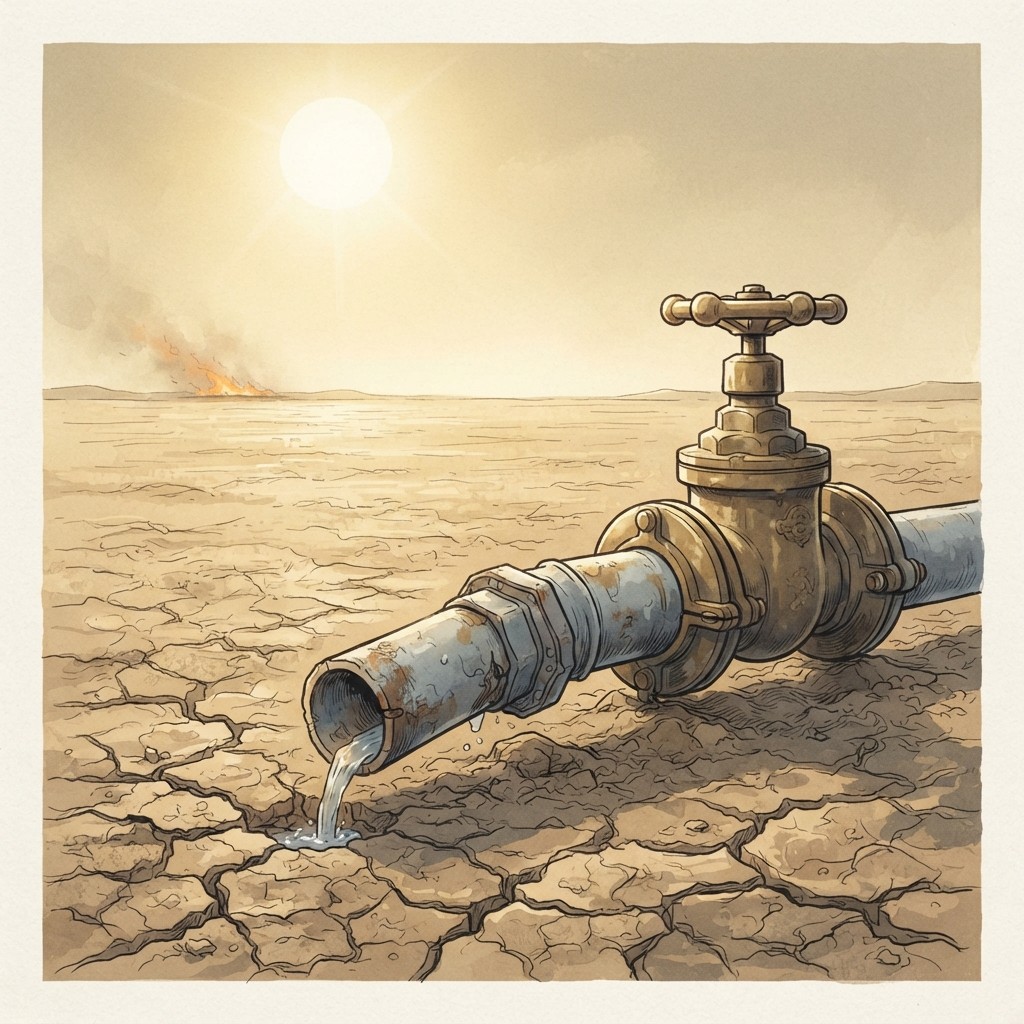
Pairs with the Crisis Response Playbook — a ready-to-use strategy tool, filled for State Farm. Included in the The Crisis Response Casebook →
In March 2024, before a single hillside above Los Angeles had caught fire that winter, State Farm sent a letter to California's insurance regulator describing its largest property subsidiary in the state. The phrase that mattered wasn't about flames. It was about capital. State Farm General had paid out $1.26 for every premium dollar it had collected over the previous nine years - more than $5 billion in cumulative losses - and its surplus was draining fast.2 Two months earlier it had already stopped writing new homeowners policies; now it was non-renewing tens of thousands more.1 The fires would come ten months later. The crisis was already here.
The official story is that climate change made California uninsurable, and State Farm fled the flames. It pulled out because wildfire risk exploded overnight. It pulled back because, for the better part of a decade, it was forbidden from charging a price that matched the risk - and a company bleeding $5 billion eventually stops volunteering for more.
Here is the thesis a smart friend can repeat at dinner: State Farm's California retreat is not proof that insurance dies in climate-exposed states. It is proof of what happens when a regulator freezes the price and the risk doesn't get the memo. The pullback was a slow-motion reckoning with a broken pricing compact, not a sudden surrender to fire.
Why a 65-cent loss is a death sentence in slow motion
Insurance is a simple machine that looks complicated. You collect premium up front, invest it, and pay claims later. The number that decides whether you live is the loss ratio - claims paid divided by premium collected. A healthy property insurer wants that number well under a dollar, because the gap funds reserves, reinsurance, and the catastrophe years that always arrive. State Farm General was running 126 cents out for every dollar in.2 You cannot invest your way out of that. Every policy you write makes the hole deeper. So the rational move is not to write the next policy - which is exactly what stopping new business in May 2023 was.1 The non-renewals followed for the same reason: shrink the book until the price is allowed to catch up.
The reason the price couldn't catch up has a name: Proposition 103, the 1988 ballot measure that requires California insurers to win regulatory approval before raising rates, and that historically barred them from pricing in forward-looking catastrophe models or the cost of reinsurance. The effect is a regime where the premium is anchored to the past while the risk lives in the future. For decades that lag was tolerable. As construction costs, catastrophe exposure, and reinsurance prices all hardened at once, the lag became fatal - and State Farm General said so plainly, citing exactly those forces when it closed the door to new business.1
| The headline | The mechanism | |
|---|---|---|
| The trigger | The 2025 wildfires | Nine years of structural underpricing[[cite:s2]] |
| The cause | Climate made California uninsurable | Price was frozen below risk for decades |
| The action | State Farm fled the state | A subsidiary stopped writing and shrank its book[[cite:s1]] |
| The verdict | Private insurance is dead here | The regulatory compact broke, not the market |
“Weak underwriting performance over 2019–2023 led to a significant deterioration of its capital position and regulatory solvency ratios.”8
The reckoning, then the deal
The capital damage showed up where capital damage always shows up first: the ratings. In March 2024, AM Best cut State Farm General's financial strength rating to B (Fair) from A (Excellent), citing a weak balance sheet and a surplus in continued decline.3 That is not a footnote - for an insurer, a low rating quietly tells mortgage lenders and reinsurers to treat your paper with suspicion. The January 2025 Los Angeles fires then arrived on an already-thin balance sheet, expected to reduce surplus by roughly $400 million on gross losses near $7.6 billion, most of which reinsurance absorbed.2 The fires didn't start the fire. They poured fuel on a structure that was already burning down.
What happened next is the part the 'they fled' narrative can't explain. A company that had actually abandoned California would not spend two years fighting through the regulatory process to keep writing there. State Farm did. After an initial setback, an administrative law judge approved - and Commissioner Lara adopted - an emergency interim 17% homeowners rate increase in May 2025, trimmed from the 21.8% requested, conditioned on a $400 million cash infusion from the national parent and a freeze on new block non-renewals.4 By March 2026, a three-party settlement among the regulator, State Farm, and Consumer Watchdog locked in that 17%, set rental and condo rates, and extended the non-renewal freeze through the end of 2026.5 The arc isn't an exit. It's a renegotiation of the price - the very thing that was missing for nine years.
Florida already ran this experiment - and proves the rule
If you want to know whether this is really about pricing rather than climate, look at the other coast and the other subsidiary. State Farm Florida is a legally separate company - its own NAIC number, its own balance sheet, its own surplus.6 In January 2009 it filed for a 47.1% statewide homeowners rate increase, was denied, and announced it would withdraw from a market of roughly 1.2 million policies.7 Tellingly, during the first three quarters of 2008 - a year with no major hurricane - its surplus still fell by $201 million.7 No storm. Still bleeding. Same disease as California: a price that wasn't allowed to keep up. And the resolution rhymes: by December 2009 the regulator and the company signed a consent order capping non-renewals at 125,000 policies and granting a 14.8% rate increase, after which State Farm Florida kept writing in the state continuously.6 The threatened exit became a negotiated price. It almost always does.
But isn't this just an insurer crying about climate to dodge fair rules?
The honest objection is that 'the regulator wouldn't let us charge enough' is exactly what every insurer says when it wants to raise prices, and Proposition 103 exists because insurers were genuinely overcharging Californians in the 1980s. Consumer Watchdog, which sat at the settlement table, would argue the rate controls protected millions of households from gouging - and they aren't wrong that the controls did real work. Two facts keep the steelman from carrying the day. First, the loss wasn't a forecast or a model; it was realized cash, $1.26 paid out per dollar in over nine years, audited and stated by the company before the fires it's blamed on even happened.2 Second, the resolution was a compromise, not a capitulation: a 17% increase, not the 21.8% requested, with refunds and interest baked in.5 The system didn't break because climate is uninsurable. It strained because the dial between price and risk had rusted in place, and turning it required a two-year fight.
In any market where the regulator caps the price below the cost, the shortage doesn't show up as a number on a screen - it shows up as the product quietly disappearing. Insurers stop writing; landlords stop building; lenders stop lending. The danger for any operator or policymaker is mistaking the symptom for the disease: the firm 'pulling out' is the visible event, but the suppressed price is the cause, and it was sitting in the filings for years. Before you conclude a market is structurally dead, check whether anyone was ever actually allowed to charge what it costs to serve. If not, you're looking at a price control, not a failed market - and the cure is a dial, not a eulogy.
State Farm never tore up its California license, never stopped paying claims, and by 2026 was back at the table agreeing to keep its customers. That is not the behavior of a company that decided the state was uninsurable. It is the behavior of a company that decided the state was unpriceable - and then spent two years proving that the difference between those two words is the entire story. The fires made better television. But the thing that nearly killed State Farm General was quieter, slower, and written in cents: a price held a step behind its risk for a decade too long. Climate didn't break the compact. The frozen dial did.
Crisis Response Playbook
A playbook for a crisis already in motion: who decides, which plays fire on which trigger, and what gets said to whom. It replaces panic and the all-hands meeting with a pre-agreed sequence each person can run alone. Blank to pre-load before a crisis hits; filled as the worked example reconstructing the plays the story's team ran — and the ones they should have.
Included, filled and blank, in the The Crisis Response Casebook. See the set → · Preview the blank →
Sources
Where this comes from — the filings, records, and reporting behind it.
- 1State Farm General stopped writing new homeowners, condo, and most other property applications in California effective May 2023, citing historic construction-cost increases, rapidly growing catastrophe exposure, and a hardening reinsurance market; in March 2024 it announced non-renewal of ~30,000 homeowners and rental dwelling policies and withdrawal from ~42,000 commercial apartment policies, effective July 3, 2024.
- 2Over the last nine years, State Farm General paid $1.26 for every premium dollar collected, resulting in over $5 billion in cumulative losses; SFG's surplus stood at $1.04 billion at end of 2024 after a decline of over $300 million from year-end 2023; the January 2025 LA fires will reduce surplus by approximately $400 million; direct losses from the LA fires estimated at approximately $7.6 billion gross, with retained losses after reinsurance of approximately $212 million.
- 3AM Best downgraded State Farm General Insurance Company's Financial Strength Rating to B (Fair) from A (Excellent) and its Long-Term Issuer Credit Rating to 'bb+' from 'a' on March 28, 2024, citing weak balance sheet strength and continued deterioration of policyholder surplus.
- 4California Insurance Commissioner Ricardo Lara adopted an ALJ ruling on May 13, 2025 granting State Farm General an emergency interim rate increase of 17% for homeowners (reduced from the requested 21.8%), contingent on a $400 million cash infusion from parent State Farm Mutual and a prohibition on new block non-renewals through end of 2025; a full rate hearing was ordered.
- 5The CDI, State Farm, and Consumer Watchdog reached a three-party settlement in March 2026 confirming the 17% interim homeowners rate, reducing rental dwelling to +32.8% and condo to ~+5.8% (with refunds plus 10% interest retroactive to June 1, 2025); State Farm agreed to no new block non-renewals through end of 2026 and will not file new rate change requests before January 1, 2027.
- 6State Farm Florida Insurance Company (NAIC #12251), a separate Florida-only subsidiary, filed plans in January 2009 to withdraw from the Florida property market, which would have affected roughly 1.2 million policies; Insurance Commissioner Kevin McCarty conditionally approved the withdrawal in February 2009 but attached conditions; by December 16, 2009 the Florida OIR entered a Consent Order under which State Farm agreed to non-renew no more than 125,000 of its 810,416 homeowner policies and received a 14.8% rate increase, and has written in Florida continuously since.
- 7In January 2009, State Farm Florida filed for a 47.1% statewide homeowners rate increase; FLOIR disapproved it on January 12, 2009; the company then announced withdrawal. During the first three quarters of 2008 — a year with no major hurricane — State Farm Florida's surplus was reduced by $201 million.
- 8S&P put State Farm General on CreditWatch Negative in February 2025, citing weak underwriting performance over 2019–2023 that 'led to a significant deterioration of its capital position and regulatory solvency ratios,' followed by continued underperformance in 2024; S&P later lowered State Farm General's financial strength rating to A- (stable) by August 2025 after capital infusion and rate approval. Separately, AM Best downgraded State Farm Mutual (parent) from A++ to A+ in November 2025.
More like this — beyond State Farm
New Strategically analyses as they publish: the defining moves in business, checked against the record. No noise, and one click to leave.