Pairs with the Crisis Response Playbook — a ready-to-use strategy tool. Included in the The Crisis Response Casebook →
On July 22, 2021, China's game regulator published its routine list of approved new titles. Then it stopped. No announcement, no end date - just an absence where the lifeblood of the world's largest gaming company used to flow. For Tencent, no new license meant no new game could legally launch and monetize in China. The next domestic approval list would not appear until April 11, 2022, and when it finally came, Tencent's name was not on it.3 The company that had spent two decades making China's games would wait over fourteen months for permission to sell a single new one.4
The story that hardened afterward is a flattering one: Tencent read the political weather, pivoted gracefully to international games and new revenue lines, tightened its belt, and emerged leaner and stronger. The truth underneath is harsher. Tencent did not navigate the crackdown. It complied with it, cut costs through it, and survived it largely because a bet it had already placed abroad happened to come good. There was no clever play. There was a company with no leverage doing the only thing a company with no leverage can do.
The fine was tiny. The message was the point.
Start with the music. In July 2021 the market regulator, SAMR, fined Tencent and ordered it to give up its exclusive music licensing rights within 30 days. The headline read like a heavyweight blow against a company that controlled more than 80% of China's exclusive music library. But the fine was RMB 500,000 - about $77,000, a rounding error for a company of Tencent's scale. And the trigger was almost clerical: Tencent had failed to properly report its 2016 acquisition of China Music Corp.1 The state was not litigating market power so much as demonstrating reach. By late August, Tencent Music had terminated its exclusivity arrangements with upstream copyright holders and agreed to report its compliance to SAMR every year for three years.2
Read that again. A $77,000 fine, and the company dismantled a position it had spent years and billions building - within weeks, with an annual three-year homework assignment attached. That is not negotiation. That is the cost of the penalty being beside the point; the cost is the relationship. Tencent understood this faster than any analyst, which is why its response across every front was the same: submit, document, comply, and never argue.
“TME terminated exclusivity with upstream copyright holders... and was required to report compliance to SAMR annually for three years.”2
Why the gaming freeze was the real weapon
Music was the warning. Gaming was the body blow, and it landed exactly where it would hurt most. In China, a game cannot earn money without a publishing license from the regulator. Freeze the licenses and you don't have to break up a monopoly - you simply starve it, quietly, by doing nothing. The freeze ran roughly 263 days for the industry as a whole, and the popular telling holds that it 'ended' in April 2022.3 It did not end for Tencent. The April batch of 45 titles excluded both Tencent and NetEase entirely. Tencent's first post-freeze domestic clearance - a health-education title, not a money machine - came on September 13, 2022. Permission to import its foreign hits like Valorant and Pokémon Unite arrived only that December.4
This is the mechanism the resilience story skips. The state did not need to seize anything. It controlled the one valve through which gaming revenue had to pass, and it left that valve closed for the dominant player long after it reopened for everyone else. Inaction is the most deniable weapon a regulator owns. There is nothing to appeal, no asset confiscated, no statement to refute - only a list that keeps coming out without your name on it.
The financial damage shows up exactly where the theory predicts. In 2022, Tencent posted its first annual revenue decline since its 2004 Hong Kong IPO - revenue of RMB 554.6 billion, down about 1% - with net profit falling roughly 16-17%. Its second quarter that year was its first-ever quarterly year-on-year revenue drop since listing.5 A company that had grown for eighteen straight years went backward the moment the state decided it should.
| The resilient-pivot narrative | What actually happened | |
|---|---|---|
| The music settlement | Tencent strategically reshaped its music business | A $77K fine forced it to dismantle exclusivity within weeks |
| The gaming freeze | Ended in April 2022; Tencent adapted | Tencent excluded until Sept 2022; foreign games until Dec 2022 |
| International games | A bold proactive bet on global markets | A pre-existing bet that happened to pay off mid-crisis |
| The 2022 revenue decline | A managed, deliberate slimming-down | First revenue fall since the 2004 IPO; profit down ~16-17% |
The 'pivot' was a rebalancing the state forced
Here is where the flattering story has its strongest case, so take it seriously. International games did grow through the crackdown, reaching RMB 53.2 billion in 2023, up 14% year-on-year, while domestic games crawled 2%.6 And in 2022, fintech and enterprise services overtook gaming as Tencent's largest revenue segment.6 On paper, that looks like a company that diversified its way out of danger. Pony Ma's own framing leaned into it, crediting 2022 with sharpened focus and 'new services and revenue lines including Video Accounts and international games.'7
But notice what produced the rebalancing. Fintech did not overtake gaming because gaming was deprioritized by choice; gaming was overtaken because the state strangled its domestic engine. The international push was not conjured in response to the freeze - it was an existing strategy that simply became, by necessity, the only growth line allowed to run free. A pivot you make because every other door is bolted is not a pivot. It is what's left. Ma's candid line to his own staff said as much: Tencent had to get used to Beijing's strict licensing regime, and approvals would stay limited in the long run.7 That is not a rallying cry. It is a man telling his company the cage is permanent and to stop pulling at the bars.
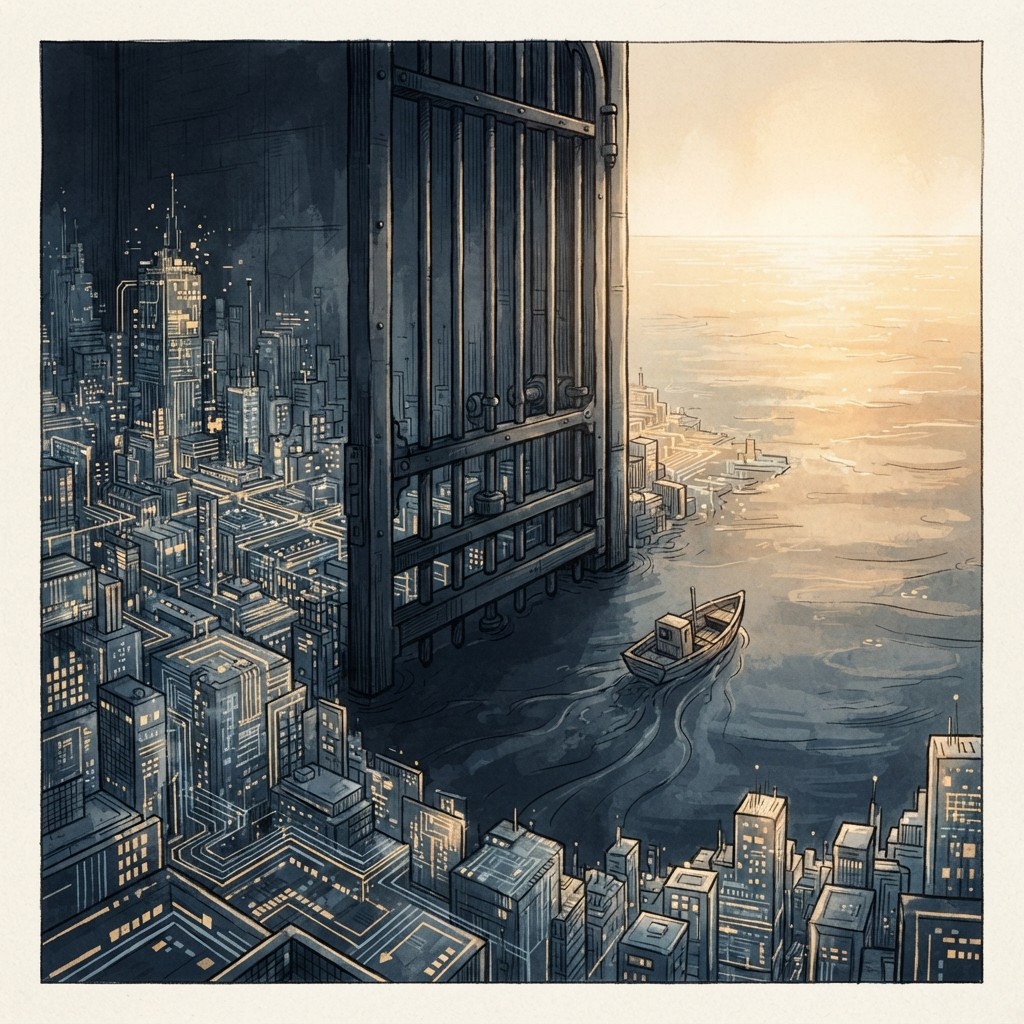
Tencent's whole 'crisis response' was posture management, because it had no operating leverage against a state that controlled the licenses. The deep lesson is about where a business sits relative to its real dependencies. A company whose revenue must pass through a single government-controlled gate doesn't have a moat - it has a permission slip. You can cut costs, divest, and pivot toward the one market the gatekeeper doesn't control, and Tencent did all three. But none of it is strategy in the sense of choosing your terms. It's choosing how to lose the least while waiting for the gate to reopen. The companies that look most 'resilient' through a crackdown are often just the ones with somewhere else to earn - and the foresight, or luck, to have built it before they needed it.
What submission cost, line by line
Compliance was not free, and Tencent paid it in assets and equity value, not just patience. In November 2022 it announced it would hand most of its $20.3 billion stake in Meituan to shareholders as a dividend - a divestment widely read as a gesture toward the regulatory climate. It divested its Tesla holdings, with reports placing the exit by early 2023.9 These were not the moves of a company repositioning from strength; they were the moves of one shedding the entanglements that drew scrutiny. The market priced the whole ordeal brutally: Tencent's capitalization fell by hundreds of billions of dollars from its early-2021 peak to its 2022 trough — a destruction of value that unfolded over multiple reporting periods and resisted any single clean summary figure.
The recovery, when it came, was real but quiet: 2023 revenue climbed 10% to RMB 609 billion, and in 2024 Tencent ran the largest buyback program in its history, HK$112 billion, ranking as the single largest buyback spender among Hong Kong-listed companies by total amount that year.8 But a giant buyback is itself a tell. It is what a company does when it has more cash than approved places to grow - when the gate is still half-shut and the surest investment left is its own discounted shares. Tencent did not buy back stock because it had run out of ambition. It bought back stock because the state had run its ambition out of room.
Strip the resilience narrative away and what remains is simpler and more useful than a comeback story. Tencent's defining asset was never its strategy under fire. It was the fact that, when the domestic valve closed, it had already built a way to earn beyond the regulator's reach - and the discipline to spend two hard years saying yes. The crackdown didn't reveal a brilliant navigator. It revealed exactly how much of a Chinese tech champion's fate is held in a list it doesn't write, published by an office it can't lobby, on a date it isn't told. Tencent survived. It just never got to choose the terms.
Crisis Response Playbook
A playbook for a crisis already in motion: who decides, which plays fire on which trigger, and what gets said to whom. It replaces panic and the all-hands meeting with a pre-agreed sequence each person can run alone. Blank to pre-load before a crisis hits; filled as the worked example reconstructing the plays the story's team ran — and the ones they should have.
Included, filled and blank, in the The Crisis Response Casebook. See the set → · Preview the blank →
Sources
Where this comes from — the filings, records, and reporting behind it.
- 1SAMR imposed a fine of RMB 500,000 (USD ~77,000) on Tencent in July 2021, ordered it to relinquish exclusive music licensing rights within 30 days, and cited its failure to report the 2016 acquisition of China Music Corp (CMC). Tencent subsequently owned more than 80% of exclusive music library resources.
- 2Tencent Music Entertainment Group's Form 6-K (SEC filing) confirms: pursuant to the SAMR Administrative Penalty Decision, TME terminated exclusivity with upstream copyright holders by late August 2021; the decision also prohibited high advance licensing payments and preferential terms; TME was required to report compliance to SAMR annually for three years.
- 3China's NPPA suspended approvals of new video games beginning August 2021 (last list published July 22, 2021) and did not resume domestic approvals until April 11, 2022 — a freeze of approximately 263 days. The first April 2022 batch of 45 titles excluded Tencent and NetEase entirely.
- 4Tencent did not receive its first new domestic game license since the freeze until September 13, 2022 (a health-education title), meaning the effective drought for Tencent lasted over 14 months. Foreign game imports including Valorant and Pokémon Unite were only cleared for Tencent in December 2022.
- 5Tencent's full-year 2022 revenue was RMB 554.6 billion (USD ~$80.5 billion), down 1% year-on-year — its first annual revenue decline since its 2004 Hong Kong IPO. Net profit fell approximately 16–17% year-on-year. Q2 2022 was also its first ever quarterly year-on-year revenue decline since listing.
- 6Tencent's full-year 2023 revenue recovered to RMB 609 billion (~$86 billion), up 10% vs 2022. International Games segment reached RMB 53.2 billion ($7.5 billion), up 14% year-on-year. Domestic games revenue grew only 2% to RMB 126.7 billion. Gaming overall contributed ~43% of 2022 total revenue, and was overtaken in scale by fintech/enterprise in that year.
- 7Pony Ma stated in Tencent's Q4 2022 earnings release: 'During 2022, we increased our business efficiency, sharpened our focus on core activities, and developed new services and revenue lines including Video Accounts and international games.' He separately told employees in a year-end 2022 meeting that Tencent must accept Beijing's strict licensing regime and that approved game volumes would remain limited long-term.
- 8In November 2022, Tencent announced it would divest the majority of its USD $20.3 billion stake in Meituan via dividend distribution to shareholders, a move attributed in part to China's regulatory crackdown. Tencent also sold its stake in Tesla by January 2023. In 2024, Tencent spent HK$112 billion on share buybacks, its largest ever repurchase program, becoming the largest buyback spender on the Hong Kong Stock Exchange.
- 9By January 2023 Tencent had sold some of its Tesla stake amid a stricter regulatory environment in China.
More like this — beyond Tencent
New Strategically analyses as they publish: the defining moves in business, checked against the record. No noise, and one click to leave.