Pairs with the Crisis Response Playbook — a ready-to-use strategy tool. Included in the Crisis Response Casebook →
“What is one more quarter of not acting worth?”
In November 2022, a month before anyone was stranded at an airport, the pilots' union said the quiet part out loud: Southwest was 'one IT router failure away from a complete meltdown.'10 That summer they had already picketed — not over pay, the usual airline grievance, but specifically over the crew-scheduling system.410 Then, the week of Christmas, a storm hit, and the prediction came true with brutal precision. Southwest canceled more than 16,700 flights between December 21 and 31 and absorbed a pre-tax hit of roughly $800 million.1 The defining crisis of the airline's modern history was not an act of weather. It was a deadline it had been warned about and chose not to meet.
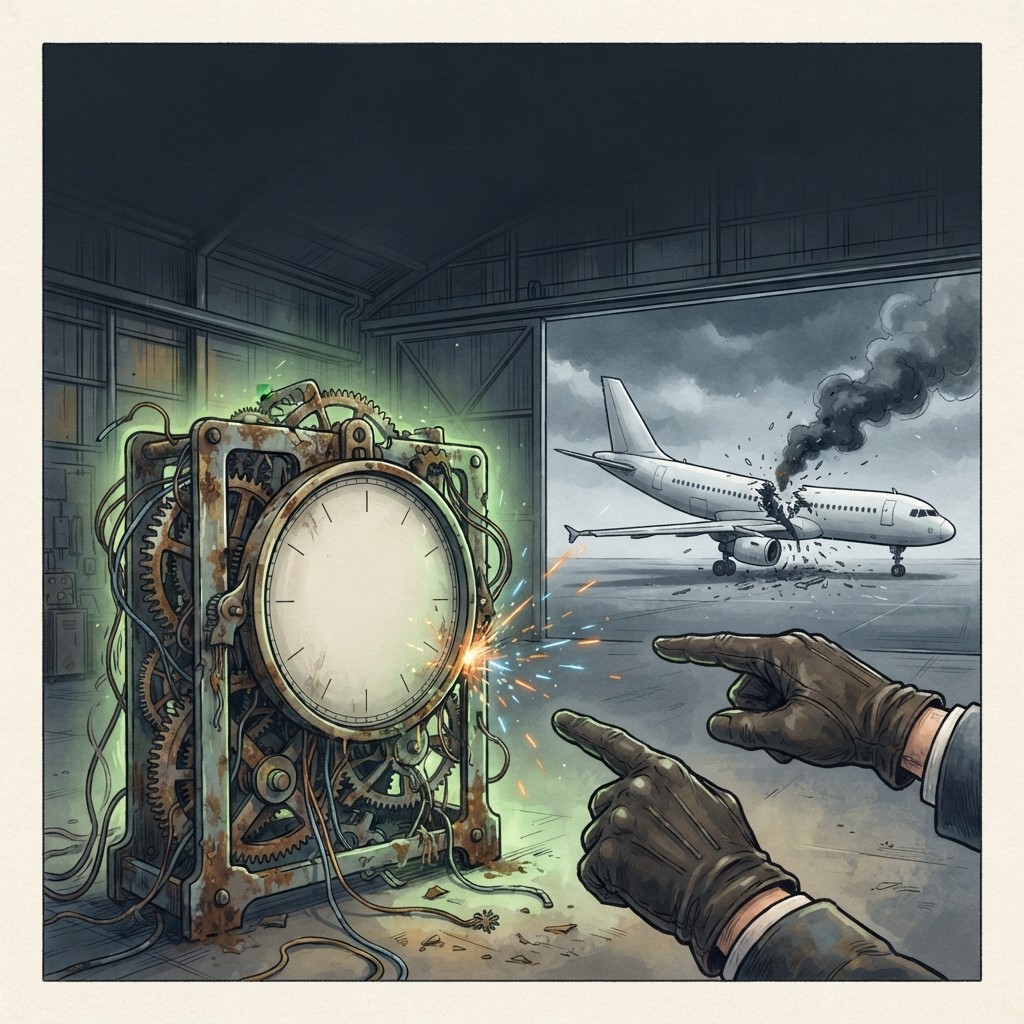
The official story is that a once-in-a-generation winter storm overwhelmed an airline. That's the part that's true and the part that's misleading. Every carrier flew into the same storm; only Southwest kept canceling for ten days after the skies cleared. The storm was the match. The bomb had been sitting in the basement for years.
Two systems that didn't talk to each other
Here is the mechanism, and it is less about software than about architecture. Southwest ran its operation on two separate brains that didn't share a nervous system. Aircraft and dispatch routing went through a homegrown tool called 'the Baker.' Crew scheduling — matching pilots and flight attendants to flights — ran through a different platform, SkySolver, supplied by GE Aerospace.7 In normal weather, the gap between them never matters. But once the storm displaced thousands of crew members across the country, the two systems fell out of sync: the airline knew where its planes were and lost the thread on where its people were. Crews legally timed out. Phone lines jammed. Recovery, on Southwest's point-to-point network where planes don't return to hubs, requires reassembling crew and aircraft simultaneously — and the only tool that could do that math was choking. The system meant to dig the airline out instead buried it deeper.
“It wasn't the case that technology caused an operational problem. It was an operational problem that caused technology issues.”5
Watterson's framing is the honest one, and it cuts against the popular 'ancient software' story.5 The failure was physical too. At Denver, Southwest had only six de-icing pads and too few ground crews to work them — a chokepoint it later widened to ten pads and 450 new hires.5 But the distinction Watterson draws is the whole point: an operational shock turned into a software collapse because the software couldn't see the operation whole. The technical debt didn't cause the storm. It removed the airline's ability to recover from one.
| The headline version | What the record shows | |
|---|---|---|
| Cause | A historic winter storm | A storm that exposed years of unfixed technical debt |
| The warning | Nobody saw it coming | The pilots' union named it a month early |
| The fix imposed | An FAA-mandated IT overhaul | A DOT consumer-protection fine, no IT mandate |
| The system | One outdated platform | Two disconnected systems — the Baker and SkySolver |
Why a fine, not a mandate, was the real verdict
A year later, the government's answer arrived — and it was not the structural reform most people assume. On December 18, 2023, the Department of Transportation (not the FAA) fined Southwest $140 million, roughly thirty times larger than any prior DOT consumer-protection penalty, including a $90 million fund earmarked to compensate future passengers.3 Notice what that penalty does and does not do. It punishes how Southwest treated stranded customers and sets a precedent for the next airline that strands theirs. It does not order Southwest to rebuild a single system. The regulator policed the consumer harm, not the architecture that produced it — and there was no FAA decree to modernize anything. The lesson regulators chose to teach was about refunds and rebooking, not about the wall between the Baker and SkySolver.
There's a quieter tell in the settlement. The DOT had a parallel investigation into whether Southwest had published schedules it couldn't actually fly — 'unrealistic scheduling.' That inquiry was closed without a finding as part of the deal.8 So the government never formally ruled on the most damning version of the story: that Southwest knowingly sold a timetable its systems couldn't keep under stress. The airline paid to make the question go away unanswered. Which means the strongest indictment — that this was a governance choice, not an accident — remains officially undecided, and that ambiguity was bought, not earned.
Isn't '99% of the time' a fair defense?
The fair objection is the one Bob Jordan made himself. In his December 28 video — seven days into the cancellations — he said the recovery tools 'serve us well, 99% of the time,' and that the company would 'double down on already existing plans to upgrade systems.'6 And he's not wrong on the arithmetic. A system that handles ordinary disruption nearly always is, by most measures, a good system. The honest counter is that the 1% is the entire job. Airlines exist to move people through exactly the chaos a system is allowed to fail in 'only' once in a hundred times. A recovery tool that works except when you most need to recover is not a 99%-reliable tool — it's a tool that's reliable precisely when reliability is cheap. The union's warning wasn't that the everyday case was broken. It was that the catastrophic case had no floor. That's the difference between a glitch and a governance failure: a glitch fails where it doesn't matter, and Southwest's failed where everything did.
Technical debt rarely announces itself in a budget line; it announces itself through the people who operate the system every day. Southwest's pilots picketed over scheduling in the summer and named the exact failure mode in November — a month before it happened. The trap is that the warning sounds like a labor grievance, so leadership files it under 'union noise' rather than 'risk disclosure.' Treat a specific, mechanism-level warning from the operators as a dated liability, not an opinion. And remember which number to watch: a system that works 99% of the time can still be the most expensive thing you own, because the 1% is where the whole business is decided.
Southwest spent roughly $800 million in a single quarter, then $140 million more to settle, to relearn something its own pilots had told it for free.13 The crisis was handled the way most defining crises are: a sincere apology, an external review, more de-icing pads, more hires, a fine paid, a question left officially open. What it has not been is a story of a company forced by regulators to rebuild the thing that broke. The bomb was disclosed, dated, and ignored — and the bill, when it came due, was paid not in the basement where the debt lived, but at every gate where a passenger waited. The most expensive failures aren't the ones nobody saw coming. They're the ones everybody did.
When the warning came before the wreck
Crisis Response Playbook
A playbook for a crisis already in motion: who decides, which plays fire on which trigger, and what gets said to whom. It replaces panic and the all-hands meeting with a pre-agreed sequence each person can run alone. Blank to pre-load before a crisis hits; filled as the worked example reconstructing the plays the story's team ran — and the ones they should have.
Included, filled and blank, in the Crisis Response Casebook. See the set → · Preview the blank →
Sources
Where this comes from — the filings, records, and reporting behind it.
- 1Southwest canceled more than 16,700 flights December 21–31, 2022; the company estimated the pre-tax Q4 financial impact at approximately $800 million, resulting in a net loss of $220 million for the quarter, with ~$410M from lost revenue and ~$390M from higher operating expenses.
- 2Southwest CEO Bob Jordan, in Q4 2022 earnings release, confirmed 'more than 16,700 flight cancellations' and a 'fourth quarter pre-tax negative impact of approximately $800 million.'
- 3The DOT fined Southwest $140 million on December 18, 2023 — approximately 30 times larger than any prior DOT consumer-protection penalty — requiring a $90 million future-passenger compensation fund as part of the settlement; total passenger-facing cost exceeded $750 million including the penalty.
- 4In summer 2022, SWAPA picketed Southwest not for pay or benefits but specifically for improvement of the crew scheduling system. In November 2022 — one month before the meltdown — SWAPA warned the airline was 'one IT router failure away from a complete meltdown.'
- 5Southwest COO Andrew Watterson said an internal review and external review by Oliver Wyman found 'it wasn't just one thing' — the meltdown was a confluence of operational and technology failures. Watterson stated: 'It wasn't the case that technology caused an operational problem. It was an operational problem that caused technology issues.' Southwest also had only 6 de-icing pads at Denver; it expanded to 10 and hired 450 new employees there post-crisis.
- 6Southwest CEO Bob Jordan released a video apology on December 28, 2022 — seven days after mass cancellations began — saying 'The tools we use to recover from disruption serve us well, 99% of the time' and that the airline needed to 'double down on already existing plans to upgrade systems.'
- 7Senate Commerce Committee testimony from SWAPA president Casey Murray identified that dispatch/aircraft routing ran through a homegrown Southwest tool called 'the Baker,' while crew scheduling ran through SkySolver, a separate platform provided by GE Aerospace — two disconnected systems that created a core architectural failure point.
- 8The DOT's December 2023 consent order closed its parallel 'unrealistic scheduling' investigation without making a finding, in exchange for Southwest agreeing to the $140M penalty — meaning the government never formally ruled on whether Southwest knowingly published a schedule it could not keep.
- 9SWAPA President Casey Murray's written Senate Commerce Committee testimony identifies that dispatch/aircraft routing ran through a homegrown Southwest tool called 'the Baker' (described as having 'minimal crew programming'), while crew scheduling ran through SkySolver, officially called 'Crew Optimization,' a separate platform provided by GE Aerospace, used by multiple airlines.
- 10In his written Senate testimony, SWAPA President Casey Murray quoted himself as saying on a podcast on November 7, 2022: 'I fear that we are one thunderstorm, one air traffic control event, one IT router failure away from a complete meltdown.' SWAPA's own press release also confirmed Murray 'accurately predicted a major holiday meltdown during a SWAPA Number Podcast recorded just a month before Southwest's catastrophic failure.'
Weighing outside help with a decision like this? Hiring a supply chain strategy consultant
More like this — beyond Southwest
New Strategically analyses as they publish: the defining moves in business, checked against the record. No noise, and one click to leave.