Pairs with the Disruption Vulnerability Assessment — a ready-to-use strategy tool. Included in the Fall Casebook →
“How much of your decline can the agreed explanation actually account for?”
On September 4, 1957 - a day Ford called 'E-Day' - the company unveiled a car it had spent years and a fortune building, and 'Edsel' began its long second life as the English language's favorite word for failure.2 You can still hear it. A flop is 'an Edsel.' A doomed idea is 'a real Edsel.' Here is the inconvenient fact buried under the joke: that first year, the Edsel sold 63,110 cars in the United States - the second-largest launch any new American auto brand had ever managed, beaten only by the DeSoto in 1929.2 The most famous failure in business history began as one of the most successful product debuts of its era.
The story everyone tells is that Ford built a hideous, over-hyped car nobody wanted, and the market laughed it out of existence. Nearly every part of that is wrong. People did buy it - in their tens of thousands. The hype was real but the demand was real too. What actually destroyed the Edsel was not taste. It was timing, stale data, and a company quietly working against itself.
The market Ford planned for had already started disappearing
Ford's thesis was sound when it was written. In the mid-1950s there was a visible gap in its lineup: a customer who had outgrown a Ford but couldn't yet justify a Lincoln had nowhere of his own to go, and was defecting to General Motors. A new mid-price brand to plug that hole was, on paper, a smart move. The problem is that the paper was old. Ford's foundational market research had been conducted in 1954 and 1955, during a boom, and it was never refreshed before the car shipped.6 By the time the Edsel arrived, the ground it was built to stand on had begun to crumble - medium-price car sales fell 14% in 1957 even as total U.S. car sales rose 5%.6 Ford launched a mid-price brand into the exact moment Americans stopped buying mid-price cars.
And the money wasn't just trading down. It was leaving the category entirely. Imports - small, cheap, sensible - exploded from 57,000 units in 1955 to 430,000 by 1958.6 The Edsel was a chrome-heavy answer to a question buyers had stopped asking. You can build a better car for a market that no longer exists, and Ford did.
The horsecollar grille nobody actually wanted to build
The grille is the part everyone remembers - that vertical oval opening down the front, mocked then and since. But the design that shipped was nobody's intention. Chief designer Roy Brown had drawn something slender and delicate. Engineers vetoed it, worried it wouldn't cool the engine. Then EVP Ernest Breech - the executive who championed the whole program - demanded the opening be made taller and wider, and the awkward 'horsecollar' was the compromise that rolled out the door.7 The car's most ridiculed feature was not a designer's vision gone wrong. It was a committee's revision of a designer's vision, defended by no one. That is the signature of organizational dysfunction, not creative failure.
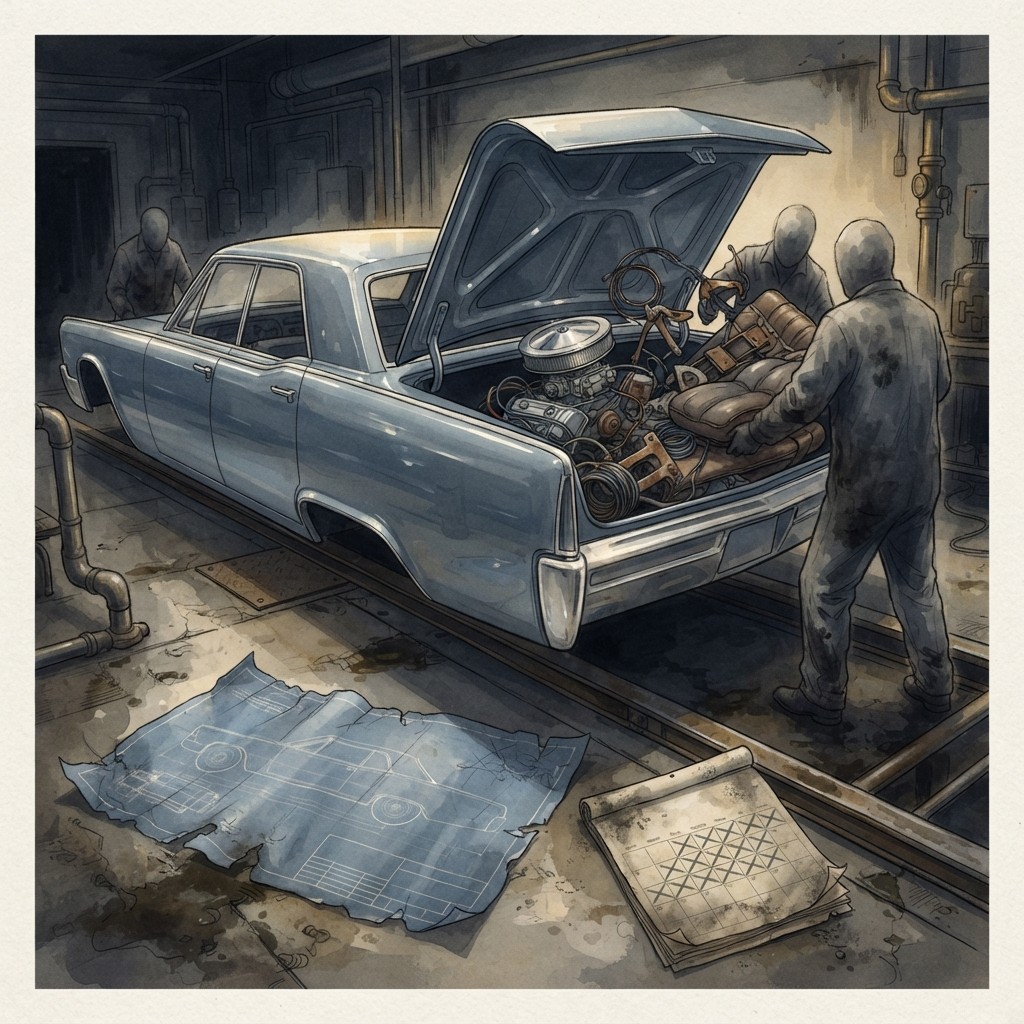
Worse than how the Edsel looked was how it was made. Ford did not build it on its own dedicated lines. It built a supposedly 'new' brand on shared Ford and Mercury assembly lines, where workers were handling different cars with different tools - and, when an Edsel-specific part didn't fit the workflow, would simply leave it loose in the trunk for the dealer to sort out.7 A car sold on the promise of being special arrived rattling, with the special parts in a bag in the back. The first buyers - the ones the launch had actually won - became the brand's loudest detractors.
Ford wanted the upside of a separate division - a distinct identity, its own dealers, its own desk in the buyer's mind - without paying for the thing that makes a separate product feel separate: dedicated manufacturing and quality control. Sharing Mercury and Ford lines saved capital and destroyed the one thing the launch needed most, which was a car that lived up to its own marketing. When the cost-saving compromise sits on the exact attribute you're charging a premium for, you are funding your own failure. The Edsel didn't underdeliver because Ford was careless. It underdelivered because it was thrifty in precisely the wrong place.
| The myth | What actually happened | |
|---|---|---|
| First-year sales | Nobody bought it | 63,110 units - 2nd-biggest brand launch in U.S. history |
| The grille | A designer's ugly vision | An exec override of a slender original design |
| The market | Wrong car, dumb idea | Right idea, but the mid-price segment was collapsing |
| Who killed it | McNamara built and killed it | Breech championed it; McNamara only recommended ending it |
| The real cause | Hype and bad taste | Stale research, recession timing, internal dysfunction, defects |
The blame that landed on the wrong man
History assigned the Edsel a villain: Robert McNamara, who recommended pulling the plug. The accusation went all the way to a presidential campaign - in 1964, Barry Goldwater blamed McNamara for the whole debacle.4 But McNamara didn't build the Edsel; Ernest Breech did. And Breech, of all people, set the record straight. He wrote to the Goldwater campaign to say McNamara 'had nothing to do with the plans for the Edsel car or any part of the program.'5 McNamara's role was triage - recommending cancellation in 1959 of a car that was already failing for reasons set in motion years before he touched it.4 So convinced was McNamara that the letter mattered, he later had copies handed to reporters whenever the charge resurfaced.5 The Edsel is a case study in how failure finds a face that fits the narrative, regardless of the facts.
“[McNamara] had nothing to do with the plans for the Edsel car or any part of the program.”5
The end - and the proof Ford had it backwards
On November 19, 1959, Ford announced the end of all Edsel production, citing 'particularly disappointing' sales - and the timing wasn't even Ford's choice. A footnote in a Ford Foundation stock prospectus had disclosed the discontinuation date before the company was ready to say it out loud.1 Only about 2,800 of the 1960-model Edsels were ever built.1 Across all three model years, total production reached just 118,287 units, and Ford's own stated investment - development, manufacturing, marketing - ran past $250 million, with broader loss estimates climbing toward $350 million.3 The brand had lived 26 months.4
Here is the part that should keep strategists up at night. Ford had a compact car in the pipeline, planned as a 1961 Edsel - the Comet. When the Edsel folded, Ford simply handed the Comet to Mercury dealers and sold it as the Mercury Comet beginning in March 1960. In its first year alone, the Mercury Comet outsold the entire three-year Edsel run.8 The escape hatch existed. The pivot toward the small, affordable cars the market was actually demanding was already designed and ready. Ford killed the brand six months before its own salvation reached the lot.
Ford's 1954-55 study wasn't sloppy; it was simply old by the time it shipped a product, and a market can turn in two years. The trap isn't bad data - it's confident data with an expired timestamp, used to justify a decision the world has already moved past. Before you bet a brand on a thesis, ask one question: when was this last true? And before you declare a failure dead, ask the harder one - is the thing that would have saved it already sitting in your own building, mislabeled?
The Edsel became a synonym for failure because the word is tidy and the truth is not. The truth is a sound thesis aimed at a market that was vanishing, a designer's idea overruled by an executive, a 'new' car built on borrowed lines with its best parts loose in the trunk, and a brand executed six months before the compact car it owned would have rescued it. Strip away the grille jokes and the legend, and the Edsel isn't a lesson about hype. It's a lesson about an organization that out-managed its own good idea - and a reminder that the most expensive failures are rarely the ones that had no demand. They're the ones that had it, and squandered it.
Disruption Vulnerability Assessment
An assessment that rates a company across the dimensions that predict disruption: how cheaply a challenger can serve the unsexy bottom of the market, how trapped you are by margins and a satisfied core. Blank to score your own position before the cliff; filled as the worked example showing where the story's incumbent was already exposed while the numbers still looked great.
Included, filled and blank, in the Fall Casebook. See the set → · Preview the blank →
Sources
Where this comes from — the filings, records, and reporting behind it.
- 1Ford announced the end of all Edsel production on November 19, 1959, citing 'particularly disappointing' retail sales; approximately 2,800 of the 1960 model had been built. Ford's hand was forced by a Ford Foundation stock prospectus footnote that publicly disclosed the discontinuation date before Ford was ready to announce.Time, AUTOS: The $250 Million Flop ↗ · 1959-11-30
- 2The Edsel was publicly introduced on September 4, 1957 ('E-Day'); full-scale production of the 1958 Edsel had begun on July 15, 1957. First-year U.S. sales totaled 63,110 units, the second-largest launch for a new American car brand, exceeded only by the DeSoto's 1929 introduction.
- 3Total Edsel production across all three model years was 118,287 units (including 7,440 in Canada). Ford's total financial loss is documented as 'over $250 million' (equivalent to ~$2.72 billion in 2025 dollars) in development, manufacturing, and marketing; total operating loss estimates range up to $350 million across secondary sources.
- 4Edsel survived just 26 months and cost Ford Motor Company upwards of $350 million (approximately $3.6 billion in 2023 dollars). It was discontinued at the direction of Robert S. McNamara. The Edsel emerged as a point of contention in the 1964 presidential campaign when Barry Goldwater blamed McNamara for its failure.
- 5Ernest R. Breech—the Edsel's key internal champion—wrote to the Goldwater campaign correcting the McNamara-killed-Edsel claim, stating McNamara 'had nothing to do with the plans for the Edsel car or any part of the program.' During his World Bank tenure, McNamara instructed staff to distribute copies of Breech's letter to press whenever the accusation arose.
- 6The medium-price car segment that Edsel was designed for was collapsing independently of the recession: medium-price car sales fell 14% in 1957 even as total U.S. car sales rose 5%. Ford's market research had been conducted in 1954–55 during a boom and was never updated before launch; imports surged from 57,000 units in 1955 to 430,000 in 1958.
- 7Roy Brown's original Edsel design featured a slender central grille opening; engineers vetoed it over cooling concerns, and EVP Ernest Breech then demanded it be made taller and wider, producing the 'horsecollar' grille. Assembly quality was also compromised because Edsels were built on shared Ford and Mercury lines, with workers using different tools and often leaving unique parts loose in the trunk.
- 8The planned 1961 Edsel Comet compact—for which prototypes and clay models existed in Ford archives, and which carried E-prefix part numbers—was reassigned to Mercury dealers after Edsel's cancellation and sold as the Mercury Comet from March 17, 1960, outselling the entire three-year Edsel production run in its first year.
Weighing outside help with a decision like this? Hiring a turnaround or restructuring advisor
More like this — beyond Ford Edsel
New Strategically analyses as they publish: the defining moves in business, checked against the record. No noise, and one click to leave.