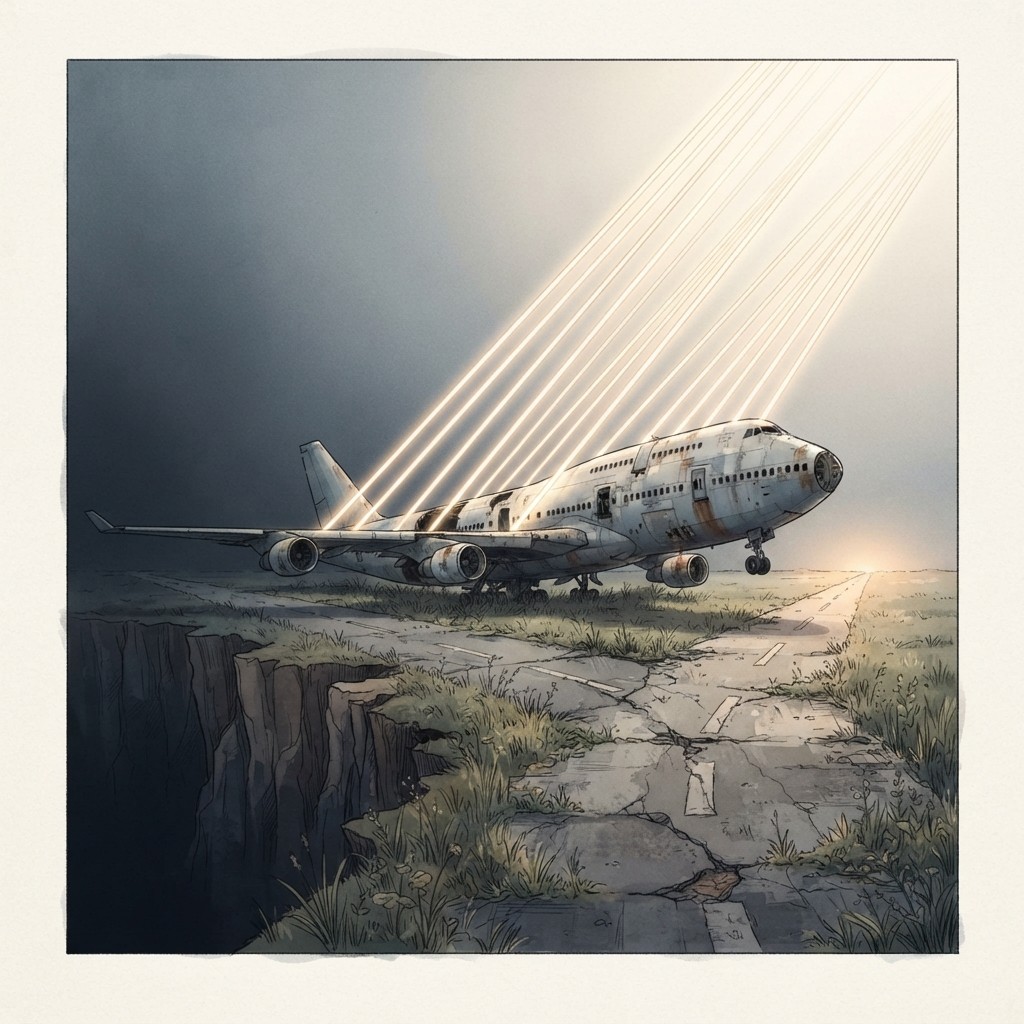
Everyone agrees Boeing is falling. Almost no one notices it's two falls at once — and only one of them is fatal.
Pairs with the Disruption Vulnerability Assessment — a ready-to-use strategy tool. Included in the Fall Casebook →
“How much of your decline can the agreed explanation actually account for?”
A Boeing test pilot, working through the certification of the 737 MAX, hit the failure that would later kill 346 people. The system pushed the nose down. It took him more than ten seconds to recognize what was happening and respond — and the FAA's own safety math assumed a pilot would catch it in four. The pilot called the condition 'catastrophic.' That word, and the test data behind it, did not reach the regulator.5 Two airplanes later, in the Java Sea and a field outside Addis Ababa, the four-second assumption met the real world.
The popular story is that Boeing is collapsing — a fallen giant, share lost to Airbus forever, a brand that can no longer be trusted to build a plane. Boeing is dying. The truth is stranger and more specific: Boeing is in real, documented, structural decline as an operator, and at the same time its position as a franchise has barely moved. Both things are true at once, and almost every take you read collapses one into the other.
The operator is bleeding, and the numbers don't argue: where the losses are real, repeated, and management's own to fix
Start with the part that isn't debatable. Boeing has lost money every year from 2022 through 2024 — $5.053 billion, then $2.242 billion, then $11.875 billion.1 That last figure is not a rounding error in a hard year; it is a hole the size of a mid-cap company. And it isn't an accounting artifact: the operating line lost $10.707 billion in 2024 on its own.1 Commercial deliveries — the actual act of handing a finished airplane to a customer who pays for it — fell to 348 from 528 the year before.2 A machinists' strike that ran until early November was the proximate cause of that delivery collapse,2 but a company that can be knocked flat by a strike is telling you something about its own footing.
This is the operational nadir made literal. But losses and missed deliveries are symptoms. The disease is upstream, and the government wrote it down.
What investigators found when they took the culture apart: the defect was never a single part — it was a system that let speed beat scrutiny
Both MAX crashes — Lion Air Flight 610, which killed 189, and Ethiopian Airlines Flight 302, which killed 157 — traced to the same chain: a single faulty angle-of-attack sensor feeding bad data into MCAS, which responded by commanding the nose down, again and again, against pilots who didn't fully know the system existed.6 The worldwide fleet was grounded from March 2019 into late 2020, covering all 387 MAX jets then delivered.6 That is the longest grounding of a major commercial aircraft type in recent aviation history9 — a fifth of a year for every plane of the type, all at once.
The House Transportation Committee spent eighteen months turning the wreckage into a 238-page indictment of how the airplane was built. Its finding was not 'a part failed.' It was that Boeing withheld crucial safety information from the FAA, and that the pressure to keep pace with Airbus's A320neo ran through the whole program as a central theme.5 Speed beat scrutiny. The cheaper, faster path won the internal argument, and the bill came due in two oceans.
“A Boeing test pilot took more than 10 seconds to respond to an uncommanded MCAS activation — far longer than the 4-second assumption the FAA relied on — and described the condition as 'catastrophic.'”5
Then came the evidence that the rot wasn't only in one program. In April 2024 a Boeing engineer testified to a Senate subcommittee that the company forced fuselage gaps closed on 787 Dreamliners without proper shims the overwhelming majority of the time, and that workers jumped on 777 sections to force them into alignment.7 Boeing disputed the structural claims, saying its own inspections found no fatigue or cracking.7 But a separate Senate inquiry surfaced something harder to wave off: a whistleblower account that Boeing was eliminating quality inspections and having workers inspect their own work — backed by a previously non-public 2021 FAA enforcement letter flagging the very same problem.8 When a regulator wrote the warning down years earlier and the same defect resurfaces, that is not a bad batch. That is a system.
The legal saga that never landed where everyone thinks it did: the reckoning the headlines describe is not the one that actually happened
Here is the most-repeated and most-wrong line in the whole story: 'Boeing pleaded guilty.' It never finally did. In 2021 Boeing entered a Deferred Prosecution Agreement — a $243.6 million criminal penalty plus $500 million for the crash families — but the fraud charge was deferred, not adjudicated.3 Then the DOJ found Boeing had breached that agreement by failing to build a real compliance program. Boeing agreed to a guilty plea in July 2024. A federal judge rejected it in December. And by May 2025 the DOJ filed a Non-Prosecution Agreement instead — meaning that after all of it, Boeing avoided a guilty plea entirely.4 The shorthand everyone uses describes a reckoning that didn't happen the way the headline says.
So why isn't the franchise dying too?: because customers aren't fleeing the bottom — they're waiting in line at it
If you stopped there, the verdict writes itself: a company that loses billions, breaks safety promises, and dodges its own plea is finished. But look at the one number the obituary writers skip. At year-end 2024 — the very bottom — Boeing's backlog had grown to $521 billion, including more than 5,500 commercial airplanes already on order.2 Customers were not fleeing during the nadir. They were waiting in line. That is the tell that separates a declining operator from a declining franchise, and it is the whole argument.
| Is the operator declining? | Is the franchise declining? | |
|---|---|---|
| The evidence | Six straight loss years; $11.9B lost in 2024; deliveries down to 348 | $521B backlog; 5,500+ aircraft on order; demand intact at the bottom |
| Root cause | Safety-culture breakdown documented by Congress and the Senate | A global duopoly that can't be re-built on a decade's notice |
| Who can fix it | Boeing — if it rebuilds inspection and trust | Only a credible second supplier — and there isn't one |
| Verdict | Yes, structurally | No — wounded, not replaceable |
The mechanism is structural, not loyal. Large commercial aircraft are a two-company world, and the other company is capacity-constrained — Airbus cannot physically absorb Boeing's order book even if every airline wanted to switch tomorrow. Fleets are standardized on specific types, pilots are rated on them, maintenance and supply chains are certified to them, and a new program takes the better part of a decade to certify. An airline furious at Boeing still cannot route around it, because there is no third runway to take. The duopoly does the holding for Boeing that Boeing can no longer do for itself.
The honest objection: doesn't a broken operator eventually break the franchise?: the backlog isn't a fortress, it's patience — and patience gets spent
The fair counter is that this distinction is too convenient — that 'declining operator, intact franchise' is just a stay of execution, because the two are connected by a wire. If Boeing keeps shipping planes that fall out of the sky, the backlog converts to cancellations, the duopoly protection turns into a demand for a third entrant, and the franchise follows the operator down. That is real. A franchise is only un-attackable until the cost of attacking it drops below the pain of staying. The backlog is not a fortress; it is patience, and patience is spent every year the operator doesn't fix itself. The reason the franchise still holds is not that Boeing earned the trust back — it's that the world has nowhere else to put the orders yet. That 'yet' is the only thing between a wounded duopolist and a replaceable one.
When a famous company stumbles, the instinct is to declare the whole thing in decline — and the instinct is usually half right and dangerously imprecise. Ask the two questions separately. Is the operator declining? Look at the things management controls: margins, execution, quality, the loss line. Is the franchise declining? Look at the things the market controls: backlog, switching cost, whether a credible alternative actually exists. Boeing fails the first test badly and passes the second — for now. The trap is conflation, in both directions: bears who short the franchise on the operator's numbers get crushed by the duopoly; bulls who buy the franchise and ignore the operator inherit a company that can be knocked flat by its own strike. The franchise buys time. It does not buy a fix.
Boeing's $521 billion order book is not proof the company is fine. It is proof the world has nowhere else to go, which is a very different and far more fragile kind of strength. The operator broke the thing the franchise is made of — trust that the airplane will not push its own nose into the ground — and rebuilt none of it; the orders kept coming anyway, because the alternative was no airplane at all. That is the real shape of this fall. It is not Boeing dying. It is Boeing discovering exactly how much its position will forgive — and spending it, one loss-making year at a time, on the bet that it can repair itself before the patience runs out.
Disruption Vulnerability Assessment
An assessment that rates a company across the dimensions that predict disruption: how cheaply a challenger can serve the unsexy bottom of the market, how trapped you are by margins and a satisfied core. Blank to score your own position before the cliff; filled as the worked example showing where the story's incumbent was already exposed while the numbers still looked great.
Included, filled and blank, in the Fall Casebook. See the set → · Preview the blank →
Sources
Where this comes from — the filings, records, and reporting behind it.
- 1Boeing recorded a full-year 2024 net loss attributable to common shareholders of $11.875 billion, with a loss from operations of $10.707 billion; the prior two years also showed net losses of $2.242 billion (2023) and $5.053 billion (2022).
- 2Boeing's full-year 2024 commercial aircraft deliveries fell to 348 from 528 in 2023; total company backlog at year-end 2024 grew to $521 billion including over 5,500 commercial airplanes; the IAM machinists' strike, which ended November 4, 2024, was a primary driver of the delivery collapse.
- 3Boeing's 2021 Deferred Prosecution Agreement with the DOJ required Boeing to pay a $243.6 million criminal penalty and $500 million in additional compensation to families of those killed in the Lion Air and Ethiopian Airlines crashes; the charge was deferred, not adjudicated as a conviction.
- 4The DOJ determined Boeing breached the 2021 DPA by failing to sufficiently design, implement, and enforce a compliance and ethics program; Boeing agreed to a new plea in July 2024; a federal judge rejected that plea in December 2024; and by May 2025 the DOJ filed a Non-Prosecution Agreement, meaning Boeing ultimately avoided a guilty plea.
- 5The House Transportation and Infrastructure Committee's 238-page final report found Boeing withheld crucial safety information from the FAA, including internal test data showing a Boeing test pilot took more than 10 seconds to respond to uncommanded MCAS activation — far exceeding the FAA's 4-second assumption — a condition the pilot described as 'catastrophic.' Production pressure to compete with Airbus's A320neo was identified as a central theme.
- 6Both 737 MAX crashes (Lion Air Flight 610, Oct 29 2018, killing 189; Ethiopian Airlines Flight 302, March 10 2019, killing 157) were caused by faulty angle-of-attack sensor input triggering repeated uncommanded MCAS nose-down commands; the worldwide grounding lasted from March 2019 to November/December 2020, covering all 387 then-delivered MAX aircraft.
- 7Boeing engineer-whistleblower Sam Salehpour testified before the Senate Permanent Subcommittee on Investigations on April 17, 2024, alleging Boeing used excessive force to close fuselage gaps on 787 Dreamliners without proper shims 98.7% of the time, and that workers jumped on 777 fuselage sections to force alignment. Boeing disputed the 787 structural integrity claims, saying its own inspections found no fatigue or cracking.
- 8The Senate Permanent Subcommittee on Investigations (PSI) initiated its Boeing safety inquiry in March 2024 following whistleblower allegations of shortcuts on 787 and 777 assembly; a separate anonymous whistleblower alleged Boeing was eliminating quality inspections and relying on workers to inspect their own work, backed by a previously non-public 2021 FAA enforcement letter identifying the same quality inspection problems.
- 9The 737 MAX accidents triggered the longest grounding of a major commercial aircraft program in recent aviation history
- 10Boeing's 2024 loss extended a six-year sequence of annual net losses dating to 2019
Weighing outside help with a decision like this? Hiring a turnaround or restructuring advisor
More like this — beyond Boeing
New Strategically analyses as they publish: the defining moves in business, checked against the record. No noise, and one click to leave.