Pairs with the Disruption Vulnerability Assessment — a ready-to-use strategy tool. Included in the Fall Casebook →
“How much of your decline can the agreed explanation actually account for?”
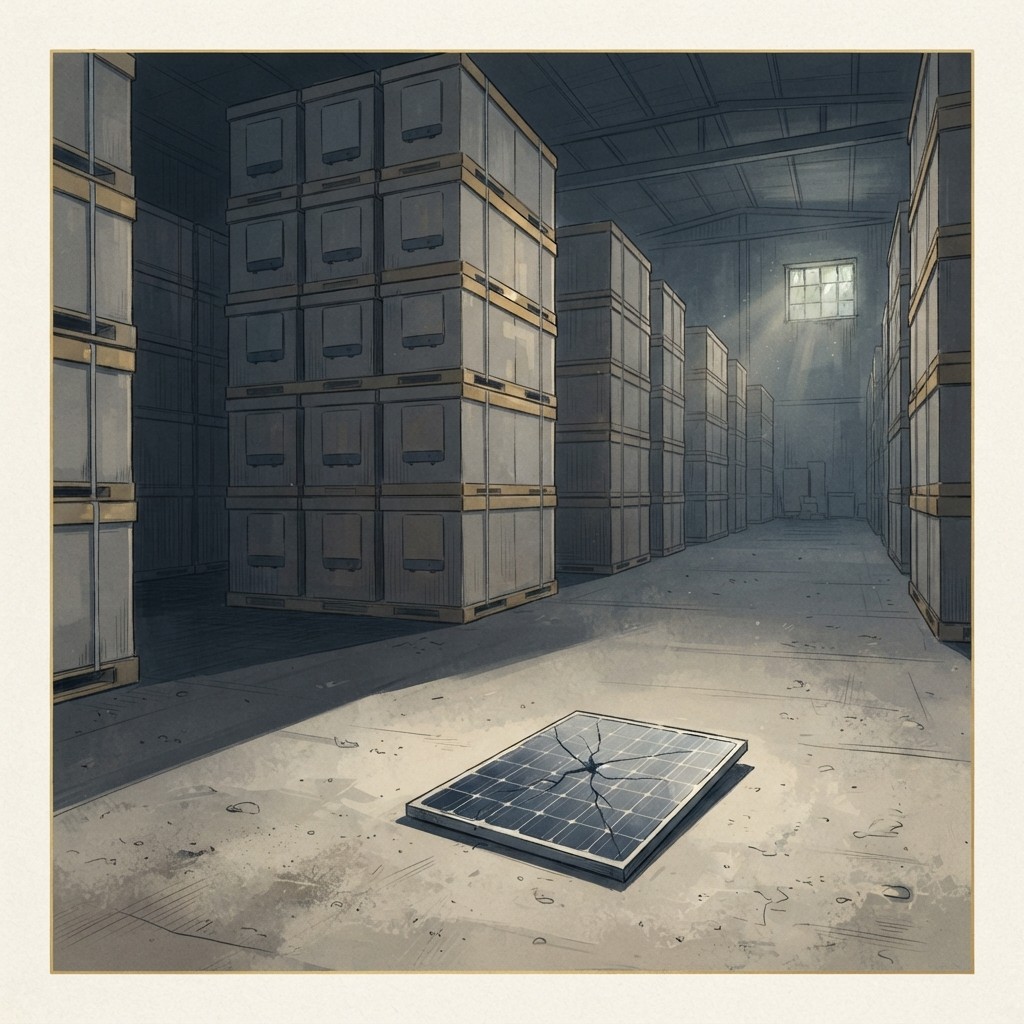
By late 2024, Enphase was shipping roughly 6.5 million microinverters a year — and the year before, it had shipped 15.5 million.1 Nothing about the product had failed. The little gray box that turns a single solar panel's DC into household AC still worked exactly as it had at the top. What changed was that the boxes weren't moving. They were stacking up in distributors' warehouses, bought during a boom and waiting for installers who had stopped calling. The collapse you read about in the stock — down roughly 90% from a peak near $336 a share89 — didn't start on a trading floor. It started on a shelf.
The official story is simple and wrong: high interest rates killed Enphase. The real story is that Enphase's distributors had bought far more inverters than homeowners would install, and a California rule change quietly erased the math that made solar-only homes pencil out. Rates were the wind. They were not the fire.
Here is the thesis, plainly: Enphase didn't suffer a demand shock so much as an inventory unwind on top of a policy shock — and you can prove it by the one number that refused to fall.
The margin that wouldn't crash gives the game away
When a company gets crushed by rising costs or collapsing pricing power, the first casualty is gross margin. Enphase's did the opposite. GAAP gross margin rose to 47.3% in 2024 — up 1.1 percentage points year over year — even as revenue fell 42%.1 That single fact rules out half the popular explanations. The product still commanded its price. The unit economics were intact. What cratered was volume — units shipped fell 58%1 — and volume falls for a very specific reason when the price holds: the buyers in the middle already have too much stuff.
Enphase says it itself, in the dry prose of its filings: through 2024 it kept cutting its own shipments on purpose — 'reducing shipments to manage channel inventory' — while citing a 'further softening in U.S. demand.'7 Read that twice. A company starving its own top line because the warehouses downstream are full is not a company that lost its customers. It is a company digesting a binge. The glut had begun materializing well before the Fed funds rate reached its peak — which is exactly why the 'rates did it' timeline doesn't line up.
California rewrote the math, then Enphase rewrote its product
The second blow came from a regulator. On December 15, 2022, the California Public Utilities Commission approved NEM 3.0, effective for new interconnection applications after April 15, 2023. It slashed the compensation homeowners get for exporting solar power to the grid by roughly 75%.4 Overnight, the simplest, cheapest residential system — panels with no battery, selling the daytime surplus back to the utility — stopped paying for itself in Enphase's single most important market. The export check that made solar-only worth it had been gutted.
| The popular story | What the filings show | |
|---|---|---|
| Primary cause | High interest rates | Channel-inventory purge + softening demand1 |
| Gross margin | Collapsed with revenue | Rose to 47.3% in FY20241 |
| Peak revenue year | 2023 | 2022, at $2.33B3 |
| NEM 3.0 | Purely negative | Hurt solar-only volume; pushed installs toward batteries5 |
But here is where the simple 'NEM 3.0 destroyed Enphase' story also breaks. The same rule that killed solar-only made solar-plus-storage the only configuration that still made sense — and a battery is a far higher-value sale than an inverter alone. Enphase saw it and pivoted hard. In August 2023 it launched a comprehensive solar-plus-storage solution built for NEM 3.0, framing the policy not as a death sentence but as a forced upgrade in its product mix.5 By the fourth quarter of 2024, the company said NEM 3.0 installs made up 66% of its California installs, carrying a 45% IQ Battery attach rate.5 The policy that shrank the volume also fattened the average sale.
Two rounds of layoffs, and what the CEO actually wrote
The November 2024 layoffs — about 500 employees and contractors, a 17% cut — got reported as the moment Enphase blinked. It wasn't the first blink. The deeper cut followed an earlier round announced in December 2023 that had already removed roughly 10% of the workforce, about 350 people.6 Two rounds, a year apart, with $17–$20 million in restructuring and impairment charges in the second.6 And the CEO's own letter to employees names the causes in order: reduced U.S. demand, high interest rates, and the lingering 2023 solar-market challenges.6 Rates are in the list. They are not at the top of it.
A revenue collapse with a stable — or rising — gross margin is almost never a demand-destruction story or a pricing-power story. It is an inventory story. Somewhere in the channel, a distributor or retailer over-bought during the good times and is now working that pile down by buying nothing, which starves the manufacturer's top line for quarters even though end demand never fell as far as the numbers suggest. The danger for analysts is borrowing the macro headline ('high rates') because it's available and plausible, when the company's own filings point at the warehouse. Read the cost line before you trust the cause.
The fair objection: rates really did hurt
The honest counter is that you can't wave away interest rates entirely. A rooftop system is a financed purchase for most households, and when the cost of a solar loan climbs, the monthly payment that has to beat a utility bill gets harder to clear. Higher rates genuinely slowed end demand — Enphase's own CEO put them on the list — and they made the inventory glut harder to clear, because the installers who would normally have drained those warehouses were selling into a chillier market. So rates mattered. The claim here isn't that they were irrelevant; it's that they were an accelerant, not the ignition. A pure rate shock would have compressed margins as the company discounted to move product. Instead the company chose to ship less and hold price — and the margin proved it could.1 You don't fix a demand problem by shipping less. You fix an inventory problem that way.
The recovery sketches the same shape from the other side. By Q4 2024 Enphase was shipping again — roughly 878 MW of microinverters in the quarter — and FY2025 revenue climbed back toward $1.47 billion with net income of about $172 million.8 If the cause had been a structural collapse in solar demand, no quick rebound. What you see instead is a channel that finally cleared and a product mix tilted toward batteries by the very policy that was supposed to sink the company.
Enphase's fall was real and brutal — a 42% revenue drop, a 90% stock wound, two rounds of layoffs. But it was the fall of a company whose customers stopped reordering, not a company whose customers stopped wanting. The headline blamed the Fed because the Fed was easy to blame. The truth was sitting on a shelf in a distributor's warehouse, and on a single line item that refused to crash: the margin. The most expensive misreadings in markets are the ones where the convenient cause and the real cause point in the same general direction — close enough to feel right, far enough off to bet wrong.
Disruption Vulnerability Assessment
An assessment that rates a company across the dimensions that predict disruption: how cheaply a challenger can serve the unsexy bottom of the market, how trapped you are by margins and a satisfied core. Blank to score your own position before the cliff; filled as the worked example showing where the story's incumbent was already exposed while the numbers still looked great.
Included, filled and blank, in the Fall Casebook. See the set → · Preview the blank →
Sources
Where this comes from — the filings, records, and reporting behind it.
- 1Enphase FY2024 net revenues were $1,330.4 million, a 42% decrease vs. FY2023, primarily due to a 58% decrease in microinverter units shipped (approx. 6.5 million units in 2024 vs. 15.5 million in 2023); gross margin increased 1.1 pp to 47.3%; net income fell to $102.7 million from $438.9 million in 2023.
- 2Enphase FY2023 revenue was $2.29 billion (~2% decline from FY2022's $2.33 billion); Q4 2023 revenue was $302.6 million vs. $551.1 million in Q3 2023; U.S. revenue fell ~35% QoQ and European revenue fell ~70% QoQ in Q4 2023, driven by reduced shipments to manage high distributor inventory and softening demand.
- 3Enphase FY2022 revenue was $2.33 billion, the actual peak year; the company described this as a record in its Q4 2021 release (which showed full-year 2021 revenue of $1.382 billion, confirming the upward trajectory that peaked in 2022).
- 4California's NEM 3.0 (Net Billing Tariff), approved by CPUC on December 15, 2022 and effective for new interconnection applications after April 15, 2023, slashed export compensation rates by 75%, reducing the economics of solar-only systems and incentivizing solar-plus-storage.
- 5Enphase announced a comprehensive solar-plus-storage product solution for NEM 3.0 on August 15, 2023, positioning the policy shift as a long-term opportunity; CEO Kothandaraman stated NEM 3.0 installs in California represented 66% of installs with a 45% IQ Battery attach rate as of Q4 2024.
- 6Enphase's November 2024 restructuring was its second round of cuts: an initial ~10% workforce reduction (~350 employees/contractors) was announced in December 2023, followed by a 17% cut (~500 employees and contractors) in November 2024, incurring $17–$20 million in restructuring and impairment charges. CEO letter cited 'reduced U.S. demand, high interest rates' and ongoing 2023 solar market challenges as drivers.
- 7Enphase's Q1 2024 revenue decline was attributed by the company itself to 'seasonality and a further softening in U.S. demand' while it 'continued to reduce shipments to manage channel inventory'; non-GAAP gross margin fell from 50.3% to 46.2% QoQ, primarily driven by lower net IRA benefit (volume).
- 8Enphase's stock fell approximately 90% from its late-2022 peak near $340 per share; the company shipped approximately 878 MW of microinverters in Q4 2024, still dramatically below 2022–2023 highs; FY2025 revenue partially recovered to ~$1.47 billion with net income of $172 million.
- 9Enphase Energy's all-time high closing stock price was $336.00 on December 02, 2022
Weighing outside help with a decision like this? Hiring a turnaround or restructuring advisor
More like this — beyond Enphase
New Strategically analyses as they publish: the defining moves in business, checked against the record. No noise, and one click to leave.