Pairs with the Moat Anatomy Canvas — a ready-to-use strategy tool. Included in the Moat Anatomy Casebook →
“What would it actually cost a challenger to take your customer?”
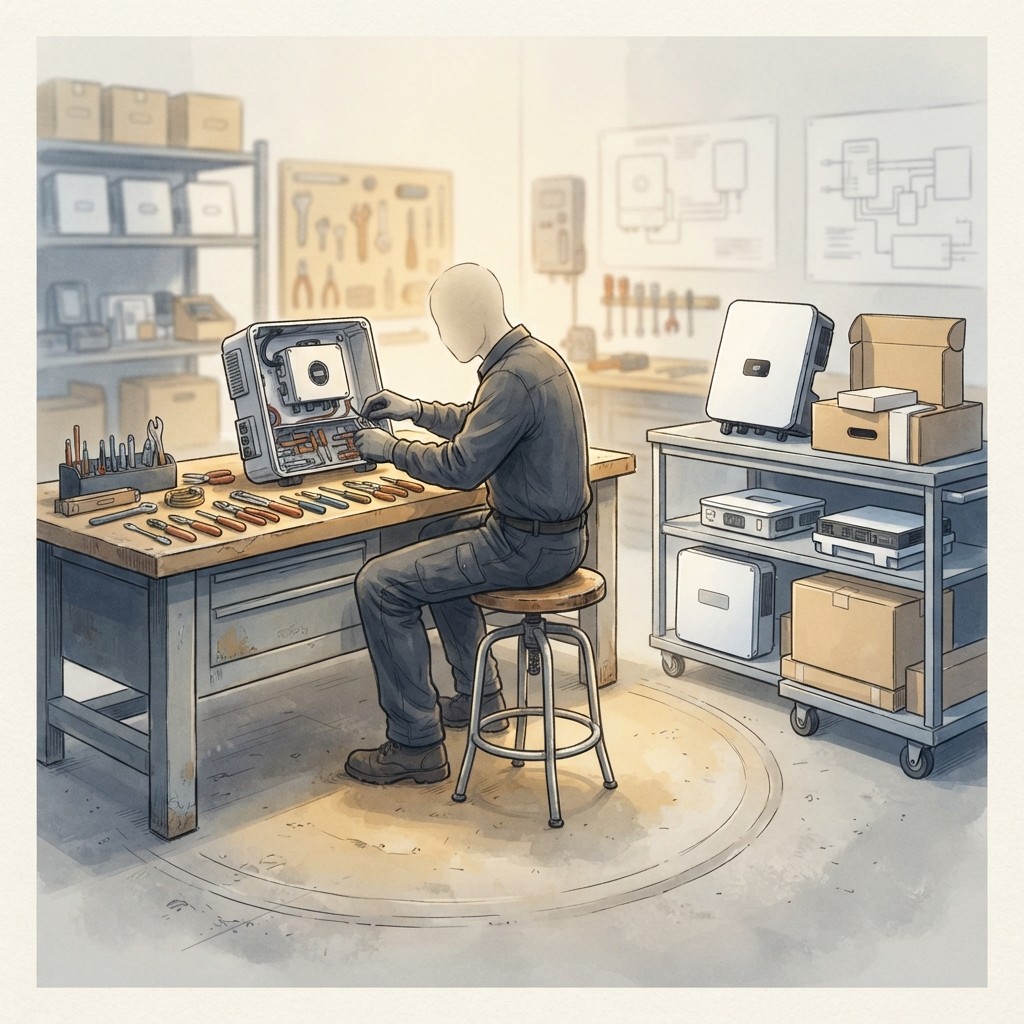
On a roof in suburban America, an electrician clips a small black box the size of a paperback beneath each solar panel. He has installed thousands of them. His crew knows the cabling, the app that commissions them, the warranty claims process, the way the monitoring software talks back. When the homeowner asks for solar, he does not deliberate over which inverter to use — he reaches for the one his hands already know. That reflex, repeated across tens of thousands of installs a year, is Enphase's real moat. Not the chip inside the box. The habit in the hands holding it.
The official story is that Enphase owns the inverter. It controls the market alongside SolarEdge — some accounts put their combined share as high as 95% — sits behind a wall of patents, and invented the microinverter. Almost every load-bearing word of that is too generous. The duopoly figure describes the U.S. residential niche, not the planet. The patent portfolio is real but ordinary. And Enphase commercialized the microinverter at scale — it did not invent the concept. The moat exists. It is just narrower and softer than the legend insists, and 2024 made that impossible to ignore.
What the duopoly chart quietly leaves out
The chart everyone cites is genuinely striking. In 2013, vendors other than SolarEdge and Enphase held more than two-thirds of the U.S. residential inverter market; by late 2019, that 'other' group had collapsed to roughly a fifth.8 Two companies absorbed nearly everyone else. That looks like an unassailable position. But read the fine print on the same data: it is U.S. residential. Globally, the inverter business is led by large string-inverter manufacturers shipping vastly more capacity, and Enphase is not among the leaders by total shipments — by 2024, Huawei and Sungrow alone combined for 55% of a 589 GWac global market, with nine of the ten largest vendors headquartered in China.9 Enphase's own 10-K is careful about the boundary — it claims 'market leadership in the microinverter category,' a category, not the market.1 The 95% number is true the way a town can have a 95% market share of one street.
| The legend | The actual position | |
|---|---|---|
| Scope | Global inverter dominance | U.S. residential microinverter niche |
| Origin of advantage | Invented the technology | First to commercialize it at scale |
| IP barrier | A patent wall rivals can't cross | ~295 U.S. + ~110 non-U.S. patents — meaningful, not impassable |
| Durability | Unassailable | Contestable by anyone who wins the installer channel |
The moat is the installer, not the inverter
So where does the strength actually come from? Trace the mechanism down past the hardware. A microinverter is a chip-and-software product: Enphase sits a small power-electronics unit under each panel rather than wiring a whole array into one central inverter. The advantage of that architecture is real, but it is not what locks customers in. The lock-in is in the installer. An installer who has standardized on Enphase has trained crews, stocked inventory, learned the commissioning app, built a warranty muscle, and accumulated a fleet of monitored systems he is on the hook to support. Switching brands means retraining, restocking, and re-learning the failure modes on someone else's hardware — across every future job. Enphase reported full-year 2023 revenue of $2.29 billion and shipped over 1.5 million microinverters in a single quarter.2 Each of those units is a small deposit into an installer's familiarity, and familiarity compounds. The flywheel doesn't run on the chip. It runs on the muscle memory of the people who fit it.
This is why the patent story misleads. As of the end of 2024, Enphase held roughly 295 U.S. patents and 110 outside the U.S. — up sharply from about 70 worldwide a decade earlier.5 That growth is real and the engineering is hard. But 405-odd patents is a meaningful portfolio, not an impassable wall, and it has not stopped SolarEdge or new entrants from selling competing module-level electronics. If patents were the moat, the share line would not move. It moved.
The year the wall got tested
Here is the evidence that the moat is channel-deep rather than patent-deep. Wood Mackenzie's distributed-solar leaderboard reported Enphase's U.S. residential inverter share falling from 55% in 2023 to 47% in 2024 — and dipping below 40% in the fourth quarter, the first time it had been that low since mid-2020.6 Over the same stretch, Tesla took the top spot in residential storage with 47% share. A SunPower bankruptcy and the arrival of Tesla's Powerwall 3 were named as the headwinds.6 Notice the shape of the threat: it did not come from a clever patent workaround. It came from a credible rival pushing an integrated product through the installer channel — exactly the place the real moat lives. When a competitor wins the electrician, the patents don't save you.
The turnaround that built the modern company tells the same story from the other direction. When Kothandaraman arrived in 2017 — first as COO, then promoted to CEO months later after the prior chief executive stepped down — he came from running a data-communications division at a semiconductor company.7 He treated Enphase like the chip-and-software business it is: better silicon, higher margins, a tighter platform. Non-GAAP gross margin reached 50.3% in late 2023, the kind of number that looks like software, not hardware.2 That operational excellence is real and it widened the moat. But it widened the part of the moat that compounds through the channel — not a legal barrier no one can cross.
Isn't a sticky installer base exactly what a great moat looks like?
The fair objection is that installer lock-in is not a weakness — it is the textbook definition of a durable moat. Switching costs, an entrenched ecosystem, a fleet of supported systems: these are precisely the assets that let Enphase hold premium margins for years. True. And the 28% of 2023 revenue denominated in euros shows the position is not purely a U.S. story, either.1 But there is a difference between a moat that cannot be crossed and one that simply hasn't been, and the distinction is the whole point. A patent wall blocks entry by law. A channel habit only blocks entry until someone offers installers a better reason to switch — a cheaper integrated package, a battery customers already want, a brand the homeowner asks for by name. The Q4 2024 number is what it looks like when that reason arrives. The moat held for over a decade not because crossing it was impossible, but because no one had yet made it worth the climb. Tesla decided it was worth the climb.
A category leader can confuse two very different defenses: a structural barrier (patents, regulation, a network rivals literally cannot replicate) and a behavioral one (habit, switching costs, an entrenched channel). They feel identical while you're winning — premium margins, rising share, a competitor that never shows up. They diverge the instant a credible challenger arrives. A structural moat survives a better offer; a behavioral moat is a bet that no one will make a better offer to the people who choose your product. Enphase owns the second kind. That's a real, valuable moat — but if you mistake it for the first, you'll underinvest in the channel precisely when someone is busy winning it away from you. Audit honestly: would your advantage survive a determined rival, or merely the absence of one?
Enphase built something genuine: not the first microinverter ever conceived, but the first one millions of roofs could actually run on, and a service relationship with five million systems behind it.4 The legend gilded it into a patent fortress and a global empire, and the gilding hid the real shape of the asset — a hard-won habit in the hands of the people who install solar, in one country, in one segment. That habit is worth a fortune. It is also exactly the kind of moat that doesn't fail slowly and then collapse; it fails the moment a better offer reaches the electrician. The chip was never the wall. The wall was the reflex — and a reflex can be retrained.
Moats that turned out to be narrower than the legend
Moat Anatomy Canvas
A one-page canvas that dissects a moat instead of asserting it: where the advantage comes from, how much of the market it covers, how long it would take to copy, and what keeps it from eroding. Blank to dissect your own claimed edge; filled as the worked example tracing the structure of the story's defensible advantage. Use it to tell a real moat from a head start.
Included, filled and blank, in the Moat Anatomy Casebook. See the set → · Preview the blank →
Sources
Where this comes from — the filings, records, and reporting behind it.
- 1Enphase Energy, Inc. FY2023 10-K: the company describes itself as holding 'market leadership in the microinverter category' and explicitly lists growing market share worldwide as a strategic goal; the filing also discloses that Euro-denominated sales were 28% of total revenue in 2023.
- 2Enphase reported full-year 2023 revenue of $2.29 billion, a ~2% decrease from $2.33 billion in 2022; Q4 2023 revenue was $302.6 million with non-GAAP gross margin of 50.3%; the company shipped 1,595,677 microinverters (~660.1 MW DC) in Q4 2023.
- 3Enphase was founded in March 2006 by Raghu Belur and Martin Fornage (originally as PVI Solutions), renamed Enphase Energy in early 2007, and released its first microinverter—the M175, rated at 175W AC—in 2008. The company went public on the Nasdaq (ENPH) in March 2012.Wikipedia, Enphase Energy ↗ · 2024
- 4Enphase's own 20-year anniversary blog post (a primary company source) confirms: 'Founded in 2006, we introduced the first microinverter-based solar system in 2008, launched the IQ series in 2017, expanded globally into batteries in 2020 and EV charging in 2022, scaled U.S. manufacturing beginning in 2023, and now support more than five million Enphase-based systems worldwide.'
- 5As of December 31, 2024, Enphase holds approximately 295 U.S. patents and 110 non-U.S. patents, per the company's own patent marking page. In 2014, the company held only ~70 patents granted worldwide with 125 active patent families.
- 6Wood Mackenzie's distributed solar leaderboard (March 2025) reports: Enphase's U.S. residential inverter market share fell from 55% in 2023 to 47% in 2024, and dipped below 40% in Q4 2024 for the first time since Q2 2020. Tesla claimed the top spot in residential storage with 47% market share in 2024. The SunPower bankruptcy and competition from Powerwall 3 were cited as headwinds.
- 7Badri Kothandaraman joined Enphase in April 2017 as COO, was appointed President and CEO in September 2017 after Paul Nahi resigned. He previously served as EVP of Cypress Semiconductor's Data Communications Division.
- 8Greentech Media (2019, citing Wood Mackenzie U.S. PV Leaderboard data): vendors other than SolarEdge and Enphase held over 67% of the U.S. residential inverter market in 2013; by Q3 2019 that 'other' group had fallen to just 20.3%—corroborating the two-player consolidation story. However, the article notes that this duopoly is U.S. residential, not global.
- 9Globally, the inverter business is led by Huawei and Sungrow, which combined for 55% of the global inverter market in 2024, with nine of the top ten global vendors headquartered in China; Enphase is not among the global top-ten leaders by shipped capacity.
Weighing outside help with a decision like this? Hiring a commercial due diligence provider
More like this — beyond Enphase
New Strategically analyses as they publish: the defining moves in business, checked against the record. No noise, and one click to leave.