Pairs with the Pricing Power Diagnostic — a ready-to-use strategy tool. Included in the Concentration Risk Casebook →
“What does changing how you charge cost before it starts paying?”
In November 2022, one designer changed jobs — and you can read the consequences in a financial statement two years later. When Alessandro Michele stepped down as Gucci's creative director,4 Kering still looked like one of the most diversified houses in luxury: Saint Laurent, Bottega Veneta, Balenciaga, Eyewear, the whole stable.10 Then watch what one transition did to the supposed portfolio. Group recurring operating income, €5.6 billion in 2022, fell to €2.6 billion in 2024 — a 46% drop.13 The other houses didn't crater. One did. And the group fell with it.
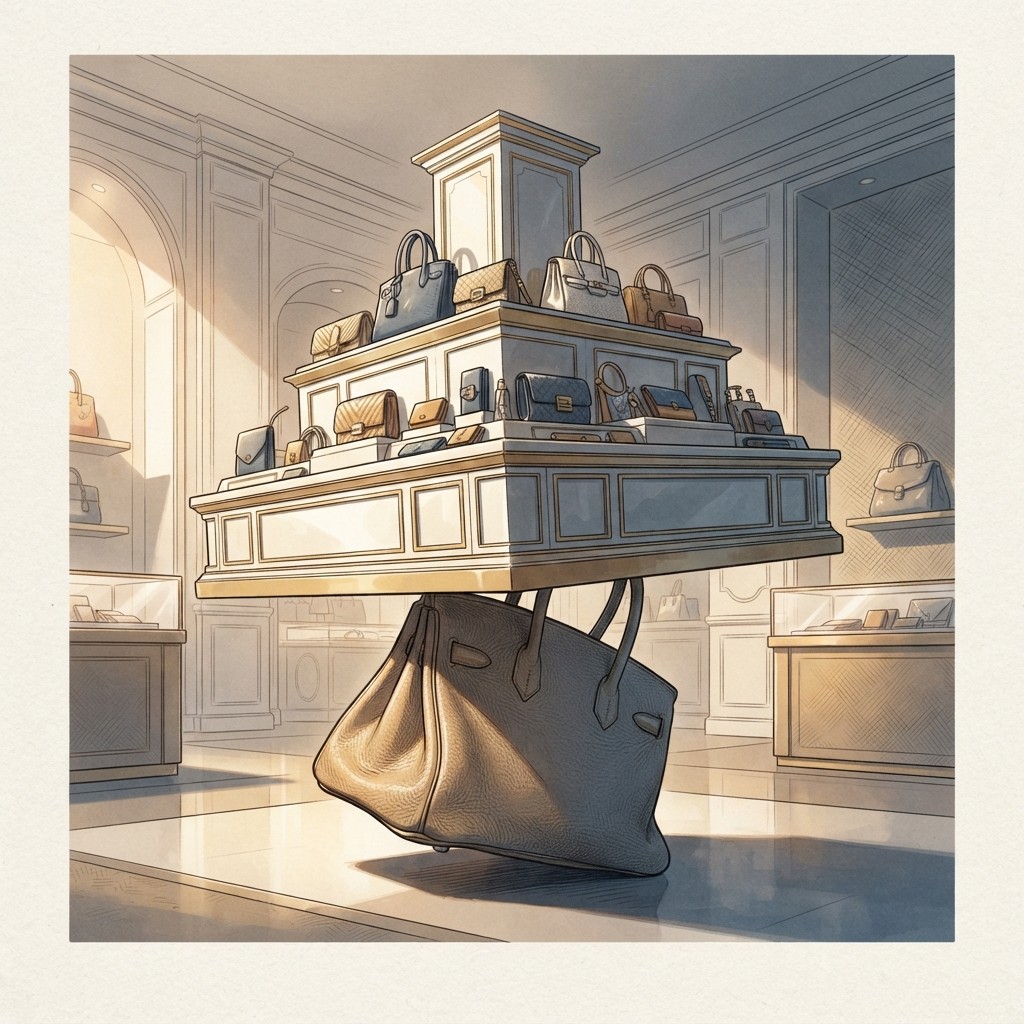
The official story is that Kering is a multi-brand luxury group, hedged across creative talents and price points the way a fund is hedged across stocks. The real story is that Kering is a single-brand bet wearing a portfolio's clothes — and the single brand happens to depend, more than almost any other in luxury, on the taste of one person who can leave at any time.
One brand, half the revenue, two-thirds of the profit
Start with the share of revenue, because it's the number most people get roughly right. In 2022 Gucci did €10.5 billion against group revenue of €20.4 billion — just over half.1 But revenue share understates the dependence badly, because Gucci has historically carried a fatter margin than the rest of the group. The number that matters is operating income, the profit that actually feeds the parent. In 2022 Gucci threw off €3.7 billion of the group's €5.6 billion in recurring operating income.1 Roughly two euros of every three Kering earned came from one house. A 'portfolio' in which a single holding contributes two-thirds of the earnings is not a portfolio. It's a position with some scenery around it.
| 2022 | 2023 | 2024 | |
|---|---|---|---|
| Gucci revenue | €10.5B | €9.9B | €7.7B |
| Group revenue | €20.4B | €19.6B | €17.2B |
| Gucci operating income | €3.7B | €3.3B | €1.6B |
| Group operating income | €5.6B | €4.7B | €2.6B |
| Group operating margin | 27.5% | 24.3% | 14.9% |
Now read the table as a sequence rather than a snapshot. As Gucci's revenue slid from €10.5 billion to €7.7 billion — a 23% reported fall in 2024 alone3 — the group's operating margin didn't drift down gracefully. It fell off a cliff, from 27.5% to 14.9%.13 That collapse is the whole thesis in one row. When your most profitable house shrinks, the high-margin earnings vanish first, and the rest of the group cannot fill the hole. The other brands are real and good. They are not, between them, a Gucci.
Why a creative-director change becomes an earnings event
Here is the mechanism, worked down. A luxury megabrand's revenue is not driven by factories or distribution — it's driven by desire, and at Gucci desire was authored largely by one creative vision. Michele's Gucci was a maximalist aesthetic so specific that it was the product. Change the author and you don't just change next season's bags; you reset what the brand means, and you do it on the fashion industry's clock, not the market's. Look at the lag. De Sarno was announced in late January 2023; his debut collection didn't reach the runway until September 2023 and didn't hit stores globally until February 2024.6 That's roughly thirteen months between 'new direction' and 'new product a customer can actually buy' — thirteen months during which the old aesthetic is winding down and the new one isn't yet on shelves.
Multiply that gap by Gucci's outsized weight in the group and you get the structural trap. A house contributing two-thirds of profit goes through an inherently slow, demand-resetting transition — and there is no other engine large enough to absorb the air pocket while a new vision proves itself. The transition is a normal, even healthy, thing for a single brand to do. It becomes a group-level earnings event only because the group bet so much on the one brand.
“Major uncertainties likely to weigh on demand among luxury consumers.”8
Wasn't it just a bad luxury market — not a Gucci problem?
The fair objection is that 2023–24 was simply a hard stretch for luxury demand generally, and Kering's COO said as much when flagging 'major uncertainties' weighing on consumers.8 If everyone was down, blaming Gucci's creative cycle confuses a macro tide for a self-inflicted wound. There's truth in it — but the numbers don't let the macro story off the hook. In Q3 2024, group revenue fell 15% while Gucci alone fell 26%.8 A soft market explains the 15%. It does not explain why one house fell nearly twice as fast as the group it dominates. The transition wasn't the only force, but it was the marginal force — the difference between a difficult year and a 46% earnings collapse.
And the reset wasn't a total failure, which is the honest complication. Kering's own 2024 results called new interpretations of the Jackie handbag 'highly encouraging.'9 The product-level signals were there; the aggregate top line and margin were not. A creative reset can be working on the shelf and still be losing on the income statement — when the brand is this large a share of the group, the math has no patience for the thirteen-month lag.
A portfolio of brands is only diversified if its parts don't move together — and Kering's parts effectively do, because one house drives the group's high-margin earnings. Owning five names doesn't hedge you when one supplies two-thirds of your profit; you've simply added scenery to a single position. The test isn't 'how many brands do we own?' It's 'if our biggest earner halves, does the rest catch us?' For Kering in 2024, the answer was no — group operating income fell 46% on one house's stumble. Real diversification means a second engine large enough to fly on while the first is being rebuilt. Count is comfort. Correlation is the truth.
Luxury sells the illusion of timelessness, but a megabrand built on one creative voice runs on the most fragile input there is: a single person's taste, and the years it takes to replace it. Kering spent a decade letting Gucci grow into two-thirds of its profit, and in doing so quietly converted a portfolio into a wager. The wager pays beautifully when the author is hot. It detonates when the author leaves — which authors always, eventually, do. The diversification was always there on the org chart. It was never there in the income statement, and the income statement is the only place it would have mattered.
Pricing Power Diagnostic
A scored diagnostic of pricing power: brand pull, switching costs, substitutes, and how critical the product is to the buyer. Each dimension rated 1-5 so you can see, at a glance, whether a price rise sticks or sends customers running. Blank to grade your own offer; filled as the worked example scoring a story's business on its real ability to charge more.
Included, filled and blank, in the Concentration Risk Casebook. See the set → · Preview the blank →
Sources
Where this comes from — the filings, records, and reporting behind it.
- 1Kering 2022 group revenue €20.4 billion (+15% reported); Gucci 2022 revenue €10.5 billion (+8% reported, +1% comparable); Gucci recurring operating income €3.7 billion; group recurring operating income €5.6 billion; group recurring operating margin 27.5%.
- 2Kering 2023 group revenue €19.6 billion (-4% reported); Gucci 2023 revenue €9.9 billion (-6% reported, -2% comparable); Gucci recurring operating income €3.3 billion (margin 33.1%); group recurring operating income €4.7 billion; group recurring operating margin 24.3%.
- 3Kering 2024 group revenue €17.2 billion (-12% reported); Gucci 2024 revenue €7.7 billion (-23% reported, -21% comparable); Gucci recurring operating income €1.6 billion (margin 21.0%); group recurring operating income €2.6 billion (-46%); group recurring operating margin 14.9%. Gucci's collaboration with Sabato De Sarno ended February 6, 2025.
- 4Alessandro Michele stepped down as Gucci creative director November 2022, citing 'different perspectives.' Kering's official statement did not characterise the exit as involuntary. WWD separately reported, citing sources, that Michele had failed to meet a request to 'initiate a strong design shift' and that Pinault sought a change — but this attribution appeared only in trade reporting, not in any Kering release.
- 5FashionUnited corroborated that Kering's official statement did not suggest Michele was asked to leave; the luxury group framed it as a mutual step-down, contrasting with the earlier forced exit of Frida Giannini and Patrizio di Marco in 2014.
- 6Sabato De Sarno was announced as Gucci creative director January 28, 2023, with his debut runway collection at Milan Women's Fashion Week in September 2023. His 'Gucci Ancora' collection hit stores globally starting February 2024.
- 7From 2015 to 2022 Kering's group revenue was essentially driven by Gucci's year-on-year high performance, with Gucci hitting the €10 billion mark in 2022. Kering's 2023 annual results declined to €19.6 billion, mainly caused by the deceleration of Gucci's performance.
- 8Kering Q3 2024 group revenue down 15% to €3.8 billion; Gucci Q3 2024 revenue down 26% to €1.6 billion; Kering projected full-year 2024 operating income drop of more than 47% to €2.5 billion. Group COO cited 'major uncertainties likely to weigh on demand among luxury consumers.'
- 9Kering's 2024 annual results press release states that the performance of new Leather Goods lines as well as iconic Gucci lines — such as the Jackie handbag and its new interpretations — is highly encouraging.
- 10Kering's 2024 annual results press release reports separately on Gucci, Yves Saint Laurent, Bottega Veneta, and Other Houses (which includes Balenciaga), and Kering Eyewear as distinct operating segments of the group.
Weighing outside help with a decision like this? Hiring a pricing strategy consultant
More like this — beyond Kering (Gucci)
New Strategically analyses as they publish: the defining moves in business, checked against the record. No noise, and one click to leave.