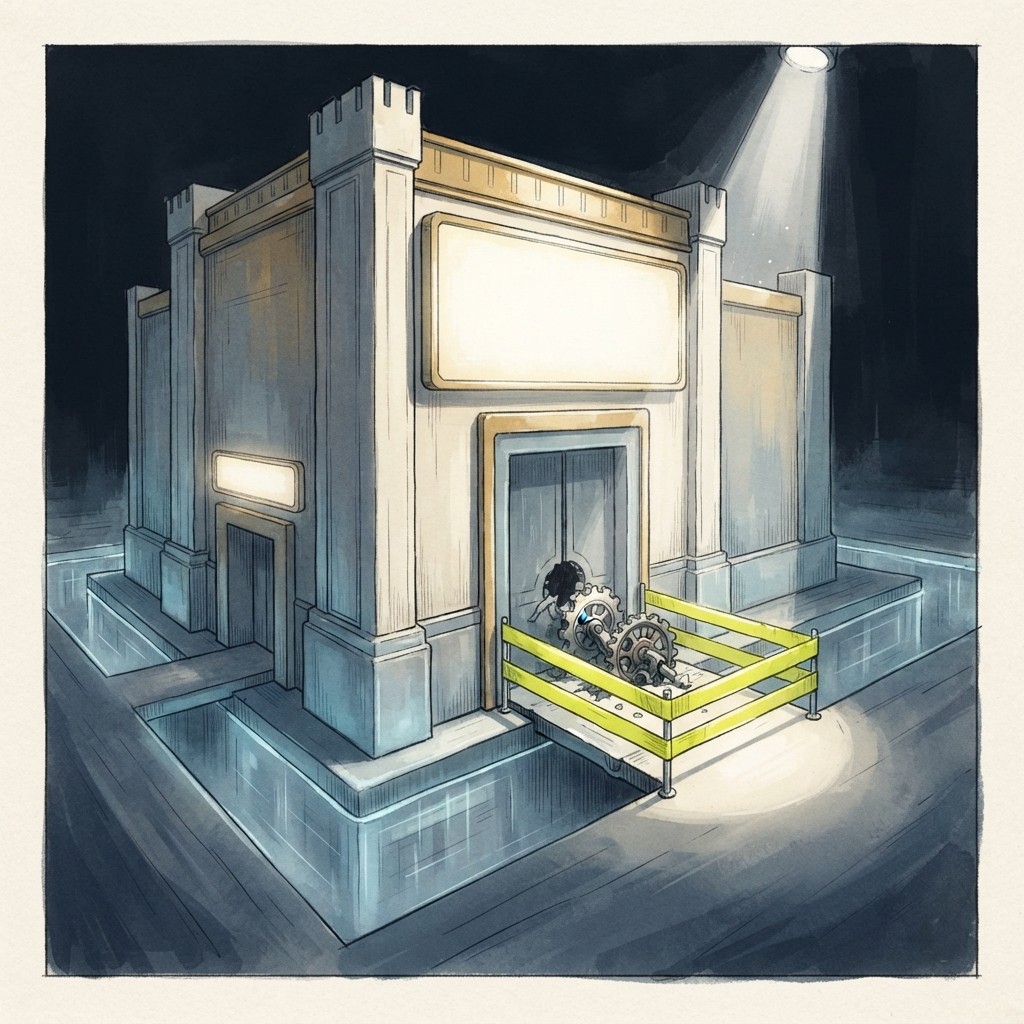
Apple's most famous number is the one most developers never pay - and the trick it built to protect that number just turned a price card into evidence.
Pairs with the Flywheel Designer Canvas — a ready-to-use strategy tool. Included in the Flywheel Casebook →
“What does your loop actually return, and how much of it is left?”
When the iPhone launched in 2007, Steve Jobs had a plan for outside developers: build web apps that run in Safari. There was no native software kit, no store, no commission. The developers revolted, and within months Jobs announced an SDK; the App Store opened in July 2008 with 500 apps.3 In its first 30 days the store moved $30 million, of which developers kept $21 million and Apple kept the rest - the famous 70/30 split, present from day one.2 Asked about it, Jobs told the Wall Street Journal he hadn't expected it to be much of a profit generator.2 He was running one of the great miscalculations in business history.
The official story today is that Apple charges every developer 30% to be in the only store on the device. That story is wrong on the first half and now illegal in the second. Most developers don't pay 30% at all - and the mechanism Apple built to defend the rate just got it held in contempt by a federal judge.
The loop that turned an afterthought into $96 billion: how a feature Jobs barely believed in compounded into one of tech's most profitable lines
Here is the flywheel, stated plainly. More iPhones in pockets give developers a reason to build. More apps make the iPhone more useful, which sells more iPhones. Each new app is also a new toll booth: a slice of every digital sale runs through Apple's payment system. The store costs almost nothing to operate per additional download, so the slices compound into one of the most profitable lines in technology. Apple's FY2024 Services revenue hit $96.2 billion - up 13% in a year - at a 73.9% gross margin, against total company sales of $391 billion.1 A margin like that doesn't look like retail. It looks like a tax on a captive economy.
But the flywheel's headline number hides a sleight of hand. Apple has touted that the App Store ecosystem facilitated $1.3 trillion in billings and sales. That figure is mostly physical commerce - retail, travel, food delivery - roughly 78% of the total, on which Apple collects nothing.8 The part Apple actually taxes is far smaller: Appfigures estimates global App Store gross revenue subject to commission at about $91.3 billion in 2024, yielding roughly $27.4 billion in Apple commissions.8 Enormous - but a fraction of what '$1.3 trillion' implies. The flywheel is real. The way it's marketed is not.
The 30% nobody actually pays: why the rate everyone fights over lands on the few loud enough to litigate it
The number that defines the whole fight - 30% - is paid by a minority of developers. Apple's standard commission is 30%, but its Small Business Program reduces it to 15% for any developer whose App Store proceeds were under $1 million in the prior calendar year, and subscriptions drop to 15% after a subscriber's first year.11 By headcount, most developers in the store sit below that million-dollar line — Apple itself says the program "will benefit the vast majority of developers who sell digital goods and services on the store" — which means the typical developer pays 15%, not 30%.9 The 30% rate lands hardest on exactly the players loud enough to litigate: high-revenue publishers and gaming, where in-app purchases are the business model. The myth that 'Apple takes 30% from everyone' survives because the people who do pay it are the people you've heard of.
| Standard rate | Small Business Program | Subscriptions, year 2+ | |
|---|---|---|---|
| Commission | 30% | 15% | 15% |
| Who it hits | High-revenue publishers, game IAP | Developers under $1M/yr in proceeds | Any retained subscriber past 12 months |
| Share of developers by count | The minority | The majority | Grows with the install base |
| When it arrived | Day one, 2008 | December 2020 | Mid-2016 |
The 30% does two jobs at once. It extracts maximum value from the developers who can least credibly leave - the big publishers whose users are already on iOS. And it functions as a public number that politicians, regulators, and rivals attack, which conveniently distracts from the quieter 15% that most of the ecosystem actually pays. Apple gets to be seen as expensive by its critics and reasonable by its small developers, from the same price card. The lesson for any platform: the rate you advertise and the rate you mostly collect can be different numbers, and the gap is a strategy.
The 27% that a judge called a cover-up: compliance on paper, the same toll with a longer driveway
In August 2020, Epic Games slipped its own payment system into Fortnite, Apple yanked the app for bypassing the toll booth, and Epic sued.5 Apple mostly won: the district court rejected Epic's federal antitrust claims and upheld Apple's right to require its in-app payment system, and the 9th Circuit affirmed that in 2023.5 But Apple lost one thing - on California's Unfair Competition Law, the court ordered Apple to stop blocking apps from linking customers to cheaper payment options outside the store.5 The toll booth had to keep a door open.
What Apple did next is the whole story. It complied on paper while gutting the point: it imposed a 27% commission on purchases made through those external links - just three points off its own 15-to-30% in-app rate - and wrapped the links in discouraging pop-ups warning users away.6 A 27% fee on a link whose entire purpose was to escape the fee is not compliance; it's the same toll with a longer driveway. In 2025, U.S. District Judge Yvonne Gonzalez Rogers found Apple in civil contempt for 'willfully' violating her injunction and referred Apple and one executive to federal prosecutors for possible criminal contempt.6
Then the last door closed. In May 2026, the Supreme Court declined to pause the contempt ruling, leaving Apple obligated to comply with the anti-steering injunction without its 27% external-link commission.7 For the first time, U.S. developers can route a paying customer off-platform with no Apple cut at all. The flywheel still spins - but one of its toll booths has been ordered permanently open.
“I didn't expect [the App Store] to be a big profit generator.”2
Isn't the flywheel still unbreakable?: a moat you keep voluntarily narrowing is one you've privately admitted is eroding
The fair objection is that none of this dents the loop that matters. iPhones still sell, developers still build, and Services revenue still grew 13% to $96.2 billion in a year of legal losses.1 A few points of commission leaking out of external links is a rounding error against that. True - for now. But the deeper read is that Apple's defense reveals the moat's real shape. Notice the sequence: the 15% Small Business Program arrived in December 2020, in the heat of the Epic fight; the 15% subscription rate predates the lawsuit by years, from June 2016.10 Apple has been quietly shaving the headline rate for nearly a decade, because it knows the 30% was always the part it couldn't defend. The contempt ruling didn't break the flywheel. It confirmed that Apple already conceded the toll was the weak point - and a moat you keep voluntarily narrowing is a moat you've privately admitted is eroding.
Jobs built the App Store as a feature to make the phone more valuable, and was honest that he didn't see the money coming. The money came anyway, in floods - and turned a device add-on into a $96 billion tollway Apple now defends in federal court.1 The flywheel was never the commission. It was the install base, the developers, and the device pulling each other forward. The commission was just the meter Apple bolted on top - and a judge has now ruled that the meter, not the road, was the part Apple was never entitled to keep at any price it chose.
More on loops, tolls, and the moats around them
Flywheel Designer Canvas
A one-page canvas for mapping a business's flywheel: the reinforcing loop, how it was started, the second-order loops it spins off, the moat it creates, and how it could spin backward. Use it to diagnose whether you have a real flywheel or a funnel drawn in a circle — and to design one of your own.
Included, filled and blank, in the Flywheel Casebook. See the set → · Preview the blank →
Sources
Where this comes from — the filings, records, and reporting behind it.
- 1Apple FY2024 total Services revenue was $96.2 billion (up 13% YoY), at a 73.9% gross margin, versus $85.2B in FY2023 and $78.1B in FY2022; total company net sales were $391.0B in FY2024.
- 2Apple's App Store launched July 10, 2008 with 500 apps; it generated $30M in its first 30 days, of which developers received $21M (implying Apple kept ~$9M, consistent with a 70/30 split from day one); Steve Jobs told WSJ he had not expected it to be a major profit generator.
- 3Steve Jobs originally directed third-party developers to build web apps for Safari when the iPhone launched in 2007; developer backlash prompted him to announce an SDK in October 2007, with the App Store opening in July 2008.
- 4Apple's standard App Store commission is 30%; Apple's Small Business Program reduces it to 15% for developers whose annual App Store proceeds were below $1M in the prior calendar year; subscriptions also drop to 15% after a subscriber's first year.
- 5Epic Games sued Apple in August 2020 after Apple removed Fortnite for bypassing the in-app payment system; the district court found Apple violated California's Unfair Competition Law (anti-steering) but upheld the in-app payment system requirement; the 9th Circuit affirmed the Sherman Act defeat and the UCL injunction in 2023.
- 6After the injunction, Apple introduced a 27% commission on purchases made via external links, plus discouraging pop-ups; U.S. District Judge Gonzalez Rogers found Apple in civil contempt in 2025 for 'willfully' violating the injunction and referred Apple and one executive to federal prosecutors for possible criminal contempt.
- 7The U.S. Supreme Court (Justice Kagan) in May 2026 declined to pause the 9th Circuit's contempt ruling against Apple, leaving Apple obligated to comply with the anti-steering injunction without its 27% external-link commission workaround.
- 8Appfigures estimates U.S. App Store developers generated $33.68B in gross revenue in 2024, with Apple taking ~$10.1B; globally, App Store gross revenue was ~$91.3B in 2024, generating ~$27.4B in Apple commissions — distinct from Apple's own $1.3 trillion 'billings and sales facilitated' figure, which includes physical-goods transactions (78% of total) on which Apple collects no commission.
- 9Apple's own announcement stated the Small Business Program 'will benefit the vast majority of developers who sell digital goods and services on the store.'
- 10Apple announced on June 8, 2016 (effective June 13, 2016) that subscriptions would drop to a 15% commission after a subscriber's first year of an auto-renewable subscription.
- 11Apple's standard App Store commission is 30%; Small Business Program reduces it to 15% for developers whose App Store proceeds were under $1M in the prior calendar year; subscriptions drop to 15% after a subscriber's first year.
Weighing outside help with a decision like this? Hiring a digital strategy consultant
More like this — beyond Apple
New Strategically analyses as they publish: the defining moves in business, checked against the record. No noise, and one click to leave.