Pairs with the Counterfactual Timeline Builder — a ready-to-use strategy tool, filled for Activision Blizzard. Included in the Counterfactual Casebook →
“What did the decision you did not take actually cost?”
Everyone knows the number. Sixty-nine billion dollars, the largest deal in the history of video games, Microsoft swallowing the maker of Call of Duty and World of Warcraft. The number is wrong, and the wrongness is instructive. Open the actual filing - the 8-K both companies submitted to the SEC on January 18, 2022 - and the figure is $68.7 billion, $95.00 a share, inclusive of Activision's net cash.13 Then open Microsoft's 2024 annual report and the deal cost $75.4 billion.9 The most-cited price in gaming history matches neither what was promised nor what was paid. It is a rounding artifact that became a fact.
The story everyone tells is that Microsoft made a bold metaverse bet, regulators tried to block it, and Microsoft won. Nearly every load-bearing word is off. It wasn't a metaverse bet in the filings - those talk about cloud and Game Pass. The FTC never blocked it. And Microsoft didn't simply win; it paid a ransom to close - and the ransom was the very thing it bought the company to get.
The thesis was cloud, and the price was the cloud surrendered
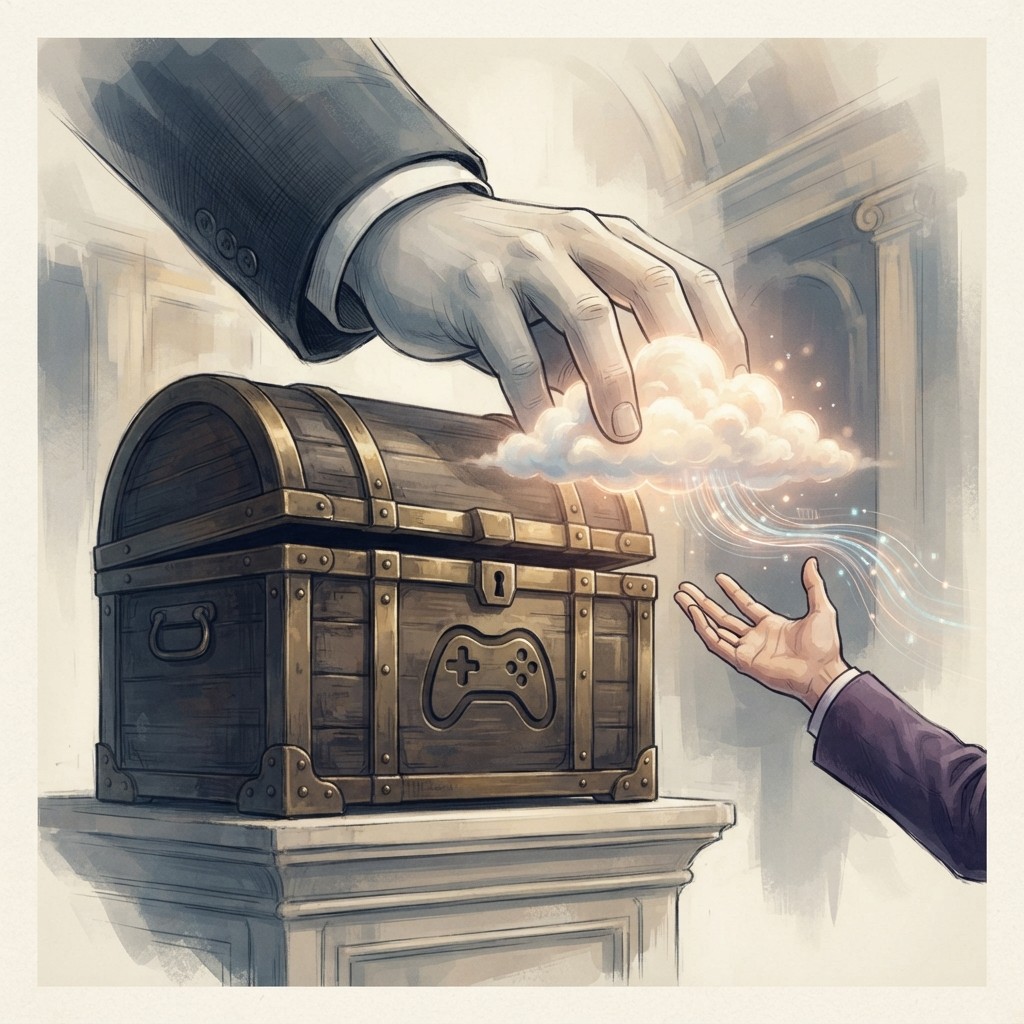
Here is the spine of the whole saga. Microsoft's strategic case, in its own filing, was about subscription and cloud gaming - putting Activision's catalog onto Game Pass and streaming it to any screen, becoming the world's third-largest gaming company by revenue behind Tencent and Sony.3 Cloud was the synergy that justified a $68.7 billion check. That is exactly what the regulators came for - and exactly what Microsoft had to give back. To get the deal past the UK's Competition and Markets Authority, Microsoft restructured it and transferred the cloud-streaming rights for every current and future Activision PC and console game, for fifteen years, to Ubisoft outside the EEA.5 Within the EEA, Ubisoft got only a non-exclusive licence. Microsoft paid full price for an asset and then, to be allowed to own it, agreed not to use its single most-touted advantage.
“Microsoft restructured the transaction to transfer cloud-streaming rights for all current and new Activision Blizzard PC and console games released over the next 15 years to Ubisoft.”5
Nobody blocked it - and that matters more than people think
The popular memory is that the FTC blocked the deal and Microsoft beat them. It didn't happen that way. On December 8, 2022, the FTC voted to challenge the acquisition, alleging it would let Microsoft starve rivals to Xbox and to its own subscription and cloud-gaming business.4 It then went to federal court for a preliminary injunction - the move that actually stops a deal - and on July 10, 2023, Judge Jacqueline Scott Corley of the Northern District of California denied it.4 The U.S. never legally blocked the transaction. The one regulator that did block it was the British CMA, in April 2023, and the CMA was also the one Microsoft ultimately satisfied - by carving out the cloud and handing it to Ubisoft. The deal didn't survive a U.S. courtroom and then sail to close. It survived the courtroom, hit a brick wall in London, and bought its way through by amputating the synergy.
| The popular story | What the filings show | |
|---|---|---|
| The price | $69 billion | $68.7B announced1; $75.4B paid6 |
| The rationale | A metaverse bet | Cloud gaming and Game Pass3 |
| Who blocked it | The FTC | FTC injunction denied4; UK CMA blocked, then cleared a restructured deal5 |
| The outcome | Microsoft won outright | Won by surrendering 15 years of cloud rights to Ubisoft5 |
Why $68.7 billion became $75.4 billion
The gap between the announced price and the paid price is its own quiet lesson in the cost of delay. The headline $68.7 billion was enterprise value, net of Activision's roughly $6.7 billion of cash on hand. Microsoft still wrote the check for the full equity, then absorbed that cash onto its own balance sheet - so the all-in purchase price lands at $75.4 billion in Microsoft's own 2024 report.9 The gap between the two figures is an accounting convention, not a cost that grew over time: $68.7B nets the cash out; $75.4B is the gross equity consideration. The regulatory delay didn't just reshape the deal - it determined what Microsoft was permitted to keep once it closed.
The '$68.7 billion' was net of Activision's cash. Microsoft paid for the equity, then took the cash onto its own balance sheet, and carried financing across the ~21 months from January 2022 to the October 2023 close - so the figure in its 2024 annual report is $75.4 billion.6 The same delay that inflated the price also produced the remedy that gutted the thesis: more time meant more regulatory leverage to extract the cloud concession.5
Wasn't the concession trivial, since the deal still went through?
The honest objection is that the cloud carve-out cost Microsoft almost nothing. Cloud gaming is still a small slice of the market; Game Pass on console and PC - the bulk of the value - was untouched; and Microsoft got the franchises, the players, the recurring revenue. By that read, surrendering streaming rights was a cheap toll to acquire a $75 billion asset. There's force in that. But it concedes the real point rather than rebutting it. If cloud was so peripheral that giving it away for fifteen years cost nothing, then the cloud-and-subscription rationale at the heart of the official filing was never the actual reason for the price - the reason was owning the catalog and the audience, full stop.3 Either the concession was painful, in which case Microsoft overpaid for a crippled thesis, or it was painless, in which case the thesis was theater. The deal can't be both a brilliant cloud play and one where ceding the cloud didn't matter. The counterfactual where the CMA never blinks - where Microsoft keeps the streaming rights it bought the company to exploit - is a materially more valuable deal than the one that closed. That delta is the price of getting through.
When you pitch a mega-acquisition, you reach for the most exciting synergy to defend the premium. But the most exciting synergy is, by definition, the one that most concentrates market power - which makes it the first thing a competition regulator will demand you give back. Microsoft built its case on bundling Activision into cloud and subscription, and that is precisely the lever the FTC and CMA targeted. The lesson isn't 'don't pursue synergy.' It's that the rationale you put in the deck and the value you actually get to keep can diverge by years and billions - so price the deal on what survives the remedy, not on the pitch.
There was a darker backdrop to all of this, easy to forget once the antitrust drama took over: Activision came to the table under a cloud of its own. The SEC had subpoenaed CEO Bobby Kotick and senior executives over harassment and discrimination allegations, demanding board minutes and personnel files.7 Just weeks after the merger was announced, a federal court signaled it would approve Activision's EEOC settlement.8 A company being investigated for how it treated its people sold itself at a moment of maximum leverage for the buyer - and then watched the buyer spend twenty-one months and an extra six-plus billion dollars getting it across the line.
So the cleanest way to hold the whole saga is this: the number was never $69 billion, the bet was never the metaverse, the FTC never blocked it, and Microsoft never won it clean. It paid $75.4 billion, gave fifteen years of the cloud to a French rival, and bought the largest catalog in gaming on the explicit condition that it not fully use the one advantage it kept telling everyone the catalog was for. The deal closed. The thesis didn't survive the closing intact - and the gap between the two is where the real story lives.
When the deal that closes isn't the deal that was pitched
Counterfactual Timeline Builder
A one-page canvas that runs two histories side by side: what actually happened, and the alternative that died at the fork. You pin the divergence point, trace each branch forward, and name the assumption that decided which one came true. Blank, it disciplines hindsight into a testable counterfactual instead of a what-if; filled, it shows the story's road-not-taken with enough rigor to argue about.
Included, filled and blank, in the Counterfactual Casebook. See the set → · Preview the blank →
Sources
Where this comes from — the filings, records, and reporting behind it.
- 1Microsoft agreed to acquire Activision Blizzard for $95.00 per share in an all-cash transaction valued at $68.7 billion, inclusive of Activision Blizzard's net cash, under an Agreement and Plan of Merger dated January 18, 2022.
- 2Microsoft Corporation, Anchorage Merger Sub Inc. (a wholly owned Microsoft subsidiary), and Activision Blizzard, Inc. entered into the Agreement and Plan of Merger as of January 18, 2022, with Activision Blizzard surviving as a subsidiary of Microsoft.
- 3Microsoft's Form 8-K (Exhibit 99-1) filed January 18, 2022 states the transaction value as $68.7 billion inclusive of net cash, and projects that at close Microsoft would become the world's third-largest gaming company by revenue, behind Tencent and Sony.
- 4On December 8, 2022, the FTC voted to file a legal challenge to block Microsoft's acquisition of Activision Blizzard, alleging it would suppress competitors to Xbox consoles and Microsoft's subscription and cloud-gaming business; the FTC's federal court request for a preliminary injunction was denied by Judge Jacqueline Scott Corley of the Northern District of California on July 10, 2023.
- 5To obtain UK CMA approval, Microsoft restructured the transaction to transfer cloud-streaming rights for all current and new Activision Blizzard PC and console games released over the next 15 years to Ubisoft Entertainment SA (excluding the EEA, where Ubisoft received a non-exclusive licence instead).
- 6The acquisition closed on October 13, 2023, with Microsoft's total purchase price confirmed at $75.4 billion in Microsoft's 2024 annual report — not the $68.7B announced figure, with the difference attributable to Activision's ~$6.7B cash position absorbed by Microsoft and financing costs accrued during the regulatory delay.
- 7The SEC subpoenaed Bobby Kotick and other senior Activision Blizzard executives, seeking communications around harassment complaints, board meeting minutes since 2019, personnel files of six former employees, and separation agreements, following the company's California DFEH lawsuit over allegations of sexual harassment and discriminatory pay.
- 8On March 29, 2022 — after the Microsoft merger was announced — a federal court indicated it would approve Activision Blizzard's settlement with the EEOC, compensating eligible claimants for harassment and discrimination claims.
- 9On October 13, 2023, Microsoft completed its acquisition of Activision Blizzard for a total purchase price of $75.4 billion, consisting primarily of cash.
Weighing outside help with a decision like this? Hiring a commercial due diligence provider
More from Stratrix
Strategy Decision Cases
879 strategic decisions with dated outcomes, ranked by how often each kind holds.
24 decision typesSee which decisions hold →The Strategist’s Craft
The methods behind the job: the planning cycle, initiative charters, decision rights, the memo that gets a yes.
Methods and templatesStart with the craft →Test a decision, free
Set a live decision against the companies that made it before you.
AcquisitionsThe Distance TestDivestituresThe Divestiture TestDiversificationThe Diversification TestMake or buyThe Make-or-Buy TestNew analyses, by email
The defining moves in business, checked against the record, as they publish.
More like this — beyond Activision Blizzard
New Strategically analyses as they publish: the defining moves in business, checked against the record. No noise, and one click to leave.