Pairs with the Cannibalization Decision Tree — a ready-to-use strategy tool, filled for Under Armour. Included in the Cannibalization Choice Casebook →
“Should you launch the thing that takes revenue from your best business?”
In 2016, two things happened to Under Armour at almost the same moment. On a runway at New York Fashion Week, the company unveiled Under Armour Sportswear — a premium fashion line built with the designer Tim Coppens, meant to put UA next to the names that get reviewed, not just worn to the gym.3 And in the back rooms of off-price outlets, the same brand was quietly piling up on the discount racks, marked down to move volume the official channels couldn't absorb. Both decisions were about the price tag. One tried to raise it. The other was busy teaching customers it was negotiable.
The story everyone tells is that Under Armour peaked in 2016 and then got run over by Nike and Adidas. That is the comfortable version, and it is mostly wrong. The competition was real, but it arrived to find a brand that had already wounded itself — and the wound was self-inflicted, strategic, and entirely about what kind of company Under Armour decided to be.
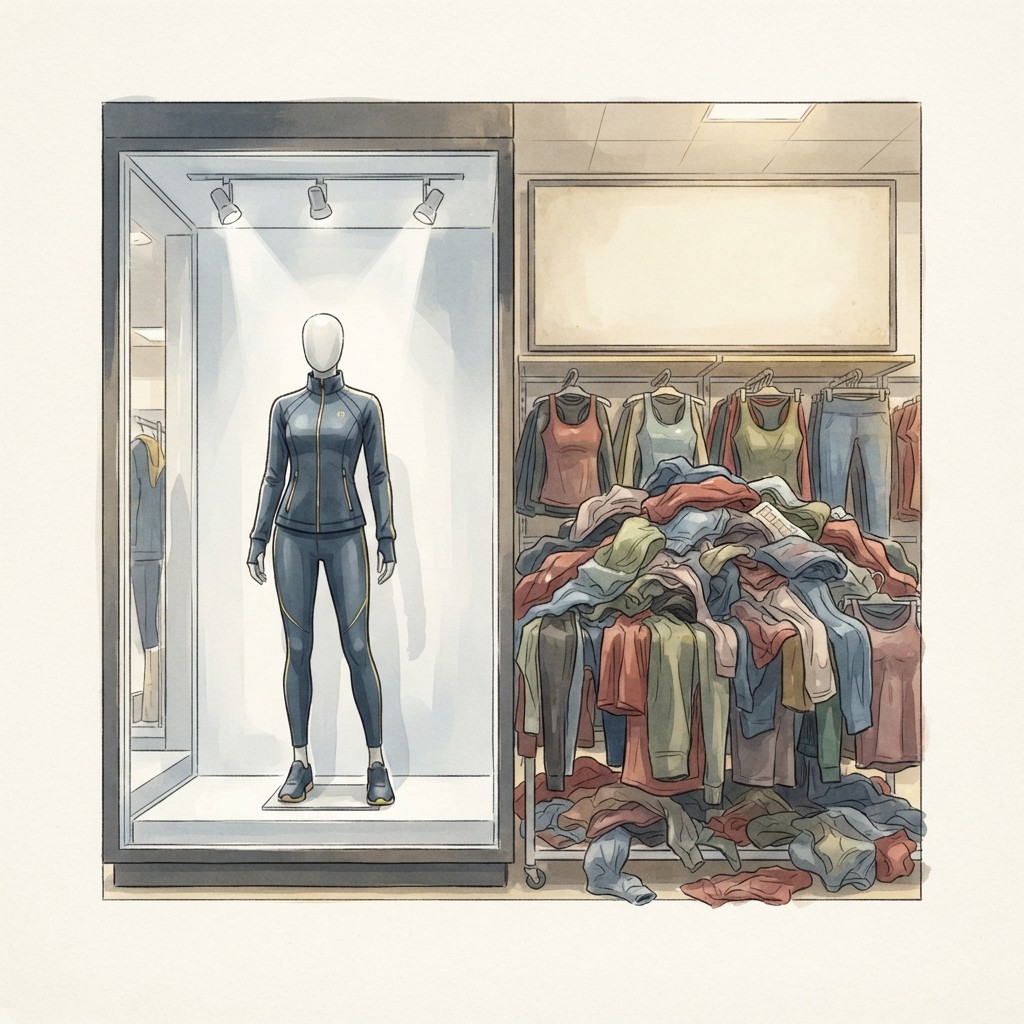
Here is the thesis a smart friend could repeat: Under Armour didn't lose a product war. It dismantled the one thing that let it charge a premium — a reputation for hard, unglamorous performance gear — by reaching up for fashion credibility and reaching down for discount volume at the same time. You cannot be aspirational and on clearance in the same season. UA tried, and the brand split down the middle.
The premium was the whole product
Under Armour was never built on style. It was built on a feeling: this is what serious athletes wear, the moisture-wicking shirt under the pads, the gear you earn. That identity did real economic work. It justified a price above commodity activewear, and it kept the brand out of the bargain bin where margin goes to die. A premium-performance brand has exactly one asset that compounds — the belief that the logo means something you'd pay extra for. Spend that belief, and there is nothing underneath it but fabric, which everyone else also sells.
So the fashion pivot was not a harmless adjacency. Launching a luxury line meant competing on taste — a game decided by runway critics and sneakerheads, not by performance — and UA had no credibility there to spend. When the Stephen Curry 2 dropped a colorway that the sneaker world openly mocked, it wasn't simply an ugly shoe.6 It was the brand publicly failing the exact test it had volunteered to take. UA had even signed Curry away from Nike in 2013 to anchor this ambition5 — and instead of minting a lifestyle icon, the franchise became a symbol of a company trying to be cool and getting laughed at for it.
“Under Armour debuts a premium fashion line — UAS, designed with Tim Coppens, shown at New York Fashion Week.”3
The discount that ate the demand
While the front of the company reached for prestige, the back of it was doing something that quietly poisoned the well. To keep the growth numbers Wall Street had been promised, Under Armour pushed inventory into retail and off-price channels — moving product now to make the quarter look right. The SEC later took an interest in exactly this behavior: in 2021 the company settled for $9 million, without admitting or denying wrongdoing, over its failure to disclose that it was pulling sales forward from future quarters to meet analyst estimates.2 That is the legal frame. The strategic frame is worse.
Because here is the mechanism, worked all the way down. Every time a customer found a UA shirt on the discount rack, they learned one thing: the premium is temporary. Wait, and it gets cheaper. That lesson is fatal to a premium brand, because it converts your most loyal buyers — the ones who paid full price — into the suckers of the story. So they stop paying full price too. Demand at the top of the price ladder erodes, which leaves even more unsold inventory, which gets dumped into off-price to clear it, which teaches the lesson again. It is a loop, and it runs downhill. The 2017 North America revenue decline — the first annual drop after years of 20%-plus growth1 — wasn't a competitor stealing customers. It was a brand training its own customers to wait for the markdown.
| The fashion reach (up) | The off-price flood (down) | |
|---|---|---|
| Goal | Prestige, higher price, cultural relevance | Volume, hit the growth target this quarter |
| What it required | Taste credibility UA didn't have | Inventory dumped where it shows |
| What it taught the customer | UA wants to be aspirational | The premium is a sale waiting to happen |
| Net effect on the premium | Strained it | Destroyed it |
The U-turn that proved the diagnosis
If the collapse had really been about losing a footrace to Nike, the fix would have been a better shoe. It wasn't. The fix UA actually reached for tells you what management believed had gone wrong. In 2017 and again in 2020, the company announced restructurings carrying hundreds of millions in charges, explicitly described as a realignment away from fashion and lifestyle and back toward performance — cutting the number of products it sold and reducing its reliance on promotional channels.7 Read that plainly: stop chasing fashion, stop flooding the discount channels. That is the company confessing, in the language of a restructuring charge, that the two reaches were the disease.
Wasn't this just Nike and Adidas, after all?
The honest counter is that Nike and Adidas were genuinely formidable, and that the athleisure wave they rode was real — so maybe UA was always going to lose share regardless of any self-inflicted wound. There is truth here, and it deserves to be said: a smaller brand fighting two giants for cultural relevance was never going to win on cool. But that objection actually strengthens the thesis rather than dissolving it. If UA could not win the fashion game against those incumbents, then choosing to play it — instead of defending the performance niche where it was already the answer — was precisely the unforced error. The competition didn't make Under Armour reach up for prestige and down for volume in the same year. Management did. And the timing matters: the revenue rolled over in 2017, while UA was still busy doing both things to itself, before competition became the primary variable. You can be losing a war and still be your own worst enemy in it.
When demand softens, a premium brand feels two equal and opposite temptations: reach UP for prestige to look more valuable, and reach DOWN into discount channels to keep volume up this quarter. Each feels like progress. Together they're a pincer that crushes the only thing a premium brand owns — the customer's belief that the price is real. The reach up usually fails because credibility can't be bought in a season; the reach down always works, and that's the danger, because it works by teaching your best customers to wait for the markdown. The next markdown then becomes mandatory. If you must pick a direction in a downturn, protect the full-price customer first. Volume you bought with a discount isn't demand — it's borrowed from the quarter you'll wish you still had.
Under Armour spent years and a small fortune in restructuring charges relearning the thing it had built the company on: that a premium is a promise, and a promise you discount is just a price. Kevin Plank, who handed off the CEO seat in October 2019,4 returned to it in April 20248 — the founder back to repair the identity the company spent on a runway and a clearance rack. The footrace with Nike was never the story that mattered. Under Armour didn't get beaten to the premium. It sold the premium itself, one markdown at a time, and discovered too late that there was no easy way to buy it back.
When a company spends the thing that made it valuable
Cannibalization Decision Tree
A decision tree for the moment the new thing threatens the cash cow: is the disruption real, will someone else do it if you don't, and can you afford to bleed your own margin to own the future? Blank to run on your own line; filled as the worked example tracing how the story's incumbent chose to cannibalize — or flinched and got cannibalized.
Included, filled and blank, in the Cannibalization Choice Casebook. See the set → · Preview the blank →
Sources
Where this comes from — the filings, records, and reporting behind it.
- 1Under Armour's North America revenue declined in 2017 — its first annual decline — after years of 20%+ growth, driven by inventory and channel management problems alongside a failed lifestyle pivot.
- 2Under Armour and the SEC reached a $9 million settlement in May 2021 over charges that the company failed to disclose it was pulling forward sales from future quarters into current quarters to meet analyst consensus estimates, without admitting or denying wrongdoing.
- 3Under Armour launched Under Armour Sportswear (UAS), a premium fashion line designed in collaboration with Tim Coppens, debuted at New York Fashion Week in 2016 as part of a deliberate lifestyle/fashion pivot.
- 4Kevin Plank transitioned from CEO to Executive Chairman of Under Armour in October 2019, with Patrik Frisk succeeding him as President and CEO.
- 5Under Armour signed Stephen Curry away from Nike in 2013, making him a UA athlete; Curry had worn Nike shoes in his early NBA career before the switch.ESPN / Sports Illustrated (contemporaneous 2013 reporting), Stephen Curry signs endorsement deal with Under Armour · 2013
- 6The Stephen Curry 2 'Sherriff Badge' colorway released in 2016 was widely mocked and cited as a symbol of Under Armour's failure to execute in the lifestyle/fashion sneaker segment.
- 7Under Armour announced restructuring plans in 2017 and again in 2020, taking hundreds of millions in charges, explicitly citing strategic realignment away from fashion/lifestyle and back toward performance, and reducing SKU count and promotional channel reliance.
- 8Kevin Plank returned as Under Armour CEO in April 2024, replacing Stephanie Linnartz who had served as CEO since February 2023.
Weighing outside help with a decision like this? Hiring a corporate strategy consultant
More like this — beyond Under Armour
New Strategically analyses as they publish: the defining moves in business, checked against the record. No noise, and one click to leave.