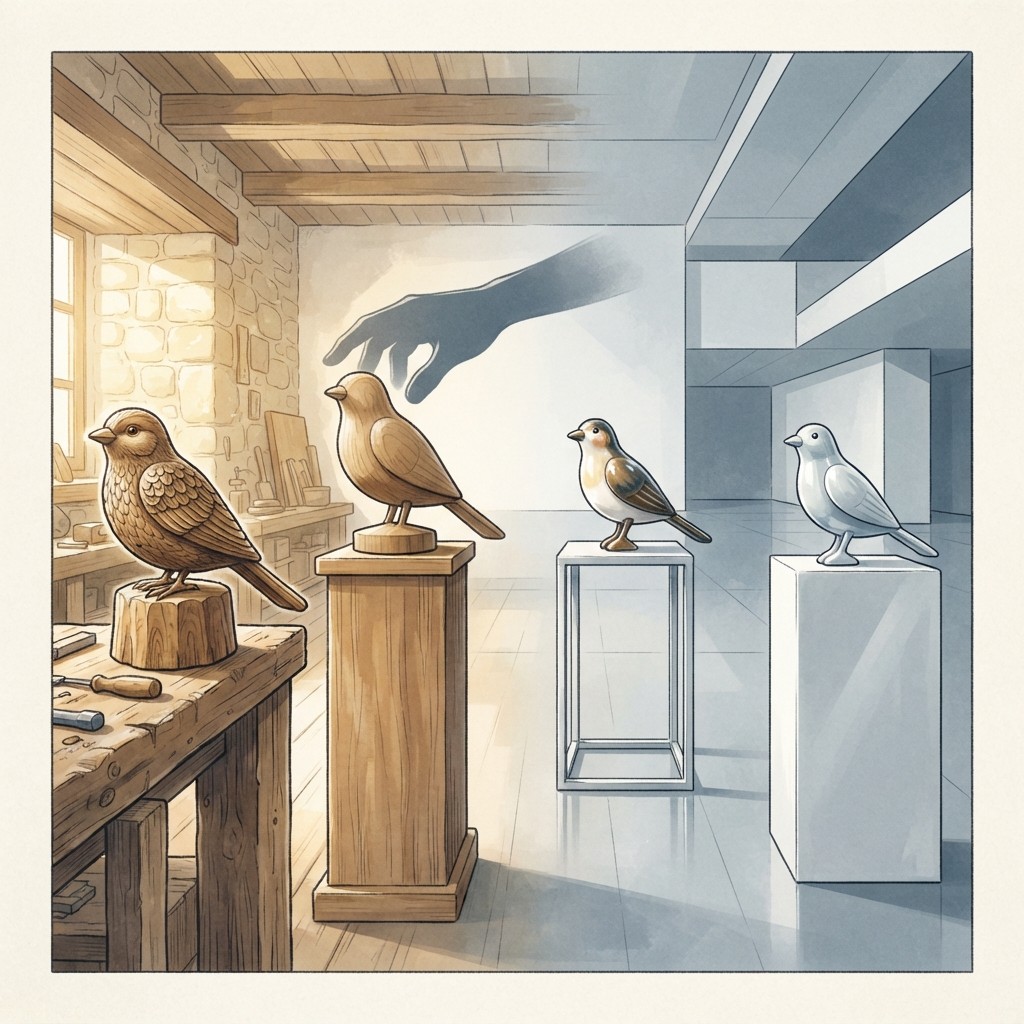
Pairs with the Profit-Engine Map — a ready-to-use strategy tool. Included in the Money Machine Casebook →
“Where does the money actually come from, and who sets the rate it comes in at?”
In June 2005, three guys in Brooklyn - Rob Kalin, Chris Maguire, and Haim Schoppik - built a website for craftspeople to sell things they made with their hands.7 The whole proposition fit in one word: handmade. You bought from a person, not a factory, and the person was the point. Nineteen years later that same company moves $10.9 billion in goods a year through 5.6 million active sellers on its flagship marketplace,1 and it has spent most of the last decade quietly arguing with itself about what that founding word is even allowed to mean.
The story you usually hear is that Etsy 'lost' its handmade soul - that scale and a private-equity-grade growth machine slowly drowned the artisans in dropshippers and AliExpress flippers. That framing is wrong in a useful way. Etsy didn't lose the definition. It kept it, in name, and renegotiated the meaning underneath - on purpose, three times, each time in the direction that let the marketplace grow.
Here is the thesis a smart friend could repeat at dinner: Etsy isn't a handmade marketplace that drifted. It's a growth machine that sells the word handmade, and every major policy pivot since 2013 has widened the word to fit the volume the business needed - while keeping the label intact so the promise still reads as true.
2013: the year 'handmade' became 'authored'
The pivotal move wasn't subtle, and it wasn't recent. In October 2013, Etsy formally changed its rules to let sellers hire unlimited staff and partner with outside manufacturers. The requirement quietly shifted from you made this to you authored this - the seller had to own the design concept, but a factory could do the actual making.2 Solo sellers revolted then, too, because they understood exactly what had happened: the load-bearing word had been swapped while the storefront stayed the same. Etsy's own Seller Handbook now dates the current production-partner framework to 2016, not 20138 - which only underlines the pattern. The definition isn't a fixed fact in a vault. It's a setting the company keeps adjusting.
Why redefine instead of just enforce? Because enforcement and growth point in opposite directions, and the math is brutal. A marketplace's value to a buyer scales with selection; selection scales with sellers; and the strictest possible definition of 'handmade' caps how many sellers - and how much inventory - can ever exist. Hold the line on artisan purity and you starve the flywheel. Widen the word and you feed it. Etsy chose to feed it, repeatedly, and dressed each widening as a clarification.
| 2005 founding | 2013–2016 | 2024 Creativity Standards | |
|---|---|---|---|
| The core requirement | Made by the seller, by hand | Authored by the seller | Disclosed by category |
| Outside manufacturing | Prohibited | Allowed with a partner | Permitted under 'designed by' |
| What's banned | Anything not handmade | Reselling, white-label | White-label resale only |
| The word that does the work | Handmade | Authorship | Human touch |
The 2022 strike was about money - and that's the tell
Etsy lore remembers April 2022 as the great handmade uprising. It wasn't, quite. The week-long strike that ran April 11–18 was triggered by one thing: a 30% transaction-fee increase, from 5% to 6.5%, that landed on April 11.5 The petition that organized it leads with the fee, notes the previous hike was back in July 2018, and only then - secondarily - asks Etsy to crack down on resellers flooding the site with non-handmade goods.6 The reseller complaint was a co-grievance riding along, not the spark.
And that ordering is the whole insight. The sellers themselves told you which lever the company was actually pulling. You strike over a fee because the fee is the visible price of being kept on a platform whose identity you no longer trust. The handmade grievance was the slow-burning resentment; the fee was the match. Etsy raised the toll on the same sellers it had spent a decade quietly outnumbering with manufacturers and resellers - and the sellers, sensing they were now a minority paying more to share a shelf with the very thing they'd been promised protection from, walked.
“We are positioning ourselves to answer the call for original goods and real people.”4
2024: a rebrand wearing the costume of a homecoming
In July 2024, Etsy announced it was 'getting back to its artisan roots' and 'escaping the race to the bottom.'4 The mechanism it shipped was a four-bucket taxonomy: items are now labeled 'made by,' 'designed by,' 'handpicked by,' or 'sourced by.' Read carefully and the move reveals itself. The standards do not ban manufacturing - seller-designed goods made by third parties live happily under 'designed by.' White-label resale was already prohibited;3 the 2024 rules mostly add disclosure on top of permissions that already existed. This is not a wall going back up. It is a set of labels going on a marketplace that had already let the manufacturers in.
The strategic sleight of hand is the word 'human touch.' 'Handmade' was falsifiable - a buyer could, in principle, check whether a person made the thing. 'Designed by a real person, possibly manufactured at scale, disclosed in a dropdown' is not falsifiable in the same way; it's a vibe with a label attached. Etsy has traded a hard promise it could no longer keep at scale for a soft one it can. That's a smart move for the GMS line. It is a weak move for restoring the trust of the original artisans, because the artisans were never confused about what 'handmade' meant - and a fuzzier standard does not un-confuse them. It just makes the gap harder to point at.
The fair objection: maybe widening the word saved the artisans
The honest counter is that there is no version of a $10.9 billion marketplace that runs on the 2005 definition, and there never was. The strictest possible Etsy is a niche craft fair with a few thousand sellers and no liquidity - and a buyer who can't find what they want leaves, taking the demand that pays the artisans too. By widening 'handmade' to 'authored,' the argument goes, Etsy built the buyer base - 89.6 million active buyers1 - that even the purest solo maker now depends on to get found at all. The manufacturers didn't displace the artisans; they funded the audience the artisans sell to. On this read, the renegotiation isn't betrayal. It's the only thing that kept the lights on.
That objection is real, and it's where most defenses of Etsy stop - comfortably. But it proves the thesis rather than refuting it. If the scale genuinely required widening the word, then Etsy should say so plainly, the way Visa says it isn't a bank. Instead it keeps invoking 'artisan roots' and 'real people' while shipping policies that permit the opposite. The problem was never that Etsy grew. It's that Etsy wants the growth and the original promise both, and the 2024 standards are the latest attempt to have them - by making the promise vague enough to survive contact with the business model.
Some businesses are built on a defensible asset; others are built on a promise compressed into a single word - handmade, organic, artisanal, premium. A word is a wonderful moat because it sets a category and commands a price. It is a dangerous one because, unlike a factory or a network, a word can be quietly widened whenever growth demands it - and the customer rarely notices the redefinition until the gap between the label and the thing is too wide to ignore. The discipline is brutal: either enforce the word hard enough to constrain your own growth, or rename it honestly before your most loyal customers do it for you. The one move that always backfires is keeping the prestigious label and hollowing out what's behind it, then acting surprised when the people who believed the label strike.
Etsy's genius and its wound are the same thing: it owns a word the whole internet wishes it had, and a word can be stretched far more cheaply than a factory can be retooled. Three times now it has stretched 'handmade' rather than defend it, and three times the stretch bought growth and cost trust. The 2024 standards aren't a homecoming. They're the most honest version yet of the trade Etsy has been making all along - a little more of the meaning, sold off in exchange for a little more of the volume. The word still says handmade. The marketplace stopped requiring it a decade ago. And the distance between those two facts is the only thing Etsy has never been able to put a label on.
When the brand and the business pull apart
Profit-Engine Map
A one-page map that pulls a business apart into the hook that gets the customer in the door and the engine that quietly earns the margin. Use it to see where the real profit lives, how the two halves are wired together, and what breaks if the link is cut. Blank to dissect your own P&L; filled as the worked example of a business whose advertised product is not where it makes its money.
Included, filled and blank, in the Money Machine Casebook. See the set → · Preview the blank →
Sources
Where this comes from — the filings, records, and reporting behind it.
- 1Etsy FY2024 total revenue was $2,808 million; GMS for the Etsy marketplace was $10.9 billion; the Etsy marketplace had 5.6 million active sellers and 89.6 million active buyers as of December 31, 2024 (8.1 million and 95.5 million across all of Etsy, Inc.'s marketplaces, including Depop and Reverb).
- 2In October 2013, Etsy formally changed its policies to allow sellers to hire unlimited staff and partner with outside manufacturers, shifting the key requirement from 'handmade' to seller 'authorship' of the product concept.
- 3Etsy's current production-partner policy requires sellers using outside manufacturers to transparently disclose the partner on applicable listings; white-label and ODM manufacturers that produce standard products for resale are explicitly prohibited.
- 4In July 2024, Etsy overhauled its policies to introduce four item classifications — 'made by,' 'designed by,' 'handpicked by,' and 'sourced by' — and CEO Josh Silverman stated the company is 'positioning ourselves to answer the call for original goods and real people.'
- 5The April 2022 Etsy seller strike ran April 11–18 and was triggered by a 30% transaction-fee increase (5% to 6.5%), not a handmade-policy change; organizers' stated demands included canceling the fee hike, cracking down on resellers, and reforming off-site ads.
- 6The Etsy strike petition text states that Etsy's transaction fee increased 30% on April 11, 2022, that the previous increase was in July 2018, and that the petition demands included cracking down on resellers flooding the site with non-handmade goods.
- 7Etsy was founded in June 2005 by Rob Kalin, Chris Maguire, and Haim Schoppik (with Jared Tarbell joining shortly after); the site's original mission was an online platform for craftsmen to sell handmade goods.
- 8Etsy's own Seller Handbook states that the production-partner rules 'haven't changed since 2016,' indicating the current framework was codified in 2016, not 2013.
Weighing outside help with a decision like this? Hiring a pricing strategy consultant
More like this — beyond Etsy
New Strategically analyses as they publish: the defining moves in business, checked against the record. No noise, and one click to leave.