Pairs with the Adjacency / Synergy Map — a ready-to-use strategy tool. Included in the Adjacency Expansion Casebook →
“When does the business next door belong to you?”
Snap two Lego bricks together and they hold with a satisfying click that has not changed since the 1950s. That click is the whole company. Everything Lego does — every movie, every video game, every licensed Star Wars set — is built to send you back to that click, holding a brick, building something. The strategy people miss is that Lego does not sell stories. It sells the bricks the stories make you want.
The official story is that The Lego Movie saved Lego in 2014, a triumph of brand storytelling over a dying toymaker. It is a beautiful story and it is false. Lego's turnaround was finished years before the film opened. The movie did not rescue a company in distress — it poured fuel on one that was already on fire, in the good way.
The turnaround happened before the cameras rolled
Go back to 2003, when Lego nearly broke. The company had piled up roughly $800 million in debt, was burning more than $160 million in cash, had watched net sales fall 26%, and had seen its operating margin collapse to 2.4% from the 18-to-19% it ran in the late 1990s.5 It had drifted into theme parks, clothing, and video games — adjacencies that pulled it away from the one thing it did better than anyone: the brick. In 2004 Jørgen Vig Knudstorp became the first non-family CEO and did the unglamorous work of pulling Lego back to its core.5 By 2006 the company was profitable again, with its operating margin recovering to 15.6%.9 The Lego Movie arrived eight years after that. The film amplified a recovery; it did not cause one.
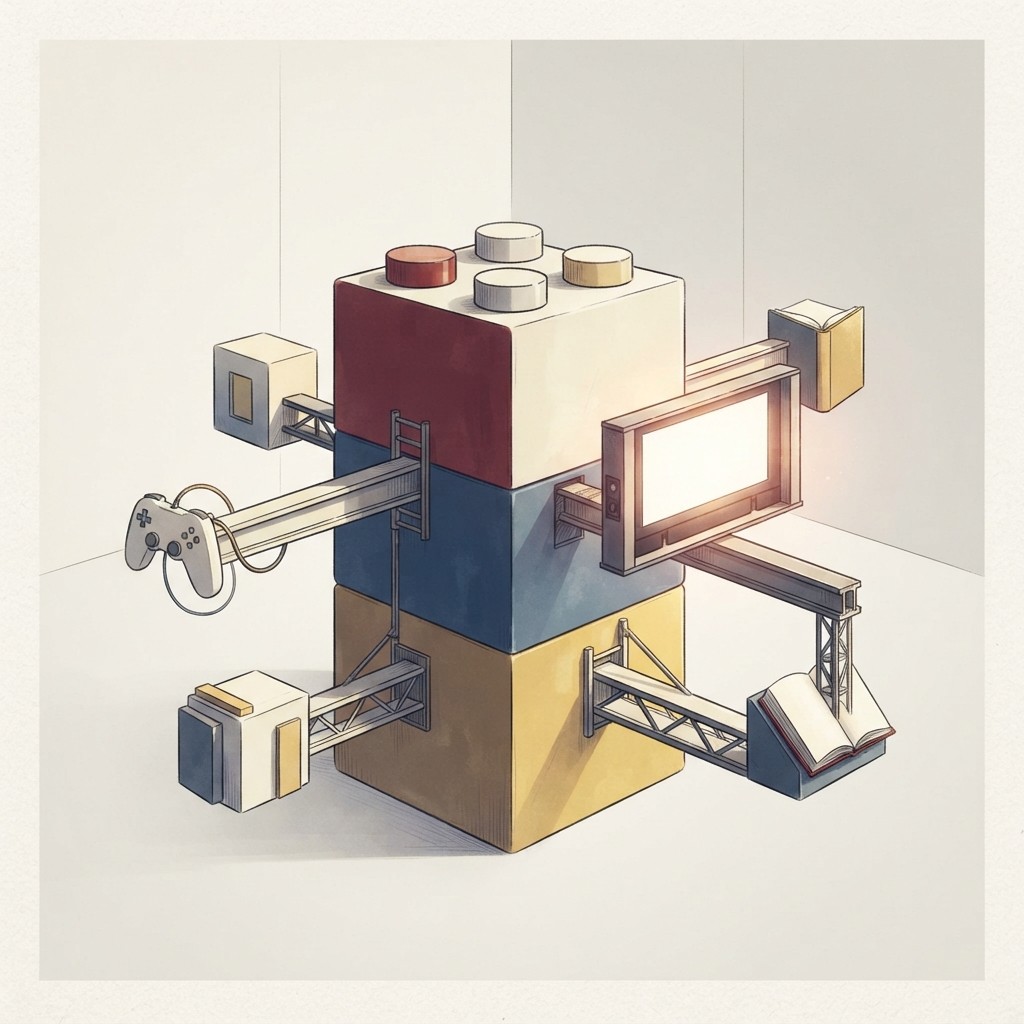
This matters because it changes what kind of asset the flywheel is. If the movie saved Lego, then Lego is a media company that happens to sell toys, and the lesson is 'tell better stories.' But the timeline says the opposite. Lego is a toy company whose stories exist to sell the product — and every adjacency it touches only works when the brick stays at the center of it.
Why a $60 million movie is one of the cheapest ads ever bought
Here is the mechanism that makes the flywheel spin. The Lego Movie cost $60 million to produce and grossed $470.8 million worldwide; Deadline Hollywood pegged its net profit at $229 million.4 So Lego ran a 90-minute commercial for itself — and the commercial turned a profit. That is the trick almost nobody else in toys can pull. A normal company pays for advertising; Lego's advertising pays it back, and then sends a child to a shelf full of branded sets. The product is the punchline of the film, and the film is free.
A theatrical film that nets $229 million is not a marketing cost — it is a marketing profit center.4 Each turn of the loop is supposed to be self-funding, so the flywheel compounds attention at zero net cost. That only holds while the story drives people back to a product Lego controls. The instant the story becomes the product, the loop stops paying for itself.
And the games work the same way. Lego shipped its first premium video game, Lego Island, back in 1997, and has since sold tens of millions of copies of titles like Lego Star Wars and Lego Indiana Jones.7 In December 2023 it went further: Lego Fortnite launched and peaked at roughly 2.4 million concurrent players, briefly the most-played experience inside Fortnite.6 Lego's parent holding company had put $1 billion into Epic Games to make that partnership happen.6 Every one of those screens is another door back to the brick.
The flywheel breaks the moment Lego lets go of the brick
Watch what happens when the story stops pointing back to the product. The Lego movie franchise stalled fast. The Lego Ninjago Movie grossed just $122.7 million on a $70 million budget — a brutal step down from the first film's roughly 7.8-times-budget multiple — and no new theatrical Lego film has come out since 2019.8 When the movies became ends in themselves, chasing cinematic universes instead of selling sets, they lost the thing that made them free. A film that does not pay for itself is no longer a flywheel turn. It is just a flop with a brick logo on it.
| The Lego Movie (2014) | The Lego Ninjago Movie (2017) | |
|---|---|---|
| Production budget | $60M | $70M |
| Worldwide gross | $470.8M | $122.7M |
| Roughly times budget | ~7.8x | ~1.8x |
| Role of the brick | The punchline; sends you to the set | Subordinated to the story |
| What it did to the loop | Funded the next turn | Stalled the franchise |
The same logic explains why the revenue numbers refuse to match the headlines. The licensed, cinematic IP gets all the storytelling, but it is not what people actually buy. In both 2023 and 2024, Lego's reported top themes mixed homegrown and licensed IP: City, Technic, and Icons alongside Star Wars and Harry Potter — Lego's own reporting describes the list as a combined group, without breaking out which type led.12 The licensed tail wags the dog in the press release. In the warehouse, the original product still rules.
Isn't this just a brand with a good marketing budget?
The fair objection is that this is too tidy: plenty of toymakers license IP and make movies, so maybe Lego is simply a strong brand that out-executes. There is truth in it. But the discipline is the strategy. Lego's defining move in 2004 was not adding adjacencies — it was cutting them, retreating from the theme parks and side businesses that had nearly sunk it, then re-entering only the ones that fed the core.5 The honest counter is that Lego cedes control more than the thesis suggests: it handed games to Epic and films to Warner studios, and the Fortnite tie-up rode on someone else's hundreds of millions of players.7 But notice the pattern of what survives. Lego Fortnite is a building experience — bricks, on a screen, in someone else's world.6 The films faded the moment they stopped being about building. Lego will rent out the story. It will not rent out the brick.
The seductive version of brand extension is to chase the biggest adjacent market — toys to films, films to theme parks, the whole licensed universe. Lego's near-death in 2003 is what that looks like when it goes wrong: revenue everywhere, margin nowhere. The disciplined version is to enter only adjacencies that send the customer back to the one product you control and profit on. A movie that nets $229 million is a free ad; a movie that flops is a distraction with your logo on it. Ask of every new venture: does this make people want the core thing more, and can it pay its own way? If the answer to either is no, you are not building a flywheel. You are just spinning.
Lego figured out the rarest thing in entertainment: how to make the advertising profitable and the product the point. The movies, the games, the licensed sets — they are all elaborate, sometimes brilliant ways of getting a person to feel that click again. The flywheel was never the films. It was the brick the films were quietly selling the whole time. Lose sight of that, and the most valuable toy company on earth becomes a content studio with great production values and nothing to sell at the exit.
Adjacency / Synergy Map
A one-page canvas for an adjacency play: the new business next door, the shared assets that justify entering it, the synergies that actually transfer versus the ones that evaporate on contact, and the dis-synergies nobody put on the deck. Blank to test your own expansion; filled as the worked example showing where the story's 'natural adjacency' was real and where it was wishful.
Included, filled and blank, in the Adjacency Expansion Casebook. See the set → · Preview the blank →
Sources
Where this comes from — the filings, records, and reporting behind it.
- 1In FY2024, Lego Group revenue grew 13% to DKK 74.3 billion (approx. $10.85bn USD), achieving record revenue and operating profit of DKK 18.7 billion.
- 2In FY2023, Lego revenue was DKK 65.9 billion (up 2%); operating profit DKK 17.1 billion (down from DKK 17.9 billion in 2022); net profit DKK 13.1 billion. Consumer sales grew 4%. Portfolio was largest-ever at 780 products. Top themes included LEGO Icons, City, Technic, Star Wars, and Harry Potter.
- 32024 Financial Highlights (primary tabular data): Revenue 74.3, 65.9, 64.6, 55.3, 43.7 bDKK for 2024-2020; Operating profit 18.7, 17.1, 17.9, 17.0, 12.9 bDKK; gross margin 68.3% and operating margin 25.2% in 2024; workforce 31,282.
- 4The Lego Movie (2014) had a production budget of $60 million, grossed $470.8 million worldwide ($258M domestic, $212.8M international), and Deadline Hollywood calculated net profit at $229 million. Total studio cost including P&A was approximately $100 million.
- 5By 2003, LEGO had accumulated debt of approximately $800 million, negative cash flow exceeding $160 million, a 26% net sales decline, and an operating margin that had fallen to 2.4% from 18–19% in the late 1990s. Jørgen Vig Knudstorp became CEO in 2004 — the first non-family CEO — and led the turnaround.
- 6LEGO Fortnite peaked at approximately 2.4–2.45 million concurrent players at launch on December 7, 2023, making it the most-played experience within Fortnite at that time. Kirkbi A/S (LEGO's parent holding company) had invested $1 billion into Epic Games when the partnership was announced in April 2022.
- 7LEGO's first premium video game was 'Lego Island' in 1997; the company has since sold tens of millions of copies of titles such as 'Lego Star Wars' and 'Lego Indiana Jones.' The Lego-Epic partnership aims to leverage hundreds of millions of Fortnite's existing active players.
- 8The Lego Movie franchise stalled after The Lego Ninjago Movie (2017) grossed only $122.7 million on a $70 million production budget — a relative underperformance versus the first film's ~7.8x budget multiple — and no new theatrical Lego film has been released since The Lego Movie 2: The Second Part (2019).
- 9By 2006 Lego's operating margin had recovered to 15.6%, confirming the company had returned to profitability that year under Knudstorp.
Weighing outside help with a decision like this? Hiring a commercial due diligence provider
More like this — beyond Lego
New Strategically analyses as they publish: the defining moves in business, checked against the record. No noise, and one click to leave.