Pairs with the Adjacency / Synergy Map — a ready-to-use strategy tool. Included in the Adjacency Stack Casebook →
“When does the business next door belong to you?”
On May 22, 2025, Comcast opened Epic Universe in Orlando — the first theme park the company ever built from scratch, rather than inherited.9 Six months earlier, it had announced it was giving away a chunk of the empire that made parks possible: USA Network, CNBC, MSNBC, E!, Syfy, Golf Channel — a $7 billion-a-year slice of cable television, spun off into a separate company it would no longer own.7 One hand was pouring concrete in Florida. The other was quietly dismantling the very layer of the business that, fourteen years earlier, had been the whole point of the deal.
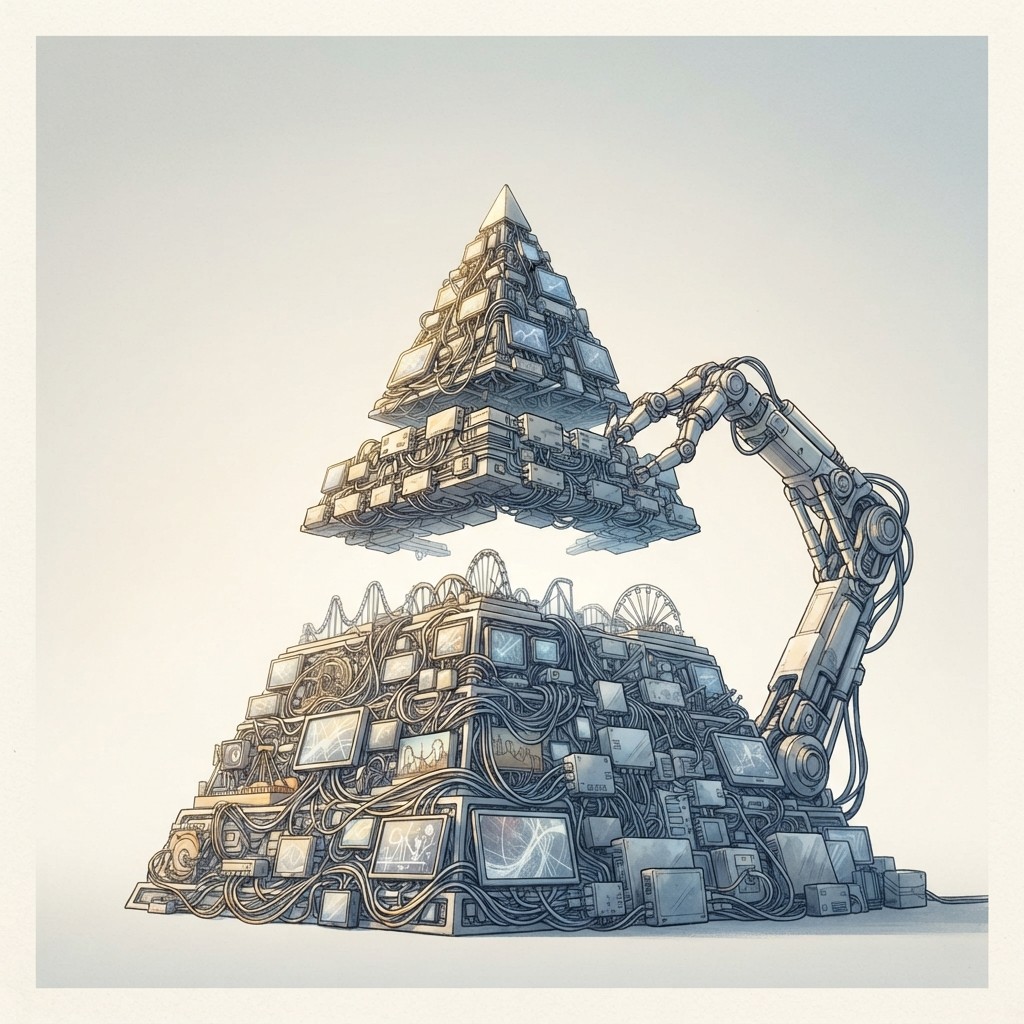
The official story is that Comcast assembled a beautiful vertical stack — it owns the pipe into your house, the channels that travel down it, a European twin in Sky, the studios that feed everything, and parks to merchandise the characters. The real story is that the stack was a thesis about reinforcement, and the reinforcement stopped working. Cord-cutting hollowed out the distribution moat, and Comcast is now narrowing on purpose the empire it spent more than $60 billion widening.
The two-step deal almost everyone misremembers
Start with the founding myth, because the myth is wrong in a way that matters. People say Comcast bought NBCUniversal in 2011. It didn't. On January 28, 2011, Comcast closed on a 51% controlling interest, handing GE about $6.2 billion in cash and contributing its own cable networks, valued at $7.25 billion when the deal was announced, for the right to consolidate the asset and name the strategy.111 Full ownership came only on March 19, 2013, when Comcast paid $16.7 billion for GE's remaining 49% — and threw in another $1.4 billion to buy the buildings themselves, 30 Rockefeller Plaza and CNBC's New Jersey home.2 Two steps, two prices, two years apart. The detail matters because it shows Comcast's confidence escalating: control first, then conviction. By 2013 the company wasn't just managing NBCUniversal — it was betting the house on the idea that a cable distributor should also be a content factory.
“Comcast acquired the remaining 49% of NBCUniversal from GE for $16.7 billion, closing on March 19, 2013, and also purchased NBC's 30 Rockefeller Plaza and CNBC's headquarters for $1.4 billion.”2
The whole bet, in one sentence
Here is the thesis Comcast sold to regulators and to itself: own the pipe and the programming so each one strengthens the other. The cable network feeds subscribers to the channels; the channels make the pipe worth paying for; the studios fill both; the parks turn the studios' characters into rides and toys. Every layer is supposed to make the layer above and below more valuable. That is the entire logic of an adjacency stack — you don't buy adjacent businesses because they're good businesses, you buy them because they make your core business harder to leave. For a decade, it held. Then the core itself began to leak.
Sky was the stack's most expensive expression. In early 2018, Comcast made a public offer for the European pay-TV operator at £12.50 per share — a 16% premium meant to top a sitting bid from 21st Century Fox.4 It was supposed to be the opening move. It became, instead, the floor of a bidding war. By the time the dust settled, Comcast had won Sky at £17.28 per share, a roughly 38% leap over its own first number, for total cash consideration of £30.2 billion — about $39.4 billion.3 The same vertical logic, transplanted to Europe: a pipe plus the content to fill it. Comcast paid auction-war prices for the privilege of owning the thesis twice.
Where the money actually comes from now
Strip the romance away and look at the 2024 books, and the stack reveals what it really is: a connectivity business wearing a media costume. Of Comcast's $123.73 billion in full-year 2024 revenue, the Residential Connectivity & Platforms segment — the pipe — accounted for $71.57 billion, very nearly 58% of the whole company. Media came to $28.15 billion, Studios $11.09 billion, and the celebrated Theme Parks, the part everyone wants to talk about, just $8.62 billion — under 7%.5 The adjacencies are real, but they orbit a center that is overwhelmingly broadband and cable. And that center is exactly what cord-cutting attacks.
| Segment | Revenue | Share of total |
|---|---|---|
| Residential Connectivity & Platforms (the pipe) | $71.57B | 57.9% |
| Media (broadcast + cable networks) | $28.15B | 22.8% |
| Studios | $11.09B | 9.0% |
| Theme Parks | $8.62B | 7.0% |
The mechanism of the unwind is straightforward once you see it. The stack was supposed to be mutually reinforcing — but reinforcement runs in both directions, which means it can also be mutually draining. When cable subscribers leave, the cable networks lose the captive audience that made carriage fees flow. The pipe stops needing the channels to justify itself, because customers increasingly want broadband, not bundles. The two assets that were designed to prop each other up start to weigh on each other instead. So in November 2024, Comcast did the unsentimental thing: it announced a tax-free spin-off of USA, CNBC, MSNBC, Oxygen, E!, Syfy, and Golf Channel — plus digital assets like Fandango and Rotten Tomatoes — into a new public company, roughly $7 billion in annual revenue, cut loose as linear economics deteriorated.7 NBC, Bravo, Telemundo, the parks, the studios, and Peacock stayed. The cable-network layer — the one the 2011 deal was built around — was the layer sent away.
But Peacock was supposed to be the bridge
The strongest defense of the stack is that Comcast saw cord-cutting coming and built a bridge across it — Peacock, the streaming service meant to carry the content layer into the post-cable world. If the bundle dies, the argument goes, the same shows and studios just travel down a different pipe. It's a fair objection, and Peacock is a real product. But the numbers say the bridge is not yet carrying its own weight. Peacock ended 2024 with 36 million subscribers — flat against the prior quarter and short of the roughly 37.6 million analysts expected — and posted an adjusted EBITDA loss of $1.79 billion for the year on $4.9 billion of revenue.6 A bridge that loses nearly $1.8 billion a year is a bridge still under construction, not one you've finished crossing. The streaming layer may eventually replace the cable-network layer Comcast is shedding. As of the most recent reporting, it is replacing it at a steep operating loss — which is precisely why the company is keeping Peacock while spinning the legacy channels off. It is betting on the new bridge by abandoning the old road.
An adjacency stack is sold as a one-way reinforcement engine — each business making the others stronger. But reinforcement is a loan, and loans can be called. The same coupling that lets a cable network and a cable pipe lift each other in good times forces them to drag each other down when the core erodes, because their fates are wired together by design. The discipline most operators skip: ask not only 'does this asset strengthen my core today?' but 'when my core weakens, will this asset cushion the fall or accelerate it?' Comcast's answer, fourteen years on, was honest enough to act on — spin off the layer that had become a drag, even though that layer was the original reason for the whole adventure. The stack that can't be unbuilt isn't a strategy. It's a trap you paid $60 billion to set for yourself.
Comcast's adjacency stack was never wrong, exactly. It was a coherent bet that distribution and content would keep needing each other, made by a company confident enough to pay auction prices in two countries to own both ends of the wire. The bet's flaw wasn't the assembly — it was the assumption that the bottom of the pyramid would hold. When it didn't, the same architecture that made the pieces stronger together made them heavier together, and the only move left was subtraction. Epic Universe rises in Orlando while the cable networks float free as Versant.10 Same company, opposite math. The genius was building the stack. The harder, later wisdom was knowing which floor to take out before the whole thing leaned on it.
Adjacency / Synergy Map
A one-page canvas for an adjacency play: the new business next door, the shared assets that justify entering it, the synergies that actually transfer versus the ones that evaporate on contact, and the dis-synergies nobody put on the deck. Blank to test your own expansion; filled as the worked example showing where the story's 'natural adjacency' was real and where it was wishful.
Included, filled and blank, in the Adjacency Stack Casebook. See the set → · Preview the blank →
Sources
Where this comes from — the filings, records, and reporting behind it.
- 1Comcast closed its acquisition of a 51% controlling interest in NBCUniversal on January 28, 2011, with GE receiving a cash payment of approximately $6.2 billion.
- 2Comcast acquired the remaining 49% of NBCUniversal from GE for $16.7 billion, closing on March 19, 2013, and also purchased NBC's headquarters at 30 Rockefeller Plaza and CNBC's Englewood Cliffs HQ for $1.4 billion.
- 3Comcast acquired Sky at £17.28 per share; total cash consideration was £30.2 billion (approximately $39.4 billion at exchange rates on the purchase dates), completing in Q4 2018.
- 4Comcast's initial public offer for Sky in early 2018 was £12.50 per share, representing a 16% premium to the existing 21CF offer — well below the £17.28 final price.
- 5For full-year 2024, Comcast's total revenue was $123.73 billion; the Theme Parks segment generated $8.62 billion (6.96%), the Media segment $28.15 billion (22.75%), Studios $11.09 billion (8.96%), and Residential Connectivity & Platforms $71.57 billion (57.85%).
- 6Peacock ended full-year 2024 with 36 million subscribers (flat vs. Q3 2024, missing analyst estimates of ~37.6 million) and posted an adjusted EBITDA loss of $1.79 billion for 2024, on revenue of $4.9 billion.
- 7Comcast announced in November 2024 a tax-free spin-off of USA Network, CNBC, MSNBC, Oxygen, E!, Syfy, and Golf Channel — plus digital assets Fandango, Rotten Tomatoes, GolfNow, and SportsEngine — into a new public company ('SpinCo') generating approximately $7 billion in annual revenue; NBC, Bravo, Peacock, Telemundo, parks, and studios remain with NBCUniversal.
- 8Comcast's SpinCo spin-off was expected to complete during 2025; David Novak (former YUM! Brands Chair/CEO) was named SpinCo's future Board Chairman in March 2025, and the spin-off was subsequently completed, with Comcast reporting Q1 2026 results 'for the first time without its now-separated Versant business.'
- 9Universal Epic Universe officially opened on May 22, 2025, as Universal Orlando Resort's fourth theme park and the largest single investment Comcast has ever made in its theme parks business.
- 10Comcast completed the separation of Versant Media Group, Inc. effective 11:59 p.m. Eastern Time on January 2, 2026, with Versant commencing regular-way trading on Nasdaq under the ticker symbol VSNT on January 5, 2026.
- 11Comcast will contribute its programming businesses and certain other properties valued at $7.25 billion; Comcast will make a payment to GE of approximately $6.5 billion in cash; NBCU, valued at $30 billion, will be contributed to the newly formed joint venture.
Weighing outside help with a decision like this? Hiring a commercial due diligence provider
More from Stratrix
Strategy Decision Cases
879 strategic decisions with dated outcomes, ranked by how often each kind holds.
24 decision typesSee which decisions hold →The Strategist’s Craft
The methods behind the job: the planning cycle, initiative charters, decision rights, the memo that gets a yes.
Methods and templatesStart with the craft →Test a decision, free
Set a live decision against the companies that made it before you.
AcquisitionsThe Distance TestDivestituresThe Divestiture TestDiversificationThe Diversification TestMake or buyThe Make-or-Buy TestNew analyses, by email
The defining moves in business, checked against the record, as they publish.
More like this — beyond Comcast
New Strategically analyses as they publish: the defining moves in business, checked against the record. No noise, and one click to leave.