Pairs with the Turnaround Diagnosis Worksheet — a ready-to-use strategy tool. Included in the The Turnaround Casebook →
In 1993, the most admired technology company in the world lost $8.1 billion in a single year — on revenue of about $62.7 billion.1 Two years earlier, in 1991, it had posted the first annual loss in its 79-year history.3 The losses were not shrinking; they were compounding: $2.86 billion, then $4.97 billion, then more than eight.1 IBM was not failing slowly. It was failing fast, and its own board had a plan for the aftermath: take the company apart.
The story everyone tells is that a new CEO arrived with a bold new vision and pulled IBM back from the brink. Almost every beat of that is wrong. The man who arrived in 1993 said, on day one, that the last thing IBM needed was a vision. And the decision that actually saved the company was not something he built — it was something he refused to do.
The plan was to chop IBM into pieces
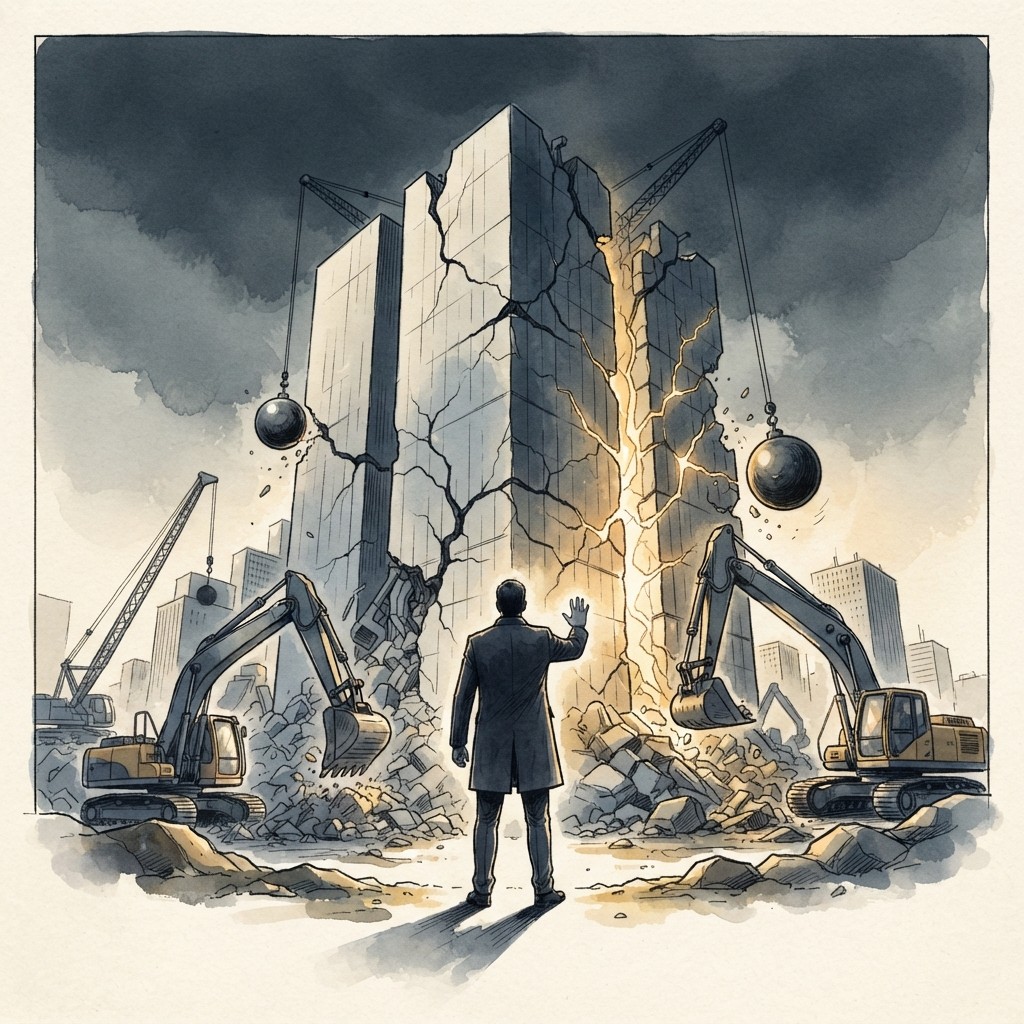
Before Lou Gerstner walked in, the board had already settled on a strategy: break IBM into autonomous units — the 'Baby Blues,' each chasing its own slice of the market as a standalone business.8 It was the fashionable answer. The conglomerate looked too slow, too sprawling, too proud to compete with the nimble specialists eating its lunch. Spin off the disk drives, spin off the printers, let each piece sink or swim. On paper, it was disciplined and modern.
Gerstner killed it. He halted the breakup and kept the company whole.8 This was the single most consequential decision of the entire turnaround, and it is the one the legend forgets, because it doesn't look like leadership — it looks like inaction. But the reasoning underneath it is the whole thesis. The thing customers actually wanted from IBM was not the best disk drive or the cheapest mainframe. It was someone who could make all of it work together. Break IBM into pieces and you would have created a dozen mediocre specialists in markets that already had better ones — and destroyed the one thing nobody else could offer: the integrated solution.
“We were precariously close to running out of money.”7
First, though, the bleeding had to stop. Gerstner's stated top priority on arrival was blunt: stop hemorrhaging cash.7 The numbers behind that urgency were real — IBM carried more than $15 billion in long-term debt against the wreckage of consecutive record losses.2 Over the turnaround period, more than 100,000 employees were laid off from a company that had maintained something close to lifetime employment since its founding.5 That is the part the legend dramatizes into a single brutal week. It wasn't. It was spread across the years it took to right the ship — triage, not a massacre.
| The board's plan | Gerstner's bet | |
|---|---|---|
| Structure | Break into autonomous 'Baby Blues' | Keep the company whole |
| What it competes on | Each unit, alone, on its product | The integrated solution no rival could match |
| The customer's question | Which vendor do I pick for each part? | Who makes all of it work together? |
| The risk | A dozen mediocre specialists | A slow giant that has to learn to move |
The 'no vision' line meant the opposite of what it became famous for
The most quoted sentence of the whole episode is a misquote — not in the words, but in the cut. At the press conference, Gerstner said the last thing IBM needed right now was a vision. Reporters stopped the recording there and a legend of anti-vision leadership was born. But the sentence kept going. What IBM needed, he said in the same breath, was 'a series of very tough-minded, market-driven, highly effective strategies.'4 That is not a rejection of strategy. It is a demand for it.
The context is everything. Gerstner explained later that he said it precisely because IBM already had the opposite problem: file drawers full of vision statements it had never executed.4 The company was not short on grand ideas about the future of computing. It was drowning in them. What it lacked was the discipline to ship anything, decide anything, or fix the cash flow that was about to kill it. 'No vision' was not a slogan against thinking. It was a pivot away from a glut of unexecuted thinking and toward the one thing IBM had forgotten how to do: act on the market in front of it.
When a sprawling company is losing money, the reflex — from boards, bankers, and activists alike — is to simplify by subtraction: break it up, spin it off, let the pieces fend for themselves. Sometimes that's right. But it's worth asking the harder question first: is the sprawl the disease, or is the integration the asset? IBM's value was never the sum of its products; it was the ability to assemble them into something a customer couldn't buy anywhere else. Gerstner's genius wasn't a new idea. It was seeing that the company's most criticized feature — its bigness — was the moat, and having the nerve to defend it while everyone insisted on dismantling it.
With the company intact, the pieces could be pointed somewhere. IBM pivoted hard into services and the web — and in 1996 its marketing department coined a term to brand the whole bet: 'e-business.'8 That was only possible because the company was still one company. A scattered set of Baby Blues could never have stood in front of a corporate customer and said: we will run your entire technology problem, end to end. The integrated giant could. The breakup would have sold off exactly the thing the next decade rewarded.
Wasn't he just lucky the internet showed up?
The honest objection is that the 1990s were a tide that lifted every technology boat, and that crediting one man's refusal to break up a company overstates the case. There's truth in it: IBM's shares rose enormously, but the S&P 500 itself gained 154% over roughly the same window, so some of the climb was simply the era.6 And the precise multiple of the comeback is genuinely contested — IBM's market value rose from $29 billion to $168 billion, a little under sixfold,5 while share-price accounts run higher.6 The recovery was real but it was not a miracle out of nowhere.
But the objection actually sharpens the point rather than blunting it. The rising tide of the 1990s lifted companies that could sell integrated technology to enterprises racing onto the internet. A broken-up IBM — a dozen separate units each fighting better specialists on price — would have caught almost none of that wave, because the wave rewarded exactly the integrated-solutions capability the breakup would have destroyed. The luck was real. So was the decision that let IBM be standing in the place the luck arrived.
IBM came back not because someone imagined a brilliant new future, but because someone looked at a company everyone wanted to take apart and saw that the sprawl was the asset, not the ailment. The losses had to be stopped, the headcount had to fall, the cash had to stop bleeding — all of it brutal, none of it visionary. The vision, such as it was, came down to a single word: no. No, we will not break this apart. And that one refusal turned out to be worth more than any of the file drawers full of futures IBM had been writing for itself and never building.
Turnaround Diagnosis Worksheet
A worksheet that forces a turnaround down to first principles: is this a cash problem, a cost problem, or a strategy problem — and which one will kill you first. It separates the bleeding you must stop this week from the rebuild that takes years. Blank to triage your own situation; filled as the worked example tracing how the story's leader sequenced survival before revival.
Included, filled and blank, in the The Turnaround Casebook. See the set → · Preview the blank →
Sources
Where this comes from — the filings, records, and reporting behind it.
- 1IBM's net loss in fiscal year 1993 was $8,101 million on total revenue of $62,716 million; in 1992 the net loss was $4,965 million; in 1991 the net loss was $2,861 million.
- 2IBM's FY1993 10-K (primary filing) shows total assets of $81,113M, long-term debt of $15,245M, and retained earnings of $11,667M at year-end 1993.
- 3IBM reported a record $5.46 billion loss for Q4 1992 and $4.97 billion loss for full-year 1992; 1991 had been the first-ever annual loss in IBM's 79-year history at $2.86 billion; 1992 restructuring charges totaled $11.6 billion pre-tax.
- 4Gerstner's full 'vision' remark at the press conference was: 'the last thing IBM needs right now is a vision' — immediately followed by the statement that IBM needed 'a series of very tough-minded, market-driven, highly effective strategies.' He explained in his memoir he said it because IBM had file drawers full of vision statements it never executed.
- 5IBM's market capitalization rose from $29 billion in 1993 to $168 billion by the time of Gerstner's 2002 retirement; over 100,000 employees were laid off after he arrived from a company that had maintained lifetime employment since inception.Wikipedia, Lou Gerstner ↗ · 2026-02-07
- 6Fortune's December 2025 obituary states IBM shares rose ninefold from Gerstner's first day (April 1993) to the January 2002 announcement of his departure, while the S&P 500 gained 154% over the same period.
- 7The NYT obituary states IBM's stock market value rose 'nearly sixfold' during Gerstner's tenure; Gerstner's first top priority upon reviewing IBM's finances was 'stop hemorrhaging cash' — 'We were precariously close to running out of money,' per his 2002 memoir.
- 8Gerstner's defining strategic decision was to halt the board's active plan to break IBM into autonomous 'Baby Blues'; he kept the company intact to deliver integrated IT solutions, and presided over the pivot to services and e-business including coining the term 'e-business' in IBM's marketing department in 1996.
More like this — beyond IBM
New Strategically analyses as they publish: the defining moves in business, checked against the record. No noise, and one click to leave.