Pairs with the Turnaround Diagnosis Worksheet — a ready-to-use strategy tool. Included in the Turnaround Casebook →
“Is this plan a turnaround, and can it be finished?”
On October 12, 2015, Dell agreed to buy EMC, and the press did the math the way the press always does: it printed one big number. About $67 billion — the largest technology acquisition ever, a hardware company swallowing a storage giant whole.1 The number was real enough to put in a headline and wrong enough to mislead an entire decade of analysis. Because that $67 billion was not a price Dell agreed to pay. It was an arithmetic snapshot of a single afternoon.
The official story is that Dell, a fading PC maker, reinvented itself by buying its way into the enterprise. The truer story is that Dell borrowed against a company it didn't fully own — VMware — to absorb one it could barely afford, then spent the next eight years selling that borrowed asset back to the market to dig out. The reinvention everyone celebrates was, underneath, a financing maneuver. A very good one. But a financing maneuver.
The $67 billion was a stock price, not a check
Read the filing instead of the headline. EMC shareholders were to receive $24.05 per share in cash, plus a tracking stock tied to EMC's roughly 81% stake in VMware. The $67 billion total value assumed VMware's volume-weighted average price of $81.78 on October 7, 2015.1 Move VMware's stock, and the deal's headline value moved with it — which it promptly did, downward, in the months that followed. The only firm commitment was the cash: $24.05 a share. The rest was a paper instrument whose worth depended on a market Dell did not control. Dell didn't pay $67 billion for EMC. It paid about a third of that in cash and pinned the remainder to VMware's ticker.
| The '$67 billion' story | The merger agreement | |
|---|---|---|
| Per-share cash | Implied as the price | $24.05 in cash |
| The rest | Part of the cash deal | A VMware tracking stock |
| The $67B basis | A fixed price | VMware's VWAP of $81.78 on one day |
| What it depended on | Dell's checkbook | VMware's market price |
Why structure it this way? Because Dell could not write a $67 billion check. It was a private company — Michael Dell and Silver Lake had taken it off the public markets in 2013 in a roughly $24.4 billion buyout at $13.65 a share, later nudged to $13.75 plus a special dividend after the Special Committee pushed back.4 That privatization is the move that made EMC possible. A public Dell, answering to quarterly shareholders and short-sellers, could never have loaded itself with the debt this deal required. A private Dell could swallow the leverage in the dark and let the patient, ugly work of paying it down happen off-stage.
The asset Dell bought, then sold twice
The merger closed on September 7, 2016, EMC folding into the new Dell Technologies, with the financing scaffolding including a $2.5 billion margin bridge facility arranged through JPMorgan.3 Of the up to $49.5 billion its banks had committed,10 Dell issued $45.9 billion in new debt to close the deal, and by the end of that fiscal year its total debt stood at about $50.4 billion in principal.9 Now the real game began — not integration, but deleveraging. And the deleveraging engine was always VMware. EMC was the body of the deal; VMware was the wallet inside its coat.
The first monetization came in 2018. Dell did not, as the loose retelling has it, 'reverse-merge with VMware.' VMware stayed a separate, publicly listed company the whole time. What Dell did was retire its own Class V tracking stock — the instrument it had handed EMC holders — by offering to exchange it for newly issued Class C Dell common stock, or cash at $109 a share, a 29% premium.5 In the same breath, Dell disclosed it had already paid down $13 billion of gross debt since the merger.5 Shareholders approved the exchange in December 2018 with more than 61% in favor, and Dell relisted on the NYSE as DELL — public again, on its own terms, without an IPO.6 That was monetization one: collapse the tracking stock, fold VMware's value onto Dell's own balance sheet, and reintroduce a deleveraged company to the market.
Monetization two arrived in 2021. On April 14, Dell and VMware agreed to spin VMware off entirely — and crucially, VMware first paid a special cash dividend of $11.5 to $12.0 billion to all its stockholders, Dell included.7 So the spin-off was not Dell walking away empty-handed; it was Dell extracting a multibillion-dollar dividend on the way out the door, then receiving its proportionate slice of an independent VMware. Dell did not sell VMware to a buyer that year. That came later and separately: Broadcom announced its roughly $61 billion acquisition of VMware in May 2022 and closed it in November 2023.8 By then VMware was its own company, and Dell's stake had already done its job.
Dell took on roughly $46 billion of new debt behind a private-company shield, then used VMware twice to pay it back: the 2018 tracking-stock exchange that absorbed VMware's value and let Dell relist after retiring $13 billion of gross debt5, and the 2021 spin-off that paid Dell a slice of an $11.5–$12.0 billion dividend7 before Broadcom's ~$61 billion check eventually valued what Dell had let go.8 The 'turnaround' was a financing structure executed with patience.
But didn't it work? Isn't that what a turnaround is?
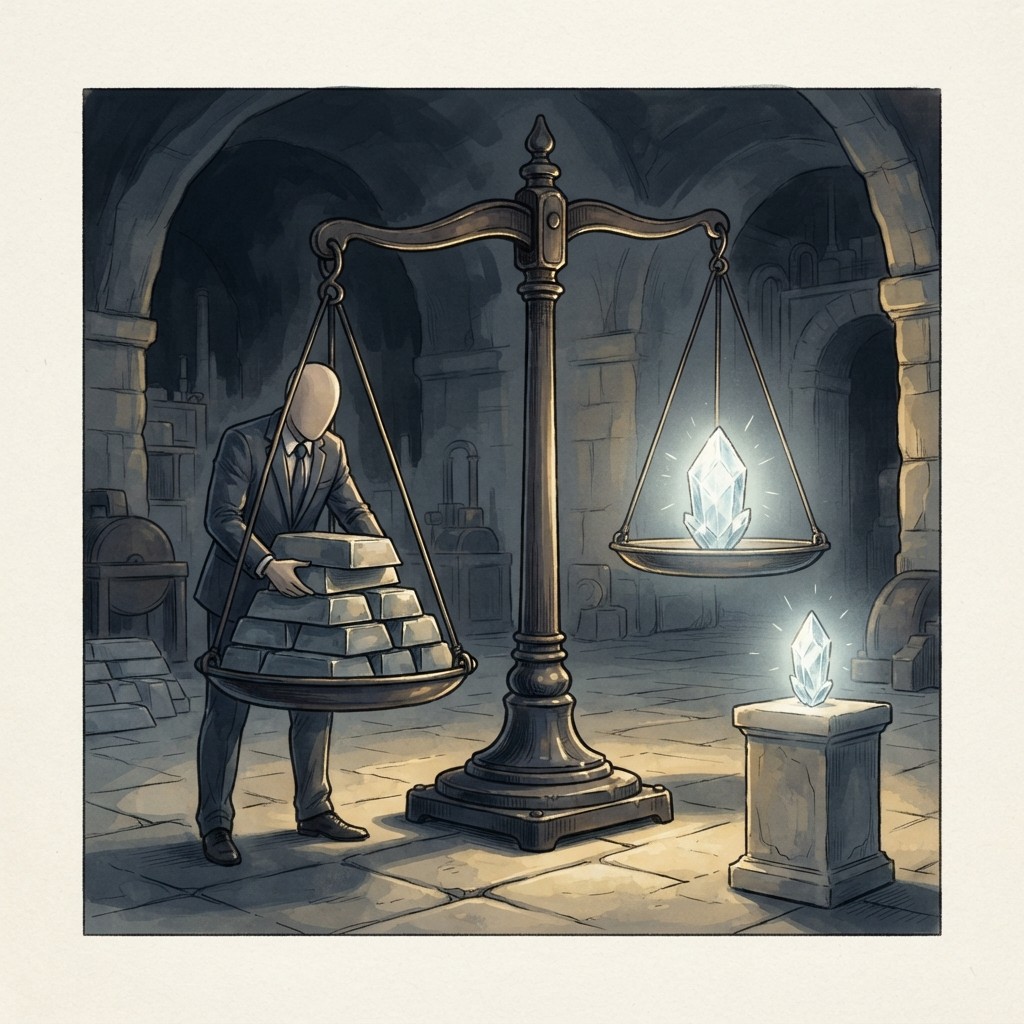
The fair objection writes itself: Dell took on a mountain of debt, paid it down, got back to public markets, and survived — what is that if not a successful turnaround? It is a successful financing, and the distinction matters. A turnaround changes what a company fundamentally is. The EMC deal changed what Dell owned and what it owed; it did not escape the gravity of the box business. The genius here was real, but it was financial: recognizing that a private company can shoulder leverage a public one cannot, and that VMware was a monetizable asset embedded inside EMC that could be sold to the market in pieces to retire that leverage. Buy the company, harvest the jewel inside it twice, hand the jewel to Broadcom when its value peaked. That is brilliant. It is also not the same as becoming a different kind of company.
And the timing carries its own irony. Dell made the largest bet in tech history on owning enterprise storage and infrastructure at exactly the moment the cloud was turning that infrastructure into a commodity rented by the hour. The most valuable thing the deal delivered — VMware — is the thing Dell ultimately let go. What remained is a larger, more leveraged-then-deleveraged version of the hardware company it always was.
The 2013 privatization was not a footnote to the EMC story — it was the precondition. Public markets punish a company that loads itself with debt to make a long, uncertain bet; they want the quarter. Private ownership buys the one thing leverage needs to be survivable: time, away from the daily verdict of the share price. Watch for this pattern. When an operator takes a company private right before a transformational, debt-heavy move, the privatization isn't the prelude — it's the enabling structure. The real maneuver is rarely the headline deal. It's the financial architecture that made the headline deal possible, and the asset quietly identified to pay for it.
Strip the narrative away and the spine is plain. Dell did not pay $67 billion in cash; it paid $24.05 a share and pinned the rest to a stock it half-owned.1 It did not reverse-merge with VMware; it retired a tracking instrument.5 It did not sell VMware in 2021; it spun it off with a dividend in hand and let Broadcom buy it two years later.8 Each correction points the same direction: the EMC deal was financial engineering wearing the costume of a turnaround. Dell bought a storage company to get the software jewel inside it, borrowed against that jewel to afford the purchase, and sold the jewel back to the world to settle the debt. The reinvention was never the hardware. It was the willingness to disappear from the public markets long enough to do the arithmetic nobody else could afford to do.
When the deal underneath isn't the deal you read about
Turnaround Diagnosis Worksheet
A worksheet that forces a turnaround down to first principles: is this a cash problem, a cost problem, or a strategy problem — and which one will kill you first. It separates the bleeding you must stop this week from the rebuild that takes years. Blank to triage your own situation; filled as the worked example tracing how the story's leader sequenced survival before revival.
Included, filled and blank, in the Turnaround Casebook. See the set → · Preview the blank →
Sources
Where this comes from — the filings, records, and reporting behind it.
- 1The Dell-EMC merger was announced October 12, 2015; EMC shareholders would receive $24.05 per share in cash plus a VMware tracking stock, with total transaction value of approximately $67 billion assuming VMware's Oct 7 2015 VWAP of $81.78.
- 2The Agreement and Plan of Merger between Dell Inc. (via Denali Holding Inc.) and EMC Corporation was entered into on October 12, 2015; the termination fee payable by EMC was $2.5 billion under specified circumstances.
- 3The Dell-EMC merger closed September 7, 2016; EMC became a wholly-owned subsidiary of Dell Technologies, and Dell arranged a $2.5 billion margin bridge credit facility with JPMorgan Chase as part of the debt financing.
- 4Dell Inc.'s 2013 go-private was valued at approximately $24.4 billion at $13.65 per share, with Michael Dell and Silver Lake Partners as acquirers; the price was later revised upward to $13.75/share plus a $0.13 special dividend after pressure from the Special Committee.
- 5In July 2018, Dell Technologies proposed exchanging outstanding Class V tracking stock for Class C common stock (at 1.3665 shares of Class C per Class V share) or cash at $109/share, representing a 29% premium; Dell had paid down $13 billion of gross debt since the EMC merger by that date, and Silver Lake owned 24% of Dell Technologies common shares.
- 6On December 11, 2018, Dell Technologies shareholders approved the Class V tracking stock exchange with more than 61% voting in favor; Dell Technologies' Class C common stock subsequently listed on NYSE under the ticker DELL.
- 7On April 14, 2021, Dell Technologies and VMware agreed that VMware would be spun off from Dell; VMware would pay an $11.5–$12.0 billion special cash dividend to all VMware stockholders immediately prior to the spin-off.
- 8Broadcom announced its acquisition of VMware for approximately $61 billion in cash and stock on May 26, 2022; the deal was approved by VMware shareholders on November 4, 2022 and closed November 22, 2023.
- 9To finance the EMC merger transaction, we issued $45.9 billion in new debt and $4.4 billion of privately placed common stock; total debt, principal amount, was $50,356 million at February 3, 2017.
- 10The lenders agreed to provide in the aggregate up to $49.5 billion in debt financing (not all of which is expected to be drawn at the closing of the merger).
Weighing outside help with a decision like this? Hiring a procurement transformation consultant
More like this — beyond Dell
New Strategically analyses as they publish: the defining moves in business, checked against the record. No noise, and one click to leave.