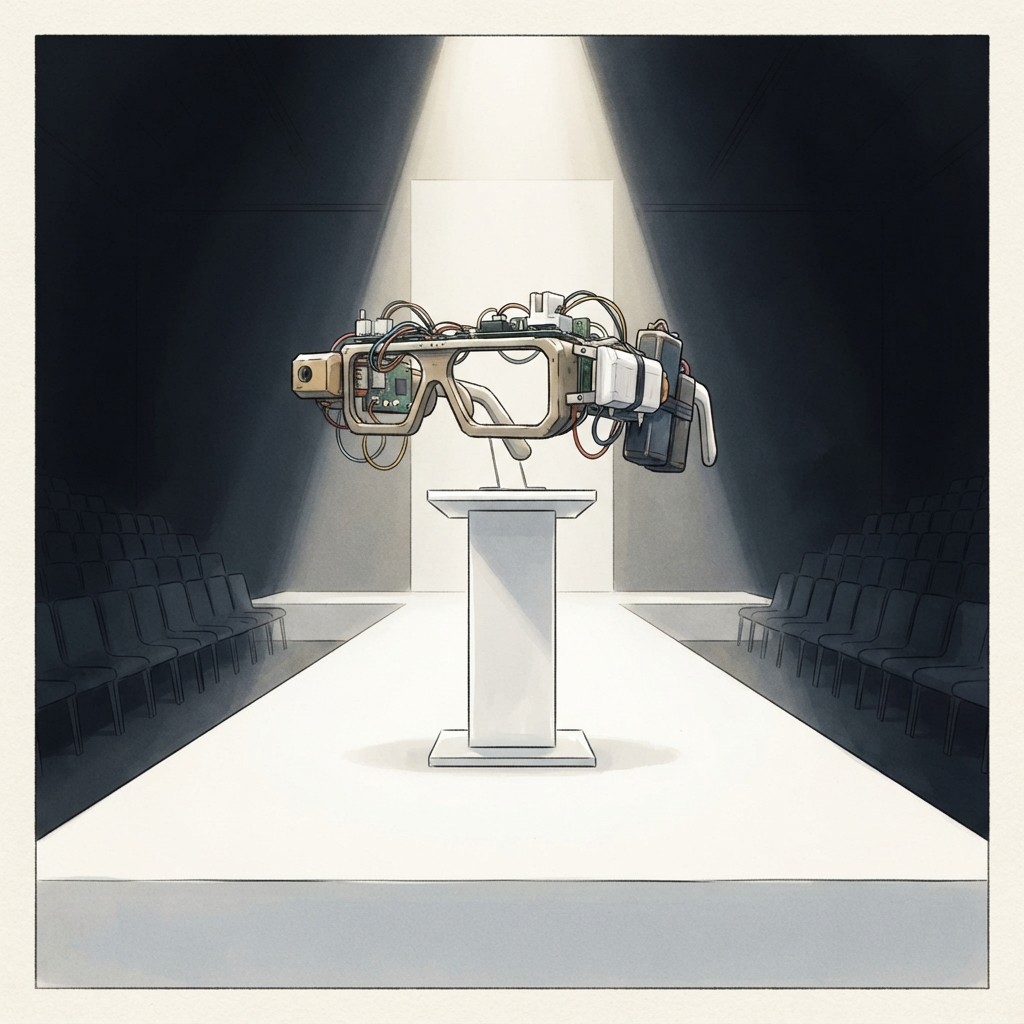
Google solved the hard physics problem — and walked straight into a social one it never tried to solve. The miniaturization was a miracle. The product still died on a stranger's face.
Pairs with the Disruption Vulnerability Assessment — a ready-to-use strategy tool. Included in the Fall Casebook →
“How much of your decline can the agreed explanation actually account for?”
In the middle of 2011, the thing that would become Google Glass weighed eight pounds.9 It was a head-mounted rig you could not have worn to dinner without a neck brace. Two years later Google had performed a genuine miracle of miniaturization — the retail device was lighter than the average pair of sunglasses.9 The engineering worked. The product still died. That gap is the whole story, because Google solved the hard physics problem and then walked straight into a social problem it had not even tried to solve.
The official memory is tidy: Google Glass was a beautiful idea that was simply too early, killed in 2015 when the world wasn't ready. Almost every clause of that is wrong. It wasn't cancelled in 2015. It wasn't only an early-adopter problem. And it didn't fail because the camera-glasses concept was ahead of its time — it failed because of a decision Google made about what the thing was.
A beta test wearing the costume of a launch: how an unfinished research artifact got dressed up as an identity product and judged like one
Glass began as a developer program. Google sold the first units through the 'Explorer Program' at its I/O conference on June 27, 2012, for a $1,500 pledge — a price and a name that both screamed 'this is for the people building on top of it.'1 The head of Google X, Astro Teller, later said the Explorer approach was the right way to learn, but that the team 'got a little off track' by 'trying to jump all the way to the consumer applications' before there was a clear use-case.7 That sentence is the diagnosis. Google took an unfinished research artifact and dressed it as an identity product — something you wear on your face, in public, to signal who you are. A prototype can be ugly and unfinished; a product worn on the face cannot. Google asked the world to judge a beta as if it were a launch, and the world obliged.
| What Glass actually was | What Google marketed it as | |
|---|---|---|
| Stage | Developer prototype / beta | Near-consumer device |
| Buyer | Builders and tinkerers | Early adopters defining their identity |
| Where it lived | A workshop | Your face, in public |
| The right yardstick | Does it teach us? | Is it socially safe to wear? |
The camera everyone could see, and no one could trust: the failure mode that punished the bystander who never opted in
Here is the mechanism that made the social problem fatal. The device carried a small, visible camera pointed at whoever you were talking to, and there was no reliable way for that person to know whether they were being recorded. A normal product failure annoys the buyer. This failure mode punished the bystander — the stranger across the table who never opted in. That is why the backlash had a moral charge that a clunky gadget never earns. The reaction wasn't 'this doesn't work well.' It was 'get that off your face.' Sergey Brin, announcing Google's next attempt years later, named exactly this: he said he made a lot of mistakes with Glass, and pointed to the visible camera on the original device as a key design error.6 When a co-founder volunteers the camera as the mistake, you can stop guessing about the cause.
“I definitely feel like I made a lot of mistakes with Google Glass.”6
The clearest proof that this was a social rejection and not a hype cycle is in the language. The slur 'Glasshole' did not arrive after years of disappointing sales. It shows up in a TechCrunch article dated January 28, 20135 — before the device had even broadly shipped to the public, which didn't happen until April 15, 2014.1 The culture had a word to shame Glass wearers more than a year before most people could buy one. You cannot 'iterate' your way out of that. By the time the product was generally available, the verdict was already a slang term.
It wasn't cancelled. It quietly switched jobs.: the same hardware that flopped on a face thrived on a factory floor — because the audience changed, not the device
The popular timeline says Google killed Glass on January 15, 2015. What Google actually did was end the consumer Explorer Program — last purchase date January 19, 2015 — and frame the move as a 'graduation' rather than a cancellation.28 And it meant it. Glass moved out of Google X, shipped as Glass Enterprise Edition in July 2017 after testing at Boeing and GE, got a second enterprise version in May 2019, and only had all sales finally discontinued on March 15, 2023.3 Eight years after the supposed funeral. The hardware that failed on a stranger's face succeeded on a factory floor — because in a warehouse there is no bystander to creep out, only a worker with a defined task and no privacy ambush. The device didn't change much. The audience did, and the audience was the whole problem.
But wasn't it just too early?: the honest objection, and the three things it still can't explain away
The honest objection is that this is too neat — that smart glasses were genuinely premature in 2013, that battery and display tech weren't there, and that any version launched then would have struggled. There's real truth in that, and it deserves a fair hearing. But notice what 'too early' can't explain. It can't explain why the same hardware thrived in enterprise within a few years.3 It can't explain why the rejection arrived as a moral slur aimed at the wearer rather than a shrug about battery life. And it can't explain Brin's own postmortem, which isn't 'the tech wasn't ready' but 'the camera was a mistake.'6 Too early is an alibi for the engineering. The actual failure was a marketing decision — to put an unsolved social design on the public's face and call it a consumer product — and Google's own X chief admits the team jumped to consumer applications before it had earned the right to.7 Worth adding: we don't even know how many Explorer units sold, because Google flatly refused to release the figures.4 A company proud of a launch tends to publish its numbers.
A prototype is allowed to be unfinished — but only in front of the people who signed up to test it. The moment a product's failure mode lands on a bystander who never opted in, you are no longer running a beta; you are running a social experiment on the public, and the public will name you for it. Before you put anything on a customer's face, in a stranger's space, or in a non-consenting third party's life, ask the bystander's question, not the buyer's: 'Can the person across from me tell what this is doing to them?' If the answer is no, the engineering being brilliant won't save you. Glass proved a camera nobody can see is not a feature that's early — it's a feature that's wrong.
Google Glass was not killed by the future arriving late. It was killed by a confusion about what it had built. The eight-pound rig that became a feather-light pair of glasses was a triumph of engineering aimed at the wrong problem — Google miniaturized the hardware and left the social design at full weight. The lesson isn't 'wait for the world to catch up.' It's that some products fail in the one place your lab can't simulate: the face of a stranger who never agreed to be in your experiment. Get the molecule right and the meaning wrong, and the world will have a name for you before your product even ships.
When the technology was fine and the judgment wasn't
Disruption Vulnerability Assessment
An assessment that rates a company across the dimensions that predict disruption: how cheaply a challenger can serve the unsexy bottom of the market, how trapped you are by margins and a satisfied core. Blank to score your own position before the cliff; filled as the worked example showing where the story's incumbent was already exposed while the numbers still looked great.
Included, filled and blank, in the Fall Casebook. See the set → · Preview the blank →
Sources
Where this comes from — the filings, records, and reporting behind it.
- 1Google opened Explorer Program sales at Google I/O on June 27, 2012 for $1,500; physical distribution of those purchases began April 16, 2013; broad public sale opened April 15, 2014.
- 2On January 15, 2015, Google announced it would stop producing the Google Glass prototype and end the Explorer Program; January 19, 2015 was the last purchase date. Glass did not disappear — it graduated from Google X and moved under Tony Fadell.
- 3Glass Enterprise Edition launched July 2017 after testing at Boeing and GE; Enterprise Edition 2 launched May 2019; all Glass sales were finally discontinued March 15, 2023 with support ending September 2023.
- 4Google's Communications Manager explicitly refused to disclose any sales figures for Glass Explorer Edition: 'We are not releasing any sales figures on Glass.'
- 5The term 'Glasshole' appears as early as January 28, 2013 in a TechCrunch article by Ryan Lawler — predating its mainstream Urban Dictionary entry by over a year.
- 6Sergey Brin stated at Google I/O 2025: 'I definitely feel like I made a lot of mistakes with Google Glass,' and pointed to the visible camera on the original device as a key design error; he was announcing Android XR with Warby Parker.
- 7Astro Teller (head of Google X) stated the Explorer program was the right approach, but Google 'got a little off track' by 'trying to jump all the way to the consumer applications' before a clear use-case was established.
- 8Google's January 15, 2015 announcement was made via a Google+ post in which the Glass team framed the end of Explorer as a 'graduation,' not a cancellation, and promised future versions; last purchase date was January 19, 2015.
- 9In mid-2011, Google engineered a prototype that weighed 8 pounds (3.6 kg); by 2013 they were lighter than the average pair of sunglasses.
Weighing outside help with a decision like this? Hiring a turnaround or restructuring advisor
More like this — beyond Google Glass
New Strategically analyses as they publish: the defining moves in business, checked against the record. No noise, and one click to leave.