Pairs with the Pricing Power Diagnostic — a ready-to-use strategy tool, filled for Apple. Included in the Price Ladder Casebook →
“What does changing how you charge cost before it starts paying?”
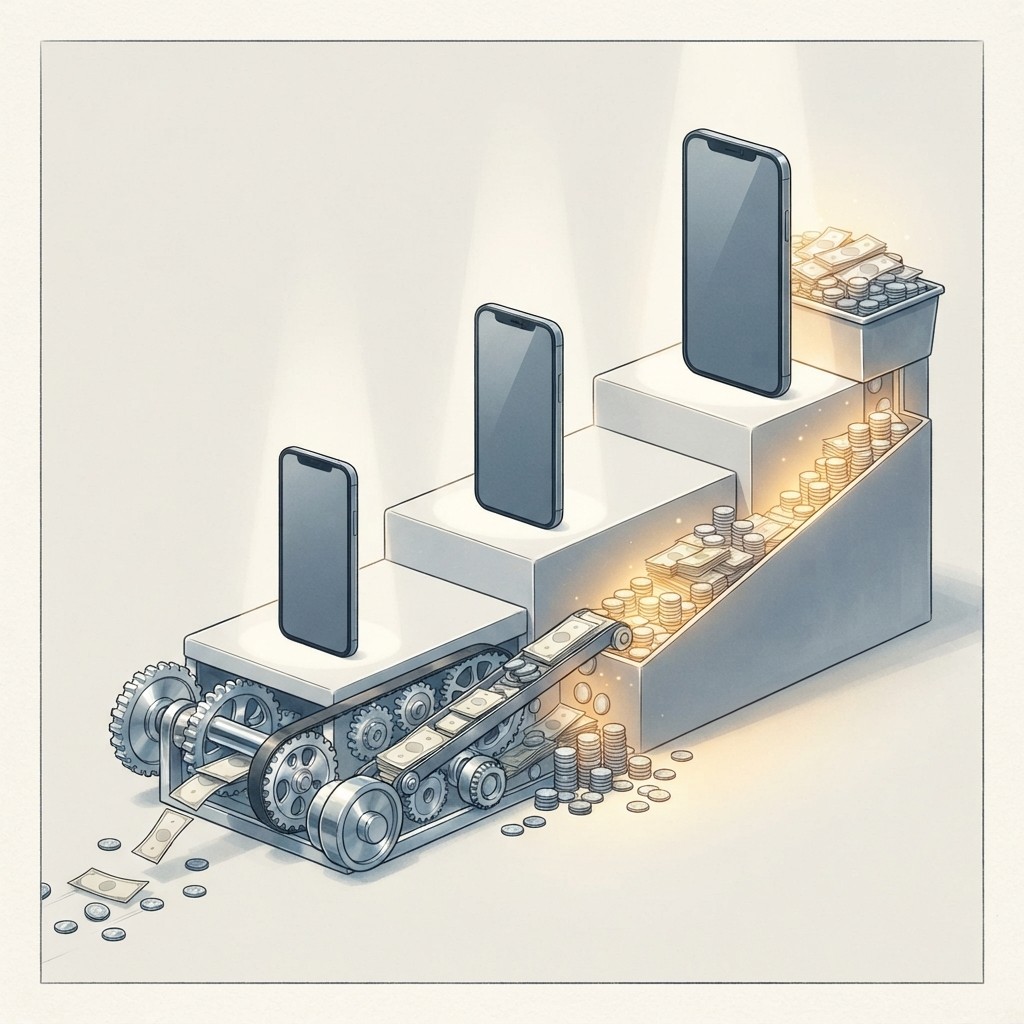
Walk into the iPhone choice and you are handed what looks like a kindness: a ladder of phones, from a $599 entry model up past a thousand dollars for the biggest Pro.4 Pick your spot. Spend what you want. It feels like the most generous menu in consumer electronics - something for the student, something for the photographer, something for whoever is leaving Android this year. But a ladder isn't a menu. A menu lets you eat anywhere on it. A ladder is built to be climbed, and Apple designed every rung knowing exactly which way you'd go.
The official story is that the price ladder exists to give customers choice. The truer story is that it exists to move the money. The cheap end recruits; the expensive end earns. And the whole machine has run quietly for years because in 2018 Apple stopped telling anyone the one number that would reveal what it was doing.
The cheap iPhone was never trying to be cheap
The myth around the entry iPhone is that it's Apple's budget brawler - the phone sent to fight Xiaomi in emerging markets on price. That's not quite what it has ever been. The original iPhone SE in 2016 launched at $399, and Apple's own pitch wasn't 'cheapest phone'; an executive justified it by pointing to more than 30 million sales of 4-inch iPhones the year before - it was a form-factor play as much as a price one.2 The point of the entry rung isn't to win the budget war. It's to exist. It puts a number on the bottom of the ladder low enough to keep Apple in the conversation when someone is choosing between iOS and Android - and then it lets the rest of the lineup do the real work.
Watch what Apple actually did with that floor when it had the chance to lower it. The 2025 successor, the iPhone 16e, didn't drop the entry price - it raised it to $599 for 128 GB, a $170 jump over the prior SE's $429.3 Apple's marketing chief still called it the 'more affordable option' that 'completes the lineup,' and the $599 sat front and center in the launch.4 A genuine budget play cuts the floor. A margin-mix engine raises the floor while still calling it the affordable one - because the floor's only job is to look like a door, not to be the cheapest room in the house.
“complete the lineup as a powerful, more affordable option”4
The rung that actually pays the bills is at the top
Here's the inversion most people miss. The phone that anchors the ladder is not the phone that earns from it. The center of gravity sits at the top: the iPhone 15 Pro Max was the best-selling smartphone above $1,000 in the world in 2024, and the Pro lineup is estimated to have produced roughly 62% of all iPhone revenue that year - up from about 58% the year before.8 So well over half the money from the single most important product on earth comes from the two most expensive rungs. The cheap end recruits the customer; the expensive end, where the camera tier and the materials and the 'Pro' name live, is where Apple wants you to land. Feature-gating does the steering - the things people most want are reserved for the rungs Apple most wants to sell.
| Entry rung (SE / 16e) | Pro rung (Pro / Pro Max) | |
|---|---|---|
| Stated purpose | An affordable option | The best iPhone |
| Real job | Recruit switchers, set the floor | Carry the revenue |
| Share of iPhone revenue | The smaller slice | ~62% of the total (est.) |
| What the price signals | You can get in for $599 | This is where you should land |
The number Apple stopped saying out loud
A price ladder that pulls customers upward has one tell: the average selling price keeps rising even as the lineup looks the same. That number is the smoking gun - and Apple stopped firing it where anyone could see. After fiscal 2018, Apple quit disclosing per-unit iPhone ASP entirely; every figure you now read is a third-party analyst estimate, not an Apple disclosure - a distinction almost everyone drops.5 The timing was not innocent. The structural shift had just happened: the $999 iPhone X dragged Apple's ASP toward $800 around the start of FY2018 and it never fell back below $700.7 Apple built the modern ladder and then, in the same window, switched off the gauge that would have shown it climbing.
What the gauge would have shown, if it were still on the dashboard, is dramatic. Counterpoint Research estimates the global iPhone ASP crossed $900 in 2024 - a record, up from $724 in 2020.6 Unit shipments fell, and the average price still rose; Apple held an estimated 46% of all smartphone revenue worldwide while selling fewer phones.6 That is the price ladder doing exactly what a margin-mix engine is supposed to do: extract more revenue per customer without needing more customers. The mix shifted up. Most people just couldn't see it move.
Apple posted $201.2 billion in iPhone revenue in FY2024.1 When units stall, the only way that line grows is by lifting the average selling price - and the ladder is the lever. Push the mix toward the Pro rungs, raise the entry floor from $429 to $5993, and revenue rises even as fewer phones ship.6 The ladder isn't decoration on the lineup; it is the variable Apple is actually managing.
Isn't this just giving customers what they want?
The fair objection is that none of this is sinister - it's a good product line. Some people genuinely want a smaller, cheaper iPhone; the original SE answered a real demand for a 4-inch phone, with 30 million such sales the year before to prove it.2 Some people genuinely want the best camera and will happily pay for the Pro. A ladder that lets each get what they want is a feature, not a trick. All true. But notice the asymmetry: a ladder built purely for choice would let the floor fall when costs allow - and Apple's floor went up $170 at the very moment it could have gone down.3 And a company merely serving preferences has no reason to stop publishing the one statistic that measures the result. The honest read isn't that the ladder is a con. It's that it serves Apple's mix and the customer's preference at the same time - and when those two pull in different directions, the $599 floor and the dark gauge tell you which one wins.
A great price ladder isn't a menu of equal options - it's a recruiting rung at the bottom and an earning rung at the top, with the features people most want gated to the rung you most want to sell. The cheap model's job is to define a floor and bring people in the door; it doesn't need to be profitable, it needs to be present. The real revenue should sit one or two steps up, reached by a small, voluntary climb that feels like the customer's idea. And the one number that exposes the whole mechanism - your average selling price, the proof the mix is drifting upward - is the number to stop publishing the moment it starts climbing. Apple stopped disclosing iPhone ASP right as its ladder took its modern shape. The lever works best when no one can see it move. One caution: a floor you keep raising eventually stops recruiting - climb-everyone-upward only works while the bottom rung is still low enough to stand on.
The iPhone ladder looks like the most honest thing Apple sells - a clear set of prices, choose your own adventure. It is actually the most carefully engineered. The entry phone exists to be a door, not a bargain. The Pro exists to be where you land. And the average price has quietly climbed past $9006 while the company that built the climb stopped telling anyone the number that would prove it. Apple didn't give you a ladder so you could pick a rung. It gave you a ladder so you'd climb.
More pricing built to move you without you noticing
Pricing Power Diagnostic
A scored diagnostic of pricing power: brand pull, switching costs, substitutes, and how critical the product is to the buyer. Each dimension rated 1-5 so you can see, at a glance, whether a price rise sticks or sends customers running. Blank to grade your own offer; filled as the worked example scoring a story's business on its real ability to charge more.
Included, filled and blank, in the Price Ladder Casebook. See the set → · Preview the blank →
Sources
Where this comes from — the filings, records, and reporting behind it.
- 1Apple's FY2024 10-K shows iPhone revenue of $201.2 billion and Services revenue of $96.2 billion out of $391.0 billion total net sales; Services grew 13% year-over-year.
- 2The original iPhone SE (1st generation) was introduced on March 21, 2016 and released March 31, 2016, at $399 (16 GB) / $499 (64 GB), positioned as 'the most powerful four-inch phone ever'; Apple executive Greg Joswiak cited over 30 million 4-inch iPhone sales in 2015 as the rationale.
- 3The iPhone 16e was announced February 19, 2025 and went on sale February 28, 2025 at a starting price of $599 (128 GB) — a $170 increase over the iPhone SE 3rd generation's $429 base price; it simultaneously discontinued the iPhone 14 and iPhone 14 Plus.Wikipedia, iPhone 16e ↗ · 2025-02-19
- 4Apple's Kaiann Drance (VP Worldwide iPhone Product Marketing) stated in Apple's press release that the iPhone 16e was designed to 'complete the lineup as a powerful, more affordable option,' with its $599 starting price advertised front and center; Fortune confirmed the $599 price and noted it ranges to $899 for 512 GB — matching the baseline iPhone 16 Plus price.
- 5Apple stopped releasing per-unit iPhone Average Selling Price (ASP) data after FY2018; all post-2018 'ASP' figures in the market are third-party analyst estimates (e.g., CIRP's US-WARP metric), not primary Apple disclosures.
- 6Counterpoint Research reported that the global iPhone ASP crossed $900 in 2024, a new record, rising from $724 in 2020; iPhone held a 46% smartphone revenue share globally despite a decline in unit shipments.
- 7The iPhone X (launched September 2017 at $999 entry price) pushed Apple's smartphone ASP to nearly $800 in Q1 FY2018 and kept it above $700 ever since, marking the structural inflection point of the modern price ladder.
- 8The iPhone 15 Pro Max was the best-selling smartphone above $1,000 globally in 2024; the Pro lineup (Pro + Pro Max) accounted for an estimated 62% of total iPhone revenue in FY2024, up from 58% in FY2023 — though these are analyst estimates (Counterpoint/Skillademia), not Apple primary disclosures.
Weighing outside help with a decision like this? Hiring a pricing strategy consultant
More like this — beyond Apple
New Strategically analyses as they publish: the defining moves in business, checked against the record. No noise, and one click to leave.