Pairs with the Moat Anatomy Canvas — a ready-to-use strategy tool. Included in the Moat Anatomy Casebook →
“What would it actually cost a challenger to take your customer?”
Switch on a Roku TV and the first thing you meet is a grid - Netflix, Disney+, Paramount+, all sitting in tidy boxes, none of them the landlord. That grid was the whole business. Roku owned the home screen every stream had to pass through, and its great trick was to want nothing from the content itself. It didn't make shows. It didn't pick winners. It treated the giant and the upstart the same, and in exchange it took a sliver of the advertising and distribution that flowed across its rails.8 By the end of 2024 that road carried 89.8 million Streaming Households watching 127.1 billion hours, throwing off $3.5 billion in platform revenue.3 Then, in June 2026, a content owner bought the road.
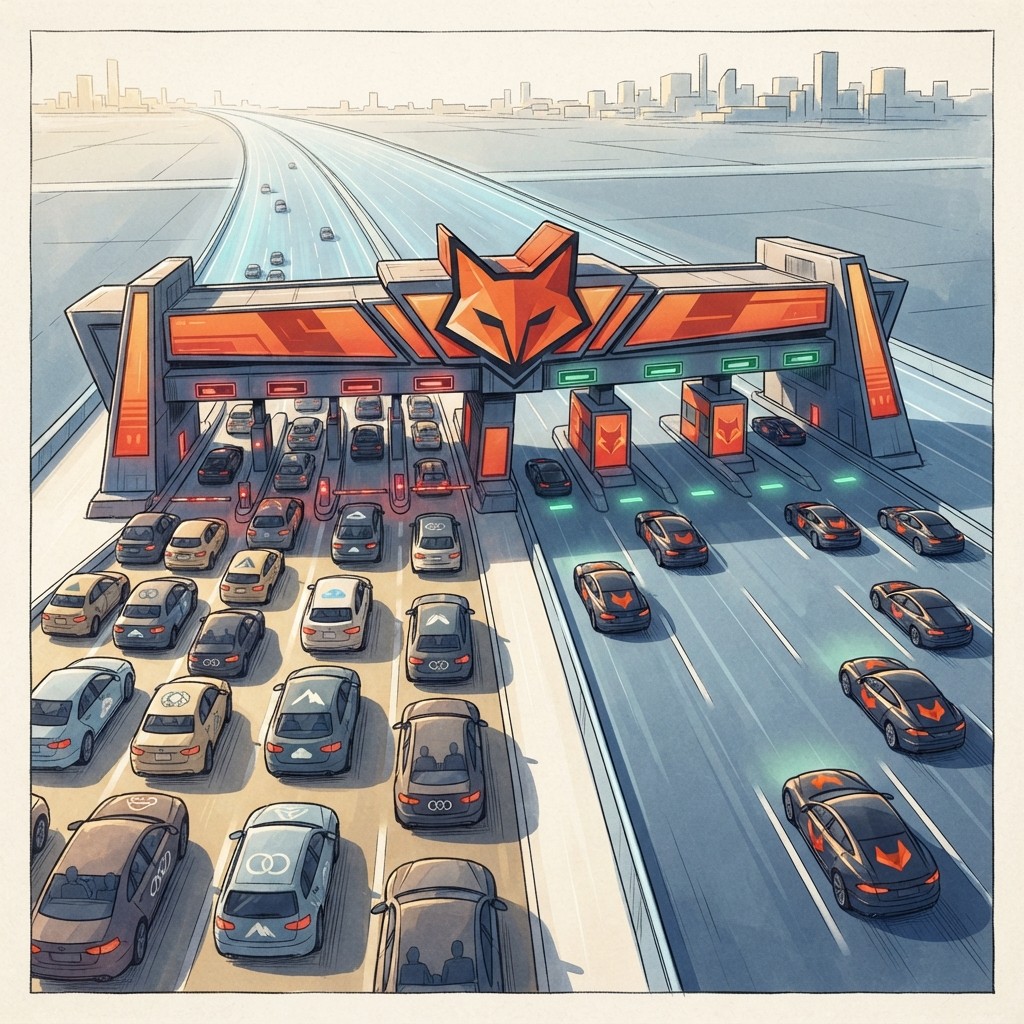
The official story is that Roku's neutrality was its moat - the impartial switchboard nobody could route around. The truer story is that neutrality was never an economic moat at all. It was a posture, and a posture only holds while the person holding it has no reason to drop it. Fox just handed it a reason.
The moat was a promise, not a wall
A real moat is structural: a network too dense to replicate, a switching cost too painful to pay, a tollbooth at a choke point no rival can dig around. Roku had a version of the choke point - it was the #1 selling TV operating system in the U.S. and Mexico, the default interface on millions of sets.4 But the thing that made content owners comfortable living on that interface wasn't the dominance. It was the promise that Roku would never compete with them for the viewer. Netflix would never wake up to find its tile demoted in favor of a Roku original, because there were no Roku originals worth promoting. The neutrality was credible precisely because Roku had nothing to gain by breaking it.
That is the difference between a positioning asset and an economic moat. A positioning asset survives only as long as the owner's incentives stay aligned with the promise. An economic moat survives even when they don't. Visa's tollbooth keeps working no matter how greedy Visa gets, because every transaction still has to physically pass through it. Roku's promise worked only while Roku stayed disinterested - and disinterest is not a wall. It is a mood.
| Roku's neutrality | A structural moat | |
|---|---|---|
| What protects it | The owner's restraint | The system's design |
| Survives a change of owner? | No | Yes |
| What a rival fears | That the promise breaks | That the road can't be re-built |
| Source of the value | Trust | Lock-in |
Why a content owner at the wheel changes everything
Here is the mechanism, worked all the way down. The aggregator model is two-sided: viewers on one side, content partners on the other. Roku monetized the partners - their ads, their placement, their subscriptions sold through the platform - while keeping both sides willing to stay. The viewers stay because the grid is convenient. The partners stay because the grid is fair. Pull the fairness and the partners start asking why they should hand a slice of their economics, and a pile of viewer data, to a company that now has its own horse in the race.
Fox owns content. It owns Tubi. The moment Fox controls the home screen, every rival service on it is distributing through a direct competitor that can tilt the grid, harvest the data, and decide whose tile sits where. NBC News reported exactly this risk: the acquisition introduces a content owner as controlling parent, altering platform incentives and giving rival media companies a reason to reduce their reliance on the platform.8 The neutrality that was Roku's selling point becomes the platform's liability - not because Fox will necessarily abuse it, but because partners now have to assume it could. In a trust business, the suspicion is the damage.
Notice the irony buried in the deal math. Fox is paying $160 a share, around $22 billion in enterprise value, with Fox shareholders set to own roughly 73% of the combined company and $400 million in targeted cost synergies.12 It is buying reach - over 100 million combined global streaming households.2 But the premium it paid was built on years of Roku being the impartial road. By owning that road, Fox cannot use it the way it would most want to without eroding the very thing it bought. Same screen. Opposite incentives.
“Frankly, we didn't think Roku had much of a chance.”7
It was independent by design, and that was the point
The independence wasn't an accident of history - it was baked in at birth. Anthony Wood founded Roku in October 2002, the sixth company of a serial builder; 'Roku' is Japanese for six.6 When Netflix wanted a streaming box, it hired Wood part-time to build one, then deliberately spun the team back out and took only a $6 million minority stake in 2008 - because Netflix wanted to be on every device, not trapped inside its own hardware.6 The whole reason Roku existed as a separate company was that the content world preferred a neutral box to a captive one.7 For two decades that logic held. The Fox deal inverts it: the captive box is back, except now it's the platform that's captive, and the content owner is the captor.
The honest objection: maybe neutrality was always overrated
The fair counter is that the neutrality story flatters Roku, and the business never lived up to the moat it claimed. Look at the economics. ARPU was essentially flat for years - $39.92 in FY2023, down 4%, before recovering to $41.49 in FY2024 - and Roku itself blamed the drag on international growth where monetization barely exists.53 A truly impregnable aggregator should have pricing power; Roku had a treadmill, adding households faster than it could monetize them. On that reading, the moat was already thin, and selling to Fox was simply a tired company taking a good price.8
That objection is right about the numbers and wrong about the conclusion. Flat ARPU doesn't prove there was no moat - it proves the moat was load-bearing in a different place. Roku's value was never premium pricing; it was being the unavoidable, trusted middle of an industry that didn't trust anyone who made content. The platform crossed $1 billion in a single quarter of platform revenue in Q4 2024 precisely because partners were willing to route through it.3 That willingness was the asset. The acquisition doesn't reveal the moat was thin. It reveals the moat was conditional - and the condition just expired.
The hardest test of a moat isn't whether rivals can copy it - it's whether it would still hold if you yourself stopped being trustworthy. A genuine economic moat protects you even when your incentives turn ugly: the tollbooth still sits at the choke point, the network is still too dense to rebuild. A positioning moat - 'we're the neutral one,' 'we're the open one,' 'we don't compete with our partners' - lives entirely on restraint, and restraint is the first thing an acquirer sheds. So before you bank on neutrality, openness, or impartiality as a defense, ask the uncomfortable question: what happens to this advantage the day someone with a different agenda owns it? If the answer is 'it evaporates,' you have a brand promise, not a wall.
Roku spent twenty years being the company nobody had to fear, and that fearlessness was the whole product. It owned the home screen by promising never to use it against the people who filled it. The promise was worth $22 billion - right up until the buyer was someone with every reason to break it. The lesson isn't that Roku lost. It's that some moats are made of trust, and trust is the one asset that cannot survive its own sale. The middle of the road is a powerful place to stand. It stops being powerful the instant it stops being the middle.
More moats that weren't what they looked like
Moat Anatomy Canvas
A one-page canvas that dissects a moat instead of asserting it: where the advantage comes from, how much of the market it covers, how long it would take to copy, and what keeps it from eroding. Blank to dissect your own claimed edge; filled as the worked example tracing the structure of the story's defensible advantage. Use it to tell a real moat from a head start.
Included, filled and blank, in the Moat Anatomy Casebook. See the set → · Preview the blank →
Sources
Where this comes from — the filings, records, and reporting behind it.
- 1Fox Corporation agreed to acquire Roku for $160.00 per share in cash and Fox Class A stock, valuing Roku at approximately $22 billion in enterprise value; deal announced June 15, 2026; Anthony Wood to join Fox Board; closing expected first half 2027.
- 2Fox Corporation 8-K corroborates $22B enterprise value acquisition of Roku; combined company reaches over 100 million global streaming households; $400M run-rate cost synergies targeted; Fox shareholders to own ~73% of combined company.
- 3FY2024: Roku Streaming Households 89.8M (up 9.8M from 2023); Streaming Hours 127.1B (up 21.1B YoY); ARPU $41.49 TTM (up 4% YoY); total net revenue $4.1B (up 18% YoY); platform revenue $3.5B (up 18% YoY); Q4 2024 was first quarter with >$1B in platform revenue.
- 4Q1 2024: Roku rebranded 'Active Accounts' to 'Streaming Households'; Streaming Households 81.6M (up 14% YoY); Streaming Hours 30.8B (up 23% YoY); Platform Revenue $755M (up 19% YoY); ARPU $40.65 TTM (flat YoY); Roku remained #1 selling TV OS in US and Mexico.
- 5FY2023: Roku ended with 80M Active Accounts globally and first full year exceeding 100B Streaming Hours (106B); Platform revenue $3.0B (up 10% YoY); total net revenue $3.5B (up 11% YoY); ARPU $39.92 (down 4% YoY due to international mix); achieved positive Adjusted EBITDA and Free Cash Flow for full year 2023, a year ahead of schedule.
- 6Roku was founded in October 2002 by Anthony Wood (ReplayTV founder); 'Roku' means 'six' in Japanese, Wood's sixth company; in 2007 Netflix employed Wood as VP of Internet TV; Netflix later spun Wood's engineering team back to Roku; Netflix invested $6M in Roku in 2008 as a minority equity investor; first Roku device launched May 2008.
- 7Reed Hastings said of Roku in 2008: 'Frankly, we didn't think Roku had much of a chance.' Wood took a part-time job at Netflix to build the device while remaining Roku CEO; the arrangement lasted nine months; Netflix wanted to be available on all devices (Xbox, PlayStation, Apple TV), which motivated spinning the project out.
- 8Roku's neutrality as an open-architecture interface treating Netflix, Disney+, Paramount+ and others equitably is the structural premise of its aggregator moat; the Fox acquisition introduces a content owner as controlling parent, altering platform incentives and potentially incentivizing rival media companies to reduce reliance on the platform.NBC News, Fox to buy Roku for $22 billion ↗ · 2026-06-15
Weighing outside help with a decision like this? Hiring a commercial due diligence provider
More like this — beyond Roku
New Strategically analyses as they publish: the defining moves in business, checked against the record. No noise, and one click to leave.