Pairs with the Moat Anatomy Canvas — a ready-to-use strategy tool. Included in the Moat Anatomy Casebook →
“What would it actually cost a challenger to take your customer?”
In 2024, $9.8 trillion moved across Mastercard's network, and the company kept $12.9 billion of it as profit - on an operating margin of 55.3%.12 It did this without lending a dollar, holding a single receivable, or carrying a cent of default risk. It is, on every metric, one of the most beautiful businesses ever built. So when people reach for the explanation, they reach for the cleanest one: network effects. More cardholders pull in more merchants, more merchants pull in more cardholders, and the loop spins itself into an un-attackable moat. It's a lovely story. It's also incomplete in a way that matters.
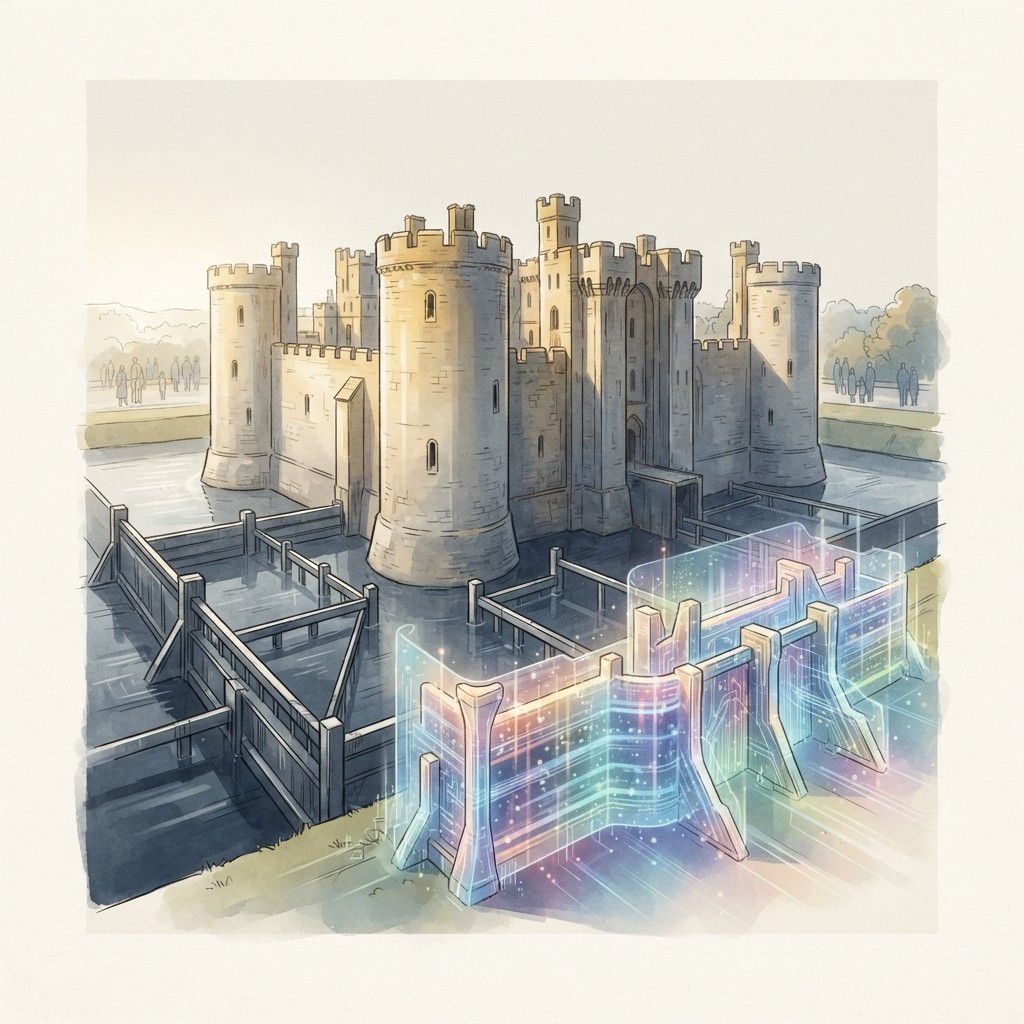
The official version is that Mastercard's moat is a pure network effect - the same self-reinforcing magic that protects every great platform. The truer version sits in court documents. The flywheel was real, but it was also fenced. For years the moat was fortified by rules: bans on banks issuing rival cards, bans on merchants steering customers to cheaper options. The network economics built the scale. The rulebook defended it.
A club before it was a company
Start with what Mastercard actually was. It wasn't founded as a company at all. In 1966 a group of banks formed the Interbank Card Association - conceived in Buffalo at the invitation of an executive at Marine Midland Bank, after BankAmericard's profitability became public knowledge and everyone wanted in.3 The name 'Mastercard' wouldn't exist until 1979. For four decades it was a cooperative: by the time it went public in 2006, it was owned by more than 25,000 financial institutions.4 That structure is the whole tell. A network owned by the banks that issue its cards is not a neutral platform. It is a coordination mechanism for its owners - and coordination mechanisms are excellent at writing rules that protect everyone inside the club and squeeze everyone outside it.
“Prior to the IPO it was a cooperative owned by more than 25,000 financial institutions.”4
Here is the part the network-effect story skips. A 2005 class action accused Mastercard, Visa, and the issuing banks of price-fixing the interchange fees merchants pay - and of enforcing rules that stopped merchants from steering shoppers toward cheaper payment methods. It was settled for $5.54 billion, approved in 2019 and affirmed on appeal in 2023.5 You don't pay $5.54 billion to settle a complaint about a network effect. You pay it to settle a complaint about a rulebook. The moat had two layers: the organic loop everyone admires, and a set of contractual restraints that made sure the loop never had to compete on price.
The thesis: a great network, propped on regulatory patience
So here is the read worth arguing for. Mastercard's moat is genuine - roughly 90% of card-processing volume outside China runs over Mastercard and Visa rails6 - but it was never the pure, organic network effect of legend. It was a strong two-sided network, fortified by exclusionary rules, and therefore structurally dependent on one thing the company doesn't control: how much coercion regulators are willing to tolerate. That dependency is exactly why Mastercard's most durable edge is quietly migrating away from the card rails themselves and toward the layer regulators can't legislate against - fraud screening, identity, and the data that flows over the network, a segment growing at more than twice the rate of core payment processing.11 The rails are the moat everyone sees. The data is the moat that's actually getting harder to cross.
| The card rails | The value-added layer | |
|---|---|---|
| What it is | Authorize, clear, settle | Fraud, identity, data services |
| How it was defended | Network scale + exclusionary rules | Proprietary data from $9.8T of volume |
| Regulatory exposure | High - routing mandates, fee caps | Low - hard to legislate against |
| Easy to bypass? | Yes, via A2A rails | Not without the data |
Why the wrappers aren't the threat - and the sovereigns are
The popular fear is that digital wallets will eat the card networks. Tap your phone, skip the plastic, cut out Mastercard. It's a myth in its strong form. Apple Pay and Google Pay tokenize the underlying card credential and route transactions over Mastercard and Visa rails - they're front-end wrappers, a prettier way to ride the same road, not a rival road.9 Every tap still pays the toll. The genuine threat doesn't come from Silicon Valley. It comes from governments. Account-to-account systems like India's UPI and Brazil's Pix move money bank-to-bank with no card network in the middle at all, and in China, state control and super-apps have effectively shut Mastercard out of the domestic market entirely.8 These are sovereign networks, built by states with the authority to mandate adoption - and where they win, Mastercard's toll simply isn't collected.
Notice the symmetry. A moat built partly on rules is most threatened by entities that write their own rules. Fee caps and routing mandates - like the proposed Credit Card Competition Act, which would force the biggest U.S. banks to offer a second routing network on credit transactions and let smaller networks compete on price7 - chip at the rails from inside. Sovereign A2A systems route around them from outside. Both attacks aim at the same soft spot: the part of the moat that was never network economics, only regulatory permission. What they can't easily touch is the intelligence Mastercard accumulates by sitting in the middle of $9.8 trillion of spending - the fraud models, the identity verification, the data layer that any new rail, government-built or not, still has to reinvent from scratch.
Isn't a 55% margin proof the moat is fine?
The fair objection is that this is too pessimistic. Mastercard grew net revenue 12% and net income 15% in 2024, with cross-border volume up 18%, all while the antitrust suits were settling and the A2A systems were scaling.1 If the moat were really propped on borrowed regulatory time, you'd see it in the numbers. You don't. The honest answer: that's exactly what a slow erosion looks like at the early stage. UPI and Pix are concentrated in their home markets, cash is still the real enemy Mastercard is busy converting, and a duopoly that controls 90% of non-China card volume6 has enormous runway before any of this bites. The point isn't that the moat is crumbling. It's about what kind of moat it is. A moat defended by rules is only as deep as the appetite to enforce those rules - and that appetite, unlike a network effect, isn't an asset Mastercard owns. So it's building one it can: an edge made of data, not permission.
A fat margin tells you a moat exists; it does not tell you what the moat is made of. Some moats are made of network economics - genuinely self-reinforcing, owned outright. Some are made of contractual restraints and regulatory tolerance - rented, not owned, and only as durable as the patience of the people who could revoke them. The test: ask what would have to change for the margin to fall, and whether the company controls that thing. If the answer is 'a regulator's mood' or 'a rule it was once sued over,' you're looking at a moat that depends on permission. The smart players know it - which is why they quietly build a second moat out of something no legislature can mandate away. For Mastercard, that's the data flowing over the rails, not the rails themselves.
Mastercard built one of the great businesses by sitting in the one place every transaction has to pass and taking a sliver of each. But it didn't just find that place - for forty years it was a club that wrote the rules of who else could stand there, and it paid $5.54 billion to settle the bill for some of those rules.5 The network effect was real. So was the fence around it. As the fence gets harder to defend - in courtrooms, in Congress, in the central banks building rails of their own - the company is busy moving its weight onto the one footing no one can legislate: not the road, but everything it knows about the trillions that travel it. The card was always the visible moat. The data was always the deeper one.
More moats, taken apart at the seams
Moat Anatomy Canvas
A one-page canvas that dissects a moat instead of asserting it: where the advantage comes from, how much of the market it covers, how long it would take to copy, and what keeps it from eroding. Blank to dissect your own claimed edge; filled as the worked example tracing the structure of the story's defensible advantage. Use it to tell a real moat from a head start.
Included, filled and blank, in the Moat Anatomy Casebook. See the set → · Preview the blank →
Sources
Where this comes from — the filings, records, and reporting behind it.
- 1Mastercard full-year 2024: GDV $9.8 trillion (+11% local currency), cross-border volume +18%, switched transactions +11% to 159.4 billion, net revenue $28.2B (+12%), net income $12.9B (+15%).
- 2Mastercard 2024 10-K: GDV for Mastercard-branded programs was $9.8 trillion; operating margin 55.3%; ~911M shares outstanding Class A as of February 7, 2025.
- 3Mastercard was conceived in 1966 as the Interbank Card Association (ICA), formed in Buffalo, NY at the invitation of Karl H. Hinke of Marine Midland Bank, in response to BankAmericard's profitability becoming public knowledge. The name 'MasterCard' was not adopted until 1979.
- 4In 2006, Mastercard made its IPO, becoming a publicly traded company. Prior to the IPO it was a cooperative owned by more than 25,000 financial institutions. Visa IPO'd separately in 2008.
- 5A class-action antitrust lawsuit filed in 2005 by merchants against Visa, Mastercard, and issuing banks for price-fixing interchange fees was settled for $5.54 billion (approved by U.S. District Judge Margo K. Brodie, February 2019); the Second Circuit affirmed the approval in March 2023.
- 6Mastercard and Visa together control roughly 90% of card payment processing volume outside China; they operate as pure network operators—taking no credit risk and holding no receivables.
- 7The Credit Card Competition Act (CCCA) represents the primary U.S. regulatory threat: if passed, it would require banks with over $100 billion in assets to offer at least two routing networks for credit transactions, forcing price competition with smaller networks.
- 8Government-sponsored A2A systems (India's UPI, Brazil's Pix) bypass Mastercard's rails entirely; in China, state control and super-apps have effectively blocked Mastercard from the domestic market. These sovereign networks are the primary structural threat, not fintech startups or digital wallets.
- 9Apple Pay and Google Pay tokenize the underlying card credential and route through the same card networks as the customer's associated payment method; on merchant processing statements they appear as the underlying card type (Visa, Mastercard, etc.).
- 10The rules of Visa and MasterCard barring banks from issuing cards on the Discover Network violated antitrust laws; the DOJ sued in 1998, won in 2001, and Mastercard paid $1.8 billion to American Express in 2004 for anticompetitive practices that prevented American Express from issuing cards through U.S. banks.
- 11Mastercard's value-added services segment now accounts for nearly 40% of total revenues, growing 23% in 2025, driven by fraud prevention, identity verification, cybersecurity, data analytics, and open banking — outpacing core network growth.
Weighing outside help with a decision like this? Hiring a commercial due diligence provider
More like this — beyond Mastercard
New Strategically analyses as they publish: the defining moves in business, checked against the record. No noise, and one click to leave.