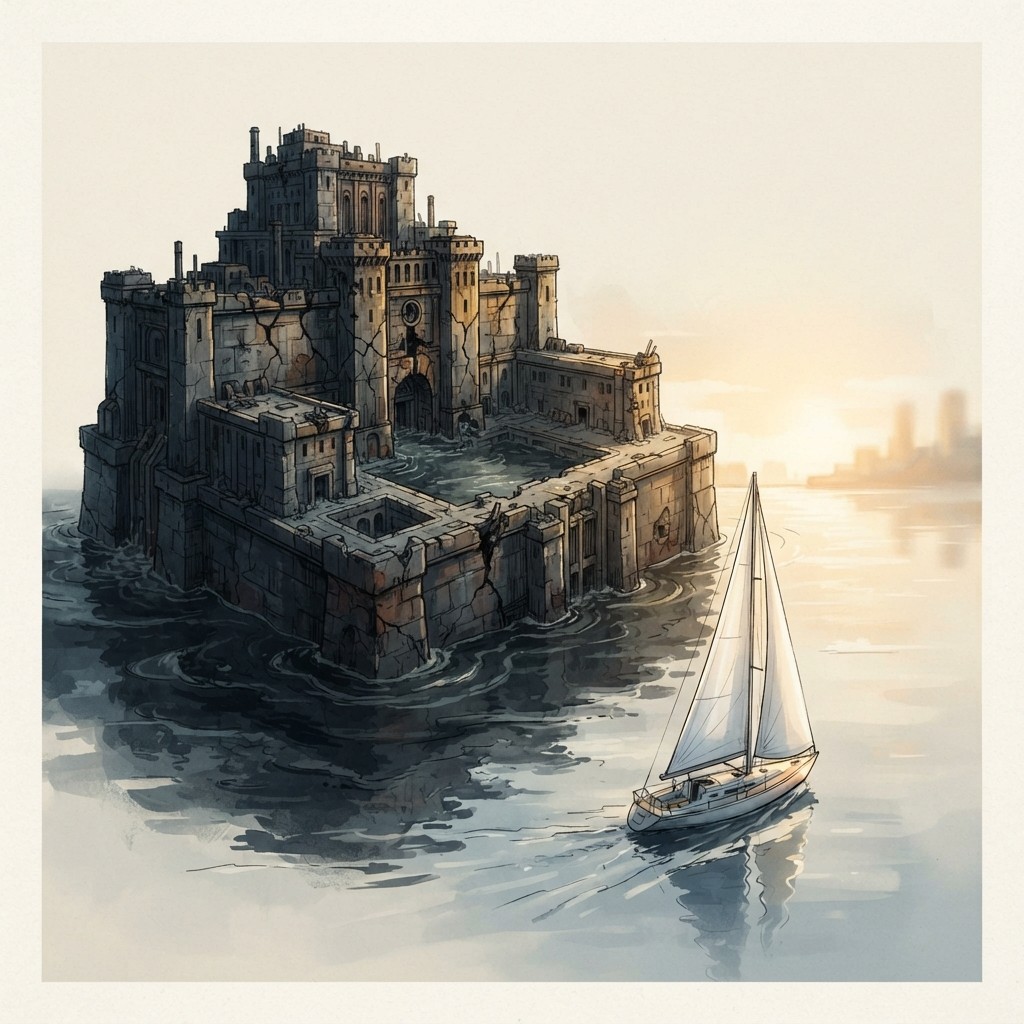
Pairs with the Moat Anatomy Canvas — a ready-to-use strategy tool, filled for AMD vs Intel. Included in the Moat Anatomy Casebook →
“What would it actually cost a challenger to take your customer?”
For most of its life, Intel made its own chips in its own factories, and that was the entire point. The crown jewel of the company was not a circuit design — it was the ability to design the chip and the manufacturing process together, in the same building, one node ahead of everyone on earth. AMD spent thirty years trying to beat that and mostly couldn't. Then it stopped trying. It sold off the factories, bought its manufacturing from someone else, and waited. And in 2018, the thing it had been losing to for decades broke from the inside: Intel's next factory process, due for mass production by the end of 2015, was years late and would not ship in a desktop chip until the back half of 2021.5
The popular story is that AMD finally built a better chip and won on merit. That's the surface. The deeper move is uglier and more interesting: AMD didn't out-engineer Intel so much as it stopped owning the one liability that would eventually sink the king. The factory that was Intel's moat became Intel's anchor — and AMD had already cut itself loose from that same kind of anchor years earlier.
The deal that built the rivalry was never a gift
Go back to the beginning, because the founding myth is wrong in a way that matters. AMD didn't get into the x86 business because Intel was generous. IBM, choosing a processor for the IBM PC, would not place the order unless Intel guaranteed a second source — a backup manufacturer who could keep chips flowing if Intel stumbled. So Intel licensed AMD, not out of goodwill but as the price of IBM's business, under a ten-year technology-exchange agreement first signed in October 1981 and formally executed in February 1982.1 The lesson sat there in plain sight from day one: a customer that big wants resilience, and resilience means not betting the whole supply chain on a single factory floor.
The partnership curdled fast. When the 386 arrived, Intel decided internally — around 1984 — to stop handing AMD the technical details. AMD invoked arbitration in 1987 and eventually won a royalty-free right to the 386, upheld by the California Supreme Court in 1994.2 But the win was muddier than the legend: the arbitrator found Intel had breached the contract and that AMD had failed to keep pace with the industry — a plague on both houses. AMD had to reverse-engineer the 386 anyway, the hard way, over years, because the chip had nearly ten times the transistors of the 8086. The relationship was settled for cash much later, in November 2009, when Intel paid AMD $1.25 billion to drop every lawsuit and complaint worldwide and signed a fresh five-year cross-license — a private deal, with no admission of wrongdoing, not a regulatory fine.3
“Intel paid AMD $1.25 billion; the companies entered a new 5-year patent cross-license, and AMD agreed to drop all pending litigation and withdraw all regulatory complaints worldwide.”3
By 2014 the litigation was history and so, nearly, was AMD. Its chips couldn't compete on performance — the Bulldozer-era parts had lost the per-clock race that had run against AMD since 2012 — and its x86 share had collapsed to around 11–12% across 2015 and 2016.8 The stock traded in the low single digits. What kept the lights on wasn't a hit CPU; it was the semi-custom chips inside the PlayStation 4 and Xbox One, a steady cheque that bought AMD time it had no right to expect.8 Into that, the board named Lisa Su CEO in October 2014.4
The crown jewel and the trap are the same object
Here is the thesis, plainly: AMD's comeback was not primarily a product-innovation story. It was a structural moat inversion. By going fabless and buying its manufacturing from TSMC, AMD escaped the integrated-device-maker trap — the obligation to advance your own factory in lockstep with your own designs — and forced Intel to compete on architecture alone, at the exact moment Intel's own factory roadmap fell apart.
Understand what the integrated model actually is. An IDM like Intel designs the chip and manufactures it under one roof, tuning the transistor process and the circuit together. When it works, it's the deepest moat in the industry — you get a node nobody else can buy. But it binds two roadmaps into one. If the factory slips, the products slip with it, and there is no escape hatch, because the factory is yours and only yours. A fabless company has no such tether. If its foundry stumbles, it can shift to whoever has the best node going. AMD turned a weakness — it could no longer afford world-class fabs — into the thing that saved it.
| Intel (integrated device maker) | AMD (fabless) | |
|---|---|---|
| Owns the factory | Yes | No — buys from TSMC |
| Roadmaps bound together | Design and process, in lockstep | Design only; process is rented |
| When the leading node slips | Products are stuck on the old node | Move designs to the best node available |
| The moat | A node nobody can buy — until it breaks | Always on whoever's node is best |
Then the break came. Intel's 10nm process was targeted for mass production by the end of 2015. It slipped to 2017, then to 2019 for volume, and the first 10nm desktop CPUs didn't ship until the second half of 2021 — roughly six years past the original plan, dragged down by a cascade of yield failures across multiple years. In July 2020 Intel made it worse, disclosing a defect in its 7nm process running about a year behind internal targets.5 For half a decade, the company's product line was lashed to a factory that wouldn't deliver, and the IDM model offered no way out.
AMD didn't win a single battle — it climbed a staircase
AMD's part of the story is often told as one dramatic leap in 2017. It wasn't. The first Zen-based Ryzen chips launched in early 2017 on GlobalFoundries' 14nm — competitive, not crushing. The real move came with Zen 2 in July 2019, when AMD shifted to TSMC's 7nm node and adopted a chiplet design, stitching small dies together instead of betting on one big one.6 That was the inversion made physical: AMD was now riding the best process on the planet while Intel was stranded on its own. The share gains were a staircase, not a jump — about 11% in 2016, ~16% by the end of 2017, 22.4% by Q3 2020, and roughly 29% by the end of 2025.67
Note which number to trust. AMD and Intel both cite Mercury Research in their earnings releases — that's unit shipments, the authoritative count.7 The flashier benchmark-submission charts that show ten-point swings measure who's submitting tests, not who's selling chips. The honest figure is the patient staircase, and the staircase is more convincing than any single leap: it traces the slow compounding of a structural edge, quarter after quarter, while the king couldn't fix his factory.
Isn't this just luck dressed up as strategy?
The fair objection is that AMD got lucky. It didn't sabotage Intel's 10nm node — Intel did that to itself — and AMD's salvation rode on TSMC executing flawlessly, which AMD also didn't control. Strip the luck away and what's left? More than it looks. The choice to go fabless was not luck; it was a decision to stop carrying the one liability that could kill you, made by a company that couldn't afford the alternative anyway. AMD didn't predict the 10nm collapse. It positioned so that whenever Intel's factory faltered — and an integrated maker's factory will eventually falter — AMD would be holding the better hand by default. Luck is what happens to your position. A good position is what turns one rival's stumble into your decade. AMD built the position; Intel supplied the stumble; the win required both, and only one of them was AMD's job.
Vertical integration is sold as the ultimate moat: own the whole stack and nobody can touch you. But integration binds your roadmap to your weakest link, and removes the escape hatch when that link breaks. Intel's factories were unbeatable until the day they weren't — and on that day, owning them meant there was nowhere to run. AMD's lesson is the uncomfortable one: sometimes the strongest move isn't to own more of the system, it's to own less of the part most likely to fail, and rent the rest from whoever's best. Before you celebrate an asset as your moat, ask the harder question — on the day it breaks, does owning it trap you? If it does, it was never only a moat.
The IBM PC story and the 10nm story rhyme across forty years. In 1981, a customer too big to argue with insisted that no single factory should be a single point of failure — and Intel licensed AMD because of it.1 In the 2010s, Intel ignored its own founding lesson and let one factory roadmap become exactly that point of failure. AMD's genius wasn't a faster chip. It was refusing to own the thing that would eventually break, and waiting — patiently, on the best node money could rent — for the king to discover what his crown jewel cost him.
When the strongest asset becomes the trap
Moat Anatomy Canvas
A one-page canvas that dissects a moat instead of asserting it: where the advantage comes from, how much of the market it covers, how long it would take to copy, and what keeps it from eroding. Blank to dissect your own claimed edge; filled as the worked example tracing the structure of the story's defensible advantage. Use it to tell a real moat from a head start.
Included, filled and blank, in the Moat Anatomy Casebook. See the set → · Preview the blank →
Sources
Where this comes from — the filings, records, and reporting behind it.
- 1IBM required Intel to provide a second-source manufacturer before it would use the 8086 in the IBM PC; Intel and AMD entered a 10-year technology exchange agreement first signed October 1981 and formally executed February 1982, making AMD a licensed second-source manufacturer of 8086 and 8088 processors.
- 2Intel internally decided in 1984 to stop sharing 80386 technical details with AMD; AMD invoked arbitration in 1987; the 1990 arbitrator found Intel breached the 1982 contract (though also found AMD at partial fault); in 1992 AMD was awarded $15M and a permanent royalty-free right to the 386; the California Supreme Court upheld this in 1994.
- 3On November 12, 2009, Intel and AMD announced a comprehensive settlement: Intel paid AMD $1.25 billion, both companies entered a new 5-year patent cross-license, AMD dropped all pending litigation and withdrew all regulatory complaints worldwide, and Intel agreed to abide by business practice provisions.
- 4AMD's board appointed Dr. Lisa T. Su as President and CEO on October 8, 2014, succeeding Rory Read; Su had joined AMD in January 2012 and served as SVP & COO from July 1, 2014.
- 5Intel's 10nm process was originally targeted for mass production by end-2015; it slipped first to 2017, then to 2019 for volume production; first 10nm desktop CPUs did not ship until second half of 2021 — a roughly six-year delay driven by yield degradation. Intel simultaneously disclosed a defect in its 7nm process in July 2020, trending approximately 12 months behind internal targets.
- 6AMD's first Zen-based Ryzen processors launched February–March 2017 on GlobalFoundries' 14nm node; Zen 2 (July 2019) moved to TSMC 7nm and introduced chiplet architecture; AMD's overall x86 market share (Mercury Research) rose from ~11% (2016) to ~16% (Q4 2017), ~22% (Q3 2020), and ~29% (Q4 2025).
- 7AMD's market share recovery used Mercury Research data as the authoritative source (cited in AMD and Intel earnings releases); in Q3 2020, Mercury Research reported AMD at 22.4% overall x86 share, a 4.1 share-point sequential increase and 6.3 share-point year-on-year increase.
- 8AMD's Zen architecture reversed a performance gap that had persisted since 2012, with AMD's Bulldozer-era products failing to compete on IPC; AMD's pre-Zen market share had fallen to approximately 11–12% across 2015–2016, with the company surviving primarily on semi-custom APU revenue from PlayStation 4 and Xbox One.
Weighing outside help with a decision like this? Hiring a commercial due diligence provider
More like this — beyond AMD vs Intel
New Strategically analyses as they publish: the defining moves in business, checked against the record. No noise, and one click to leave.