Pairs with the Flywheel Designer Canvas — a ready-to-use strategy tool. Get it — included with a subscription, or $1.99 →
A Tesla in Phoenix brakes a little too hard for a left-turning truck, recovers, and drives on. The driver barely notices. But the car noticed: the moment is packaged, anonymized, and beamed back to a training cluster where it joins billions of others. In the third quarter of 2025 alone, Tesla received 2.5 billion telemetry packages from a global fleet of millions of vehicles.8 No survey gathered that. No lab simulated it. It arrived for free, while people were just trying to get to work. That is the flywheel — and almost everyone is pointing at the wrong one.
The official story is that Tesla's flywheel is a cost machine: build more cars, gain scale, push battery prices down, sell more cars, repeat. It is a clean loop, and it is mostly a myth. The cost decline was real and enormous — and it happened to the entire industry, not to Tesla alone.
The cheaper-battery loop belongs to everyone
Lithium-ion pack prices fell roughly 90% between 2008 and 2023 — from about $1,415/kWh to $139/kWh in constant dollars, per the U.S. Department of Energy.4 BloombergNEF's survey traces the same curve from a different start: $732/kWh in 2010 down to $111/kWh by 2024.5 If that decline were Tesla's private flywheel, you'd expect it to be Tesla's private benefit. It isn't. The DOE attributes the drop to chemistry, manufacturing, and global production volume — a tide that lifted CATL, BYD, and every legacy automaker's EV program at once.4 The curve even broke its own straight line: pack prices actually rose in 2022 on a commodity spike, the opposite of what a self-reinforcing cost loop would predict.5
Tesla's own attempt to own this loop has stumbled. Its proprietary 4680 cell program was supposed to be the in-house cost weapon — and at the company's mid-2024 shareholder meeting, the CEO dodged direct questions on 4680 costs and noted that suppliers had drastically cut their prices — with Tesla still aiming for cost parity by year-end rather than claiming an advantage9. When your secret-sauce battery is more expensive than the off-the-shelf one, the battery is not your moat. The real proof showed up in the income statement: in 2024, total automotive revenues fell 6% to $77.07 billion, down from $82.42 billion the year before.110 An accelerating cost-and-volume flywheel does not produce a shrinking car business.
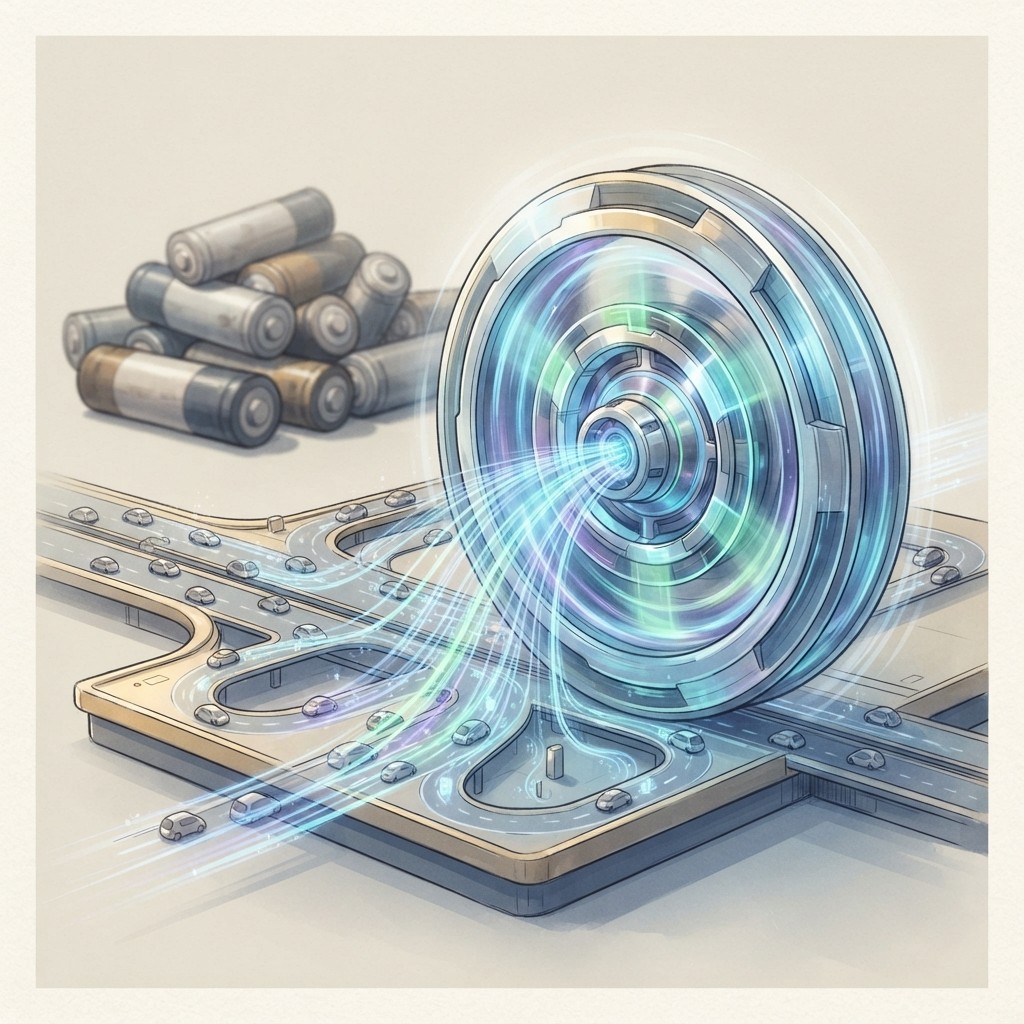
Here is the thesis, plainly: Tesla's real flywheel isn't cheaper batteries — it's miles. Every car on the road is a sensor that pays for itself, generating proprietary driving data that compounds into an AI lead no competitor can simply purchase. The cost loop is a commodity. The data loop is the asset.
Why the data loop is the one no one can buy
A flywheel needs a self-reinforcing turn, and the data loop has one a balance sheet can't replicate. More cars sold means more cameras on more roads. More cameras means more rare, weird, hard-to-simulate moments — the dog that darts out, the faded lane line, the construction cone in the wrong place. More of those edge cases means a better model. A better model sells more cars. The turn isn't capital; it's coverage. And the coverage is already vast: annual FSD miles grew from roughly 6 million in 2021 to 80 million in 2022, 670 million in 2023, and 2.25 billion in 2024, according to data compiled by Tesla watchers and widely reported — after Tesla boosted its AI training compute capacity by 400% in a single year.7 The fleet that crossed 3.6 billion cumulative supervised miles by March 20257 passed 10 billion by May 2026.6
| The cost loop (the myth) | The data loop (the moat) | |
|---|---|---|
| What turns it | Production volume | Cars on the road |
| Who else has it | The whole EV industry | Almost no one at this scale |
| Can a rival buy in? | Yes — from CATL, BYD | No — miles can't be purchased |
| Tesla's own status | 4680 cells cost more, not less | 10B+ supervised miles by 2026 |
This is the part competitors underestimate. A rival can license a battery chemistry, buy a cell line, hire away engineers. None of that buys a decade of real-world miles from millions of cars in the wild. Data assembled this way is path-dependent — you can only get it by having already sold the cars that generate it. That is what makes the loop a moat rather than a feature: the lead widens precisely because Tesla got there first and kept driving.
But does more data actually make the driving safe?
The honest objection is the one that decides everything: a data flywheel only matters if data volume mechanically converts into safe autonomy — and the evidence that it does is shaky. The 10-billion-mile threshold itself was a moved goalpost. The CEO had previously suggested 6 billion miles would be enough; in January 2026, after missing his own promise to deliver unsupervised FSD by the end of 2025, he reset the bar to roughly 10 billion. The fleet hit it in May 2026 — and regulators still had not cleared unsupervised driving.6 His self-driving timelines have been wrong for years, and these are multi-year misses, not rounding errors. A flywheel that keeps spinning while the finish line keeps moving is not obviously delivering the thing it's supposed to.
Worse, the safety math is disputed at the source. Tesla's robotaxi fleet in Austin logged 14 crashes in about 800,000 miles — roughly four times the minor-collision rate Tesla's own Vehicle Safety Report claims for average American drivers.6 And Tesla's own safety report concedes it uses internally derived minor-collision ratios rather than independent crash databases.8 So the company grading the flywheel's output is also writing the rubric. That doesn't prove the data is worthless — coverage genuinely is rare and valuable — but it punctures the tidy claim that more miles automatically equals safer driving. The flywheel reliably produces a dataset. Whether it reliably produces autonomy is still, after a decade, an open question.
Not every flywheel is a moat. The test is simple: can a well-funded competitor purchase their way into the same loop? If yes — like cheaper batteries available from any supplier — it's a tide, not an advantage. The durable loops are the path-dependent ones: data, network density, accumulated trust, things you can only earn by having already done the thing. But there's a second test most analysts skip: does the loop's output actually compound the thing you claim? A flywheel that reliably produces a vast dataset, yet hasn't reliably produced the safe autonomy it was built to deliver, is spinning — just not necessarily toward the prize. Measure the output, not the motion.
Tesla built the most genuinely uncopyable asset in the car business — and it isn't the battery, the brand, or even the best-selling Model Y. It's the quiet stream of moments from millions of windshields, arriving for free, that no rival can assemble by writing a check.7 The cost-reduction story was the one the world told because it was easy to draw on a whiteboard. The real flywheel is harder to see and harder to copy: a fleet that turns ordinary commutes into proprietary fuel. The open question is no longer whether Tesla can gather the miles. It's whether the miles were ever the same thing as the answer.
Loops that compound — and ones that only look like it
Flywheel Designer Canvas
A one-page canvas for mapping a business's flywheel: the reinforcing loop, how it was started, the second-order loops it spins off, the moat it creates, and how it could spin backward. Use it to diagnose whether you have a real flywheel or a funnel drawn in a circle — and to design one of your own.
Included with any subscription, or unlock this tool for $1.99. Get it → · See plans →
Sources
Where this comes from — the filings, records, and reporting behind it.
- 1Tesla FY2023 total revenues were $96.773B (automotive sales $78.509B; energy generation and storage $6.035B; services and other $8.319B); FY2024 total automotive revenues fell 6% YoY to $77.07B; energy generation and storage rose 67% to $10.086B.
- 2Tesla FY2024: $7.1B GAAP operating income; total revenues $97.69B; energy generation and storage revenue $10.086B (up 67% YoY); total automotive revenues $77.07B (down 6% YoY); average COGS per vehicle hit an all-time low in Q4 2024.
- 3Tesla 2023 total vehicle deliveries were 1,808,581 (up from 1.31M in 2022); Q4 2023 deliveries were 484,507. CEO Musk said during Q3 2023 earnings call that Model Y was likely to be the best-selling car on Earth in both revenue and unit volume.
- 4The U.S. DOE reported that average Li-ion EV battery pack prices dropped 90% between 2008 and 2023 — from $1,415/kWh (2023 constant dollars) in 2008 to $139/kWh in 2023 — driven by improvements in battery technologies, chemistries, manufacturing, and production volume. This is an industry-wide trend, not specific to Tesla.
- 5BloombergNEF's 2024 Battery Price Survey shows pack-level costs fell from $732/kWh in 2010 to $111/kWh in 2024 — an 85% reduction in 14 years — corroborating the DOE data. At least one source notes battery prices actually increased in 2022 due to commodity price spikes, breaking the straight-line decline narrative.
- 6Tesla's FSD (Supervised) fleet crossed 10 billion cumulative miles in May 2026 per Tesla's updated safety page — the threshold Musk set in January 2026 for 'safe unsupervised' driving. This was a moved goalpost: he had previously cited 6 billion miles as sufficient. The Austin robotaxi fleet reported 14 crashes in ~800,000 miles — approximately four times the average human-driven crash rate in similar urban conditions.
- 7Tesla's FSD (Supervised) fleet surpassed 3.6 billion cumulative miles by March 2025, with 2.16 billion of those miles logged in 2024 alone. Tesla boosted AI training compute capacity by 400% in 2024. Annual FSD miles grew from ~6M in 2021 to 80M in 2022, 670M in 2023, 2.25B in 2024, and 4.25B in 2025.
- 8Tesla's official Vehicle Safety Report states that in Q3 2025 alone, Tesla received 2.5 billion telemetry packages from its global fleet (excluding China), and that the fleet comprises millions of vehicles worldwide generating real-world driving data at scale. Tesla's own methodology note acknowledges using internally derived minor-collision ratios rather than independent crash databases.
- 9At the 2024 annual shareholder meeting, Musk avoided a direct answer on 4680 costs and said suppliers had drastically lowered their battery prices, with Tesla aiming for cost parity with third-party suppliers by year-end — implying the home-built cells had not yet reached parity.
- 10Tesla FY2023 total automotive revenues were $82,419 million ($82.42 billion), per the multi-year financial summary in Tesla's FY2024 annual report.
- 11Musk's January 2026 post raised the bar to 10 billion miles after Tesla failed to deliver unsupervised FSD by the end of 2025 — a deadline he had previously committed to publicly.
More like this — beyond Tesla
New Strategically analyses as they publish: the defining moves in business, checked against the record. No noise, and one click to leave.