Pairs with the Flywheel Designer Canvas — a ready-to-use strategy tool. Included in the Flywheel Casebook →
“What does your loop actually return, and how much of it is left?”
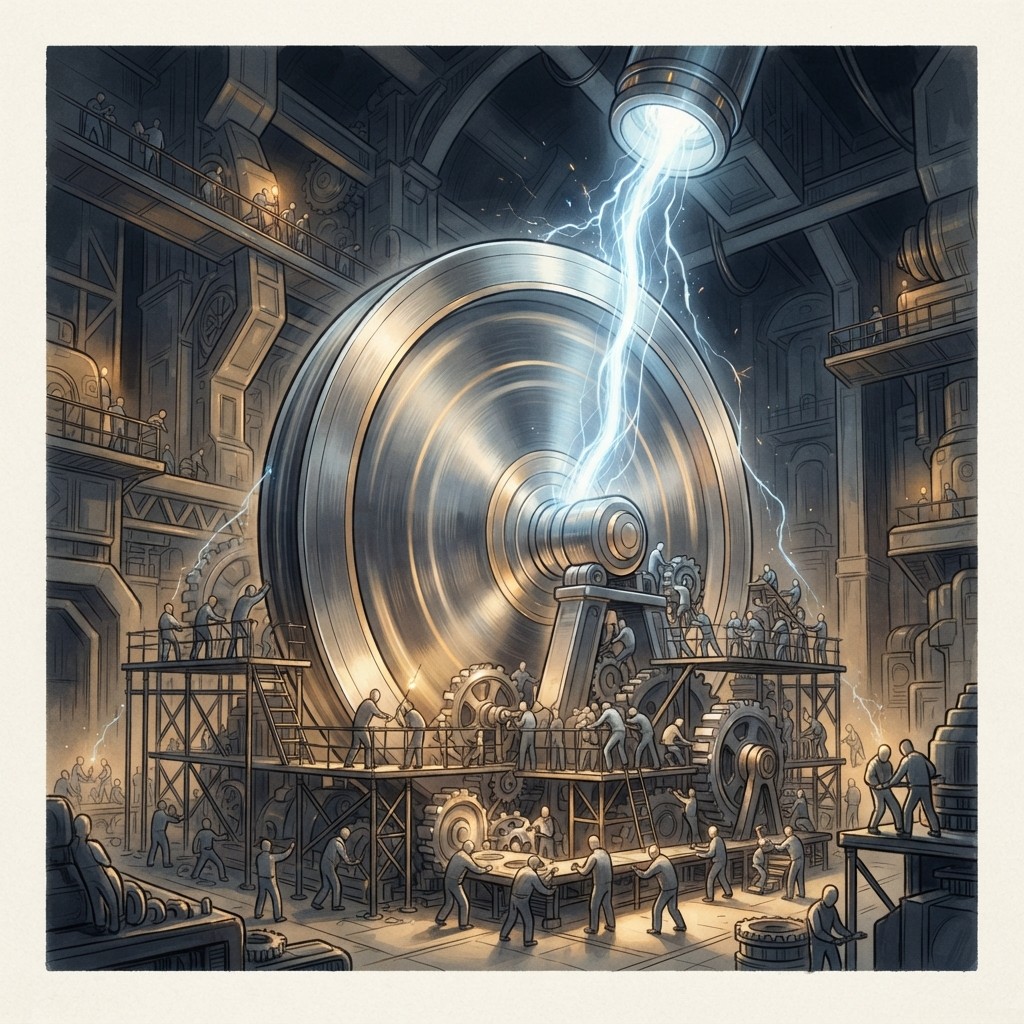
A nine-year-old logs in, drops into a game another kid built last spring, and spends real money — turned into a currency called Robux — to buy a hat that doesn't exist anywhere outside the screen. On any given day in 2024, about 82.9 million people did some version of this, for 73.5 billion hours of engagement.1 Almost none of those games were made by Roblox. The company built the workshop, the storefront, the currency, and the rails. The players bring the demand; an army of outside creators brings the supply; and Roblox stands in the middle taking a cut of every transaction. That loop is the entire machine. The only real question is who it spins for.
The official story is a creator paradise: anyone can build a game, players flood in, and Roblox writes the developers life-changing checks. The pieces are even true. Developer payouts hit $922.8 million in 2024.1 But the headline number is the loud part. The quiet part — the part written into the spread between buying Robux and cashing them out — is where the flywheel reveals who it was really designed to enrich.
The loop is real — and it accelerates on its own
Roblox's flywheel is not marketing fluff; the company names it that way in its own filings. More content pulls in more players, more players make a bigger audience, a bigger audience pulls in more creators, more creators make more content — and around it goes.5 The numbers show the wheel genuinely turning. In fiscal 2025 revenue grew 36% to $4.9 billion and bookings grew 55% to $6.8 billion, with roughly 60 million daily active users added from the end of 2024 to the end of 2025.3 Roblox attributed the surge to 'increased content diversity and deeper engagement' feeding 'the Roblox flywheel.'3 When a system grows faster the bigger it gets, it has a flywheel. Roblox has one of the most powerful in consumer software.
The spread is the business, and creators sit on the wrong side of it
Here is the move almost everyone misses. The popular shorthand is that Roblox 'gives creators 30%.' Roblox's own stated figure is closer to 25% of user spend.6 And an independent investigation by People Make Games found the real number can fall as low as 17 cents on the dollar — because the loss isn't one fee, it's a spread — a finding WBUR's reporting on the investigation corroborated.6 Players buy Robux at one price; developers redeem Robux for cash at a far worse one. The investigation's example is brutal in its simplicity: players buy 100,000 Robux for roughly $1,000, but a developer redeems those same 100,000 Robux for only about $350.6 The currency is the toll. Money goes in expensive and comes out cheap, and the difference never has to be itemized as a cut, because it's baked into the exchange rate itself. Steam and comparable platforms hand developers 70 to 89 cents on the dollar.6 Roblox keeps a wider slice than the major platforms it most directly competes with for developer supply — and most of the people building its inventory never see the math.
| Roblox (effective) | A typical platform (e.g. Steam) | |
|---|---|---|
| Stated to creators | ~25% | 70–89% |
| Investigation found as low as | ~17% | — |
| How the cut is taken | A buy/sell spread on Robux, not a line item | An explicit revenue share |
| Who bears the risk of a flop | The creator | The creator |
Because Robux is bought dear and redeemed cheap, the platform's take is set by the exchange rate, not by a published percentage. The same 100,000 Robux that cost a player ~$1,000 to buy redeem for only ~$350 to a developer.6 That gap is structural: it scales automatically with volume, requires no negotiation, and never appears to anyone as a fee. The more the flywheel spins, the more the spread compounds — for the house.
Aggregate growth, individual scarcity
The aggregate payout numbers are designed to dazzle, and they do. Creators earned a record $281.6 million in the first quarter of 2025 alone, and more than 100 developers cleared $1 million over the prior twelve months.8 But step from the aggregate to the individual and the picture inverts. Roughly 24,500 developers qualified for DevEx in 2024, with a median earning of about $1,575 for the year.7 Out of 82.9 million daily users, only about one million pay anything at all.1 The vast majority of the audience is players, not earners; the vast majority of earners make beer money; and the headline millions concentrate at the very top. The flywheel produces a few breakout fortunes and a very long tail of hobbyists — and the long tail is the supply that keeps the wheel full.
Isn't a tiny cut on a huge platform still a great deal — and isn't this just child labor?
Two fair objections. The first: even 25 cents of access to 82.9 million daily users beats 80 cents of access to nobody, and Roblox provides the engine, the hosting, the payments, the moderation, and the distribution that no solo teenager could build. That's real, and it's why creators keep showing up. But notice that 'we offer access nobody else can' is exactly the argument every dominant platform makes right before it widens its take — and Roblox, even after raising the DevEx rate 8.5% in September 2025, still sits far below industry norms.46 The defense justifies a cut; it does not justify the widest cut in the market. The second objection is sharper: the early 'child labor' framing. Roblox's own age data complicates it — the company stated that more than 90% of its top 1,000 experiences by hours engaged are owned by creators aged 18 or older, and that the average top earner is 25.7 So the typical breakout developer is an adult, not a child. But that data answers a narrower charge than the one that matters here: whoever the builders are, the economics still route most of the value they create back to the platform.
“On pace to exceed $1 billion of earnings for the full year.”8
The most extractive platform fee is the one that never looks like a fee. Roblox doesn't post '75% to the house' — it posts a friendly '30%' and lets the Robux buy/sell spread quietly do the rest, so the loss lands in an exchange rate nobody screenshots. If you supply a platform with your work, the number that matters is not the published revenue share. It's how many real dollars come back per real dollar the customer spent — measured at the cash-out, not the headline. And if a platform's payout is reported only in giant aggregates, ask for the median. The aggregate is the marketing; the median is the deal.
Roblox built something genuinely rare: a flywheel where the inventory shows up for free, builds itself, markets itself, and pays to be hosted. The company even ran a net loss of $940.6 million in 2024 while the wheel was spinning at full speed1 — proof that the machine's purpose isn't reported profit yet, it's accumulated position. Every spin deepens the lock-in: more games no other platform has, more players who've sunk their hours and their Robux, more creators with nowhere comparable to go. The genius was never the generosity. It was choosing to own the currency, set its exchange rate in both directions, and let the world's children — and the adults building for them — fill the shelves for a quarter on the dollar.
Platforms that profit from someone else's work
Flywheel Designer Canvas
A one-page canvas for mapping a business's flywheel: the reinforcing loop, how it was started, the second-order loops it spins off, the moat it creates, and how it could spin backward. Use it to diagnose whether you have a real flywheel or a funnel drawn in a circle — and to design one of your own.
Included, filled and blank, in the Flywheel Casebook. See the set → · Preview the blank →
Sources
Where this comes from — the filings, records, and reporting behind it.
- 1FY2024: Average DAUs were 82.9 million (up 21% YoY); hours engaged were 73.5 billion (up 23% YoY); revenue grew 29% to $3.6 billion; bookings grew 24% to $4.4 billion; net loss was $940.6 million; only ~1.0 million daily unique paying users out of 82.9 million DAUs; developer exchange fees paid out $922.8 million.
- 2Roblox's official FY2024 IR press release confirms: Revenue $3.6B (+29% YoY), bookings $4.4B (+24% YoY), DAUs 82.9M (+21% YoY), hours engaged 73.5B (+23% YoY), operating cash flow $822.3M (+79% YoY), free cash flow $641.3M (+417% YoY).
- 3FY2025 (full year): Revenue grew 36% YoY to $4.9 billion; bookings grew 55% YoY to $6.8 billion; operating cash flow was $1.8 billion; approximately 60 million DAUs were added from Q4 2024 to Q4 2025; Roblox described 'increased content diversity and deeper engagement' as fueling 'the Roblox flywheel.' DevEx fees grew 70% YoY to $477M in Q4 2025 alone after the September 2025 DevEx rate increase.
- 4From March 2024 to March 2025, Roblox creators earned over $1 billion globally through DevEx, a 31%+ YoY increase. As of September 2025, developers had already exceeded $1 billion for full-year 2025, vs. $923 million for all of 2024. The DevEx rate was increased 8.5% on September 5, 2025 (from $0.0035 to ~$0.0038 per Robux). Between Q4 2022 and Q4 2025, creators eligible for DevEx grew 415% in Japan and 303% in Korea.
- 5Roblox went public via a direct listing on the NYSE on March 10, 2021 under ticker RBLX. The S-1/A (Amendment No. 4) is the primary registration document describing the flywheel, creator economy, and risk factors. No new shares were issued; existing shareholders sold stock.
- 6Roblox's effective developer revenue share is approximately 25% of user spend (Roblox's own stated figure) but an independent investigation by People Make Games/WBUR found developers receive as little as 17 cents per dollar entering the platform, due to the Robux buy/sell spread: users buy 100,000 Robux for ~$1,000 but developers redeem 100,000 Robux for only ~$350. This is materially below the industry standard of 70-89% paid to developers by platforms like Steam.
- 7More than 90% of the top 1,000 Roblox experiences by hours engaged are owned by developers aged 18 or older; the average age of top-earning developers is 25. Roblox stated the 'overwhelming majority' of DevEx participants are over 18. In 2024, approximately 24,500 developers qualified for DevEx, with median earnings of ~$1,575 for the 12 months ending December 2024.
- 8Q1 2025 (primary-source SEC press release): Roblox creators earned a record $281.6 million in Q1 2025 alone; over the prior 12 months, more than 100 Roblox developers earned over $1 million. CEO David Baszucki stated the community was 'on pace to exceed $1 billion of earnings for the full year.'
- 9People Make Games (Quintin Smith) published a YouTube investigation in August 2021 finding Roblox developers receive as little as 17 cents per dollar entering the platform, due to the Robux buy/sell spread
Weighing outside help with a decision like this? Hiring a digital strategy consultant
More like this — beyond Roblox
New Strategically analyses as they publish: the defining moves in business, checked against the record. No noise, and one click to leave.