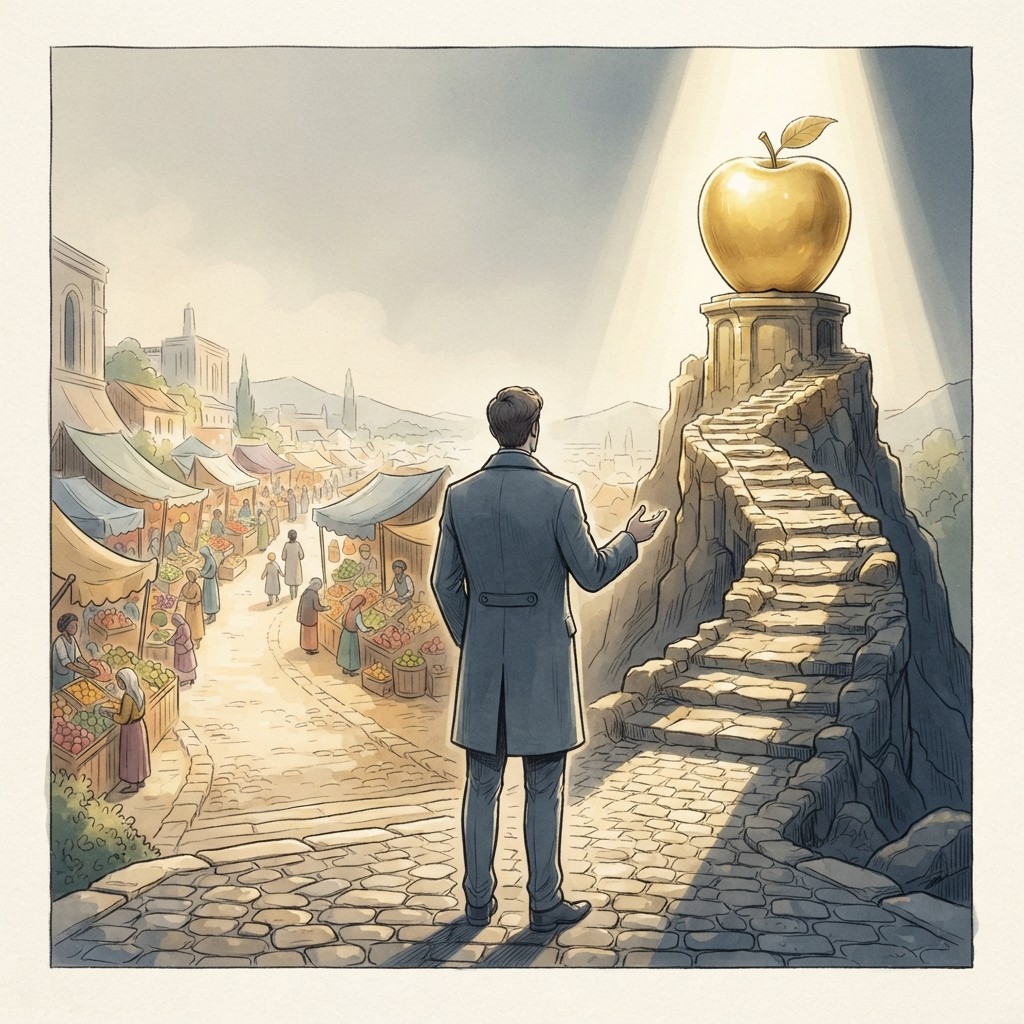
History gave Apple a villain too stubborn to open the Mac. It got the man — and the motive — exactly wrong.
Pairs with the Counterfactual Timeline Builder — a ready-to-use strategy tool. Included in the Counterfactual Casebook →
“What did the decision you did not take actually cost?”
On June 25, 1985, two Microsoft executives mailed Apple a roadmap for winning the personal computer war — and it was a roadmap to give the Mac away. Bill Gates and Jeff Raikes urged Apple to license Mac technology to three to five major manufacturers — AT&T, DEC, HP, Motorola — and let the platform spread the way Microsoft's would soon spread on every beige box in America.1 The memo went to John Sculley and Jean-Louis Gassée.1 One of them wanted to do it. The other killed it. For thirty years, almost everyone has had the wrong man in the wrong chair.
The official story is that Sculley, the soft-drink executive who pushed Jobs out, was too closed-minded to open the platform — and that his stubbornness handed the desktop to Windows. Nearly every word of that is backwards. Sculley was the one trying to open it.
The licensing champion was the man history blames: the CEO was shopping the platform around while someone else quietly killed every deal
Sculley didn't resist licensing in 1985. He chased it. He sent a vice president, Chuck Berger, out to drum up interest, and the interest was real — AT&T's chief executive personally contacted Sculley about bundling Mac software onto Unix workstations.410 This is a CEO actively shopping his platform to the largest companies in the country. The man who stopped him was Jean-Louis Gassée, the newly installed head of Macintosh, and his argument was not philosophy. It was arithmetic: licensing the OS to other hardware makers would surrender Apple's hardware margins, which ran above 55%.4 By the winter of 1985, Gassée had killed every deal and Sculley dropped the plans.4 The closed Mac was not an act of ideology. It was an act of margin protection — and it was made by the head of the hardware business, not the CEO.
“We urge Apple to license Macintosh technology to 3-5 significant manufacturers... AT&T, DEC, HP, Motorola.”1
Here is the thesis, and it is uncomfortable for both camps. Apple stayed closed not because Sculley was rigid, but because Gassée was right about the money — Apple was a hardware company that happened to make an operating system, and every machine someone else built was a machine Apple didn't sell. The decision looks like a blunder only if you assume Apple's real product was the software. It wasn't. The real product was the box, and the box carried a margin no licensee would ever pay Apple to give up.
What licensing would have cannibalized: follow the dollar and the open strategy only pays if the buyers were never yours to begin with
To see the trap, follow the dollar. When Apple sells a Mac, it captures the entire 55%-plus margin on the hardware.4 When Apple licenses the OS instead, it captures a fee per machine — and someone else captures the hardware. That trade only works if the licensee sells to people Apple could never reach. If the licensee instead sells to people who would have bought a Mac, Apple has swapped a fat hardware margin for a thin software fee on its own customer. Gassée's bet was that the second thing would happen. A decade later, Apple ran the experiment and found out.
| Sell the hardware (closed) | License the OS (open) | |
|---|---|---|
| Apple captures | Full hardware margin (>55%) | A per-machine license fee |
| Who builds the box | Apple | The licensee |
| Works only if | Apple can serve demand itself | Licensees reach NEW buyers |
| The risk | Limited reach | Cannibalizing your own customer |
The clone program proved the fear — at a $50-per-machine price: Apple finally ran the experiment, and the nightmare arrived precisely on schedule
Apple finally reversed course. In December 1994 it announced a clone program with Power Computing as the first licensee, and Radius shipped the first authorized clone on March 27, 1995. The terms: Mac System 7.x and the ROMs, licensed at a flat $50 per machine.5 On paper, free money. In practice, a leak. Apple's CFO found the strategy cost the company money outright — the $50 fee didn't come close to recouping the hardware sale it replaced — and CFO Fred Anderson told Wired that 'somewhere around 99 percent' of clone sales went to the existing customer base.12 That is Gassée's nightmare arriving exactly on schedule. The clones weren't expanding the Mac universe. They were selling the same Mac buyers a cheaper box, and Apple was collecting fifty dollars to lose its best customers.
Steve Jobs ended it the way he ended most things — abruptly and completely. He shipped Mac OS 8 on July 26, 1997, an OS the clone vendors were not licensed to sell, stranding them on the old version. Then Apple bought Power Computing's core assets for $100 million in Apple stock that September.6 He didn't cancel the program; he made it impossible to continue, then absorbed the largest survivor. The bet on premium hardware economics, suspended for two and a half years, was back on.
Wasn't the closed platform what cost Apple the war?: the standard autopsy names the wrong cause of death
The strongest objection is the one history settled on: Windows won the desktop precisely because it ran everywhere, and Apple, by staying closed, doomed itself to a single-digit share and a near-bankruptcy. That is true as far as it goes — and it is the wrong autopsy. Even Jobs, announcing the Power Computing buyout, said clones could only amount to a tiny percentage of overall Mac OS sales, and that Mac OS computer sales had declined by almost 20% over the prior two years.13 The collapse was a demand problem, not a licensing problem. And when Apple did open up, the clones didn't grow the platform; they fed on it.7 So the refusal wasn't a strategic error that lost the war. It was a defensible — if ultimately losing — bet that Apple's money lived in the hardware, and the one time Apple bet the other way, the numbers proved Gassée right and the company nearly died doing it.
There is one more irony buried in the same year the licensing fight began. Under pressure from Microsoft, which threatened to stop building Mac applications, Sculley signed a deal on November 22, 1985 granting Microsoft a license to the Mac's visual displays.8 When Apple later sued, the courts found that agreement covered 179 of the 189 interface elements Apple contested, and the rest weren't copyrightable.2 The Ninth Circuit affirmed in September 1994, ruling Apple could not get patent-like protection for the idea of a graphical interface, and the Supreme Court declined to hear it in February 1995.3 Apple wouldn't license the look to hardware makers who'd pay for it — but had already licensed it, under duress, to the one competitor best positioned to exploit it.
Apple's fatal clarity was also its great clarity: it knew it sold hardware, not software, and it refused to license away the thing it actually charged for. The trap is that the obvious strategy — 'license it everywhere, like Microsoft' — only creates value if the licensees reach buyers YOU can't. If they sell to your existing customers instead, you've swapped a fat margin for a thin fee and paid for the privilege of being cannibalized. Before you open a platform, answer one question with numbers, not optimism: does each licensed unit expand the market, or just resell it to the person who'd have bought from you anyway? Apple guessed right for ten years, guessed wrong for three, and the three nearly ended the company.
The legend needs a villain who was too closed-minded to see the future. The record offers something stranger and more useful: a CEO who fought to open the platform and a hardware chief who closed it on arithmetic — and who was vindicated by the very experiment that proved him a loser. Apple's refusal to license the Mac wasn't a failure of vision. It was a correct read of where its money lived, held a decade too long against a market that had stopped caring. The bet wasn't wrong. The world was.
Counterfactual Timeline Builder
A one-page canvas that runs two histories side by side: what actually happened, and the alternative that died at the fork. You pin the divergence point, trace each branch forward, and name the assumption that decided which one came true. Blank, it disciplines hindsight into a testable counterfactual instead of a what-if; filled, it shows the story's road-not-taken with enough rigor to argue about.
Included, filled and blank, in the Counterfactual Casebook. See the set → · Preview the blank →
Sources
Where this comes from — the filings, records, and reporting behind it.
- 1Bill Gates and Jeff Raikes sent a memo dated June 25, 1985 to John Sculley and Jean-Louis Gassée titled 'Apple Licensing of Mac Technology,' urging Apple to license Mac technology to 3–5 major manufacturers including AT&T, DEC, HP, and Motorola.
- 2The November 22, 1985 Apple–Microsoft agreement granted Microsoft 'a non-exclusive license of the audiovisual displays in Windows 1.0.' The court found this agreement covered 179 of the 189 GUI elements Apple later contested, and the remaining 10 were not copyrightable.
- 3The Ninth Circuit affirmed the district court on September 19, 1994, ruling 'Apple cannot get patent-like protection for the idea of a graphical user interface, or the idea of a desktop metaphor.' Apple's Supreme Court certiorari petition was denied February 21, 1995.
- 4Sculley sent VP Chuck Berger to drum up licensing interest in 1985; AT&T's CEO Bob Allen personally contacted Sculley about bundling Mac software on Unix workstations. Gassée killed the deals to protect margins above 55%. Sculley dropped all licensing plans in the winter of 1985.Low End Mac, The Apple vs. Microsoft GUI Lawsuit ↗ · 2006-03-15
- 5Apple announced its Mac clone licensing program in December 1994 with Power Computing as the first licensee; Radius shipped the first authorized clone on March 27, 1995. Apple licensed Mac System 7.x and ROMs to clone makers at a flat rate of $50 per machine.
- 6Jobs killed the clone program by shipping Mac OS 8 on July 26, 1997, which clone vendors were not licensed to ship; Apple then bought Power Computing's core assets for $100 million in Apple stock in September 1997.Macworld, Reliving the Clone Wars ↗ · 2008-05-23
- 7Apple CFO Fred Anderson found the clone licensing strategy cost Apple money: the $50 per-unit fee did not recoup lost hardware sales revenue. Apple's then-CFO told Wired in 1997 that 'somewhere around 99 percent' of clone sales went to the existing customer base.
- 8Microsoft threatened to stop developing Mac applications unless Apple licensed Mac OS GUI elements for Windows. Sculley agreed, signing the November 22, 1985 deal. Sculley was forced out as CEO in June 1993 partly because he opposed licensing Macintosh software — while the board had turned in favor of it.[[cite:s11]]
- 9Apple CFO Fred Anderson estimated that 99 percent of clone makers' sales went to previous Mac owners, and that clone vendors did not sell very many systems to new customers.
- 10AT&T was interested in licensing the Mac OS for use in their own equipment — the then-CEO of AT&T made a personal phone call to Sculley — but Gassée would have none of it, and so the idea of licensing the Mac OS was shelved.
- 11Sculley was ultimately forced to step down as Apple CEO because he was opposed to licensing Macintosh software; the board was in favor of letting other computer makers use Apple's software, but Sculley was opposed.
- 12Apple CFO Fred Anderson told Wired in 1997 that 'somewhere around 99 percent' of clone sales went to the existing customer base.
- 13Jobs, announcing the Power Computing buyout, said clones could only amount to a tiny percentage of overall Mac OS computer sales, and that during the past two years the total number of Mac OS computers sold had declined by almost 20%.
Weighing outside help with a decision like this? Hiring a commercial due diligence provider
More like this — beyond Apple
New Strategically analyses as they publish: the defining moves in business, checked against the record. No noise, and one click to leave.