Pairs with the Counterfactual Timeline Builder — a ready-to-use strategy tool. Included in the Counterfactual Casebook →
“What did the decision you did not take actually cost?”
In 2000, Toys R Us did something that sounds, in hindsight, like handing a competitor the keys to your house: it agreed to sell its toys through Amazon.com. Under the ten-year deal, Toys R Us would pick and buy the inventory; Amazon would build the site, fill the orders, and answer the phone.1 The legend that grew up around this is tidy and damning - the toy giant taught Amazon how to sell toys, Amazon used the lesson to swallow it whole, and a once-mighty chain marched obediently to its own funeral. It is a great story. It is also mostly wrong.
The version everyone repeats is that Toys R Us outsourced its future to Amazon and Amazon stole it. The deal was the death blow. What actually happened is that the deal worked, then Amazon broke it, then a New Jersey judge handed Toys R Us the right to walk away. The fatal decision came five years later, in a transaction that had nothing to do with toys and everything to do with debt - and the people who made it have an obvious interest in you blaming Jeff Bezos instead.
The deal that was supposed to be a death trap actually worked
Strip the hindsight away and the 2000 alliance was a sensible trade between two companies covering each other's weaknesses. Toys R Us had just been fined by the FTC for failing to deliver Christmas gifts on time during the 1999 holiday season - $350,000 for a logistics meltdown that told everyone it could not run a website at scale.7 Amazon could fulfill, but kept choking on toy inventory, a category that goes from frenzy to worthless the day after Christmas. So they paired up: Toys R Us bought the toys, Amazon shipped them, and for the first several years it worked well for both sides - sharpening Toys R Us against eToys and Walmart.com while solving Amazon's inventory headache.8 In exchange Amazon took fixed payments, per-unit fees, a single-digit slice of revenue, and warrants for 5% of the toy site.1 This was not a company surrendering. It was a company that knew exactly what it couldn't do, paying someone else to do it.
“The arrangement initially worked well for both sides for the first several years, improving Toys R Us's ability to compete with eToys and Walmart.com while eliminating toy inventory problems plaguing Amazon.”8
The relationship soured for a reason that vindicates Toys R Us, not Amazon. The whole point of the deal, from the toy company's side, was exclusivity in the Toy and Game and Baby Products categories. Amazon then began signing up rivals - Target, plus independent sellers through its zShops marketplace - and selling toys around the partner it had promised to protect.8 So in May 2004, Toysrus.com sued, alleging Amazon had violated those exclusivity rights.2 This is not the behavior of a company that got conned and slunk away. It is a company that read its contract and went to court.
The court agreed - and that is the part the legend deletes
In March 2006, Judge Margaret Mary McVeigh issued a 131-page opinion. She ruled that Amazon had breached the agreement, and along the way she questioned the credibility of Amazon executives, including Bezos himself.3 Toys R Us, in other words, was right on the merits. The court gave it the right to terminate the deal and reopen an independent website - precisely the freedom the legend claims it never had.4 If the Amazon deal had been a one-way trap, this is the moment the trap should have snapped shut. Instead the trapped party walked out the front door with a judge holding it open.
You'll see it written that Toys R Us 'won a $51 million judgment' against Amazon in 2006. It didn't. McVeigh awarded no monetary damages at all - she found Toys R Us couldn't prove it had paid a premium for exclusivity, so the win came as termination rights, not a check.3 The $51 million was a separate, negotiated out-of-court settlement Amazon paid roughly three years later, around 2009.4 The conflation matters, because it dresses up a legal win that produced almost no cash as a triumphant payday - and obscures how little the whole saga actually moved the company's fate.
The decision that actually did the killing
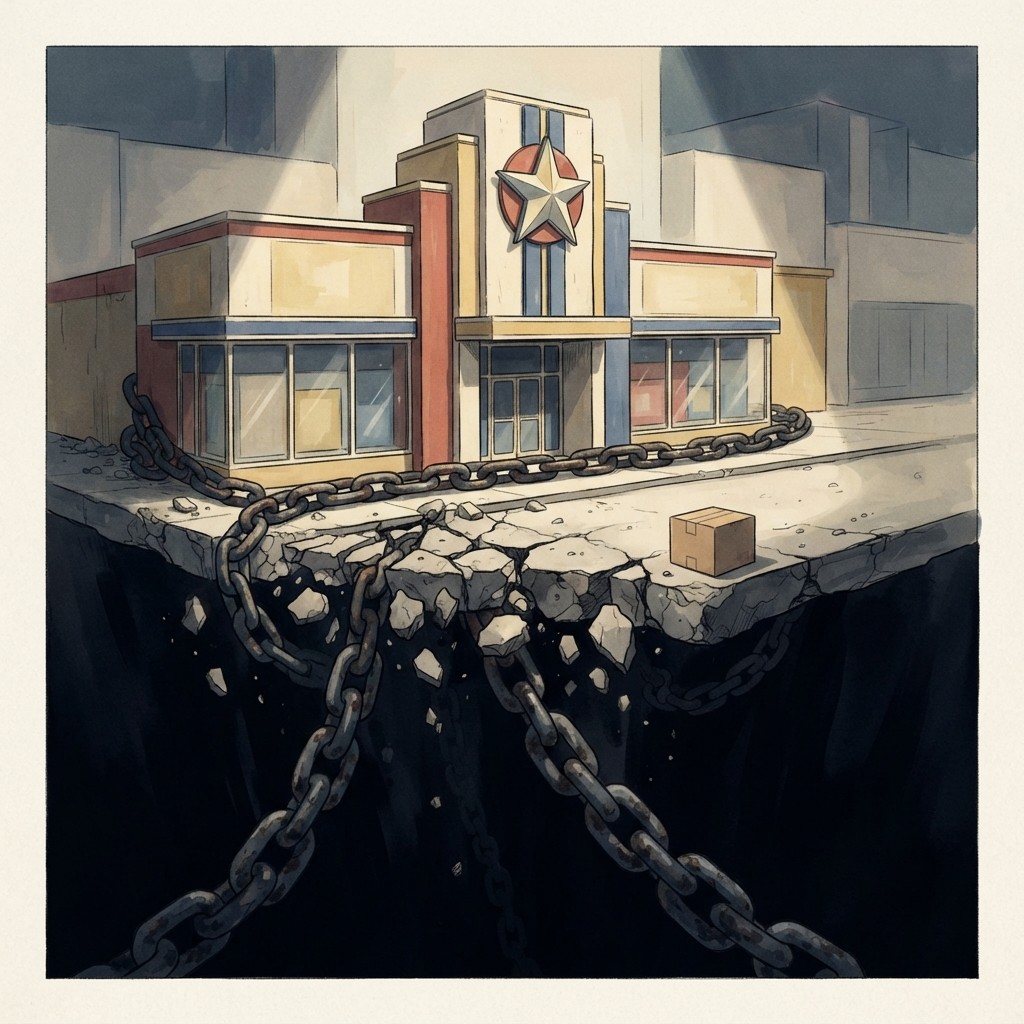
Here is the fork that mattered, and it has no Amazon in it. On March 17, 2005 - a year before the court ruling - Toys R Us agreed to be taken private by KKR, Bain Capital, and Vornado for $26.75 a share, a deal valued at $6.6 billion plus assumed debt. It closed that July.5 The structure is the whole story. The buyers put in roughly $1.6 billion of their own equity and financed the rest with more than $5 billion in debt - and that debt was recourse only to Toys R Us.6 Read that again. The borrowing was done in the company's name, secured by the company's assets, repayable from the company's cash flow. The private-equity firms borrowed against the store and left the store holding the loan.
| The 2000 Amazon deal | The 2005 buyout | |
|---|---|---|
| What it did | Outsourced fulfillment Toys R Us couldn't run | Loaded $5B+ of debt onto the company |
| Who bore the downside | Amazon (it took warrants + fees) | Toys R Us (debt was recourse only to it) |
| How it ended for Toys R Us | Won in court, freed to leave | Interest payments outran a profitable business |
| Who profited | Both sides, for several years | KKR, Bain, Vornado - $81M in 2005 fees alone |
This is the mechanism the Amazon story conveniently buries. A leveraged buyout converts a cash-generating retailer into an instrument for servicing debt. Every dollar that should have gone into stores, e-commerce, or price competition with the very companies eating its lunch now had a prior claim on it: interest. A company that needed to invest its way out of a structural threat was instead obligated to pay its way out of a loan it never asked for. And the buyers extracted fees on top - $81 million in 2005 alone, simply for arranging the debt that would eventually crush the company they had just bought.6 The Amazon deal was a symptom of a real weakness. The buyout was a deliberate financial decision that turned that weakness into a fatal condition.
But didn't the deal still prove Toys R Us couldn't compete?
The honest objection is that this lets Toys R Us off too easily. The 2000 deal existed because the company genuinely could not run its own website - the FTC fine for botched Christmas deliveries is real, and you don't outsource your storefront to a rival unless you've already lost confidence in your own operation.7 That's fair, and it's exactly the point: the Amazon deal was the diagnosis, not the disease. It revealed a company that had fallen behind on the one capability that would define the next two decades of retail. But a behind-the-curve retailer with steady cash flow has options - it can buy talent, build slowly, copy what works. A behind-the-curve retailer carrying more than $5 billion of debt has one option: pay the interest, and pray. The Amazon partnership showed the patient was sick. The buyout removed the patient's ability to recover. Diagnosis is not cause of death.
The cleanest tell in any leveraged deal is one phrase: recourse only to the company. When the borrowing is secured by the target's assets and repayable from the target's cash, the buyers have engineered a one-way bet - they keep the upside and the fees, and the company keeps the risk. Toys R Us didn't borrow $5 billion to grow; it became the collateral for a loan that benefited someone else, then spent a decade paying it down instead of fighting the war it was actually in. When the post-mortem points at a flashy external villain, follow the debt back to who signed for it.
It is far more comfortable to remember Toys R Us as the company that handed Amazon the toy aisle than as the company that was hollowed out by its own owners. The first story has a villain we love to fear and a moral we already believe. The second has a balance sheet, a recourse clause, and $81 million in fees. But the court record is clear: Amazon broke the deal, and Toys R Us won the right to leave it. The real fatal move was made not in a Seattle warehouse but in a 2005 term sheet - the moment a profitable retailer was made to borrow against itself so that three firms could own it for almost nothing. The Amazon deal didn't kill Toys R Us. It just gave everyone a more interesting thing to point at while the debt did the work.
Counterfactual Timeline Builder
A one-page canvas that runs two histories side by side: what actually happened, and the alternative that died at the fork. You pin the divergence point, trace each branch forward, and name the assumption that decided which one came true. Blank, it disciplines hindsight into a testable counterfactual instead of a what-if; filled, it shows the story's road-not-taken with enough rigor to argue about.
Included, filled and blank, in the Counterfactual Casebook. See the set → · Preview the blank →
Sources
Where this comes from — the filings, records, and reporting behind it.
- 1Under the 10-year agreement, Toysrus.com identified, bought, and managed inventory; Amazon.com handled site development, order fulfillment, and customer service. Amazon was compensated via periodic fixed payments, per-unit payments, and a single-digit percentage of revenue, and received warrants for 5% of Toysrus.com.
- 2Toysrus.com filed suit against Amazon.com on May 24, 2004 in the Superior Court of New Jersey, Chancery Division, Passaic County, alleging violation of its exclusivity rights in the Toy and Game and Baby Products categories.
- 3NJ Superior Court Judge Margaret Mary McVeigh issued a 131-page opinion ruling Amazon breached its agreement but awarded NO monetary damages, finding Toys R Us unable to prove it had paid a premium for exclusivity; the judge also questioned the credibility of Amazon executives including Jeff Bezos.NBC News, Toys 'R' Us wins suit against Amazon.com ↗ · 2006-03-02
- 4The 2006 ruling gave Toys R Us the right to terminate the deal and reopen an independent website; separately, approximately three years later (circa 2009), Amazon agreed to pay $51 million to settle the dispute.
- 5On March 17, 2005, Toys R Us announced a definitive agreement to be acquired by KKR, Bain Capital, and Vornado for $26.75 per share in a transaction valued at $6.6 billion plus the assumption of existing debt; the acquisition closed July 21, 2005.
- 6The LBO was financed with approximately $1.6 billion in equity and more than $5 billion in debt, which was recourse only to Toys R Us; KKR, Bain, and Vornado received $81 million in transaction fees in 2005 related to the initial LBO debt.
- 7During the 1999 holiday season, Toys R Us failed to deliver Christmas gifts on time, resulting in a $350,000 fine from the US Federal Trade Commission for late shipping.
- 8The arrangement initially worked well for both sides for the first several years, improving Toys R Us's ability to compete with eToys and Walmart.com while eliminating toy inventory problems plaguing Amazon; executives grew unhappy only as Amazon signed agreements with rival retailers including Target and independent zShops sellers.NBC News, Toys 'R' Us wins suit against Amazon.com ↗ · 2006-03-02
Weighing outside help with a decision like this? Hiring a commercial due diligence provider
More like this — beyond Toys R Us
New Strategically analyses as they publish: the defining moves in business, checked against the record. No noise, and one click to leave.