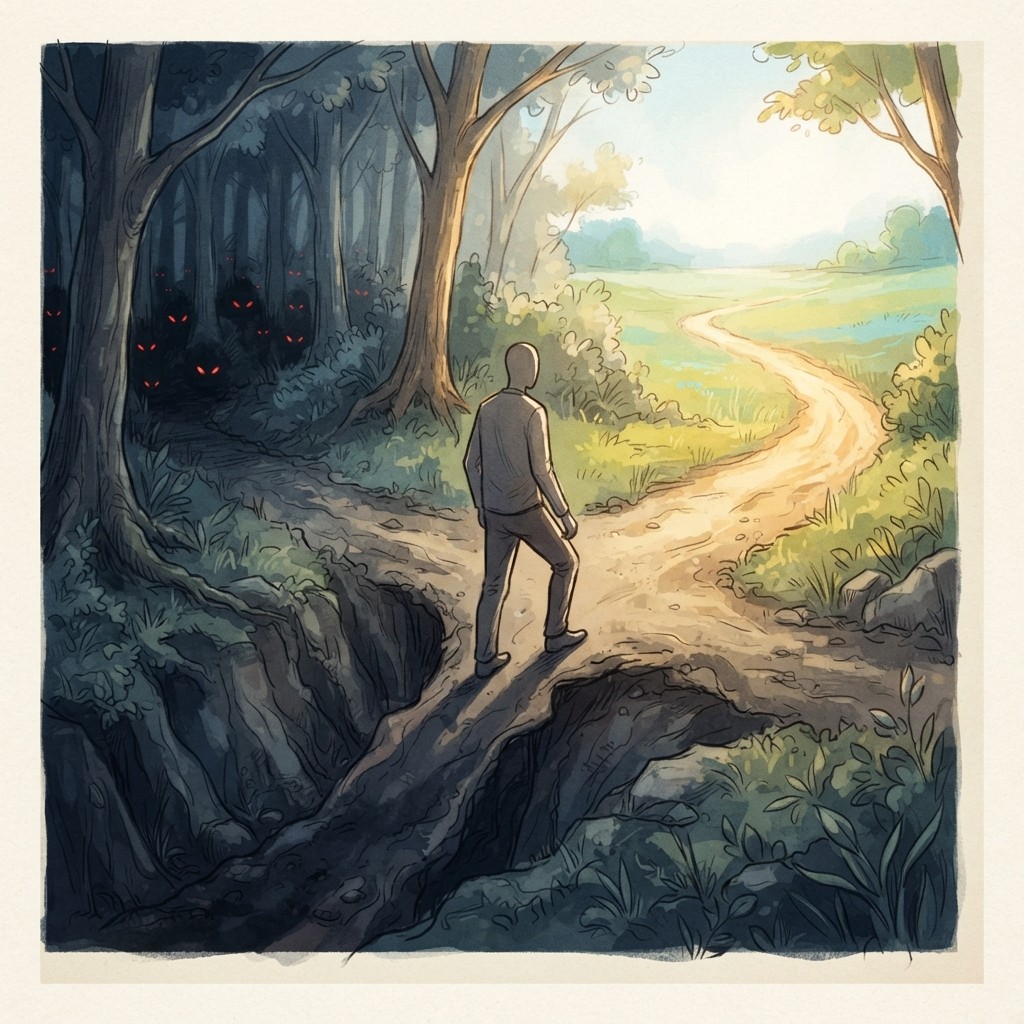
Pairs with the Counterfactual Timeline Builder — a ready-to-use strategy tool. Included in the Counterfactual Casebook →
“What did the decision you did not take actually cost?”
In March 2015, a World Health Organization agency put a label on glyphosate — the active ingredient in Roundup — that no buyer of a chemical company wants to read: probable human carcinogen.7 That was more than a year before Bayer made its first offer for Monsanto. By the time Bayer wired the money and closed the deal on June 7, 2018, Monsanto was already in court defending over 120 toxic-tort cases.7 None of this was hidden. It was on the public record, sitting in plain sight, waiting in the data room. Bayer read it, weighed it, and paid $128 a share anyway — roughly $63 billion once you fold in Monsanto's debt.1
The official story is that Bayer made a bold bet on agriculture and got blindsided by an unforeseeable wave of litigation. The honest version is harsher: the wave was forecast, posted, and dated before the deal closed. This wasn't a company surprised by a hidden defect. It was a company that bought a lawsuit it could read in advance — and then told investors the diligence had been 'exhaustive.'7
The risk wasn't buried. It was published.
Counterfactual analysis lives or dies on one question: what did the decision-maker know, and when? In most M&A disasters the buyer can plausibly claim ambush — a fraud surfaced later, a market turned, a technology obsolesced. Bayer cannot. The two facts that would eventually cost it tens of billions were both timestamped before its May 2016 offer. The carcinogen classification was a year old.7 The litigation docket already ran past 120 cases.7 A buyer staring at those two numbers is no longer making a bet on an unknown. It is choosing to absorb a known, growing liability — and pricing it at zero.
“Bayer described its due diligence as 'exhaustive,' 'appropriate,' and 'thorough' — despite the probable-carcinogen classification and over 120 pending toxic-tort cases already on the record.”7
That gap — between what was knowable and what was claimed — is the whole case. The securities class action settled for $38 million, a number approved by a federal judge in 2025.7 By itself, $38 million is a rounding error against a $63 billion deal. But it is the cheapest, clearest piece of evidence that the litigation risk was not a black swan. It was a known input that the diligence process was supposed to price, and didn't.
The arithmetic of walking away
Here is the counterfactual stated plainly. The road Bayer took: pay $128 a share, take on $20 billion in new bonds to finance it2, watch roughly 40% of market capitalization evaporate after closing8, announce a $10.1–$10.9 billion settlement in 20203, and keep paying — over $11 billion out the door, with billions more in reserves against ongoing claims.3 The road not taken: pay the break-up cost of an abandoned deal and keep the company you already had. When the litigation bill alone dwarfs the premium you paid, the counterfactual stops being a thought experiment and becomes simple subtraction. Even accounting for the $2 billion reverse break-up fee written into the merger agreement, it was structurally cheaper not to own the asset at all.
| Closing Monsanto | Walking away | |
|---|---|---|
| Equity price paid | $128/share, ~$63B with debt | $0 |
| New financing debt | US$15B + €5B in bonds | None |
| Roundup litigation exposure | ~$16B earmarked, $11B+ paid | None |
| Market-cap impact | ~40% destroyed post-close | Capital intact |
| What was known going in | Probable carcinogen + 120+ cases | Same — and avoidable |
The damage was not abstract. At Bayer's 2019 annual meeting, 55.5% of shareholders voted no confidence in CEO Werner Baumann over the deal — the lowest approval rate in Germany's postwar corporate history, according to the Financial Times — a historic rebuke for a sitting chief executive of a blue-chip German firm.11 The owners of the company had done the same arithmetic and reached the same verdict the counterfactual produces: this should not have closed.
The fair objection: it wasn't all Roundup, and the law later turned
The honest counter has two parts, and both have teeth. First, the market-cap destruction was multi-causal. Analysts pointed to a thinning pharmaceutical pipeline and looming patent cliffs on Xarelto and Eylea starting in 2023, and to the acquisition debt that left Bayer unable to chase the pharma deals it needed.8 Roundup was the proximate trigger, not the sole cause. Second — and this is the part that complicates the indictment — the law eventually moved Bayer's way. In June 2026 the Supreme Court ruled 7-2 in Monsanto v. Durnell that federal pesticide law preempts state failure-to-warn claims where the EPA never required a cancer label, blocking thousands of suits.12 If you'd known that ruling was coming in 2018, the deal looks a lot less reckless.
But notice what each objection concedes. The pipeline weakness doesn't exonerate the deal — it indicts it harder, because the acquisition debt constrained Bayer's ability to pursue the pharma investment the pipeline required.8 And the 2026 court win arrived eight years and over $11 billion too late.6 A favorable ruling that lands after you've paid out a fortune and lost your CEO doesn't rescue the decision; it only proves the cost of holding the position long enough to be vindicated. A good outcome you had to bleed for eight years to reach is not a good bet. It is an expensive escape from a hole you didn't have to dig.
The most dangerous liability in any acquisition is the one already on the public record — because it doesn't look like a risk, it looks like noise everyone has already 'accounted for.' A pending lawsuit count, a regulatory classification, a published agency finding: these are not surprises waiting to happen. They are surprises that have already happened, sitting in the data room, daring you to discount them to zero because the strategic story is too good to interrupt. The discipline is to run the deal twice — once on the synergy case, and once assuming the visible liability compounds to its worst plausible end. If walking away is cheaper than the second number, the first number was never the real price. Bayer ran only the dream.
Strip the strategy deck away and the Monsanto deal reduces to a single, stubborn fact: every input needed to predict the disaster was published, dated, and available before Bayer signed. The carcinogen label existed. The lawsuits existed. The break-up option existed. The company chose the one path that turned all three into a $16 billion bill and a 40% haircut — then called the diligence thorough.7 The counterfactual isn't a clever exercise here. It's the cheaper company that was sitting right next to the expensive one, separated by a single decision Bayer had every fact in hand to get right.
When the warning was in the file all along
Counterfactual Timeline Builder
A one-page canvas that runs two histories side by side: what actually happened, and the alternative that died at the fork. You pin the divergence point, trace each branch forward, and name the assumption that decided which one came true. Blank, it disciplines hindsight into a testable counterfactual instead of a what-if; filled, it shows the story's road-not-taken with enough rigor to argue about.
Included, filled and blank, in the Counterfactual Casebook. See the set → · Preview the blank →
Sources
Where this comes from — the filings, records, and reporting behind it.
- 1Bayer successfully completed the acquisition of Monsanto on June 7, 2018; Monsanto shareholders were paid $128 per share; total cost including Monsanto's debt was approximately $63 billion.
- 2Bayer's primary-source Q2 2018 Interim Report confirms Monsanto contributed €543 million to sales in Q2 2018 and records an after-tax acquisition loss of €165 million since first consolidation; bonds of US$15 billion and €5 billion were issued to finance the deal.
- 3On June 24, 2020, Bayer announced it would pay $10.1 billion–$10.9 billion to resolve current and future Roundup litigation, plus up to $400 million for dicamba drift litigation and approximately $820 million for PCB water litigation.
- 4Bayer's 2020 Roundup settlement called for $8.8–$9.6 billion for current claimants and $1.25 billion for future claims, pending court approval from Judge Vince Chhabria of the Northern District of California; as of 2020 Bayer faced roughly 125,000 claims.
- 5The Supreme Court ruled 7-2 in Monsanto v. Durnell (No. 24-1068) that FIFRA preempts state-law failure-to-warn claims where EPA has not required a cancer warning on Roundup's label, blocking thousands of lawsuits against Bayer. The ruling was issued June 25, 2026.[[cite:s9]]
- 6Bayer had paid over $10 billion to settle a portion of claims and has reserved billions more for ongoing Roundup-related litigation expenditure since the deal closed.
- 7Federal investors' class action (Sheet Metal Workers' National Pension Fund et al. v. Bayer AG) alleged Bayer misled investors about due diligence on Monsanto acquisition and the Roundup litigation risk; at the time of Bayer's 2016 due diligence, Monsanto was already defending over 120 toxic-tort cases; IARC had classified glyphosate as a probable human carcinogen in March 2015. The securities class action was settled for $38 million, approved by a federal judge in 2025.
- 8Shareholders stripped approximately 40% off Bayer's market cap after the Monsanto deal closed in June 2018; at Bayer's 2019 annual meeting, 55% of shareholders voted no-confidence in CEO Werner Baumann over the deal; analyst commentary also cited thinning pharma pipeline and patent expirations on Xarelto and Eylea from 2023 as co-equal structural risks.
- 9The Supreme Court ruled 7-2 in Monsanto Co. v. Durnell, No. 24-1068, on June 25, 2026, that FIFRA expressly preempts state-law failure-to-warn claims where EPA has not required a cancer warning on Roundup's label.
- 10At Bayer's 2019 annual general meeting, 55% of shareholders voted against ratifying management's conduct — a no-confidence rebuke over the Monsanto deal; Bayer's stock had fallen nearly 40% since the deal closed.
- 1155.5% of Bayer shareholders voted against ratifying management's actions at the 2019 AGM, described as the lowest approval rate in Germany's postwar corporate history, according to the Financial Times.
- 12The Supreme Court ruled 7-2 on June 25, 2026 in Monsanto Co. v. Durnell, No. 24-1068, that FIFRA expressly preempts state-law failure-to-warn claims where EPA has not required a cancer warning on Roundup's label; Justice Kavanaugh wrote the majority; Justices Jackson and Gorsuch dissented.SCOTUSblog, Monsanto Company v. Durnell (24-1068) ↗ · 2026-06-25
- 13In February 2026, Bayer announced it would increase overall litigation provisions and liabilities from 7.8 billion euros to 11.8 billion euros (including 9.6 billion euros for glyphosate), in connection with a proposed $7.25 billion Roundup class settlement.
Weighing outside help with a decision like this? Hiring a commercial due diligence provider
More like this — beyond Bayer
New Strategically analyses as they publish: the defining moves in business, checked against the record. No noise, and one click to leave.