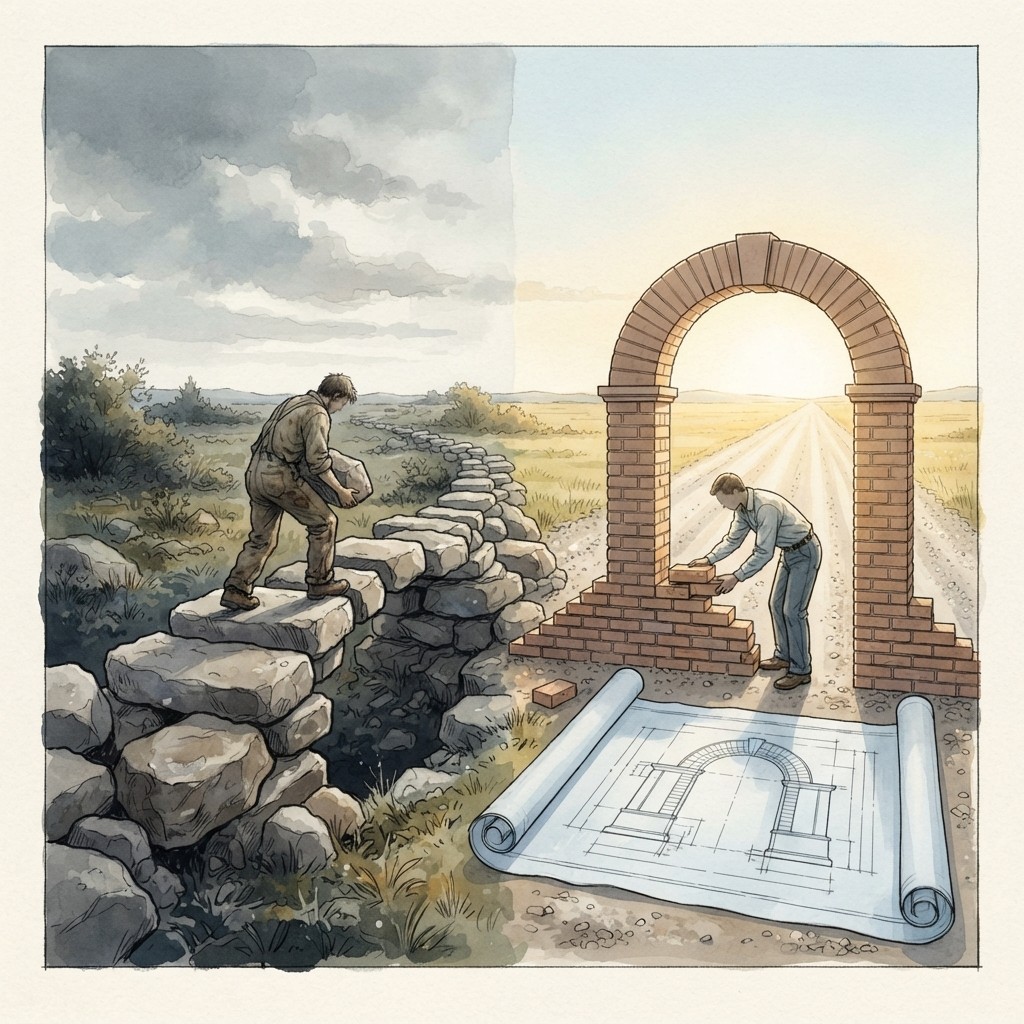
Pairs with the Adjacency / Synergy Map — a ready-to-use strategy tool. Included in the Adjacency Expansion Casebook →
“When does the business next door belong to you?”
Six years before Tony Stark ever flew, Warner Bros. was already trying to put Batman and Superman on screen together. In 2002 it had a Batman vs. Superman film in the works with director Wolfgang Petersen; by 2008 it had a full Justice League movie — Justice League: Mortal — in active development, casting and crewing up.6 Then it shelved the thing. That same year, a smaller, cash-strapped studio released a film about a B-list hero almost no one outside comic shops cared about — Iron Man — and quietly bet the company on the idea that one movie could become a connected world.1 One of those companies owned Batman and Superman. The other owned the future.
The official story is that Marvel won because it was more creative, and DC lost because it was darker, clumsier, less fun. That's a comforting story and it's mostly wrong. Marvel didn't out-imagine DC. It out-built it. The gap in outcomes wasn't an accident of talent — it was structural, and it was visible in the org chart before a single frame was shot.
Here is the thesis a smart friend can repeat at dinner: Marvel's dominance is a story about architecture, not genius — one decision-maker, a phased plan written before the first film opened, and a balance sheet to absorb the risk. DC had none of the three until it was a decade too late.
One person decided, and everyone knew who it was
Architecture starts with who holds the pen. At Marvel, the answer never moved. Kevin Feige was named president of production at Marvel Studios in early 2007, while Iron Man was still filming, and was promoted to president of Marvel Studios in May 2008, days after the film opened.3 From that point forward, the whole connected story had a single author with the authority to say yes and the authority to say no across every film. Continuity wasn't a committee output. It was one person's plan.
DC's contrast is brutal precisely because it came from the inside. David S. Goyer, who co-wrote the launch of the DC universe, later described executives pressuring the creative team with the line 'We need our MCU!' — and pointed to the deeper rot: a revolving door of leadership, someone new roughly every 18 months.7 You cannot author a ten-year story when the author changes every year and a half. Each new executive arrived with a new vision, a new tone, a new urgency to catch up — and so the universe was rebuilt, mid-flight, again and again. Goyer's own metaphor for it was the sharpest verdict anyone offered: this is not how you build a house.
“We need our MCU!”7
Marvel planted a forest; DC planted a flag
The second piece of architecture is sequence. Marvel spent years on solo films — building characters one at a time so that by the time they assembled, the audience already loved each of them individually. DC ran the play in reverse. Warner Bros. established its connected universe with Man of Steel in 2013, and then, within weeks of release, fast-tracked the sequel — the one that would crash Superman into Batman before either had a foundation underneath him.4 Man of Steel itself was no flop; it grossed roughly $667–670 million worldwide and turned a profit.5 The problem was what came next. Batman v Superman opened big at about $874 million worldwide — and then fell off a cliff, dropping 69% domestically in its second weekend.5 That second-weekend collapse is the signature of a film audiences showed up for and didn't tell their friends to see. DC tried to harvest a team-up before it had grown the team.
| Marvel (MCU) | DC (DCEU) | |
|---|---|---|
| Who holds the plan | One president, unbroken | Revolving door, ~every 18 months |
| Sequence | Solo films first, then assemble | Rushed to the team-up early |
| The launch film | A B-list hero (Iron Man) | Superman (Man of Steel) |
| The balance sheet behind it | Disney, post-2009 | Warner Bros., always stretched |
Why a $4 billion check was really a permission slip
The third piece is money — but not in the obvious way. On August 31, 2009, Disney agreed to acquire Marvel at a transaction value of roughly $4 billion, a deal that ultimately closed at $4.24 billion.2 The cliché is that Disney's cash bought Marvel its dominance. The truer reading is that Disney's balance sheet bought Marvel patience. A long-arc plan only works if you can absorb a soft film without panicking and tearing up the blueprint. With Disney behind it, Marvel could let a phase breathe. Warner Bros., chasing quarterly results inside a larger media conglomerate, kept reacting — fast-tracking sequels, swapping leaders, hunting for the shortcut. Patience is a capital structure decision before it is a creative one.
Each factor multiplies the others — and each can zero out the product. Marvel held all three and the slivers compounded: Avengers: Endgame alone grossed about $2.799 billion8, and the franchise crossed $30 billion with Deadpool & Wolverine in 2024 to become the highest-grossing film franchise ever.9 DC owned more famous characters and a head start, but with a missing factor or two, the product never compounded.
Isn't this just hindsight — and didn't Marvel get lucky?
The honest objection is that this is too tidy: any winner's structure looks inevitable once you know it won, and Marvel's bet on a connected universe could easily have died with Iron Man. Fair. Iron Man was a genuine gamble — a $186 million budget on a hero with no mass following.1 If it had failed, there would be no phased plan to admire. But notice what survives that objection. The architecture argument doesn't claim Marvel was guaranteed to win; it claims DC was structurally set up to lose. And that part holds even running the tape forward, not backward. DC had the more bankable characters and a six-year head start on the very idea.6 It still lost — and it lost on exactly the variables the architecture thesis names: no stable author, the wrong sequence, no patience. When the better-resourced contestant with the better-known IP and the earlier start loses anyway, luck is a weak explanation. The blueprint isn't.
When you expand into adjacent products that are supposed to reinforce each other, the order you ship them in is the strategy — not a logistics detail. Build the standalone pieces that compound first; assemble the grand crossover only after each part can stand on its own. And before you green-light any of it, settle the two questions that decide everything quietly: who holds the plan unbroken across the whole arc, and is your capital patient enough to let it breathe through a soft year? Marvel answered both before its first film opened. The caution: a famous brand and a head start feel like a lead, but they are not a substitute for architecture — DC had both and still lost the race it started first.
Endgame doesn't even hold the all-time box-office crown anymore — it sits second, after Avatar's re-release reclaimed the top spot.8 That's the small, perfect irony: the franchise people credit to creative magic was beaten, at its own peak, by a single film with no universe behind it. The MCU's real achievement was never one transcendent movie. It was the boring stuff that doesn't trend — one author, the right order, and the patience to wait. DC owned Batman and Superman and started building first. It out-imagined no one. It just kept rebuilding the house while the people next door quietly finished theirs.
Adjacency / Synergy Map
A one-page canvas for an adjacency play: the new business next door, the shared assets that justify entering it, the synergies that actually transfer versus the ones that evaporate on contact, and the dis-synergies nobody put on the deck. Blank to test your own expansion; filled as the worked example showing where the story's 'natural adjacency' was real and where it was wishful.
Included, filled and blank, in the Adjacency Expansion Casebook. See the set → · Preview the blank →
Sources
Where this comes from — the filings, records, and reporting behind it.
- 1Iron Man (2008) grossed $585,171,547 worldwide on a $186 million production budget, opening to $102,118,668 domestically.
- 2Disney agreed to acquire Marvel Entertainment on August 31, 2009, at a transaction value of approximately $4 billion ($50/share); the deal ultimately closed at $4.24 billion.
- 3Kevin Feige was named president of production at Marvel Studios in March 2007 (replacing Michael Helfant), then promoted to president of Marvel Studios in May 2008 following Iron Man's opening weekend.
- 4Warner Bros. established the DCEU with Man of Steel (2013); after its release, Warner Bros. fast-tracked a sequel within weeks, with initial universe plans having been scrapped after the 2011 film Green Lantern was a critical and commercial failure.
- 5Man of Steel (2013) grossed approximately $667–670 million worldwide; Batman v Superman (2016) grossed approximately $874 million worldwide but suffered a 69% second-weekend domestic drop.
- 6Warner Bros. was attempting to build DC crossover films as early as 2002 (Batman vs. Superman with director Wolfgang Petersen) and had Justice League: Mortal in active development by 2008 before it was shelved.
- 7DCEU screenwriter David S. Goyer stated on the 'Happy Sad Confused' podcast that Warner Bros. executives pressured the creative team with 'We need our MCU!', and cited a revolving door of executives — with someone new every 18 months — as a core structural failure of the DCEU.
- 8Avengers: Endgame (2019) grossed $2.799 billion worldwide (per Box Office Mojo), holding the all-time record from July 2019 until Avatar's 2021 re-release reclaimed the top spot; it is currently the second-highest-grossing film of all time.
- 9The MCU crossed $30 billion in total franchise box office with the release of Deadpool & Wolverine (2024) and is now the highest-grossing film franchise of all time at over $32.4 billion.
Weighing outside help with a decision like this? Hiring a commercial due diligence provider
More like this — beyond Marvel vs DC
New Strategically analyses as they publish: the defining moves in business, checked against the record. No noise, and one click to leave.