Meta built a camera people genuinely loved, sold in the millions. Then it died anyway. The flaw wasn't in the lens - it was in the logo on the box.
Pairs with the Disruption Vulnerability Assessment — a ready-to-use strategy tool. Included in the Fall Casebook →
“How much of your decline can the agreed explanation actually account for?”
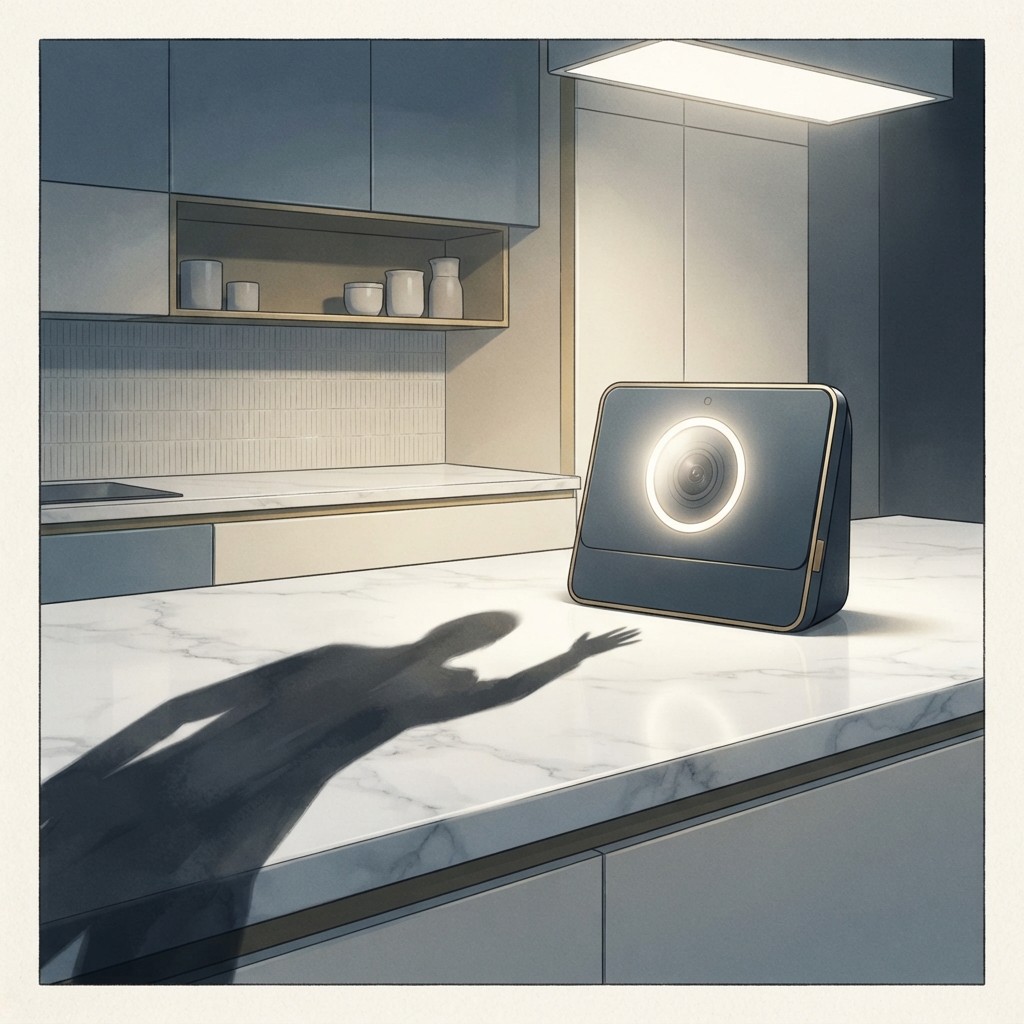
In October 2018, Facebook asked you to put a camera in your kitchen. It was a good camera. The Portal's whole trick was a lens that smoothly panned and zoomed to keep you in frame as you wandered around making dinner, so a video call felt less like a webcam and more like someone was actually in the room.2 People who bought it genuinely liked it. Years later, Meta's own technology chief would say users 'fucking loved it' and that the thing sold in the millions.3 And it was dead by December 31, 2022.1 The product worked. That was never the question.
The story everyone tells is that Portal flopped - a dud nobody wanted, swept away in Meta's cost-cutting. Almost every part of that is off. People wanted it; it sold in the millions; it was loved. What it could not do was the one thing Facebook desperately needed it to do: be trusted. Portal didn't die of a product defect. It died of a brand defect.
The worst possible product, from the worst possible company, at the worst possible moment: a home camera pitched by the brand the public had just stopped trusting with anything
Consider the timing, because it is almost comically bad. The Cambridge Analytica scandal - the harvesting of data from tens of millions of Facebook users - broke in March 2018. The CEO was hauled before Congress in April. The following July, the FTC would fine the company $5 billion for privacy violations.6 And in the middle of that smoking crater, in October 2018, Facebook chose to launch a device whose entire purpose was to sit on your counter, watch you, and listen.2 The pitch asked the public to grant Facebook the most intimate sensor in the home at the precise moment the public had decided Facebook could not be trusted with a friend list.
“Some of the people who would most want a device like this trust us the least. That is not a marketing problem you can outspend.”
Then Facebook proved the point itself. At launch it said Portal data would not be used for ad targeting. Within roughly a week, it walked that back, clarifying that metadata - the length of calls, the frequency of calls, general usage data - could in fact feed ad targeting.4 Note what actually happened: the company was reasonably truthful. It maintained, consistently, that the video and audio content of your calls was not stored or analyzed.4 But the seven-day reversal taught a far more damaging lesson than any single policy. It taught buyers that whatever Facebook promised about this camera on day one might quietly change by day eight. For a data company, that is the original sin: the asset you are selling is restraint, and restraint is the one thing your business model is built to lack.
Why the trust deficit was a ceiling, not a headwind: the people willing to let Facebook in weren't the people who buy gadgets first
Here is the mechanism, worked down. A normal product launches and tries to climb from early adopters to the mass market. Portal could not make that climb, because the people most comfortable inviting Facebook's camera into their home were, by definition, the people least worried about Facebook - and those are not the same people who buy the latest gadget. Bosworth himself noted the device skewed toward women and people over 40.3 That is not a random demographic. It is the slice of the population least steeped in tech-privacy panic and most drawn to an easy way to see the grandkids. Portal found real love inside that niche. But the niche was the ceiling. To scale, Portal needed the trust of exactly the cohort - younger, online, privacy-literate - that had spent 2018 deleting Facebook. The trust deficit didn't slow Portal down. It capped how far it could ever go.
| The niche Portal won | The mass market it needed | |
|---|---|---|
| Who | Women, people over 40, video-call grandparents | Younger, online, privacy-literate buyers |
| Relationship to Facebook | Comfortable, low suspicion | Burned by Cambridge Analytica, deleting the app |
| What sold them | It just works - keeps you in frame | Would never trust the brand with a home camera |
| The result | Sold in the millions, genuinely loved | Never crossed over - the ceiling held |
Spending could not break that ceiling. Facebook poured roughly $48.6 million into US TV advertising for Portal over a six-week window in late 2018.5 It also, separately, got caught when its own employees posted five-star reviews on Portal's Amazon listing, against Amazon's rules - the kind of small, telling own-goal that confirms exactly what skeptics already suspect.8 You cannot advertise your way out of a trust problem; advertising raises awareness, and awareness of a thing people distrust just spreads the distrust faster.
Wasn't it really just killed to cut Reality Labs' losses?: the budget story is true and beside the point - the product had already stopped growing
The tidy financial explanation is that Portal was a casualty of Meta's spending crisis - Reality Labs, the division that housed it, lost $13.7 billion in 2022 alone.7 That is true and misleading at the same time. Those losses are overwhelmingly VR and AR R&D - the Quest, the metaverse - not Portal hardware. Portal was a rounding error sitting in a building that was hemorrhaging money for entirely different reasons. The official cause of death, by Meta's own account, wasn't a unit-economics bloodbath; Bosworth's on-record explanation was that executives saw no path for Portal to become a massive business rather than merely a nice one.3 And that is the deeper point, not a softer one. 'No path to massive' is what a trust ceiling looks like on a strategy slide. The product wasn't losing - it just couldn't grow, and a company burning billions on the next platform had no patience for a beloved device permanently stuck at niche. The discontinuation, finalized as Meta cut 11,000 jobs in late 2022, was a resource-allocation decision.2 But the thing it was allocating away from had already hit its limit, for reasons that had nothing to do with the budget.
Before you build, ask not 'is this a good product?' but 'does our brand have standing to sell THIS, here?' A camera for the living room is not sold on lens quality - it is sold on trust, and trust is brand-specific and non-transferable. The same hardware that fails in Meta's box might thrive in a brand the public reads as harmless. The lesson isn't 'don't build the product.' It's that a trust deficit functions as a hard ceiling on certain categories, and no marketing budget, feature, or price cut raises it. Match the product to the permission your customers have already granted you - or expect to win a niche and mistake it for a failure.
Portal is remembered as the gadget nobody wanted. The truth is stranger and more instructive: it was a gadget plenty of people did want, made by the one company they couldn't let into the house. Meta built a fine camera and asked the public to trust it with a live feed of their living room - six months after the public learned exactly how Facebook treated the data it already had. The device never had a quality problem. It had a standing problem. And the most expensive lesson in the whole episode is that some doors don't open with a better product. They open with a brand the customer was willing to let in - and that was the one thing Portal couldn't ship.
When the company was the reason the product failed
Disruption Vulnerability Assessment
An assessment that rates a company across the dimensions that predict disruption: how cheaply a challenger can serve the unsexy bottom of the market, how trapped you are by margins and a satisfied core. Blank to score your own position before the cliff; filled as the worked example showing where the story's incumbent was already exposed while the numbers still looked great.
Included, filled and blank, in the Fall Casebook. See the set → · Preview the blank →
Sources
Where this comes from — the filings, records, and reporting behind it.
- 1Meta Portal has not been available for purchase since December 31, 2022. Meta's own support page confirms this end-of-sale date.
- 2Facebook announced Portal for sale on October 8, 2018, with a 10.1-inch Portal and a 15.6-inch Portal Plus. The November 2022 discontinuation decision followed Meta's cut of 11,000 jobs; a full consumer-to-enterprise pivot attempt had been reported as early as June 2022.
- 3Meta CTO Andrew Bosworth stated Portal sold in the 'millions' of units and that users 'fucking loved it.' The kill decision came because executives saw no path to Portal becoming a massive business. Meta declined to disclose exact sales figures. Portal appealed disproportionately to women and people over 40.
- 4At Portal's October 2018 launch, Facebook initially claimed Portal data would not be used for targeted advertising. Within approximately one week, Facebook reversed this, stating that metadata such as 'length of calls, frequency of calls' and 'general usage data' could feed ad targeting. The company maintained that video and audio content of calls was not stored or analyzed.
- 5Meta spent $48.6 million on US TV advertising for Portal over a six-week window in late 2018.
- 6The Cambridge Analytica data scandal broke in March 2018, six months before Portal's October 2018 launch. Facebook's CEO testified before Congress in April 2018. The FTC ultimately fined Facebook $5 billion in July 2019 for privacy violations.
- 7Reality Labs — the Meta division that housed Portal alongside VR/AR — reported operating losses of $13.7 billion in FY2022, $16.1 billion in FY2023, and $17.7 billion in FY2024. These figures are dominated by VR/AR R&D, not Portal hardware.
- 8In January 2019, NYT columnist Kevin Roose reported that Portal's Amazon product listing contained five-star reviews written by Facebook employees, in violation of Amazon's community guidelines. Facebook VP Andrew Bosworth stated the reviews were 'neither coordinated nor directed from the company' and said employees would be instructed to remove them.
Weighing outside help with a decision like this? Hiring a turnaround or restructuring advisor
More like this — beyond Meta Portal
New Strategically analyses as they publish: the defining moves in business, checked against the record. No noise, and one click to leave.