Pairs with the Disruption Vulnerability Assessment — a ready-to-use strategy tool. Included in the Fall Casebook →
“How much of your decline can the agreed explanation actually account for?”
Picture a shopper in late 2012, standing in a store, holding a box with the word 'Wii U' on it. They liked the Wii. They are now trying to work out whether this is a new machine or just a fancy controller for the one already under their television. Nothing in the marketing tells them clearly. So they put the box down. Multiply that single moment of confusion across millions of shoppers and you have the whole story of the Wii U - a console that sold just 13.56 million units in its entire life,1 less than a tenth of what the machine that replaced it would do.
The official story is that the Wii U was a flop - bad hardware, a gimmicky tablet controller, a console nobody wanted. Almost none of that is the real reason it failed. The Wii U did not lose because its idea was bad. It lost because nobody could tell what the idea was, and then Nintendo took that same idea, gave it a name people understood, and sold 155.92 million of them.7
The product that couldn't explain itself
Start with the name. 'Wii U' was meant to signal a successor to the Wii, the best-selling console of its generation. Instead it signaled an add-on - a 'you' version of the Wii you already owned. The flagship feature, the GamePad, was a controller with a screen built in, which let you keep playing when someone else wanted the TV. That is a genuinely good idea. But the marketing pointed the camera at the GamePad and never widened the shot to show the new box behind it. Nintendo's own people knew it. Days after the September 2012 pricing announcement, Nintendo of America's director of product marketing admitted that Nintendo had made mistakes conveying that the Wii U was a brand new console, with consumers repeatedly asking whether it was an accessory for the existing Wii rather than a new platform.9 That is not spin. That is a company indicting its own launch in public, before the console had even shipped.
“The marketing focused too much on the GamePad - to the point that consumers mistook it for a Wii accessory rather than a new platform.”5
Confusion at the shelf is not a cosmetic problem in the console business - it is fatal, because consoles run on a flywheel that only spins if the first push is hard enough. Buyers attract developers; developers make games; games attract more buyers. When the Wii U launched in North America on November 18, 2012,2 the first push barely happened. So third-party studios looked at the install base, saw too few machines to justify the cost of a port, and most pulled back. With no games coming, the few interested buyers had no reason to buy. The flywheel didn't just stall. It spun backwards.
| The official story | The real mechanism | |
|---|---|---|
| The cause | Bad, gimmicky hardware | Nobody could tell it was a new console |
| The GamePad | A failed gimmick | A good idea, badly explained |
| The software gap | Weak games | Confusion → low sales → no third-party support |
| The verdict | A doomed product | A working idea with a broken launch |
An expensive prototype, billed to shareholders
The cost showed up where it always does: the accounts. By the fiscal year ending March 2014, the Wii U had managed just 2.72 million units sold for the year, and Nintendo posted an operating loss of ¥46.4 billion.4 Crucially, this was the third consecutive year of operating losses, not the first; the Wii U — which had launched mid-way through the second of those three years — weighed on the bottom line across its fiscal years in market.4 A company famous for printing money was now bleeding it, year after year, because the bridge between two hit consoles had collapsed into the river.
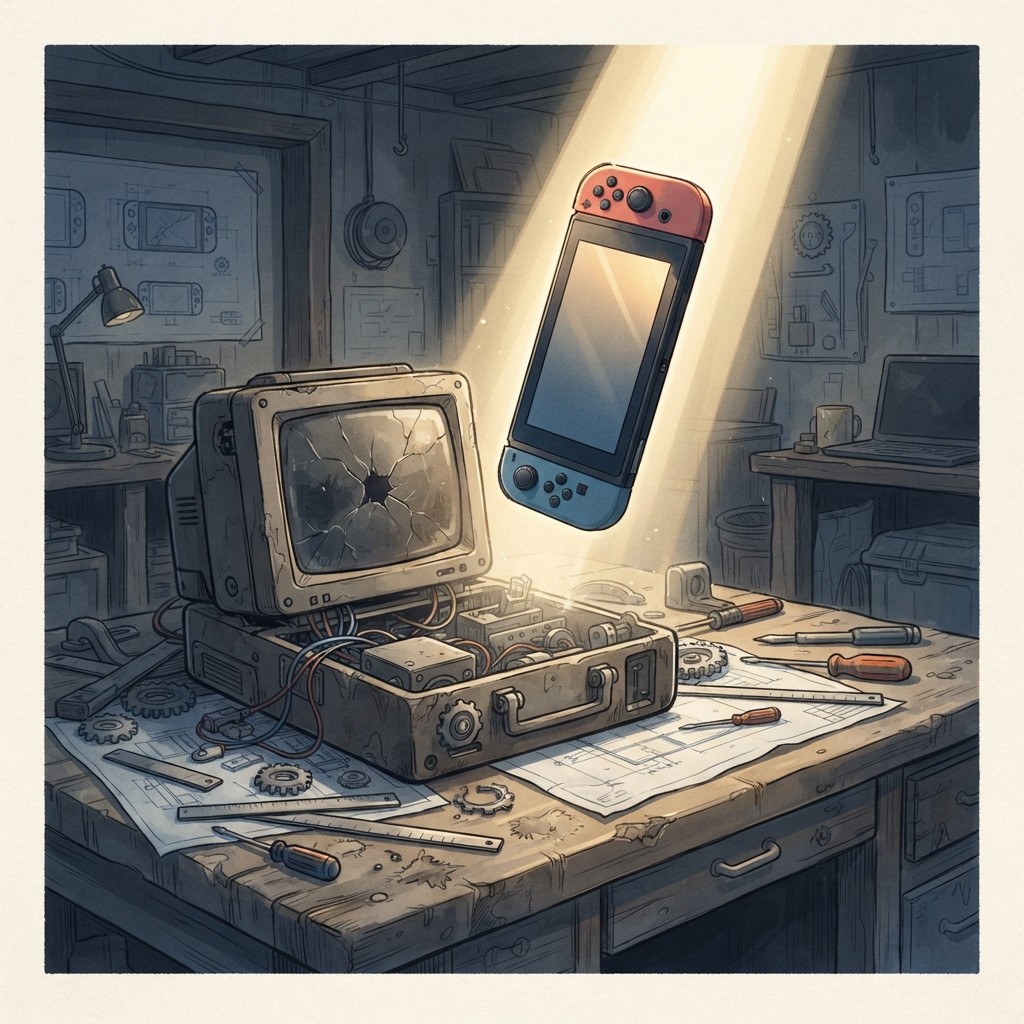
Here is where the reframe earns its keep. Nintendo did not throw the Wii U's ideas away when it died. It harvested them. The core promise - play on the big screen, then lift the same game out of the dock and keep going - was the Wii U's GamePad concept, finally built as one clean object instead of a console plus a tethered tablet. When the Switch launched on March 3, 2017 at $299.99,6 it was selling the exact idea the Wii U had been trying and failing to communicate for four years. The Wii U, in other words, was not a disaster. It was R&D that shipped to stores. Nintendo prototyped the hybrid console in public, watched what confused people, and charged shareholders ¥46.4 billion a year to learn the lesson.
Nothing makes the point sharper than The Legend of Zelda: Breath of the Wild. It was originally announced as a Wii U exclusive - the game meant to rescue the dying console. By E3 2016 it had been quietly reassigned as a simultaneous Switch launch title, after the Wii U was already abandoned.8 The Wii U's last great hope was repossessed and handed to its successor. Same game. Same idea. The only thing that changed was the box it came in - and whether anyone understood what that box was.
Wasn't it just a bad console, full stop?
The fair objection is that this is too generous. The Wii U was, by Nintendo's own lifetime number, its lowest-selling home console ever - 13.56 million units — among the lowest in the company's home console history, and widely compared to the ill-fated Virtual Boy as one of Nintendo's worst-selling platforms.1 You don't get to lose that badly and call it strategy. And the objection has teeth: the four wasted years were real, the lost developer relationships were real, the ¥46.4 billion was real money. None of that was planned. But notice what the 'just a bad console' reading cannot explain - why the very same concept, rebuilt with a name people understood and a single clear promise, became the best-selling Nintendo system of its kind. If the idea were the problem, the Switch fails too. It didn't. What failed the first time was the telling, not the thing. The Wii U proves a brutal rule of consumer hardware: a product that cannot explain itself in one sentence at the shelf will die there, no matter how good the idea inside the box.
The Wii U's idea and the Switch's idea were the same: play on the TV, then take the screen with you. One sold 13.56 million units; the other sold 155.92 million. The difference wasn't the technology - it was whether a shopper could grasp the product in the two seconds before they put the box down. When you launch something genuinely new, your hardest job is not building it. It's naming it and framing it so the customer instantly knows what category it lives in and why they'd want it. Nintendo learned that the most expensive way possible: by shipping the right idea inside the wrong sentence, watching it fail for four years, then shipping the identical idea inside the right one.
The Wii U is remembered as the worst thing Nintendo ever did. It is closer to the most useful. It was a four-year experiment, conducted on a global stage, into exactly how a great idea can die of bad framing - and Nintendo read the results coldly, kept the idea, threw away the framing, and built the comeback on the corpse. The disaster wasn't the price Nintendo paid for the Switch. The disaster was the Switch's first draft. It just had a different name on the box.
Disruption Vulnerability Assessment
An assessment that rates a company across the dimensions that predict disruption: how cheaply a challenger can serve the unsexy bottom of the market, how trapped you are by margins and a satisfied core. Blank to score your own position before the cliff; filled as the worked example showing where the story's incumbent was already exposed while the numbers still looked great.
Included, filled and blank, in the Fall Casebook. See the set → · Preview the blank →
Sources
Where this comes from — the filings, records, and reporting behind it.
- 1Wii U total lifetime hardware sales: exactly 13.56 million units; software: 103.60 million units — as of March 31, 2026.
- 2Wii U North American launch date: November 18, 2012; Japan launch: December 8, 2012. Basic Set Japan price ¥26,250, Premium Set ¥31,500.
- 3Nintendo posted an operating loss of ¥46.4 billion for fiscal year ending March 31, 2014 — its third consecutive year of losses. Wii U hardware sold only 2.72 million units that fiscal year (6.17 million life-to-date), and was cited as having 'a negative impact on Nintendo's profits.'
- 4Nintendo's own FY2014 financial results confirm: Wii U hardware sold 2.72 million units for the year and 6.18 million life-to-date; operating loss was ¥46.4 billion; net loss ¥23.2 billion.
- 5Nintendo of America's Senior Product Marketing Manager Bill Trinen admitted (in a GameSpot interview, September 14, 2012) that Wii U pre-launch marketing 'focused too much on the GamePad,' causing consumers to mistake it for a Wii accessory rather than a new platform.
- 6Nintendo Switch launched March 3, 2017 in Japan, North America, Europe, Australia, and other major markets at US$299.99 / ¥29,980.
- 7Nintendo Switch lifetime hardware sales reached 155.92 million units (software: 1,528.14 million units) as of March 31, 2026, per Nintendo's own IR data.
- 8The Legend of Zelda: Breath of the Wild was originally announced as a Wii U exclusive; it was only confirmed as a simultaneous Switch (NX) launch title at E3 2016, after the Wii U was functionally abandoned.
- 9Nintendo director of product marketing Bill Trinen told GameSpot in a September 19, 2012 interview that Nintendo made mistakes conveying that the Wii U is a brand new console, with consumers repeatedly asking whether it was an accessory for the Wii or a new system.
Weighing outside help with a decision like this? Hiring a turnaround or restructuring advisor
More like this — beyond Nintendo Wii U
New Strategically analyses as they publish: the defining moves in business, checked against the record. No noise, and one click to leave.