Pairs with the Disruption Vulnerability Assessment — a ready-to-use strategy tool. Included in the Fall Casebook →
“How much of your decline can the agreed explanation actually account for?”
In January 2022, FTX raised $400 million at a $32 billion valuation, with Temasek, SoftBank's Vision Fund 2, and Tiger Global writing the checks.23 Ten months later it filed for bankruptcy with assets and liabilities the courts could not even count, and the man brought in to clean up the wreckage said he had never seen anything like it - not even at Enron, which he had also run through bankruptcy.5 That is the story everyone tells: the genius founder, the fraud, the spectacular fall. It is true, and it is the wrong story to explain the crypto winter.
The official version is that FTX collapsed and dragged crypto down with it. FTX broke, so crypto froze. The dates say the opposite: crypto had already lost most of its value before anyone heard the name Alameda. By the time FTX filed, the total market had fallen from roughly $3 trillion to around $800 billion - a 70% wipeout that was largely complete before November.6 FTX didn't start the winter. It arrived to bury what the cold had already killed.
The crash came in three acts, and FTX was the finale
The crypto winter was not an event. It was a structured deleveraging - the same fortune being destroyed three times, at three different layers of the stack, by three different mechanisms. Act one was macro: the Federal Reserve started raising rates, and the speculative money that had inflated everything from meme coins to a near-$3 trillion total market cap began draining out. The peak was November 2021; the decline ran for months before any single firm imploded.6 This was the tide going out. Nothing had broken yet - it had only become expensive to hold things that produced no cash.
Act two was the algorithm. In May 2022, the Terra/LUNA ecosystem - an algorithmic stablecoin propped up by a token that backed it and a token backed by the stablecoin, a snake eating its own tail - unwound in roughly three days, erasing about $45 billion in combined LUNA and TerraUSD market value.7 This was not a price decline. It was a structure discovering it had no floor. And because the leveraged players had lent each other money against these tokens, the failure didn't stay contained: it took down Three Arrows Capital, Celsius, and Voyager Digital in a chain of contagion bankruptcies through the summer.7 By August, the layer of crypto lenders and hedge funds that ran on borrowed money was already gone.
Act three was the theft. On November 2, a CoinDesk report exposed that the balance sheet of Alameda Research - the trading firm tied to FTX - was stuffed with FTT, the token FTX had created itself.4 A rival noticed, said it would sell its FTT, and the price of the thing propping up Alameda began to fall. Customers tried to withdraw roughly $1 billion in a single day; FTX halted withdrawals on November 8 and filed for bankruptcy on November 11.41 This was the final layer - the exchange where ordinary people thought their money was simply being held.
| Act I: Macro | Act II: Terra/LUNA | Act III: FTX | |
|---|---|---|---|
| What broke | Speculative valuations | An algorithmic structure | Customer trust |
| Mechanism | Rising rates drain easy money | A self-referential stablecoin with no floor | Misappropriation of deposits |
| When | From Nov 2021 | May 2022 | Nov 2022 |
| Layer destroyed | Token prices | Leveraged lenders & funds | The exchange itself |
Why "liquidity crisis" is the lie SBF wanted you to keep
Here is where the popular story isn't just incomplete - it's a defense argument that got mistaken for journalism. FTX's failure is endlessly described as a 'liquidity crisis,' a phrase that implies a fundamentally healthy firm caught in a sudden bank run. That framing was promoted, in part, by Sam Bankman-Fried himself, and it matters enormously, because 'we were solvent but illiquid' is a misfortune while 'we spent the customers' money' is a crime. The courts settled which it was. SBF was convicted on seven counts of fraud in November 2023 and sentenced to 25 years, ordered to forfeit $11 billion, in what prosecutors called one of the biggest financial frauds in American history.8 A liquidity crisis is when the safe is locked and you can't reach the cash. FTX's safe was empty because the cash had been moved to cover Alameda's losses. Those are not the same accident.
“Never in my career have I seen such a complete failure of corporate controls and such a complete absence of trustworthy financial information.”5
But didn't FTX make everything worse?
The fair objection is that FTX wasn't merely the last domino - it was the loudest, and that loudness did real damage. FTX was a top-tier global exchange that millions trusted and that blue-chip investors like SoftBank and Temasek had blessed at a $32 billion valuation.2 Its failure didn't just confirm the winter; it poisoned the well, attaching the word 'fraud' to the entire category and freezing institutional interest for a year. All true. But notice the sequencing the objection can't escape: the $45 billion Terra wipeout, the contagion bankruptcies at Celsius, Voyager, and Three Arrows, and the 70% market collapse all happened before FTX filed.76 Even the brief hope of rescue evaporated instantly - the headline that a rival would acquire FTX was a non-binding letter of intent, signed and abandoned within a day once the books were opened. FTX made the winter worse the way a funeral makes grief worse: it didn't cause the death, it just made everyone finally admit it had happened.
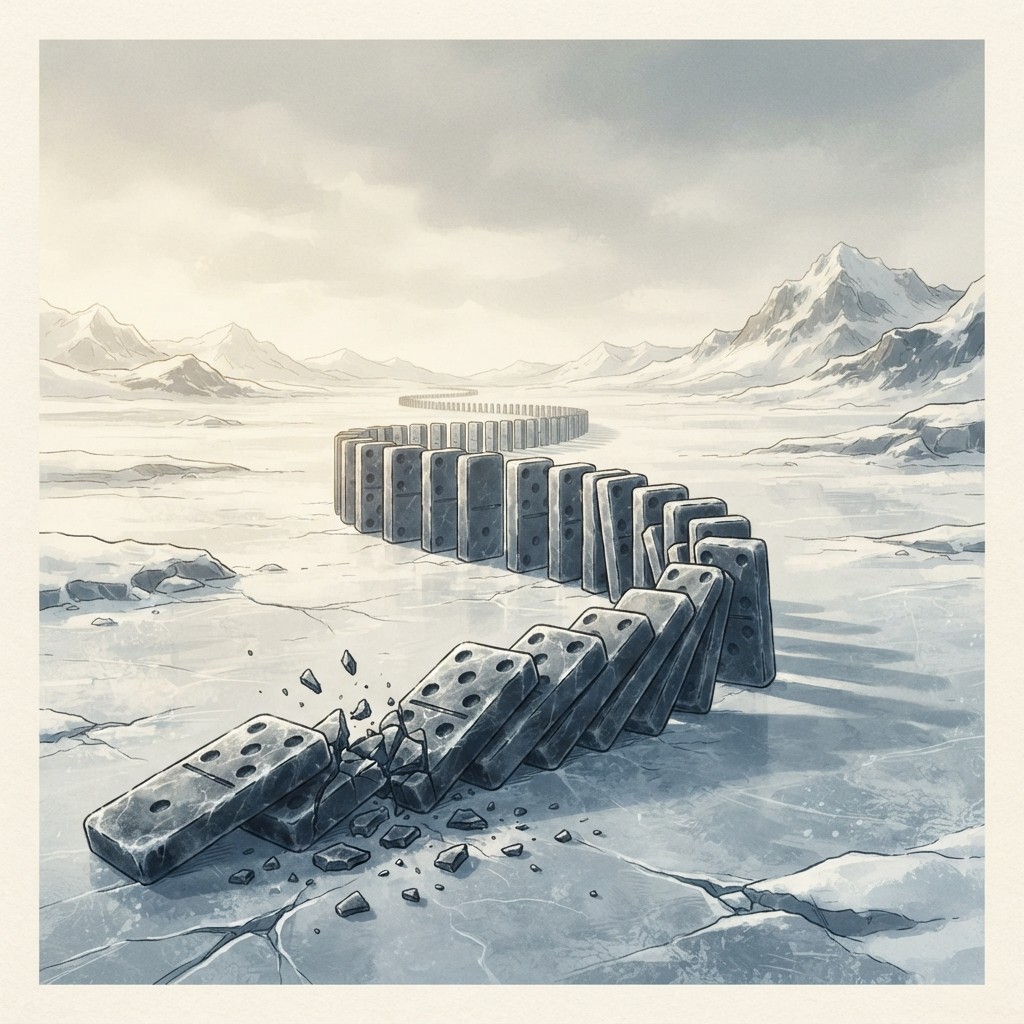
When a system collapses, the most visible failure is rarely the first one - it's the one with a famous name. The instinct is to write the story around the spectacular fall, because a fraud with a convicted villain is a better narrative than a slow drain of macro liquidity. But leveraged systems break from the bottom up: the cheap money leaves first, then the players who borrowed against worthless collateral, then finally the household names whose customers thought they were safe. If you want to understand a cascade, ignore which domino made the most noise and ask which one fell first. The famous collapse is usually a symptom wearing the costume of a cause.
The crypto winter was the same money dying three times - once as a valuation, once as a structure, once as a deposit - and FTX only owned the last death. Calling it the cause is comforting because it gives the disaster a face and a villain, and faces are easier to remember than the boring truth that rising interest rates and self-referential leverage had already done most of the killing. The deepest lesson of 2022 isn't that one founder lied. It's that an entire system built on assets backing other assets backing nothing had no floor to land on - and the floor it lacked had been missing long before anyone halted a withdrawal.
When the famous failure wasn't the real one
Disruption Vulnerability Assessment
An assessment that rates a company across the dimensions that predict disruption: how cheaply a challenger can serve the unsexy bottom of the market, how trapped you are by margins and a satisfied core. Blank to score your own position before the cliff; filled as the worked example showing where the story's incumbent was already exposed while the numbers still looked great.
Included, filled and blank, in the Fall Casebook. See the set → · Preview the blank →
Sources
Where this comes from — the filings, records, and reporting behind it.
- 1FTX Trading Ltd. filed a voluntary petition for Chapter 11 relief in the U.S. Bankruptcy Court for the District of Delaware on November 11, 2022, Case No. 22-11068 (JTD); 101+ affiliated debtors including Alameda Research and West Realm Shires (FTX US) were jointly administered.
- 2FTX raised $400 million in a Series C round announced January 31, 2022, setting a $32 billion valuation; investors included Paradigm, Temasek, SoftBank Vision Fund 2, Multicoin Capital, and Tiger Global.
- 3FTX's $32 billion Series C valuation was confirmed by CNBC on January 31, 2022; Temasek, SoftBank's Vision Fund 2, and Tiger Global participated; the exchange had raised a combined $2 billion in venture funding to date and reported daily trading volumes averaging $14 billion.
- 4On November 2, 2022, CoinDesk published a report revealing that Alameda Research's balance sheet was heavily composed of FTT tokens; this triggered Binance's announcement on November 6 that it would sell its FTT holdings, sparking approximately $1 billion in single-day customer withdrawals; FTX halted withdrawals November 8; FTX filed for bankruptcy November 11.
- 5John J. Ray III stated in a November 17, 2022 court filing: 'Never in my career have I seen such a complete failure of corporate controls and such a complete absence of trustworthy financial information,' including during the Enron bankruptcy, which he also oversaw.
- 6The total cryptocurrency market capitalization peaked at approximately $2.9–$3 trillion in November 2021 and had fallen to approximately $800 billion or below by mid-November 2022—a decline of roughly 70%–73% peak-to-trough.
- 7The Terra/LUNA ecosystem collapsed over approximately three days in May 2022, erasing approximately $45 billion in combined LUNA and TerraUSD market capitalization; the collapse triggered contagion bankruptcies at Three Arrows Capital, Celsius, Voyager Digital, and ultimately contributed to FTX's failure.
- 8Sam Bankman-Fried was convicted on November 2, 2023 on seven counts of fraud and sentenced on March 28, 2024 to 25 years in prison and ordered to pay $11 billion in forfeiture; the collapse of FTX was described by federal prosecutors as 'one of the biggest financial frauds in American history.'
Weighing outside help with a decision like this? Hiring a turnaround or restructuring advisor
More like this — beyond The Crypto Winter
New Strategically analyses as they publish: the defining moves in business, checked against the record. No noise, and one click to leave.