Pairs with the Disruption Vulnerability Assessment — a ready-to-use strategy tool. Included in the Fall Casebook →
“How much of your decline can the agreed explanation actually account for?”
On May 9, 1996, McDonald's brought the Rockettes to Radio City Music Hall.4 A corporate chef assembled a hamburger under spotlights, the CEO gave remarks, and the press dutifully reported that a burger built with mustard, mayonnaise, and a peppered bun was about to grow McDonald's up.5 This was the Arch Deluxe: the first in a planned line of sandwiches aimed at adults, with the next chicken and fish versions already on the drawing board.14 McDonald's reportedly expected a billion dollars in first-year sales.4 It got a place in the Museum of Failure instead.8
The story everyone tells is tidy: McDonald's blew $100 million on a fancy burger nobody wanted. Almost every part of that sentence is shaky. The price tag is wrong, the speed of the failure is wrong, and - most importantly - the lesson is wrong. The Arch Deluxe didn't fail because McDonald's spent too much on the wrong product. It failed because its research lied to it, gently and expensively, and told it exactly what it wanted to hear.
The $100 million number is the first thing they got wrong
Pin down what was actually spent and the famous figure dissolves. The Darden Business School case - the closest thing to an internal record - puts the launch advertising budget at $70 million, handled by the agency Fallon McElligott.1 Multiple secondary accounts push the total advertising spend across the campaign's life to around $200 million, described at the time as more than any fast-food company had ever put behind a single product.43 Wikipedia's aggregate, folding in research and production, climbs past $300 million.3 Notice what 'one hundred million' is doing here: it isn't any of these numbers. It's a media-laundered midpoint, vague enough to repeat and small enough to flatter. The real spend was larger and the real story is worse, because it wasn't about money at all.
| Figure | What it covers | Source quality |
|---|---|---|
| $70 million | Launch advertising budget only | Darden case - closest to primary |
| ~$200 million | Total advertising across the campaign | Widely reported secondaries |
| $300 million+ | Research + production + marketing | Aggregate estimate |
| $100 million | Nothing in particular | A repeated midpoint |
McDonald's didn't lack adults. It had them all along.
The premise of the whole project was that McDonald's was a kids' restaurant that needed to recruit grown-ups. But its own 1995 data said the opposite. Adults 35 and over already accounted for 44% of fast-food visits annually.1 The adult market wasn't missing - it was sitting in the dining room, buying the cheap stuff. McDonald's didn't have a traffic problem with adults; it had a conversion problem. The Arch Deluxe was an answer to a question nobody had asked, aimed at a customer who was already there and already spending. And the company badly needed something to work: by 1996 it had more than 12,000 U.S. locations and was losing same-store ground to Burger King and Wendy's.6 A flashy adult burger felt like a growth lever. It was actually a misdiagnosis dressed as one.
The focus group that flattered everyone in the room
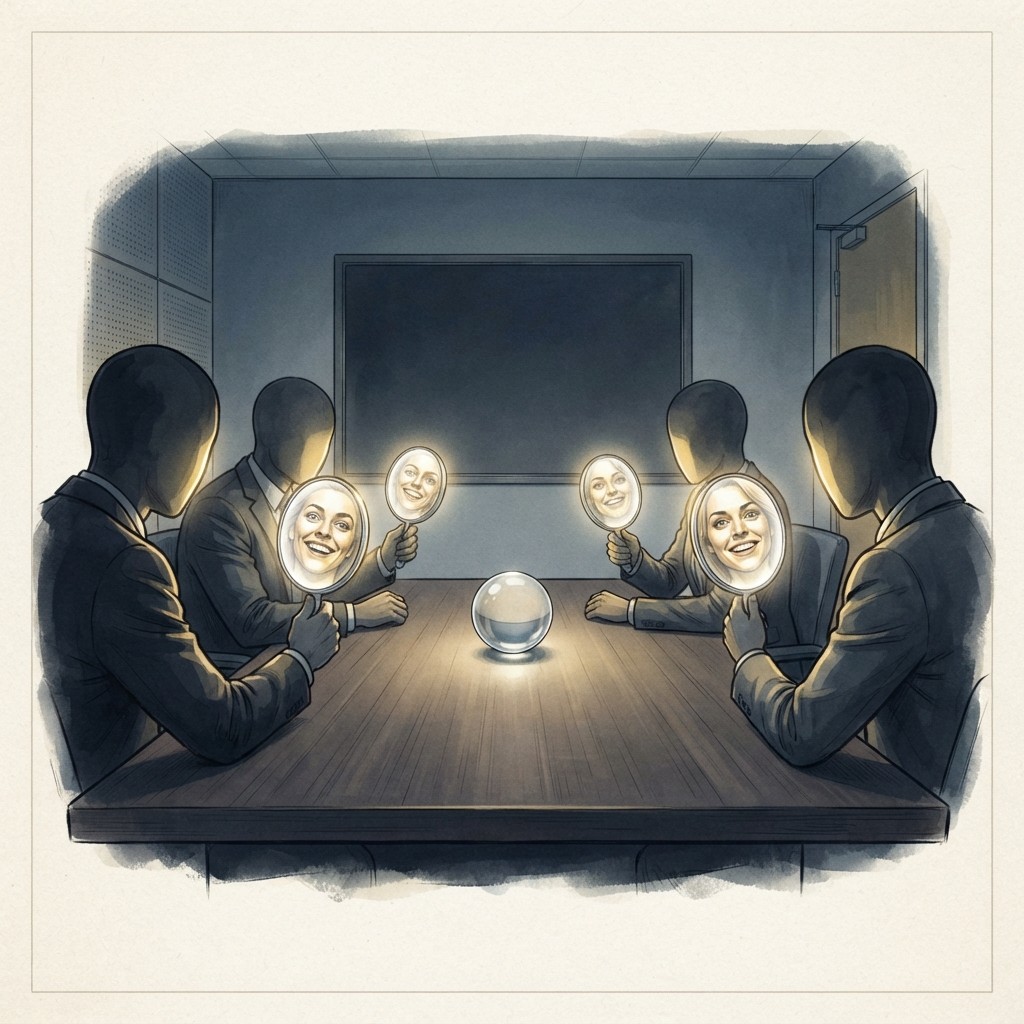
Here is the mechanism most analysts point to, one the spending headlines consistently bury. McDonald's tested the Arch Deluxe heavily, and it tested well. But the people doing the tasting were volunteers - and a volunteer for a burger focus group is, almost by definition, a person who likes trying new burgers.7 That is the opposite of the McDonald's core customer, who shows up because the food is fast, familiar, and cheap. So the research room was packed with food enthusiasts rating a peppered, sauced-up sandwich as adventurous and good, while the actual customer base - the price-sensitive family that wanted a Quarter Pounder for a couple of bucks - was never really in the sample. The numbers came back glowing. The verdict was real. The verdict was just about the wrong people. When the burger reached the counter, enthusiasm came in far below what the focus groups had promised.7
And the company's own segmentation should have set off the alarm. Internal research found that 78% of customers rated the Arch Deluxe best for kids - against only 18% for adults.6 The adult burger was reading, to ordinary people, as a kids' item. That is a signal the volunteer panel never sent, because the volunteer panel wasn't built to send it. A self-selected sample doesn't just give you noisy data. It gives you confident, well-sampled, statistically clean data about a population you don't sell to.
Before you trust a glowing focus group, ask who walked into the room. A volunteer pool self-selects for enthusiasm - exactly the trait your mainstream customer lacks. The danger isn't bad data; it's clean data about the wrong people. New Coke won approximately 190,000 blind taste tests and still failed because the test measured the wrong thing910; the Arch Deluxe sailed through its panels for the same reason. If the sample is biased toward people who love novelty, the report will recommend novelty, every time, with a beautiful confidence interval. Sample the customer you have, not the one who showed up to taste.
“78% of customers rated it best for kids; only 18% rated it best for adults.”6
Wasn't it just a bad burger at a bad price?
The fair objection is that this is over-engineered: maybe the Arch Deluxe simply tasted off, or cost too much. The price story doesn't hold - it retailed between $2.09 and $2.49, ordinary money even then, not the absurd figures sometimes thrown around.3 And the taste can't be the core problem either, because in controlled testing people genuinely liked it.7 The honest counter cuts the other way: if the product was fine and the price was fine, the failure has to live in the strategy and the research that justified it. Which is the point. McDonald's didn't build a bad burger. It built a defensible one, validated by a process that was structurally incapable of telling it the truth, sold to a customer who already came in for the opposite of premium. The burger was the symptom. The methodology was the disease.
It didn't even die quickly. The Arch Deluxe lingered at select restaurants through 1998 and 1999 and wasn't formally discontinued until August 18, 2000 - four years after the Rockettes.3 The popular memory of a humiliating instant withdrawal is its own small myth, layered on top of the bigger one about the cost. What survived was a permanent exhibit in the Museum of Failure and a shorthand for corporate overreach.8 But the most expensive lesson isn't 'don't spend $300 million on a burger.' It's quieter and harder to hear: the better your research looks, the more carefully you should check who it asked. McDonald's didn't fail to listen to its customers. It listened beautifully - to the wrong ones - and paid full price for the answer it already wanted.
When the research lies and the brand pays
Disruption Vulnerability Assessment
An assessment that rates a company across the dimensions that predict disruption: how cheaply a challenger can serve the unsexy bottom of the market, how trapped you are by margins and a satisfied core. Blank to score your own position before the cliff; filled as the worked example showing where the story's incumbent was already exposed while the numbers still looked great.
Included, filled and blank, in the Fall Casebook. See the set → · Preview the blank →
Sources
Where this comes from — the filings, records, and reporting behind it.
- 1McDonald's budgeted $70 million for the Arch Deluxe launch advertising campaign, handled by Fallon McElligott; the burger was introduced in spring 1996 as the first in a planned series of adult-targeted sandwiches; McDonald's was the fourth-largest U.S. advertiser in 1995, spending $490 million on measured media; adults 35+ accounted for 44% of fast-food visits.
- 2McDonald's FY1996 10-K annual report filed with the SEC; consolidated balance sheet at December 31, 1996 shows total assets of $17.386 billion; provides the audited financial record for the year the Arch Deluxe launched.
- 3The Arch Deluxe launched May 9, 1996; retail price ranged from $2.09 to $2.49; it was first tested in Canada in October 1995; formally discontinued August 18, 2000; still sold at select locations in 1998–1999; total estimated spend on research, production, and marketing exceeded $300 million.Wikipedia, Arch Deluxe ↗ · 2024
- 4McDonald's spent $200 million on advertising the Arch Deluxe, more than any fast food company had spent on a product launch before; the press debut was held at Radio City Music Hall featuring the Rockettes; McDonald's expected $1 billion in first-year sales (per a 1996 New York Times report); plans included expanding the Deluxe line to chicken and fish.
- 5Then-CEO Michael Quinlan delivered opening remarks at the Radio City Music Hall press debut; corporate chef Andrew Selvaggio (formerly of Chicago's Pump Room) assembled the burger under spotlights; the launch was covered by Adweek.
- 6The Arch Deluxe was released on May 9, 1996 at Radio City Music Hall; McDonald's set aside a $200 million budget for release and promotion; by 1996, U.S. McDonald's locations numbered more than 12,000 and were losing ground to Burger King (+2.5% sales) and Wendy's (+7.5% sales); internal McDonald's research found 78% of customers rated it best for kids vs. 18% for adults.
- 7McDonald's focus groups were composed of volunteers, creating selection bias: participants were likely food enthusiasts willing to try new items, not representative of McDonald's core price-sensitive customer base; when released publicly, real consumer enthusiasm was far lower than focus groups predicted.
- 8The Arch Deluxe is displayed in the Museum of Failure; by 1998 it had been phased out of almost every location; the $300 million investment became synonymous with corporate overreach.
- 9Coca-Cola performed 190,000 blind taste tests on U.S. and Canadian consumers before launching New Coke
- 10The return of original formula Coca-Cola on July 11, 1985 put the cap on 79 days; Coca-Cola's formula was changed after taste tests of nearly 200,000 consumers
- 11Analysts estimated McDonald's spent $100 million to introduce the Arch Deluxe in May 1996
Weighing outside help with a decision like this? Hiring a turnaround or restructuring advisor
More like this — beyond McDonald's Arch Deluxe
New Strategically analyses as they publish: the defining moves in business, checked against the record. No noise, and one click to leave.