Pairs with the Counterfactual Timeline Builder — a ready-to-use strategy tool, filled for Quibi. Included in the Counterfactual Casebook →
“What did the decision you did not take actually cost?”
On launch day — April 6, 2020 — Quibi was downloaded 379,000 times, and Jeffrey Katzenberg had every reason to feel vindicated.7 He had raised $1.75 billion, hired Hollywood, and built a beautiful app for watching ten-minute shows on a phone.1 By early June, daily downloads had fallen below 20,000.7 By October 21 the company announced it was shutting down; by December 1 it went dark.2 Roughly six months from the most-funded launch in streaming history to the shutdown announcement, and under eight to the lights going out.
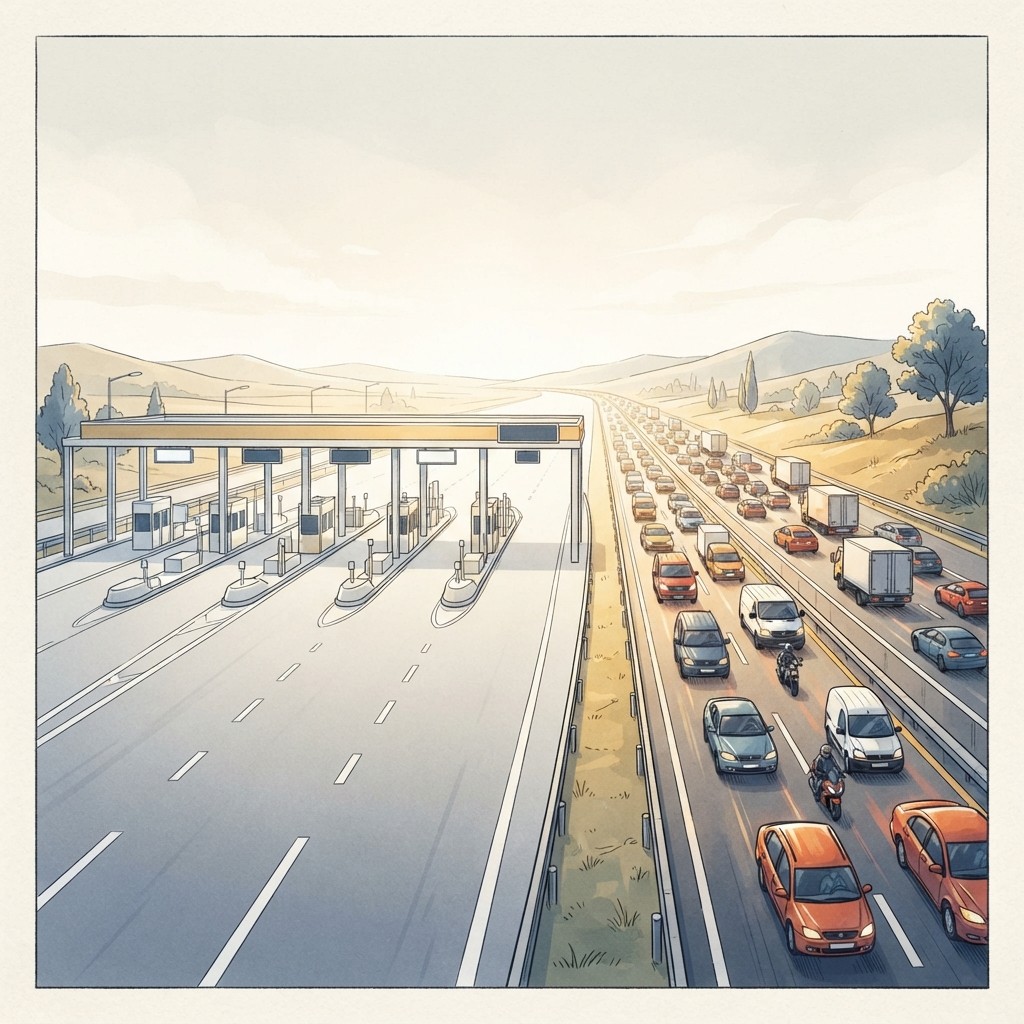
The official story is that the coronavirus killed Quibi. People couldn't commute, so they couldn't watch on the go, so a product built for the gaps in a busy day had no gaps to fill. The real story is that Quibi spent $1.75 billion building a toll road right next to a free highway that millions of people were already driving on — and the highway was called TikTok.
COVID is the alibi, not the cause
Blaming the pandemic is convenient because it makes the failure feel like bad luck rather than bad design. But the fatal decisions were locked in before anyone had heard of lockdowns. Quibi launched mobile-only, with no way to cast to a television and no real social sharing — you literally could not clip a moment and send it to a friend. It charged a subscription to compete against TikTok and YouTube, which charged nothing. And it did all this against an app that, in the very same quarter Quibi launched, recorded 315 million downloads — a single-quarter record for any app outside Chinese third-party stores.8 The thesis wasn't strangled by the virus. It was strangled by the structure.
| Quibi | TikTok | |
|---|---|---|
| Price to watch | Paid subscription | Free |
| Who makes the content | Hollywood, commissioned | The users themselves |
| How you find a show | A curated catalog you browse | An algorithm that feeds you |
| Can you share a clip? | No | Sharing is the whole point |
| Cost per hour of content | Up to $6 million | Approximately zero |
Look at the bottom row and the doom is obvious. Quibi paid up to $6 million per hour of produced content, commissioning over 8,500 episodes across 175-plus shows for more than $1 billion.4 TikTok's content cost it essentially nothing, because its users made all of it. One company manufactured supply at studio rates; the other got an infinite, self-replenishing supply for free and skimmed attention off the top. That is not a fair fight. That is a margin structure facing an army it cannot afford to feed.
The flywheel Quibi never had
Here is the mechanism, worked all the way down. TikTok's loop runs on its own thinness: a creator posts, the algorithm tests the clip on a few viewers, the ones who watch and share signal the system to push it wider, that reach pulls in more creators chasing it, and more creators means more clips to test tomorrow. Every additional user makes the product better for every other user and costs the company almost nothing. Quibi's loop ran backwards. A subscriber paid; the cash went to commission a fixed slate of shows; the shows sat in a closed app no one could share out of. Nothing a user did made the product better for the next user. There was no flywheel — just a very expensive catalog and a bet that people would pay to browse it.
The conversion numbers tell the same story from the user's side. Sensor Tower estimated that only about 8% of day-one free-trial users became paying subscribers; Antenna put it higher at 27%; Quibi disputed both.7 But argue the range all you like — when the free alternative is the most-downloaded app of the quarter and the paid one converts a single-digit-to-low-double-digit fraction of curious triers, the asking price is the problem. You don't pay a toll to drive on a road that is bumpier than the free one beside it.
“Significantly less than $100 million.”4
The salvage value confirms the diagnosis. Roku acquired distribution rights to 75-plus Quibi shows in January 2021, and its own Q1 2021 10-Q shows a $96.7 million increase in content assets that quarter — the closest primary-source proxy we have for the price.5 More than a billion dollars of premium short-form content, sold for under a tenth of what it cost to make.4 The market's verdict on commissioned short-form video was that it was worth pennies on the dollar — because the supply of short-form video had become, thanks to TikTok, effectively free.
But wasn't Quibi's content genuinely better?
The honest counter is that Quibi wasn't trying to be TikTok — it was trying to be prestige television in ten-minute pieces, polished work from real filmmakers, a different product for a different mood. Fair. And in a world where attention were not zero-sum, both could exist. But they were fighting for the same scarce thing: the idle minutes someone spends staring at a phone. TikTok had not just entered that slot; it had colonized it, training a reflex — open app, thumb up, infinite feed — that no curated catalog could interrupt. Quibi's quality argument assumes people were choosing what to watch. They weren't. They were being fed, and the feeding was free, endless, and already a habit.
It's worth being precise about one more legend. Quibi's signature Turnstyle feature — the seamless rotation between portrait and landscape — was not the clean breakthrough it was sold as. A rival, Eko, had filed a patent on horizontal-to-vertical toggle video back in 2015 and sued, alleging the technology was shown to Katzenberg in a 2017 meeting; a federal judge denied an injunction but let the core patent and trade-secret claims proceed, with Eko seeking at least $96.5 million.6 Even the differentiator was contested. The one thing Quibi could point to as uniquely its own had someone else's fingerprints on it.
Quibi's deepest error wasn't mobile-only delivery or the missing share button — those were symptoms. The root error was choosing to manufacture, at up to $6 million an hour, a kind of content that a competitor was generating for free at infinite scale. When a platform has turned your users into your suppliers, every dollar you spend commissioning supply is a dollar spent fighting gravity. Before you fund a premium version of a behavior, ask the lethal question: has someone already made the raw material free? If they have, your budget is not a moat. It's a meter running against a flywheel that costs nothing to spin. Compete on a different behavior, or don't compete at all.
Katzenberg liked to say that everything that went wrong was the coronavirus. But the virus didn't write the business plan. It didn't decide to charge for what was free next door, to lock the content inside an app no one could share from, or to spend a billion dollars manufacturing a supply that users were giving away by the hundred million. Quibi didn't lose to a pandemic. It lost to a flywheel it never had — and the genius of TikTok was simply standing in the place where the content makes itself, and charging nothing to watch it.
When the business model loses before the product ships
Counterfactual Timeline Builder
A one-page canvas that runs two histories side by side: what actually happened, and the alternative that died at the fork. You pin the divergence point, trace each branch forward, and name the assumption that decided which one came true. Blank, it disciplines hindsight into a testable counterfactual instead of a what-if; filled, it shows the story's road-not-taken with enough rigor to argue about.
Included, filled and blank, in the Counterfactual Casebook. See the set → · Preview the blank →
Sources
Where this comes from — the filings, records, and reporting behind it.
- 1Quibi raised exactly $1.75 billion across two rounds: $1 billion in August 2018 (led by Madrone Capital Partners, including Disney, WarnerMedia, Alibaba, and major studios) and $750 million announced March 4, 2020.
- 2Quibi launched April 6, 2020, projected 7.4 million year-one paying subscribers, shut down October 21, 2020 (announced), and went dark December 1, 2020 — approximately six to eight months after launch.
- 3At shutdown Quibi had approximately 500,000 subscribers per CNBC citing people familiar, while Kantar independently estimated 710,000 subscriber households in Q3 2020 — down from 1.1 million in Q2 2020; no figure was ever confirmed by Quibi.
- 4Quibi spent over $1 billion commissioning 8,500 short-form episodes across 175+ shows at up to $6 million per hour of produced content; the content library was sold to Roku in January 2021 for 'significantly less than $100 million.'
- 5Roku's Q1 2021 10-Q (SEC primary filing) confirms the Quibi content acquisition closed January 8, 2021 and drove a $96.7 million increase in content assets that quarter, providing the closest primary-source proxy for the purchase price.
- 6Eko filed suit in U.S. District Court for the Central District of California (March 10, 2020) alleging Quibi's Turnstyle feature infringed Eko's patents — including U.S. Patent No. 10,460,765 filed in 2015 — and misappropriated trade secrets demonstrated to Katzenberg in a March 2017 meeting. Eko sought at least $96.5 million in damages. A federal judge denied an injunction but allowed core patent and trade-secret claims to proceed.
- 7Quibi's daily downloads peaked at 379,000 on launch day (April 6, 2020) per Sensor Tower, dropping to fewer than 20,000 per day by early June 2020; only ~8% of day-one free-trial users converted to paid subscribers per Sensor Tower, versus 27% per Antenna — with Quibi disputing both figures. The company projected 7.4 million year-one subscribers but was on track for fewer than 2 million.
- 8TikTok recorded 315 million downloads in Q1 2020 alone — a record for any app in a single quarter, excluding Chinese third-party stores (SensorTower); the app was downloaded 850 million times in full-year 2020 and hit 1 billion monthly active users in September 2021.
Weighing outside help with a decision like this? Hiring a commercial due diligence provider
More from Stratrix
Strategic Decisions
The big calls companies keep facing, told through the 819 companies on record that made them.
24 decisionsFind your decision →The Strategist’s Craft
The methods behind the job: the planning cycle, initiative charters, decision rights, the memo that gets a yes.
Methods and templatesStart with the craft →Test a decision, free
Set a live decision against the companies that made it before you.
AcquisitionsThe Distance TestDivestituresThe Divestiture TestDiversificationThe Diversification TestMake or buyThe Make-or-Buy TestNew analyses, by email
The defining moves in business, checked against the record, as they publish.
More like this — beyond Quibi
New Strategically analyses as they publish: the defining moves in business, checked against the record. No noise, and one click to leave.