Pairs with the Crisis Response Playbook — a ready-to-use strategy tool, filled for RTX (Raytheon). Included in the Crisis Response Casebook →
“What is one more quarter of not acting worth?”
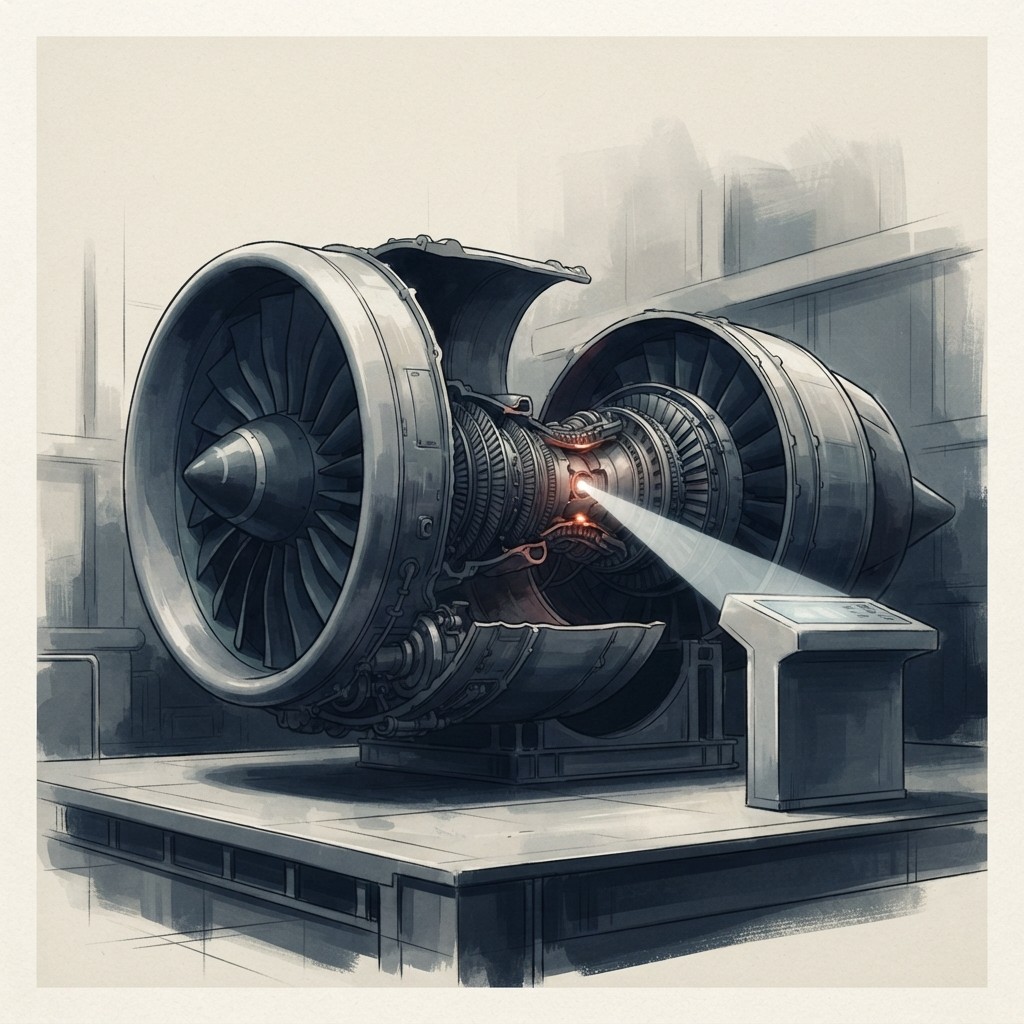
By late October 2024, 835 jets powered by Pratt & Whitney's geared turbofan sat on the ground—parked, idle, earning nothing—against an active fleet of 1,723. One in three of these aircraft was in storage.8 The cause wasn't a crash, a software bug, or a strike. It was dust: a rare contamination baked into the powder metal that Pratt used to forge the hottest, fastest-spinning parts of the engine, somewhere on the factory floor between late 2015 and 2021.7 A flaw measured in microns ended up grounding a third of a fleet and carving billions out of an aerospace giant's books.
The official telling is that RTX disclosed a manufacturing problem in 2023, took a charge, and moved on. That isn't quite what happened. RTX disclosed the same problem twice—first as an inspection program in July, then, seven weeks later, as a multibillion-dollar charge with a fleet-wide removal schedule.12 The crisis didn't change in those seven weeks. The framing did.
Here is the thesis a sharp analyst could argue with, and the one worth defending anyway: this was a self-inflicted process failure, and RTX's most consequential decision wasn't how to fix the metal—it was how to meter the bad news. The company released the severity in tranches, booked the damage in a way that protected its adjusted earnings, and kept its guidance intact, while the customers flying the engines absorbed an operational hit far longer and harsher than anyone first estimated.
Why the word 'manufacturing' is worth billions
Start with the distinction RTX worked hardest to establish. The defect lives in the high-pressure turbine and high-pressure compressor disks—the components that spin at the engine's core, where contaminated powder metal can seed micro-cracks that, left unchecked, risk an uncontained disk failure.7 That is genuinely dangerous, and it is why a regulator-style special instruction went out on August 4, 2023, forcing accelerated inspections and engine removals on an initial subset of operational engines no later than September 15.5 But RTX's COO drew a line in public and would not let it blur: 'This is not a GTF design issue, this is a manufacturing process issue on our part with metal.'7
That sentence is load-bearing. A design defect indicts the whole product line and threatens every future sale. A manufacturing-process issue is bounded—it has a start date and an end date. The affected parts were made between Q4 2015 and Q3 2021, which means engines in production at the time of disclosure were clean.7 By naming the problem precisely, RTX fenced it: the GTF as a design lives; only a defined batch of parts dies. The fix is a containable inventory of bad disks, not a referendum on the geared turbofan itself.
“This is not a GTF design issue, this is a manufacturing process issue on our part with metal.”7
The two-tranche disclosure, and what each one bought
On July 25, 2023, in its Q2 earnings release, RTX disclosed a 'rare condition in powder metal' requiring accelerated inspection of the PW1100G-JM fleet, with roughly 200 accelerated removals expected by mid-September.1 Read on its own, that's a maintenance footnote: a couple hundred engines, a routine-sounding inspection. No dollar figure on the table. Then, on September 11, a separate 8-K reset the picture entirely—now 600 to 700 engines beyond the prior forecast would need shop visits between 2023 and 2026, and the gross financial impact was pegged at $6 to $7 billion.2
These are routinely collapsed into a single 'September 2023' event, and the conflation hides the technique. The first disclosure established the existence of a problem on RTX's own calendar, in its own earnings release, on a small scale. The second disclosure attached the real number—after the market had already absorbed that a problem existed. By the time the Q3 results landed on October 24, the news was confirmation, not shock: the company simply reported that the impact came in 'in line with' the September estimate.6 A surprise had been pre-engineered into an update.
How an 83% sales collapse becomes a manageable footnote
Now the accounting, because this is where the crisis got framed most cleverly. The headline shorthand is 'a $3 billion charge,' but the precise entry is stranger and more revealing. RTX recorded a $5.4 billion reduction in reported sales, then partially offset it with a $2.5 billion reduction in cost of sales reflecting program partners' 49% share—netting to a $2.888 billion pre-tax operating profit impact.3 Pratt & Whitney's reported Q3 sales came in at $926 million, down 83% year-over-year—but that collapse is entirely an artifact of booking the charge against revenue under long-term contract accounting, not a real evaporation of business.3
| What it looks like | What it is | |
|---|---|---|
| Pratt Q3 reported sales | Down 83% — collapse | An accounting artifact of the charge3 |
| The charge | A '$3B charge' | $5.4B sales cut, less $2.5B partner offset = $2.888B net3 |
| Partner offset | A negotiated rescue | A fixed 49% program-share split3 |
| Adjusted EPS | Should crater | $1.25, up 3% year-over-year6 |
The partner offset matters more than it looks. It wasn't a negotiated bailout that RTX scrambled to arrange; Pratt holds a 51% share of the GTF program, so its partners automatically carry 49% of the pain.3 Roughly half the cost was always going to land on someone else's ledger by the structure of the deal. So the gross $5.4 billion gash shrinks to a net $2.9 billion before tax—and against that, the company reported adjusted EPS of $1.25, up 3% year-over-year, and announced a $10 billion accelerated share repurchase.6 A grounded-fleet crisis, and the same quarter buys back ten billion dollars of its own stock. The metal failed; the financial story held.
Where the disclosure couldn't reach: the airlines
Disclosure cadence can manage a stock. It cannot fix a turbine. And this is the part of the story RTX's framing could not soften, because it played out on someone else's balance sheet. The affected variants reach across the single-aisle world—the PW1100G on the A320neo, the PW1500G on the A220, the PW1900G on the Embraer E2.8 As inspections ran, the parked-jet count climbed: 835 stored airframes by late October 2024, a one-in-three storage rate.8 An engine pulled for inspection has to go to a shop, and the shops backed up. Turnaround times stretched to 300–360 days against an initially cited expectation of roughly 60.8
That gap—a year on the ground where two months were planned—is the real measure of the operational damage, and it is the number RTX's clean financial story never had to internalize. RTX recognized its charge once, in a quarter, with a partner offset. The airlines absorbed grounded fleets, lost flying, and lease costs on aircraft that couldn't earn, quarter after quarter, with no offset at all. The cost didn't disappear when RTX booked it. It moved downstream.
When bad news is unavoidable, the timing of severity is a strategic lever, not just a compliance obligation. RTX put the problem on the table in July as a small inspection program, then attached the multibillion-dollar number in September—so that by the October earnings call the market was confirming an estimate rather than reacting to a surprise. The technique is legitimate when the staged facts are all true and the structure is sound: a fixed 49% partner split really does halve the hit, and a manufacturing-process flaw really is bounded where a design flaw isn't. But notice the limit. Disclosure cadence governs the stock; it does nothing for the operation. The same crisis that produced a 3%-up adjusted EPS produced a one-in-three grounded fleet and year-long shop queues for customers. Manage the narrative all you want—the metal still has to come out of the engine.
The fair objection: maybe this was just honest reporting
The honest counter is that none of this required cynicism. A manufacturer that discovers a defect mid-quarter genuinely doesn't know the full scope until it works through the affected serial numbers—so a July disclosure of 200 removals followed by a September revision to 600–700 may simply be a company updating as it learns, not metering the news.12 The partner offset is contractual, not contrived. The 83% sales drop is honest accounting under the rules. And RTX did name the problem precisely rather than hiding it; the COO's 'manufacturing process issue' line is an admission of fault, not a dodge.7
All true—and it doesn't undo the thesis, it sharpens it. The point was never that RTX lied. It's that RTX never had to. The structure of the situation—a defined batch of bad parts, a 49% partner split, contract accounting, a problem that could be honestly disclosed in escalating tranches—gave management a set of true things to say in an order that protected the franchise and the guidance. Good framing rarely requires falsehood. It requires choosing which true thing to say first.
RTX spent 2023 proving that a manufacturer can take a multibillion-dollar quality failure squarely on the chin and still walk away with its guidance intact, its buyback enlarged, and its product line's reputation fenced off from the flaw. The disk cracks were real; so was the discipline around how the world learned of them. The lesson isn't that RTX got lucky. It's that the cheapest crisis to survive is the one whose severity you control the calendar on—and the most expensive seat in the system was never the one that did the disclosing. It was the airline with a third of its jets on the ground, waiting a year for an engine that was promised back in two months.
When the official story and the real one diverge
Crisis Response Playbook
A playbook for a crisis already in motion: who decides, which plays fire on which trigger, and what gets said to whom. It replaces panic and the all-hands meeting with a pre-agreed sequence each person can run alone. Blank to pre-load before a crisis hits; filled as the worked example reconstructing the plays the story's team ran — and the ones they should have.
Included, filled and blank, in the Crisis Response Casebook. See the set → · Preview the blank →
Sources
Where this comes from — the filings, records, and reporting behind it.
- 1RTX first publicly disclosed the powder-metal defect on July 25, 2023, in its Q2 2023 earnings release, stating that a 'rare condition in powder metal used to manufacture certain engine parts will require accelerated fleet inspection' of the PW1100G-JM fleet, with approximately 200 accelerated removals by mid-September 2023.RTX Corporation, RTX Reports Q2 2023 Results ↗ · 2023-07-25
- 2On September 11, 2023, RTX issued an 8-K announcing a Q3 charge related to the powder-metal matter, disclosing that approximately 600 to 700 engines beyond its prior forecast would be removed for shop visits between 2023 and 2026, and that the gross financial impact was estimated at $6–7 billion.
- 3RTX's Q3 2023 8-K (Exhibit 99, filed October 24, 2023) confirms the precise charge: a net pre-tax operating profit impact of $2.888 billion ($2.9 billion), recorded as a $5.4 billion reduction in reported sales, partially offset by a $2.5 billion reduction in cost of sales representing partners' 49% share. Pratt & Whitney's Q3 2023 reported sales were $926 million, down 83% year-over-year solely due to the charge.
- 4RTX's FY2023 10-K (filed February 5, 2024) refers to the issue formally as the 'Powder Metal Matter,' stating that 'Pratt & Whitney determined this year that a rare condition in powder metal used to manufacture certain engine parts requires accelerated inspection of the PW1100G-JM fleet.' Full details are cross-referenced to Note 17: Commitments and Contingencies.
- 5RTX's 10-Q filed October 21, 2025, confirms the operative regulatory trigger: 'On August 4, 2023, Pratt & Whitney issued a special instruction (SI) to operators of PW1100 GTF powered A320neo aircraft, which required accelerated inspections and engine removals covering an initial subset of operational engines, no later than September 15, 2023.'
- 6RTX confirmed on its Q3 2023 earnings call (October 24, 2023) that the gross financial impact was 'in the range of $6 billion to $7 billion' as communicated in September, and that the Q3 pre-tax operating profit impact of approximately $2.9 billion was 'in line with where we expected.' Adjusted EPS of $1.25 was up 3% year-over-year, and the company announced a $10 billion accelerated share repurchase program.
- 7The affected parts were manufactured between Q4 2015 and Q3 2021. The defect is a powder-metal contamination in high-pressure turbine (HPT) and high-pressure compressor (HPC) components, which could cause premature cracking and uncontained disk failures. RTX COO Christopher Calio stated publicly: 'This is not a GTF design issue, this is a manufacturing process issue on our part with metal.'
- 8By end-October 2024, Cirium data showed 835 GTF-powered jets in storage globally—a 33% storage rate against the active fleet of 1,723 aircraft. Affected GTF variants include PW1100Gs (A320neo), PW1500Gs (A220), and PW1900Gs (Embraer E-Jets E2). Shop visit turnaround times reached 300–360 days, versus an initially cited ~60-day projection.
Weighing outside help with a decision like this? Hiring a supply chain strategy consultant
More like this — beyond RTX (Raytheon)
New Strategically analyses as they publish: the defining moves in business, checked against the record. No noise, and one click to leave.