Pairs with the Crisis Response Playbook — a ready-to-use strategy tool. Included in the Crisis Response Casebook →
“What is one more quarter of not acting worth?”
In early March 2022, Bob Chapek had a decision in front of him that looked like a no-brainer for the company that built its empire on warmth and inclusion: say something about a Florida bill opponents called 'Don't Say Gay.' He chose not to. In an internal memo to staff on March 7, he refused to take a public stand, arguing that corporate statements 'do very little to change outcomes or minds' and would be 'counterproductive.'10 By the time Disney finally spoke up at its March 9 shareholder meeting, the bill had already passed both chambers of the Florida legislature — the House on February 24 and the Senate on March 8.92 Chapek's own verdict on his strategy: it 'didn't quite get the job done.'2
The story everyone remembers is that Disney bravely opposed the bill and got punished for its courage. Almost every beat of that is backwards. Disney did not lead the fight - it was dragged into it by its own employees. And the punishment that followed was not the price of a brave stand. It was the price of a reversal so visible that it handed a governor the perfect pretext to make an example of the most powerful company in his state.
The revolt that came from inside the castle
Chapek's silence wasn't a neutral act. It read, to the people who actually make Disney's product, as abandonment. The backlash didn't come from activists outside the gates - it came from Marvel, Pixar, and Lucasfilm, the three studios that are the company's creative heart, all of them publicly critical of how their CEO had handled it.7 Pixar employees went further, alleging in a statement that Disney corporate executives had censored same-sex affection from finished films.7 For a company famous for its internal cohesion, this was an unprecedented public fracture.7 When your own studios are issuing statements against you, the lobbying-quietly strategy is already dead; you just haven't announced it yet.
So Chapek announced it. On March 11, he wrote employees an apology that conceded the whole premise of his earlier approach: 'our silence was painful,' he wrote, and 'You needed me to be a stronger ally in the fight for equal rights and I let you down.' Disney simultaneously paused all political donations in Florida.3 It even pledged $5 million to organizations protecting LGBTQ+ rights - but the gesture curdled fast, because the Human Rights Campaign publicly refused to accept the money, saying it wouldn't take a dollar until Disney showed concrete action.3 The reversal pleased almost no one. It looked, to employees, like too little too late - and to the political right, like a corporation caving to its activist staff.
“Our silence was painful... You needed me to be a stronger ally in the fight for equal rights and I let you down.”3
The thesis: the reversal was the exposure
Here is the whole episode in one sentence. Disney didn't get attacked for a position - it got attacked for the loud, two-stage way it arrived at one. By staying silent, Chapek alienated his own people; by reversing under their pressure, he turned a HR problem into a public political statement, and a public political statement is a target. After DeSantis signed HB 1557 on March 28, Disney issued a statement that its goal was for the law to be repealed or struck down.1 That declaration - not the original quiet lobbying, which would have drawn no fire at all - became the stated precipitating cause of everything that came next.1 The lesson isn't 'take a brave stand' or 'stay out of politics.' It's that performative positioning, especially positioning forced out of you in two clumsy moves, creates real regulatory exposure that a clear strategy from the start would have avoided.
A company that commits to a stance from the outset, and a company that genuinely stays neutral, are both defensible. The lethal third option is the visible flip - silent, then loud - because it satisfies no constituency and hands every one of them evidence. Employees see the silence as the real you and the apology as panic. Opponents see the apology as the real you and weaponize it. Chapek's reversal didn't resolve the crisis; it converted an internal morale problem into a public political fight against an opponent who held the legislature. Decide where you stand before the bill moves, not after it passes.
What DeSantis actually took - and didn't
The retaliation came fast and looked total. On April 19, DeSantis expanded a special legislative session; lawmakers filed identical bills - HB 3C in the House, SB 4-C in the Senate - to dissolve special districts created before November 1968, a date chosen to capture exactly one target: Reedy Creek, the self-governing district Florida had handed Disney back in 1967 so it could build Walt Disney World at no cost to taxpayers.48 The Senate passed it 23-16, the House 70-38, and DeSantis signed it on April 22, setting a dissolution date of June 1, 2023.4 The district spanned roughly 25,000 acres and carried about $1 billion in bond debt, and the apocalyptic headline wrote itself: Disney's debt about to crash onto county taxpayers.8
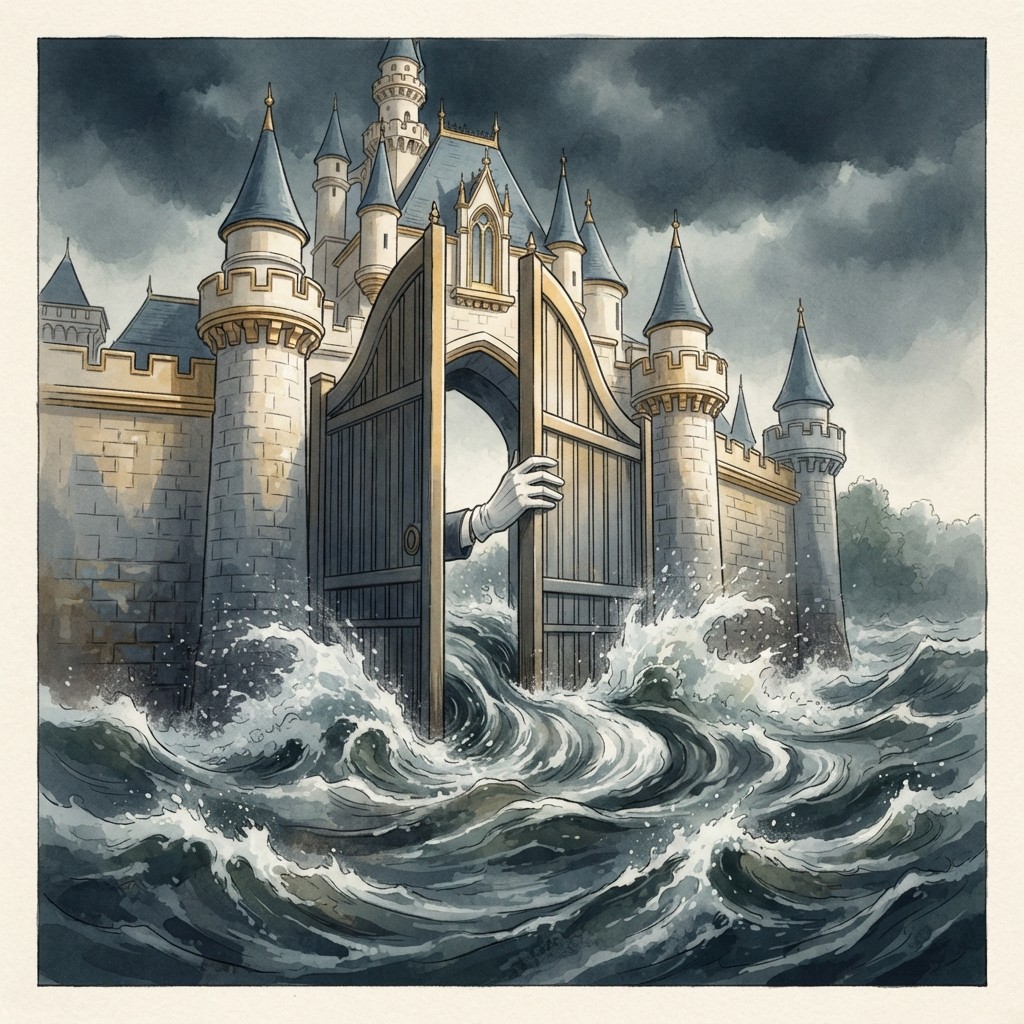
Except the dissolution never happened. Before June 1, 2023 ever arrived, the legislature quietly replaced the kill order with a takeover. In February 2023, CS/HB 9-B retained the district entirely - renaming it the Central Florida Tourism Oversight District, trimming its powers, and replacing Disney's board with one appointed entirely by DeSantis.5 The district still exists. It still provides the same municipal services. The roughly $1 billion in bond debt stayed inside the renamed district, never landing on county taxpayers at all.11 'Dissolution' was always the threat; control was always the goal. DeSantis didn't burn the castle down. He changed the locks and kept the keys.
| The popular story | What the record shows | |
|---|---|---|
| Disney's stance on the bill | Brave early opposition | Silent until after it passed both chambers |
| Reedy Creek | Dissolved by DeSantis | Renamed, retained, board replaced |
| The ~$1B debt | Dumped on county taxpayers | Kept inside the renamed district |
| How the fight ended | Disney won | Disney conceded its last-minute agreements were void |
But surely Disney won in the end?
The fair objection is that Disney is enormous, its lawyers are excellent, and it emerged with its theme parks humming and its operating footprint intact - so how is this a loss? Two answers. First, on the substance: in the March 2024 settlement, Disney had to concede that the 'last-minute development agreements' its outgoing Reedy Creek board had secretly passed just before DeSantis took control were 'null, void, and unenforceable.'6 Those agreements were Disney's attempt to lock in decades of governance autonomy before the new board arrived. They were the prize. Disney gave them up, dropped its state lawsuits, and saw its federal First Amendment suit dismissed in January 2024.6 Disney kept the building; it lost the keys to how the building is governed - which was the entire thing the fight was about.
Second, the deeper cost can't be settled in a courtroom. The honest counter to the whole episode is that Chapek faced a genuine dilemma - any stance would have angered roughly half his customers, so maybe quiet was rational. But that defends neutrality, not what Disney actually did. It didn't stay neutral. It backed in, then backed out, then declared war by press release, then spent two years and untold legal fees retreating to a position weaker than the one it started from. A company that had decided clearly - either way - on March 1 would have had no internal revolt to quell and no theatrical reversal to be punished for.
Disney spent half a century with a kingdom inside Florida that it governed almost as a sovereign. It lost that not because it took a courageous stand and paid for it, but because it couldn't decide whether it was taking one. The silence enraged its artists; the apology enraged a governor; the lawsuit ended in a concession. The most powerful brand in entertainment discovered that the dangerous move in a culture war is not picking a side. It's letting everyone watch you pick one twice.
When a company's response becomes the crisis
Crisis Response Playbook
A playbook for a crisis already in motion: who decides, which plays fire on which trigger, and what gets said to whom. It replaces panic and the all-hands meeting with a pre-agreed sequence each person can run alone. Blank to pre-load before a crisis hits; filled as the worked example reconstructing the plays the story's team ran — and the ones they should have.
Included, filled and blank, in the Crisis Response Casebook. See the set → · Preview the blank →
Sources
Where this comes from — the filings, records, and reporting behind it.
- 1DeSantis signed HB 1557 ('Parental Rights in Education,' aka 'Don't Say Gay') on March 28, 2022, and Disney subsequently released a statement saying its goal was for the law to be repealed or struck down — the stated precipitating cause of the Reedy Creek retaliation.
- 2Disney CEO Bob Chapek did not publicly oppose HB 1557 while it was in the legislature; he told shareholders at the March 9 annual meeting that Disney had opposed the bill 'from the outset' but chose behind-the-scenes lobbying, and admitted the approach 'didn't quite get the job done.' Public opposition came after both chambers had already passed the bill.FactCheck.org, DeSantis vs. Disney Q&A ↗ · 2022-05
- 3Chapek apologized to employees in a March 11, 2022 letter, writing that 'our silence was painful' and 'You needed me to be a stronger ally in the fight for equal rights and I let you down.' Disney simultaneously paused all political donations in Florida. The Human Rights Campaign refused to accept Disney's pledged $5 million donation.
- 4On April 19, 2022, DeSantis expanded a special legislative session; Rep. Randy Fine filed HB 3C and Sen. Jennifer Bradley filed SB 4-C — identical bills dissolving special districts established before November 1968, explicitly targeting Reedy Creek. The Senate passed the bill 23-16 on April 20; the House passed it 70-38 on April 21; DeSantis signed it April 22, 2022, setting a dissolution date of June 1, 2023.
- 5The dissolution never took effect. In February 2023, the Florida legislature replaced the dissolution law with CS/HB 9-B, which retained the district (renamed the Central Florida Tourism Oversight District) with reduced powers and placed it under a board appointed entirely by Governor DeSantis, rather than dissolving it.
- 6Disney filed a federal lawsuit in April 2023 (Disney v. DeSantis) alleging First Amendment retaliation. The federal suit was dismissed January 31, 2024; Disney appealed to the 11th Circuit. Separately, on March 27, 2024, Disney and the DeSantis-backed CFTOD board reached a state-court settlement in which Disney dropped its state lawsuits and conceded its 'last-minute development agreements' were null and void.
- 7All three of Disney's major content studios — Marvel, Pixar, and Lucasfilm — were publicly critical of Chapek's handling of the Don't Say Gay crisis; a Pixar employee statement alleged Disney corporate executives had censored same-sex affection from films. This internal revolt was widely reported as unprecedented for Disney.
- 8Reedy Creek was established by the Florida legislature in 1967 so Disney could develop Walt Disney World infrastructure at no cost to Florida taxpayers; it covered roughly 25,000 acres across Orange and Osceola counties and carried approximately $1 billion in outstanding bond debt at the time of the dispute.
- 9CS/CS/HB 1557 passed the Florida House on February 24, 2022, and the Florida Senate on March 8, 2022 — both chambers before Disney's March 9 shareholder meeting.
- 10On March 7, 2022, Chapek sent employees an internal memo stating that 'corporate statements do very little to change outcomes or minds' and arguing that public positioning would be 'counterproductive,' effectively refusing to take a public stand against HB 1557.
- 11Following concerns about the dissolution process and the handling of the district's outstanding debt, the dissolution law was replaced in February 2023 by CS/HB 9-B, which retained the district and renamed it the Central Florida Tourism Oversight District — meaning the ~$1 billion in bond debt remained inside the preserved district and was never transferred to county taxpayers.
Weighing outside help with a decision like this? Hiring a supply chain strategy consultant
More like this — beyond Disney
New Strategically analyses as they publish: the defining moves in business, checked against the record. No noise, and one click to leave.