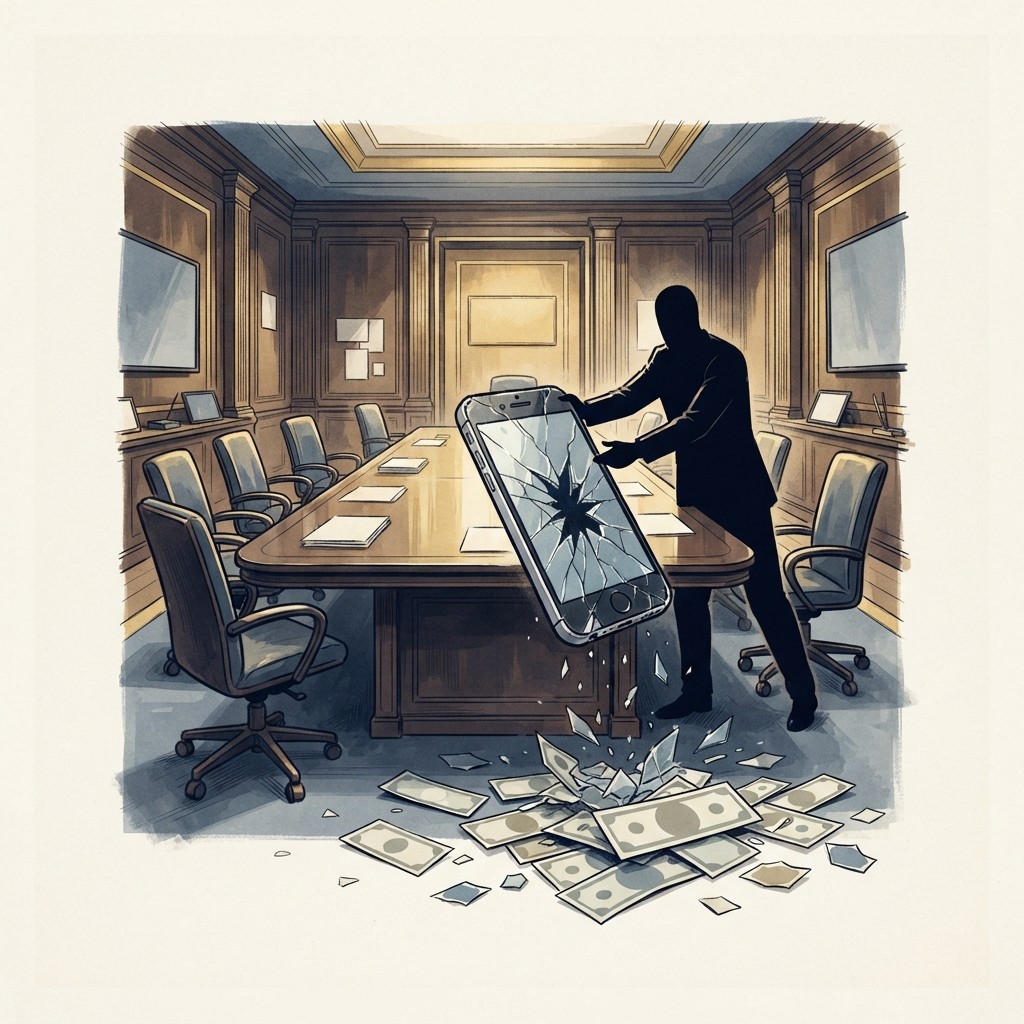
Everyone in the room who mattered most thought the deal was a mistake. It happened anyway — because one man tied his job to it.
Pairs with the Counterfactual Timeline Builder — a ready-to-use strategy tool. Included in the Counterfactual Casebook →
“What did the decision you did not take actually cost?”
In June 2013, at a Microsoft board meeting, Steve Ballmer reportedly raised his voice and said that if he didn't get his way, he couldn't be CEO.510 What he wanted was Nokia. The room around him was skeptical: the future CEO had voted against it in a straw poll, the co-founder had reportedly pushed back, and at least one executive never came around.5 Ballmer got his way anyway. Three months later Microsoft announced it would buy Nokia's phone business for EUR 5.44 billion.1 Less than two years after that, Microsoft wrote off $7.5 billion.2 The phone business was effectively dead.
The official story is that Microsoft made a bad strategic bet on mobile — that it misread where phones were going and paid the price. That telling is both flattering and wrong. The people in the room did read it correctly. They said no. The failure wasn't that nobody saw it coming. It's that the company couldn't stop one departing executive from spending nearly $10 billion on a bet the board itself opposed.
The room said no, and the deal happened anyway: when dissent gets aired but not honored, scrutiny becomes theater
Strip away the hindsight and look at who objected. Multiple board members and senior executives — including Satya Nadella, Bill Gates, and Tony Bates — initially opposed buying Nokia.5 These were not bystanders. Nadella would be CEO within months; Gates was the company's co-founder and chairman emeritus. When the people who built the company and the person about to run it all line up against a deal, that deal does not lack scrutiny. It lacks a brake. The objections were aired, registered, and then run over. In his own account, Nadella later wrote that he voted 'no' in the straw poll: 'We were chasing our competitors' taillights.'11 That single phrase is the whole diagnosis. He didn't think the price was wrong. He thought the strategy was backward — buying your way into a race you've already lost.
“I voted no … We were chasing our competitors' taillights.”4
Here's the honest complication, and we'll meet it head-on rather than tidy it away: Nadella didn't stay a holdout. He changed his vote and supported the acquisition before it was announced.5 That matters, because it means the deal wasn't pushed through over a unanimous wall of opposition. But it doesn't rescue the governance story — it sharpens it. When a CEO threatens his own job over a single acquisition, dissent doesn't have to be overruled. It evaporates. People who privately think a deal is wrong fall into line, because the alternative is a leadership crisis on the way out the door. Tony Bates reportedly stayed opposed.5 Most didn't have the appetite for that fight.
The platform was already dying when Microsoft bought it: the deal didn't cause the decline — it inherited it onto Microsoft's balance sheet
The most damning fact isn't in the boardroom — it's in the market-share data. The popular narrative treats the Nokia deal as the thing that killed Windows Phone. The timeline says the opposite. Windows Phone's global share peaked at roughly 3.4% in 2013 and had already slipped to about 2.5% by the second quarter of 2014 — before the acquisition even closed that April.9 Microsoft didn't buy a rising platform and then mismanage it. It bought a falling one, at the moment it was falling, and bolted the cost of building phones onto its own balance sheet. The deal didn't cause the decline. It converted someone else's decline into Microsoft's loss.
There was warning in writing, years earlier, from inside Nokia itself. In February 2011, CEO Stephen Elop's internal memo leaked: Nokia, he wrote, was 'standing on a burning platform.'7 It was a candid admission that the company's mobile position was untenable. Microsoft would go on to buy the very business that had described itself as on fire — and Elop, a former Microsoft executive, came back to Redmond in the deal. The diagnosis was on the record before the check was written. Buying a burning platform doesn't make the fire go out. It just puts you on it.
How a $5 billion deal became a $9 billion one and a $7.5 billion hole: watch the number drift, because the drift is part of the story
Watch the number move, because the drift is part of the story. The deal was announced at EUR 5.44 billion, commonly converted to roughly $7.2 billion at the time.18 But the all-in cost didn't hold there. An April 2015 SEC filing put the total near $7.9 billion, and Microsoft's FY2015 annual report ultimately placed the full purchase price at about $9.4 billion once every adjustment was counted.8 Then came the reckoning. In July 2015, Microsoft recorded $7.5 billion of impairment and restructuring charges on its phone hardware business: a $5.1 billion goodwill write-down, a $2.2 billion intangible asset impairment, and $780 million in restructuring.2 Most of what the company had paid to acquire the business, it now declared worth essentially nothing.
| The announcement | What followed | |
|---|---|---|
| Headline price | EUR 5.44 billion (~$7.2B) | ~$9.4 billion all-in by FY2015 |
| Boardroom signal | A bold mobile bet | Future CEO, co-founder, others opposed |
| Platform health | A growth opportunity | Share already falling before close |
| The outcome | Microsoft's phone future | $7.5 billion written off in ~2 years |
Wasn't this just a normal bet that didn't pan out?: a bet a board chooses is risk; one forced through is failure to function
The fair objection is that big companies make bold bets, most of them fail, and calling every failed acquisition a 'governance failure' is just sour grapes with a fancier label. Boards exist to take risks, not to veto every uncertain move. That's true — and it's exactly why the distinction matters. A genuine bet is one a board weighs and chooses to make, eyes open, accepting the odds. That is not what happened here. The decision wasn't reached on its merits; it was forced through by a CEO who reportedly tied his own continued leadership to getting it done.5 The tell isn't that the bet failed. It's that the people best positioned to judge it — the incoming CEO, the founder — had reportedly judged it badly and were unable to act on that judgment. A board that can't say no to a departing executive's last big idea isn't taking a risk. It's failing to function.
The cautionary tale here isn't 'don't bet on mobile.' It's that the most expensive failures are often the ones the room already saw coming. When a deal's loudest skeptics include the incoming CEO and the founder, and the deal happens anyway because the outgoing leader staked his job on it, the problem isn't analysis — it's authority. Look for the moment dissent gets aired but not honored. A board that registers objections and then overrides them on the force of one personality has not exercised judgment; it has merely documented its own helplessness. The protection against a billion-dollar mistake is not smarter people in the room. It's people in the room who can make 'no' stick.
Microsoft is sometimes told as a company that misjudged mobile and paid for it. The more useful reading is harsher and more specific. It judged mobile correctly — its own future CEO called the deal 'chasing taillights' before a dollar changed hands.4 What it could not do was convert that judgment into a decision. The phone never had a chance; the data was already turning against it.6 The $7.5 billion wasn't the price of a bad guess.2 It was the price of a board that knew better and couldn't say so out loud. The hardest thing for a powerful institution to buy, it turns out, is the ability to stop itself.
Counterfactual Timeline Builder
A one-page canvas that runs two histories side by side: what actually happened, and the alternative that died at the fork. You pin the divergence point, trace each branch forward, and name the assumption that decided which one came true. Blank, it disciplines hindsight into a testable counterfactual instead of a what-if; filled, it shows the story's road-not-taken with enough rigor to argue about.
Included, filled and blank, in the Counterfactual Casebook. See the set → · Preview the blank →
Sources
Where this comes from — the filings, records, and reporting behind it.
- 1On September 3, 2013, Microsoft announced it would pay EUR 3.79 billion to purchase Nokia's Devices & Services business and EUR 1.65 billion to license Nokia's patents, for a total transaction price of EUR 5.44 billion.
- 2Microsoft recorded $7.5 billion of goodwill and asset impairment charges related to Phone Hardware in FY2015 Q4, comprising a $5.1 billion goodwill write-down and a $2.2 billion intangible asset impairment, plus $780 million in restructuring expenses.
- 3Microsoft concluded in July 2015 that an impairment adjustment of its Phone Hardware segment assets and goodwill of approximately $7.6 billion was required (pre-earnings announcement statement).
- 4Satya Nadella confirmed in his book Hit Refresh that he voted against the Nokia acquisition in Ballmer's straw poll, writing 'I voted no … We were chasing our competitors' taillights.'
- 5Multiple Microsoft board members and executives including Nadella, Bill Gates, and Tony Bates initially opposed the Nokia deal; Ballmer reportedly shouted at a June 2013 board meeting that if he didn't get his way he couldn't be CEO. Nadella later changed his vote; Bates remained opposed.
- 6IDC data showed Windows Phone global market share peaked at 3.4% in 2013 and had already dropped to 2.5% by Q2 2014 — before the Nokia acquisition even closed in April 2014.
- 7Stephen Elop's internal 'Burning Platform' memo, leaked on February 8, 2011, described Nokia as 'standing on a burning platform' and was confirmed authentic by multiple sources; Nokia's board considered it a misjudgment and chairman Jorma Ollila criticized it.
- 8The total purchase price of the Nokia acquisition grew from the announced EUR 5.44 billion (~$7.2B) to approximately $7.9 billion per an April 2015 SEC filing, and ultimately to $9.4 billion in the FY2015 annual report once all adjustments were included.
- 9According to IDC data, Windows Phone's market share fell from 3.4 percent to 2.5 percent in Q2 2014 versus Q2 2013.
- 10Bloomberg BusinessWeek reported that Ballmer shouted at a June 2013 board meeting that if he didn't get his way he couldn't be CEO, and his shouting could be heard outside the conference room.
- 11Nadella writes in Hit Refresh: 'I voted no. I did not get why the world needed the third ecosystem in phones, unless we changed the rules … But it was too late to regain the ground we had lost. We were chasing our competitors' taillights.'
Weighing outside help with a decision like this? Hiring a commercial due diligence provider
More like this — beyond Microsoft
New Strategically analyses as they publish: the defining moves in business, checked against the record. No noise, and one click to leave.