Pairs with the Asset-Light vs Asset-Heavy Comparator — a ready-to-use strategy tool. Included in the Asset-Light Myth Casebook →
“Which parts of the business should you stop owning?”
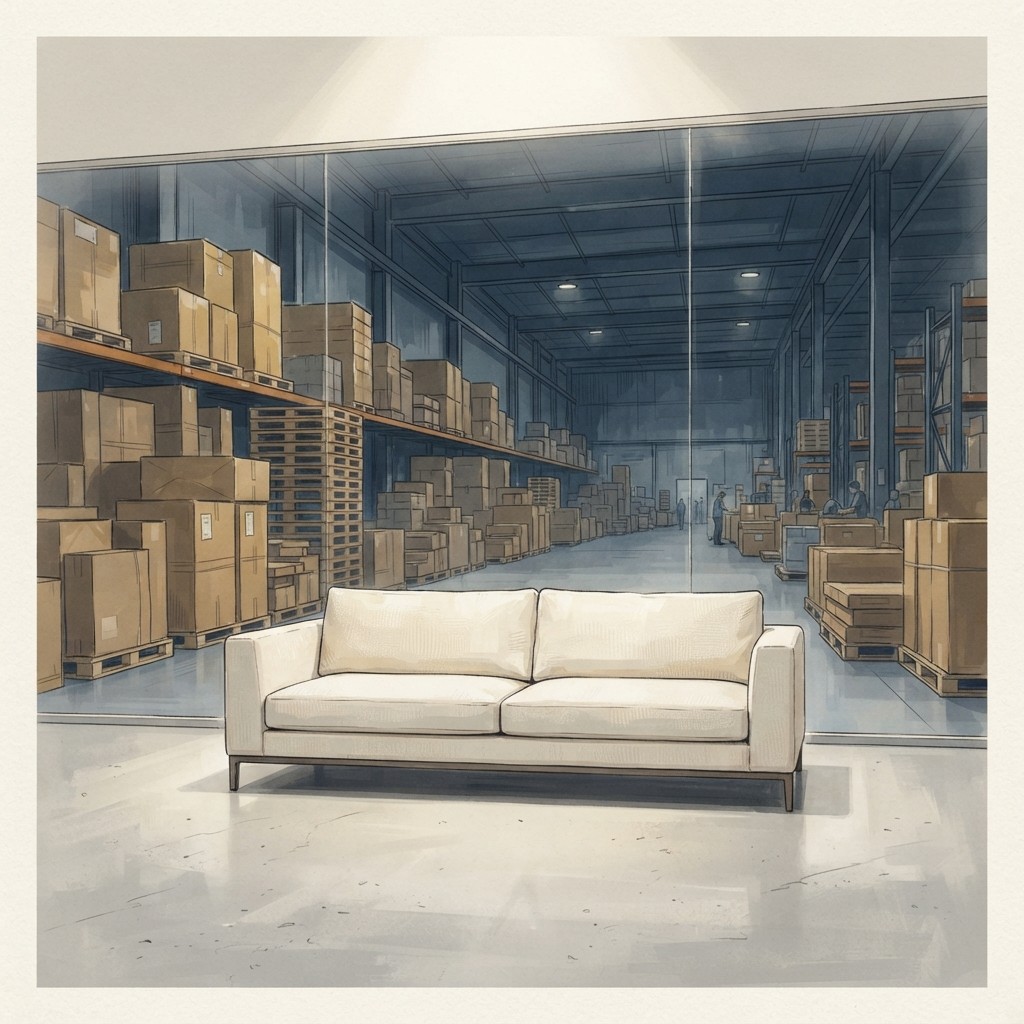
A sectional sofa weighs 200 pounds, ships in three boxes, and breaks if a forklift sneezes at it. Selling that online without ever touching it is the dream Wayfair was built to sell investors: a sleek website, a catalog of millions of items, and suppliers who pack and ship every order while Wayfair just takes a cut. No warehouses. No trucks. No inventory. Asset-light, the way software is asset-light. That story is half true, and the half that's false is the half that costs a fortune.
The official version is that Wayfair holds no inventory and is a pure-play drop-shipper. The real version is in its own SEC filing: finished-goods inventory, stated at FIFO, with fulfillment-center labor, rent, and depreciation capitalized as the cost of carrying it.1 Wayfair does not hold inventory for most orders. It absolutely holds inventory for a growing slice of them - and that slice is the whole strategy.
“[CastleGate is] like a bespoke mousetrap for our specific type of goods... we have no plans to offer it to outside companies.”7
The drop-ship company that quietly became a warehouse company
Wayfair didn't start in 2011, and it didn't start asset-light by accident. The underlying company was founded in 2002 as CSN Stores by Niraj Shah and Steve Conine - Cornell graduates who had already co-founded an earlier venture before this one, which matters, because the tidy 'two college kids made a furniture site' myth hides a real operating track record. CSN ran more than 200 niche websites, hit $100 million in sales by 2006, and only consolidated everything under the Wayfair.com banner on September 1, 2011.34 For most of that history, the model genuinely was light: suppliers held the goods, Wayfair held the customer. Then, starting around 2015, it began doing the opposite of what an asset-light company is supposed to do.6 It started building warehouses.
That network is CastleGate, and it is not small. By 2025 it spanned roughly 60 buildings totaling about 22 million square feet across multiple continents, with its own ocean-freight forwarding arm whose volume grew 40% year over year.6 The promise to customers is speed: delivery in as little as two days to the vast majority of them.5 The reason a furniture retailer needs all of that is the furniture itself. Bulky, fragile, expensive-to-return home goods are the worst category in e-commerce to ship blind through somebody else's loading dock - and the best category to defend if you own the dock.
Here is the thesis, plainly. Wayfair is not an asset-light marketplace that happens to own some warehouses. It is a capital-intensive logistics company wearing an asset-light brand, and it is betting that owning the supply chain for bulky home goods is the only thing that keeps Amazon from eating it. The bet may even be right. The trouble is that the bill arrives now and the payoff arrives later - if it arrives.
Why the bet costs money before it makes money
Owning fulfillment is a margin trade disguised as a service. When a supplier drop-ships, Wayfair carries no inventory cost and no warehouse - but it also has no control over delivery speed, damage rates, or returns, and on a 200-pound sofa those are the things that decide whether the customer ever comes back. When Wayfair pre-positions the same sofa in a CastleGate building near the customer, it can promise two-day delivery and police the handling - but now it owns the rent, the labor, the depreciation, and the risk that the sofa sits unsold.15 Speed and control are the product. The capital is what you pay for them.
| Drop-ship (the legacy majority) | CastleGate (the strategic bet) | |
|---|---|---|
| Who holds the goods | The supplier | Wayfair |
| Delivery speed | Whatever the supplier manages | As little as two days |
| Control of damage & returns | Almost none | Wayfair's |
| What sits on Wayfair's books | Almost nothing | Inventory, rent, labor, depreciation |
| Share of revenue | The shrinking majority | ~25% and climbing |
Look at the financials and the disguise falls off. Wayfair IPO'd on October 2, 2014 and has not posted a full-year GAAP profit since - not once.23 In FY2024 it lost $492 million. That was the good news: the loss had narrowed from $738 million in 2023 and a staggering $1.331 billion in 2022. But the revenue line that's supposed to outrun all that spending went the wrong way - $11,851 million, down 1.3% year over year, on $3,574 million of gross profit.2 A company that is building a logistics empire to win share is, for now, building it on shrinking revenue and a decade of red ink. That is the gap the brand story papers over: 'asset-light' is what the marketing says; 'logistics-heavy and not yet profitable' is what the 10-K says.
For bulky, fragile furniture, the left side is exactly what a supplier's loading dock can't deliver and what a customer remembers. CastleGate buys it - 60 buildings, 22 million square feet, two-day delivery to most customers.56 But the right side hits the income statement immediately, while the moat compounds slowly, which is why a company executing the plan can still report a $492 million annual loss.2
The tell: the moat went up for sale
The most revealing move isn't in the financials - it's in the strategy reversal. In early 2022, Shah called CastleGate 'a bespoke mousetrap for our specific type of goods' and said flatly that Wayfair had no plans to offer it to outside companies.7 A bespoke mousetrap is a moat: it works only for you, and that's the point. By August 2025, the company had done the opposite - opening CastleGate as a third-party logistics platform to its entire supplier base, for orders on any channel, with hundreds of suppliers reportedly using the multichannel offering.8 You don't sell access to your moat unless you've decided the moat needs to pay its own way.
A business can describe itself as asset-light long after it has stopped being asset-light, because the phrase is worth real money to a stock - it implies software margins. The test is never the label; it's the balance sheet and the capital plan. If a 'pure marketplace' is quietly buying 22 million square feet of warehouse and capitalizing labor into inventory, it is making a capital-intensive bet, and you should value it like one. The other tell is the pivot: when a company opens its 'bespoke' internal system to outsiders, it has reclassified that asset from secret weapon to revenue line - usually because the secret weapon got too expensive to keep to itself.
There's a fair objection here, and it's the bull case: maybe this is exactly what building a durable moat looks like, and the losses are the price of admission. Furniture is the one large e-commerce category Amazon has never cleanly conquered, precisely because the logistics are miserable - and miserable logistics, owned and mastered, are the most defensible thing a retailer can have. The narrowing losses, the growing CastleGate share, the forwarding arm up 40% - all of it is consistent with a company climbing toward the far side of a heavy investment.26 That's a real argument. But it cuts both ways. A moat you have to subsidize with a decade of losses, on revenue that's now shrinking, and that you've started renting to your own suppliers to defray the cost, is not yet a moat that pays. It's a bet that one might.
Wayfair sold the market a software company and built a freight company. The pitch was that it would never touch the sofa; the strategy is that touching the sofa - owning every fragile inch of its journey - is the only thing that keeps it alive against Amazon. Both can be true. The label says asset-light, and the warehouses say otherwise, and the income statement says the warehouses are winning the argument. The genius, if there is one, won't show up in the brand story. It'll show up the first year the logistics finally turn a profit on a revenue line that's growing again - and the company has been waiting on that year since 2014.
When the model isn't what the brand says it is
Asset-Light vs Asset-Heavy Comparator
A side-by-side matrix that pits owning the assets against renting or orchestrating them, dimension by dimension. Blank to weigh your own model choice; filled as the worked example showing why the story's company went capital-light — or planted its money in concrete and steel.
Included, filled and blank, in the Asset-Light Myth Casebook. See the set → · Preview the blank →
Sources
Where this comes from — the filings, records, and reporting behind it.
- 1Wayfair's FY2024 10-K discloses finished-goods inventories stated at FIFO lower-of-cost-or-NRV, with inventory costs including fulfillment-center labor, rent, and depreciation—contradicting the claim that Wayfair carries zero inventory.
- 2Wayfair FY2024 net loss was $492 million (improved from $738 million in FY2023 and $1.331 billion in FY2022); FY2024 net revenue was $11,851 million, down 1.3% year-over-year; gross profit was $3,574 million.
- 3Wayfair IPO'd on the New York Stock Exchange on October 2, 2014 under ticker W; the company was originally founded in August 2002 as CSN Stores by Niraj Shah and Steve Conine, both Cornell B.S. graduates who had previously co-founded Simplify Mobile.Wikipedia, Wayfair ↗ · 2026
- 4CSN Stores consolidated over 200 niche websites under the single Wayfair.com banner on September 1, 2011 (the rebrand date, not the founding date); the company reached $100 million in sales by 2006 and expanded internationally to Canada and the UK by 2008.
- 5CastleGate operates 15 fulfillment centers across three countries and delivers in as little as two days to 97% of Wayfair customers; it offers end-to-end international logistics including CastleGate Forwarding (ocean freight) and CastleGate Fulfillment (warehousing and outbound).
- 6CEO Niraj Shah stated on the August 24, 2025 earnings call that CastleGate penetration (revenue from products shipped out of Wayfair's own fulfillment centers) is approximately 25%, up ~400 basis points year-over-year; the network spans 60 buildings totaling 22 million square feet across multiple continents; Wayfair has been investing in CastleGate since 2015; CastleGate Forwarding volume grew 40% year-over-year.
- 7In a March 2022 interview at TPM22, Shah said CastleGate was 'like a bespoke mousetrap for our specific type of goods' and that Wayfair had 'no plans to offer CastleGate to outside companies'—a position he formally reversed by August 2025 when CastleGate Multichannel was opened to all suppliers for non-Wayfair orders.
- 8Wayfair's Multichannel CastleGate expansion was confirmed by Shah on the August 24, 2025 earnings call; Retail Dive and Trucking Dive independently corroborated that the full offering launched to Wayfair's entire supplier base in 2025 after a 2024 test, with 'hundreds of suppliers' now utilizing it—directly contradicting Shah's 2022 position that CastleGate would not be offered externally.
Weighing outside help with a decision like this? Hiring a supply chain strategy consultant
More like this — beyond Wayfair
New Strategically analyses as they publish: the defining moves in business, checked against the record. No noise, and one click to leave.