Pairs with the Turnaround Diagnosis Worksheet — a ready-to-use strategy tool. Get it — included with a subscription, or $1.99 →
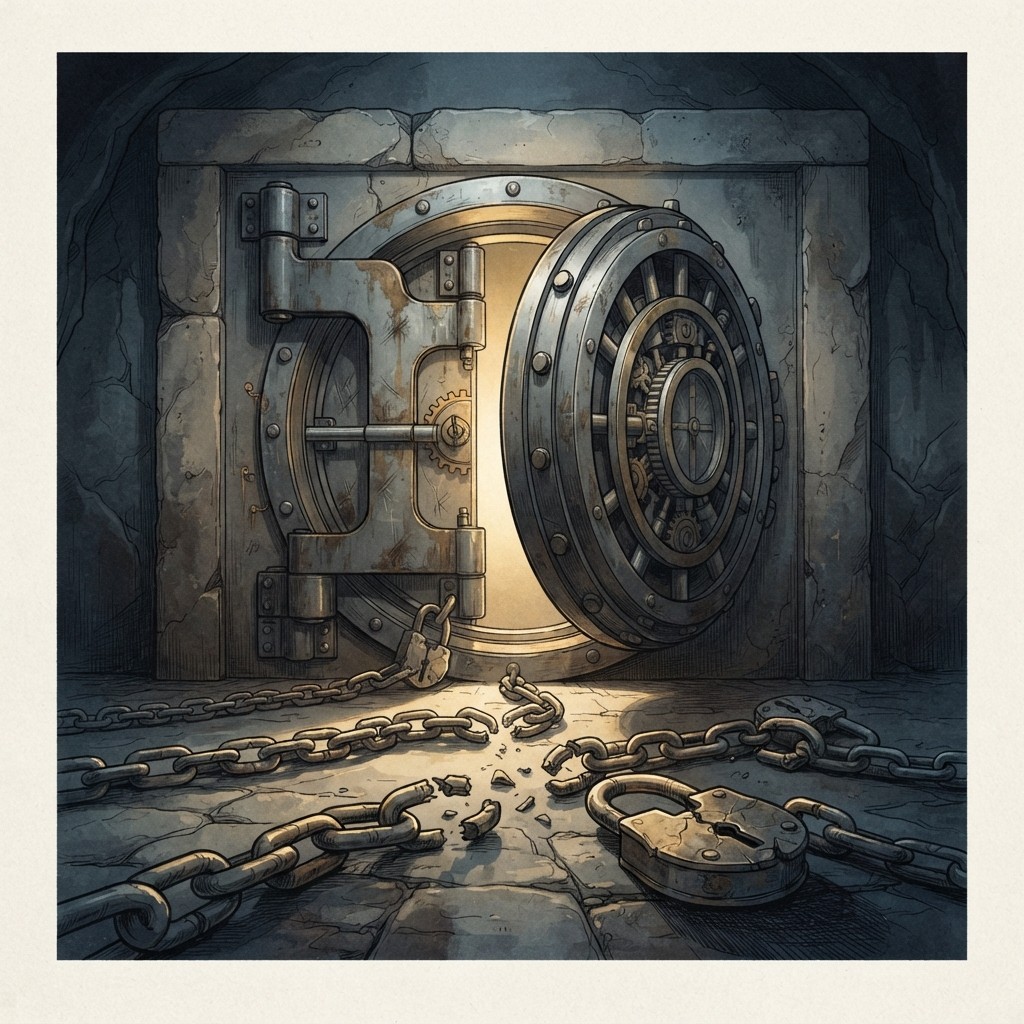
For seven years, the fourth-largest bank in America had to ask permission to grow. Not from the market, not from its customers - from the Federal Reserve. In February 2018 the Fed did something it had never done to a bank this size: it froze Wells Fargo's balance sheet at roughly $2 trillion and told it to stay there until it cleaned up its governance.3 Every rival could chase deposits, fund loans, and compound. Wells Fargo could not. The most powerful punishment in modern banking wasn't a fine. It was a velvet straitjacket - a giant told to stand perfectly still while the rest of the industry ran past it.
The story everyone tells is that Wells Fargo got caught opening fake accounts, paid a record fine, and the CEO got fired. Almost every beat of that is wrong about the part that mattered. The fine was a rounding error. The CEO retired, on paper of his own accord.2 And the scandal that broke in 2016 wasn't the scandal at all - it was a five-year window onto a practice that had been running since 2002.4 The comeback story isn't about the accounts. It's about the cap, and what it took to earn back the right to be a normal bank.
The fines were the headline. The cap was the sentence.
Start with the numbers everyone misremembers. In September 2016, Wells Fargo paid $185 million to settle with the CFPB, the OCC, and Los Angeles over roughly 1.53 million unauthorized deposit accounts and 565,000 credit-card accounts - about 2.09 million in total, covering 2011 to 2016.1 A year later, the bank's own outside review pushed the figure to about 3.5 million potentially unauthorized accounts going back to 2009.5 In February 2020, the Justice Department extracted $3 billion to close out criminal and civil liability for a practice that, it turned out, ran all the way back to 2002 - forged signatures, fake PINs, 'simulated funding' to make dead accounts look alive.4 Fifteen years, not five.
Here is the thing about all those dollars: a bank that earns tens of billions can absorb them. What it cannot absorb is being told it may not get any bigger. That is what the Fed's February 2018 consent order did. It capped total assets at the December 2017 level - roughly $2 trillion - and held the cap in place until the bank's governance and risk-management overhaul satisfied the Fed and a third-party review was complete.3 The genius of the cap, from the regulator's seat, was that it tied the punishment directly to the disease. The scandal was caused by a growth machine with no brakes. So the Fed removed the growth, and made getting it back conditional on installing the brakes.
What it actually takes to earn growth back
A cap on growth changes the entire physics of a turnaround. If you cannot grow the balance sheet, the only lever left for returns is cost. Every dollar of profit has to come from doing the same volume of business with less. That is the mechanism behind everything Charlie Scharf did when he took over - and why the playbook looked less like a vision and more like a demolition. Reuters' account is blunt about the scale: new leadership top to bottom, more than 55,000 jobs cut, unprofitable businesses exited, and a rebuild of the risk management, performance-review, and control systems that had quietly rewarded the gaming in the first place.7
That last item is the load-bearing one. The scandal was never really about ethics in the abstract - it was about incentives. Branch employees had sales quotas they could not hit honestly, so they hit them dishonestly. Rebuilding 'performance-review systems' is corporate-speak for the only fix that matters: removing the pressure that turned ordinary tellers into account-fabricators. You cannot tell a regulator the culture is fixed. You have to show it the machinery that produced the culture, and prove you've replaced it. The 55,000 jobs and the new control framework weren't two separate projects. They were the same audition, performed for an audience of one - the Federal Reserve.
| The comeback story | The unfinished story | |
|---|---|---|
| The cap lift | Proof the bank is fixed | A governance box, checked |
| 55,000 job cuts | Discipline restored | Cost-cutting forced by frozen growth |
| Efficiency ratio | 78% down to 63% | Margin from austerity, not vindication |
| The verdict | Culture transformed | Incentive pathology contained, not cured |
The cost discipline shows up in one number. Wells Fargo's efficiency ratio - the share of revenue eaten by expenses, where lower is better - sat at a bloated 78% in 2022, against 69% the year before.8 By mid-2023 it had been wrenched down to 63%.8 A fifteen-point swing in a bank that size is not a tweak; it is a different company operating the same branches. That is what a frozen balance sheet forces you to learn: how to make money standing still.
“an outrageous giveaway”6
So is it actually fixed - or just compliant?
On June 4, 2025, the Fed voted to remove the cap, finding that Wells Fargo had met all the conditions required to lift it - a milestone analysts credited largely to Scharf's seven-year grind.67 The bank can grow again. The straitjacket is off. The honest counter is that meeting the Fed's conditions and curing the disease are not the same thing, and a serious critic should press exactly there. Senator Elizabeth Warren called the decision 'an outrageous giveaway,' and the Fed itself left certain provisions of the 2018 consent order in place - hardly the language of a closed case.6 A turnaround that lifts a regulatory penalty has proven it can satisfy a regulator. It has not yet proven the incentive pathology that produced 3.5 million questionable accounts won't reassemble itself once the pressure to grow returns.
And that is the real test, the one no consent order can score. The disease was a growth machine that paid people to manufacture customers. The cure was to take the growth away and rebuild the incentives underneath. Now the growth is back. The genuine question - the only one that matters - is whether the new machinery holds when the old temptation returns. A bank that behaves well while it is forbidden from growing has demonstrated discipline under restraint. Discipline under appetite is a different exam entirely, and Wells Fargo is only now sitting it.
The smartest part of the Wells Fargo episode wasn't the bank's recovery - it was the regulator's diagnosis. Fines treat the symptom: they extract money for harm already done and leave the machine that caused it running. The asset cap treated the cause. It identified that the scandal was a function of unchecked growth incentives, then removed the growth and made its return conditional on rebuilding the incentives. The lesson for anyone judging a turnaround: don't ask whether the company paid for its sins. Ask whether the mechanism that produced them has actually been replaced - and whether the proof was gathered while the temptation was absent or present. A culture that behaves only while it's caged hasn't been fixed. It's been contained.
Wells Fargo spent more than $4 billion in penalties — including $185 million in 20161, $3 billion to the DOJ in 20204, and $3.7 billion to the CFPB in 20229 — cycled through three CEOs11, and spent seven years standing still to win back the one thing a bank exists to do: grow. That is a genuine comeback, and it deserves to be called one. But a comeback proves you survived the fall - not that you've learned to walk near the edge. The cap is gone. The appetite is back. And the only verdict that will ever matter on this turnaround is one no regulator can issue today: whether a machine built to grow can resist, this time, the very thing it was built to want.
Turnaround Diagnosis Worksheet
A worksheet that forces a turnaround down to first principles: is this a cash problem, a cost problem, or a strategy problem — and which one will kill you first. It separates the bleeding you must stop this week from the rebuild that takes years. Blank to triage your own situation; filled as the worked example tracing how the story's leader sequenced survival before revival.
Included with any subscription, or unlock this tool for $1.99. Get it → · See plans →
Sources
Where this comes from — the filings, records, and reporting behind it.
- 1In September 2016, Wells Fargo paid $185 million in fines to the CFPB ($100M), OCC ($35M), and the City and County of Los Angeles ($50M) for creating approximately 1.53 million unauthorized deposit accounts and 565,000 credit-card accounts between 2011 and 2016.
- 2John Stumpf announced his retirement as Chairman and CEO effective immediately on October 12, 2016; Tim Sloan was elected CEO and Stephen Sanger became non-executive Chairman.
- 3The Federal Reserve issued its consent order capping Wells Fargo's total consolidated assets at the December 31, 2017 period-end level of approximately $2.0 trillion on February 2, 2018, to remain in effect until governance and risk-management plans were finalized to the Fed's satisfaction and a third-party review was completed.
- 4In February 2020, Wells Fargo agreed to pay $3 billion to resolve DOJ criminal and civil liability for a practice running from 2002 to 2016 in which employees provided millions of accounts or products without customer consent, including forging signatures, creating unauthorized PINs, and 'simulated funding.' The $3 billion includes a $500 million civil penalty distributed by the SEC to investors.
- 5An August 2017 Wells Fargo-commissioned outside review expanded the potentially unauthorized account total to approximately 3.5 million, adding 1.4 million accounts to the earlier 2.09 million figure, covering the period January 2009 through September 2016; approximately 190,000 of these accounts incurred fees.
- 6On June 4, 2025, the Federal Reserve Board of Governors voted to remove the $1.95 trillion asset cap, determining that Wells Fargo had met all conditions required for its removal; certain provisions of the 2018 consent order remained in place. Senator Elizabeth Warren called the decision 'an outrageous giveaway.'
- 7Reuters reported that CEO Charlie Scharf's turnaround included installing new leadership, cutting more than 55,000 jobs, exiting unprofitable businesses, and reworking the bank's risk management, performance-review systems, and controls. The asset-cap lift was largely credited by analysts to Scharf's efforts.
- 8Wells Fargo's FY2022 10-K shows an efficiency ratio of 78% and ROTCE of 9.0%, against 69% and 14.3% in 2021; the company's own 2Q23 earnings supplement shows the efficiency ratio had improved to 63% by mid-2023, reflecting the cost discipline under Scharf.
- 9In December 2022 the CFPB ordered Wells Fargo to pay $3.7 billion ($1.7 billion civil penalty + more than $2 billion in consumer redress) for widespread mismanagement of auto loans, mortgages, and deposit accounts, bringing total government penalties against the bank to $6.2 billion since 2016.
- 10The Federal Reserve imposed a $1.95 trillion asset cap on Wells Fargo in 2018; the cap held total assets at that level until governance and risk-management conditions were satisfied. The cap was lifted in June 2025.
- 11John Stumpf was ousted as CEO in 2016; Tim Sloan took over to clean up the bank's reputation but became a lightning rod for criticism and was replaced after three years by Charles W. Scharf.
More like this — beyond Wells Fargo
New Strategically analyses as they publish: the defining moves in business, checked against the record. No noise, and one click to leave.