Pairs with the Distribution Channel Map — a ready-to-use strategy tool, filled for Walmart vs Amazon. Included in the Distribution Rebellion Casebook →
“How much of the channel's margin do you actually keep?”
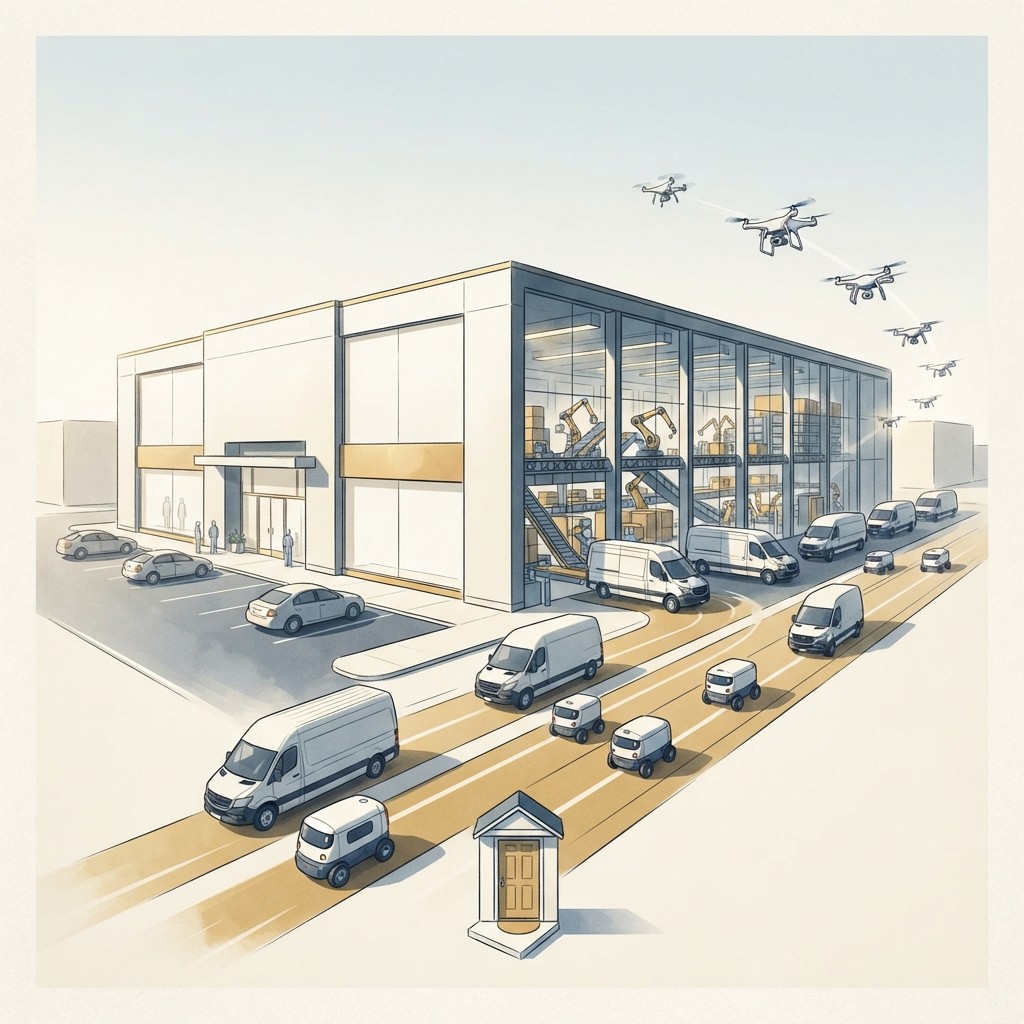
Somewhere within ten miles of nine out of ten Americans, a Walmart is quietly doing something it was never built to do: it is acting as a warehouse. A worker walks the same aisles a shopper would, fills a tote with someone's online order, and hands it to a car in the parking lot or a driver headed to a doorstep. The building hasn't changed. Its job has. Roughly 40% of Walmart's online orders now flow through stores it already owned, in real estate it had already paid for.3 That single repurposing is the reason the oldest scoreboard in retail — bricks versus clicks — has stopped telling you anything true.
The official story is that Amazon is the internet company and Walmart is the store company, and the only question left is how fast clicks eat bricks. That story is dead. Walmart's global e-commerce sales crossed $100 billion in fiscal 20241 — making the supposed brick-and-mortar dinosaur one of the largest online retailers on earth. And Amazon, the supposed pure-play, spent $13.7 billion in August 2017 to buy a chain of grocery stores8 and has been trying to grow a physical footprint ever since.
Both of them already won the war everyone is still scoring
Here is the thesis a smart friend can repeat at dinner: bricks versus clicks is over because both sides won it, and the real fight is now over a single thing — who can turn a physical store into the cheapest last-mile node. Walmart is winning that on volume because it had the nodes already. Amazon is trying to buy its way in. Look at what's actually carrying each company. Walmart's online growth is led explicitly by store-fulfilled pickup and delivery, which grew 27% in a single quarter of fiscal 2025.2 Amazon, meanwhile, posted $638 billion in revenue for 2024 on a business that now leans on a grocery footprint it cannot seem to expand.4 One company turned its stores into e-commerce. The other is trying to graft stores onto e-commerce. Same destination. Opposite directions of travel.
| Walmart | Amazon | |
|---|---|---|
| Where it started | Stores | The website |
| What it built/bought | $100B+ in e-commerce on top of stores | A $13.7B grocery chain on top of the website |
| The last-mile node | ~4,700 stores it already owned | 535+ Whole Foods it must expand |
| Cost of the node | Sunk — real estate already paid for | Fresh capital, repeatedly promised |
Why proximity you already paid for beats proximity you have to buy
The mechanism is geometry, not genius. Last-mile delivery — the final leg from a building to a customer's door — is the most expensive part of e-commerce, and its cost collapses the closer the inventory already sits to the buyer. Walmart's advantage is that it spent sixty years putting buildings near people for a completely different reason: to sell groceries off shelves. Now those ~4,700 U.S. stores sit within ten miles of 90% of the population3, and proximity that was built to attract foot traffic turns out to be exactly the proximity that makes delivery cheap. Walmart's own press release names it without flinching: stores are 'the star of the last mile.'3 The genius is that the cost was already incurred. Walmart isn't building fulfillment infrastructure — it's re-reading the infrastructure it already had.
Amazon is running the same play in reverse, and it's harder. Its physical stores segment — Whole Foods, Amazon Fresh, Amazon Go — grew revenue 12% since 2022, and Amazon Fresh and Whole Foods together cleared tens of billions in 2024 sales.6 Respectable. But notice what it took: a multi-billion-dollar acquisition and years of effort to assemble a footprint Walmart already had as a byproduct of being Walmart. And there's a deeper trap in Amazon's own numbers. Its 10-K states plainly that orders placed online for pickup or delivery from its physical stores are booked under 'Online stores,' not the physical-stores segment.5 So the part of Whole Foods that behaves most like a last-mile node — the omnichannel throughput — doesn't even show up where you'd look for it. Amazon's reported physical-store revenue undercounts the very economic activity that matters most, which makes any clean comparison to Walmart's store sales apples to oranges.
The expansion Amazon keeps promising and not building
If physical proximity is the prize, Amazon's record at acquiring it is the tell. In May 2024, Whole Foods' then-CEO announced 30-plus new stores a year, with 75 in the pipeline.7 By January 2026, Amazon had added only about 14 net new Whole Foods locations before that CEO departed — and then issued a fresh press release promising 100 new stores, an echo of the same pledge it had just failed to keep.7 This is not new. When Amazon bought Whole Foods in 2017, the feared instant grocery dominance never materialized; the chain grew slowly for years.8 The pattern is consistent: Amazon announces physical scale, and physical scale arrives at a fraction of the announcement. Stores, it turns out, are slow, capital-heavy, and unglamorous to open — which is precisely why already owning 4,700 of them is the asset Amazon keeps narrating and Walmart simply has.
“Working as Fulfillment Centers, Walmart Stores are the Star of the Last Mile.”3
Doesn't Amazon's scale and AWS cash just settle this?
The honest objection: Amazon is bigger where it counts and richer where it matters. Its 2024 operating income leapt 86% to $68.6 billion, and AWS alone threw off $108 billion in revenue at margins retail can only dream of.4 With that profit pool, Amazon can simply fund its way into more stores — capital is the one thing it never lacks. Fair. But the limiting reagent in last mile isn't money; it's time and physical permanence. You cannot wire-transfer a store into existence near a customer. Walmart's edge is decades of real estate that has already cleared zoning, already opened, already sits where the people are — and Amazon's own results show that even with AWS behind it, opening stores has been the thing it consistently fails to do at the pace it promises.7 AWS can subsidize the losses. It cannot compress the calendar. And while Amazon spends to acquire proximity, Walmart spends to do something cheaper: re-purpose proximity it already paid for, which is why its store-fulfilled e-commerce keeps compounding at 27% a quarter.2
Walmart's win wasn't a new strategy — it was a re-reading. The same 4,700 stores that looked like a legacy liability in the 'Amazon is eating retail' narrative turned out to be pre-built last-mile infrastructure, paid for, in exactly the right places. The move generalizes: when a new game appears, the first question isn't 'what must we build?' but 'what do we already own that the game has just made valuable?' The asset you were apologizing for may be the asset the rival has to buy. But the caution cuts both ways — proximity only wins if you actually convert it into throughput, which is the work Amazon keeps announcing and Walmart keeps doing.
Strip away the framing and the picture is almost funny. The internet company is opening grocery stores, badly. The store company is one of the largest online retailers alive. They have converged on the identical realization — that the cheapest path to a customer's door runs through a physical building near that door — and they are racing toward it from opposite ends. Walmart got there by reinterpreting what it already owned. Amazon is trying to get there by buying what it doesn't. Bricks didn't beat clicks, and clicks didn't beat bricks. The contest was never between them. It was always about who could stand closest to the customer for the least money — and right now, the company with 4,700 buildings it never has to build is winning a race the other one keeps promising to enter.
When the obvious scoreboard is the wrong one
Distribution Channel Map
A map of every hop between the company and the customer — each intermediary, who owns the relationship at each step, and where the company controls the channel versus where it's at the channel's mercy. Blank to chart your own route to market; filled as the worked example showing where the story's company went direct, fought its gatekeepers, or got disintermediated.
Included, filled and blank, in the Distribution Rebellion Casebook. See the set → · Preview the blank →
Sources
Where this comes from — the filings, records, and reporting behind it.
- 1Walmart's global e-commerce sales crossed $100 billion in FY2024 (fiscal year ended January 31, 2024), with revenues up 6% to $648 billion total and operating income up 32%.
- 2Walmart U.S. global e-commerce grew 27% in Q3 FY2025 (quarter ended October 2024), with penetration up across all segments, led by store-fulfilled pickup & delivery and marketplace.
- 3Walmart operates ~4,700 U.S. stores located within 10 miles of 90% of the U.S. population, and uses these as fulfillment nodes handling approximately 40% of online orders; the company's own press release describes stores as 'the star of the last mile.'
- 4Amazon's total revenue for FY2024 was $638.0 billion (up 11% YoY from $574.8B), with operating income of $68.6 billion (up 86% YoY from $36.9B at a 10.8% margin). North America segment revenue was $387B, International $143B, AWS $108B.
- 5Amazon's 10-K explicitly states that 'sales to customers who order goods online for delivery or pickup at our physical stores are included in Online stores' — meaning Whole Foods pickup/delivery revenue does NOT appear in the physical stores segment, making that segment's reported revenue an undercount of physical store economic activity.
- 6Amazon's physical stores segment (Whole Foods, Amazon Fresh, Amazon Go) increased revenue 12% since 2022, and together Amazon Fresh and Whole Foods generated 'tens of billions' in sales in 2024, per Amazon's own newsroom. Whole Foods has expanded to 535+ locations; Amazon Fresh has 60+ stores.
- 7In May 2024, then-Whole Foods CEO Jason Buechel announced 30+ new stores/year with 75 in the pipeline. By January 2026, Amazon had added only ~14 net new Whole Foods locations. Amazon announced 100 new Whole Foods in Jan 2026, echoing the same unfulfilled 2024 pledge.
- 8Amazon acquired Whole Foods in August 2017 for $13.7 billion (commonly cited as 2018 in secondary sources, which is incorrect). Whole Foods operated 468 stores at acquisition; it had $16B in net sales in its final pre-acquisition annual report (FY2017).
Weighing outside help with a decision like this? Hiring a digital strategy consultant
More like this — beyond Walmart vs Amazon
New Strategically analyses as they publish: the defining moves in business, checked against the record. No noise, and one click to leave.