Pairs with the Crisis Response Playbook — a ready-to-use strategy tool, filled for Credit Suisse. Included in the Crisis Response Casebook →
“What is one more quarter of not acting worth?”
In the space of a few weeks in early 2021, two of Credit Suisse's clients detonated. First the bank froze four supply-chain finance funds whose assets, at the last marking, were worth around $10 billion — money belonging to its own investors.2 Then, days later, a Manhattan family office called Archegos defaulted on its margin calls and left Credit Suisse holding a hole that would settle, across two quarters, at roughly $5.5 billion.3 Two unrelated firms, two completely different businesses, one bank caught flat-footed by both at once. That is not bad luck. That is a smoke detector going off in every room of the house at the same time.
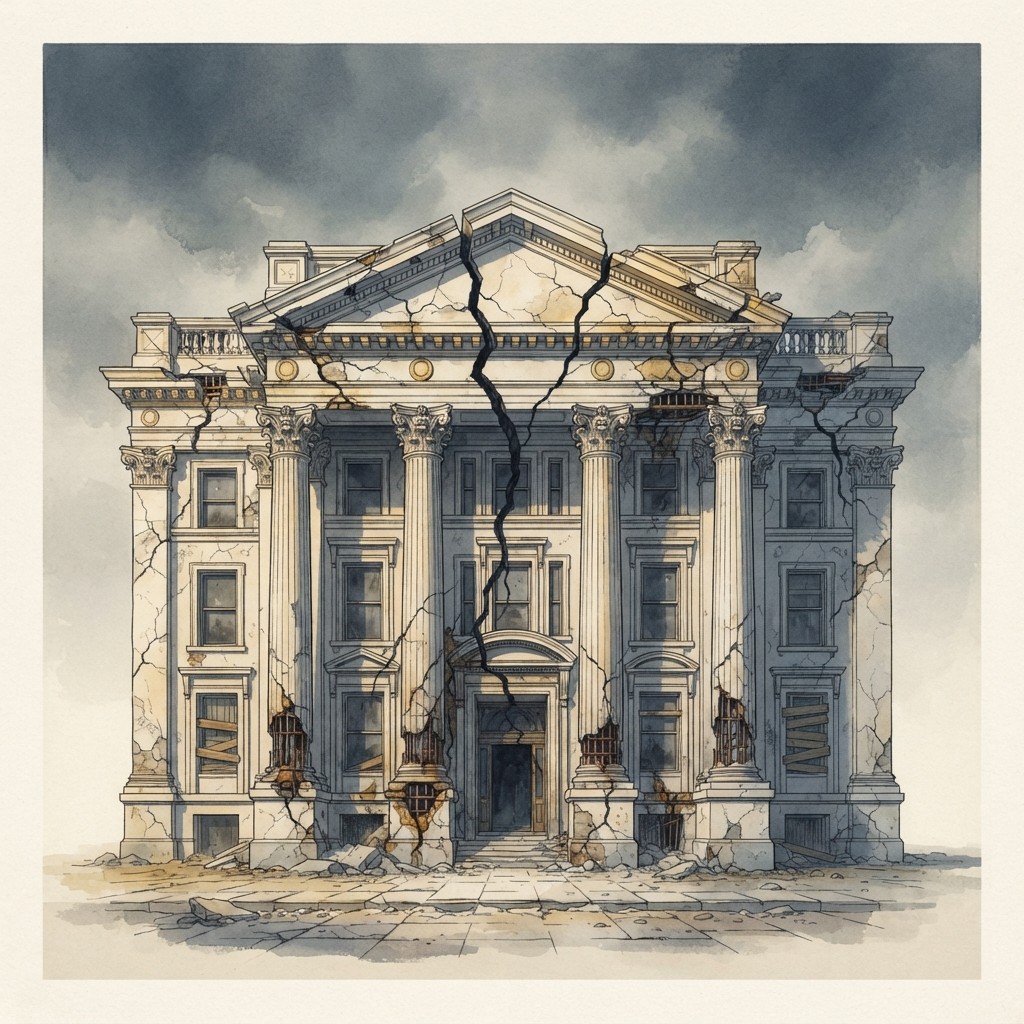
The official story is that Credit Suisse was a healthy institution ambushed by two freak events. The truer story is the reverse: the events were not the disease. They were the diagnosis — read out loud, in a quarter, of a risk culture that had been hollowing out for years.
The thesis: the scandals didn't break the bank. They described it.
Here is the read worth arguing for. Archegos and Greensill were not random shocks to a sound system; they were what a system looks like when revenue has quietly been allowed to win every argument with risk. Two clients on opposite sides of the firm failed the same internal test — can someone at this bank say no and make it stick? — and the answer, in both cases, was no. A bank can absorb one bad client. When two unrelated ones expose the identical flaw simultaneously, the flaw is the bank.
Look at Greensill first, because the documentation is unusually blunt. Switzerland's regulator, FINMA, concluded that Credit Suisse 'seriously breached its supervisory obligations' in its risk management of the Greensill relationship. And the detail that makes the whole thesis concrete: a senior manager overruled an internal risk manager's recommendation not to grant Greensill a bridge loan.4 The control existed. It worked. It said no. And it was overridden by someone with revenue on the brain. The failure wasn't a missing safeguard — it was a safeguard with no authority.
“Credit Suisse seriously breached its supervisory obligations with regard to risk management in the context of the Greensill case.”4
Why a 'family office' was the perfect blind spot
Archegos shows the same pattern from a different angle. The bank's own investigation, conducted by the Paul Weiss law firm and filed with the SEC after more than 80 interviews and 10 million documents, described Archegos not as a hedge fund but as a family office.1 That distinction is not pedantry — it is the whole mechanism. A family office managing only its principal's money sat outside the disclosure regime that forces big investors to reveal their holdings. Built largely through total return swaps, the position never had to surface in a public filing. So each prime broker saw only the slice of risk it had financed, and none of them could see the monster they were collectively feeding. The structure was a one-way mirror, and every bank was looking at its own reflection.
Worse, the client was not a stranger. Hwang's prior firm, Tiger Asia, had pleaded guilty in 2012 to illegally trading Chinese bank stocks, settling for more than $60 million, and Hwang himself paid $44 million to the SEC and was later banned from trading in Hong Kong for four years.6 That record was public. The banks were initially wary — and then extended the prime-brokerage lines anyway. A control system is only as good as its willingness to act on what it already knows. Credit Suisse knew, and lent.
| Greensill | Archegos | |
|---|---|---|
| What CS held | Four supply-chain funds, ~$10bn last NAV | ~$5.5bn loss on margin default |
| Where it sat | Asset management / lending | Prime brokerage / investment bank |
| The warning that existed | Risk manager said don't lend | Hwang's 2012 fraud guilty plea was public |
| What overrode it | A senior manager's override | The fee revenue from the relationship |
| Root cause | Risk authority subordinated to revenue | Risk authority subordinated to revenue |
But Credit Suisse was defrauded — doesn't that change the story?
The strongest objection to all this is real, and it deserves a straight answer: Credit Suisse was, in part, a victim. Bill Hwang was convicted in July 2024 on 10 of 11 criminal counts — securities fraud, wire fraud, racketeering conspiracy, market manipulation — and sentenced to 18 years in prison. Prosecutors proved he lied to his banks about the composition of his portfolio to obtain financing and inflate stock prices.5 So this was not merely a bank dozing at the wheel; a sophisticated criminal deliberately deceived it. Fair point.
But notice what that concession quietly admits. The job of a prime broker's risk function is precisely to assume the client might be lying and to bound the exposure anyway — through margin, concentration limits, and the discipline to size a position you cannot fully see. A bank that lends to a man with a documented fraud conviction, against a portfolio it admits it could not see through, and then loses billions when he turns out to be lying, has not been merely unlucky. It has discovered that its defenses depended on the honesty of the people they were built to defend against. The fraud is real. It is also exactly the kind of event a functioning risk culture exists to survive.
Most institutions don't fail because they lack risk controls — they fail because the controls can be overruled by whoever brings in the revenue. Credit Suisse had a risk manager who said no to the Greensill bridge loan, and a senior manager who said yes anyway. The lesson isn't 'add more controls.' It's that a control with no enforceable veto is theater. When the people who generate the fees can always overturn the people who guard the balance sheet, you don't have a risk function — you have a department that writes memos for the post-mortem. Ask of any safeguard: who can override it, and what stops them?
The two-year fuse: why 2021 didn't kill it, and 2023 did
Here is the part the headlines flatten. Credit Suisse did not collapse in 2021. It bled. It returned roughly $6.7 billion to Greensill investors by early 2022, with about $2.7 billion still at risk and a warning that recovery could take five more years — a slow, public 'hard grind' that kept the wound open in front of clients.8 The scandals didn't sever an artery; they severed trust, and trust drains slowly until, one day, it doesn't. The bank's final crisis in March 2023 was a liquidity run, stoked by global bank fears, that ended in a CHF 3 billion all-stock rescue by UBS, more than CHF 100 billion in central-bank liquidity support, and CHF 16 billion of bonds written to zero.7
FINMA was careful to note the proximate 2023 risk was illiquidity, not insolvency.7 That distinction matters and it confirms the thesis rather than contradicting it. A solvent bank does not need rescuing unless the world has stopped believing it. The straight line from Archegos and Greensill to the UBS takeover does not run through an accounting entry. It runs through confidence — the one asset a bank cannot replenish from retained earnings, and the one the scandals spent two years burning down.
So the obituary writes itself wrong if it says two scandals killed a healthy bank. They didn't. They were the moment the institution's own machinery — its risk veto, its due diligence, its willingness to say no to a paying client — was tested in two places at once and failed identically in both. The $5.5 billion and the frozen funds were never the cause of death. They were the X-ray that finally showed everyone the break, and a break, once seen, cannot be unseen by the depositors and clients whose belief was the only thing holding the structure up.
Crisis Response Playbook
A playbook for a crisis already in motion: who decides, which plays fire on which trigger, and what gets said to whom. It replaces panic and the all-hands meeting with a pre-agreed sequence each person can run alone. Blank to pre-load before a crisis hits; filled as the worked example reconstructing the plays the story's team ran — and the ones they should have.
Included, filled and blank, in the Crisis Response Casebook. See the set → · Preview the blank →
Sources
Where this comes from — the filings, records, and reporting behind it.
- 1Credit Suisse incurred approximately $5.5 billion in total losses from Archegos Capital Management's March 2021 default; the Paul Weiss investigation was commissioned by the CS Board and covered 80+ interviews and 10M+ documents.
- 2Credit Suisse's Q1 2021 earnings release confirmed a CHF 4.4bn (approx. $4.7bn) provision for credit losses linked to Archegos in Q1, the SCFF (Greensill) bridge loan had been reduced to $90M outstanding, and the last NAV of the four Greensill supply-chain funds was approximately $10bn.
- 3In 1H21, Credit Suisse's Investment Bank reported a loss of CHF 5,024 million in respect of the failure by Archegos to meet its margin commitments, confirming the $5.5bn total loss figure across Q1 and Q2.
- 4FINMA concluded that Credit Suisse 'seriously breached its supervisory obligations' with regard to risk management in the Greensill case; a senior manager overruled an internal risk manager's recommendation not to grant Greensill a bridge loan; FINMA opened four enforcement proceedings against former Credit Suisse managers.
- 5Bill Hwang was convicted on July 10, 2024 on 10 of 11 criminal counts including securities fraud, wire fraud, racketeering conspiracy, and market manipulation; he was sentenced on November 20, 2024 to 18 years in prison. Prosecutors established he lied to banks about portfolio composition to obtain financing and artificially inflate stock prices.
- 6In 2012, Tiger Asia Management and Hwang admitted to illegally using inside information to trade Chinese bank stocks and agreed to criminal and civil settlements totaling more than $60 million; Tiger Asia/Hwang also paid $44 million to the SEC. In 2014, Hwang was banned from trading in Hong Kong for four years.
- 7On March 19, 2023, UBS agreed to acquire Credit Suisse for CHF 3 billion in an all-stock deal; the Swiss National Bank provided over CHF 100 billion in liquidity support; CHF 16 billion of AT1 bonds were written down to zero. FINMA stated the proximate risk was illiquidity, not insolvency.
- 8As of early 2022, Credit Suisse had returned approximately $6.7bn to Greensill fund investors, with ~$2.7bn remaining at risk; the bank warned investors they were unlikely to recoup remaining losses for at least another five years.
Weighing outside help with a decision like this? Hiring a supply chain strategy consultant
More like this — beyond Credit Suisse
New Strategically analyses as they publish: the defining moves in business, checked against the record. No noise, and one click to leave.