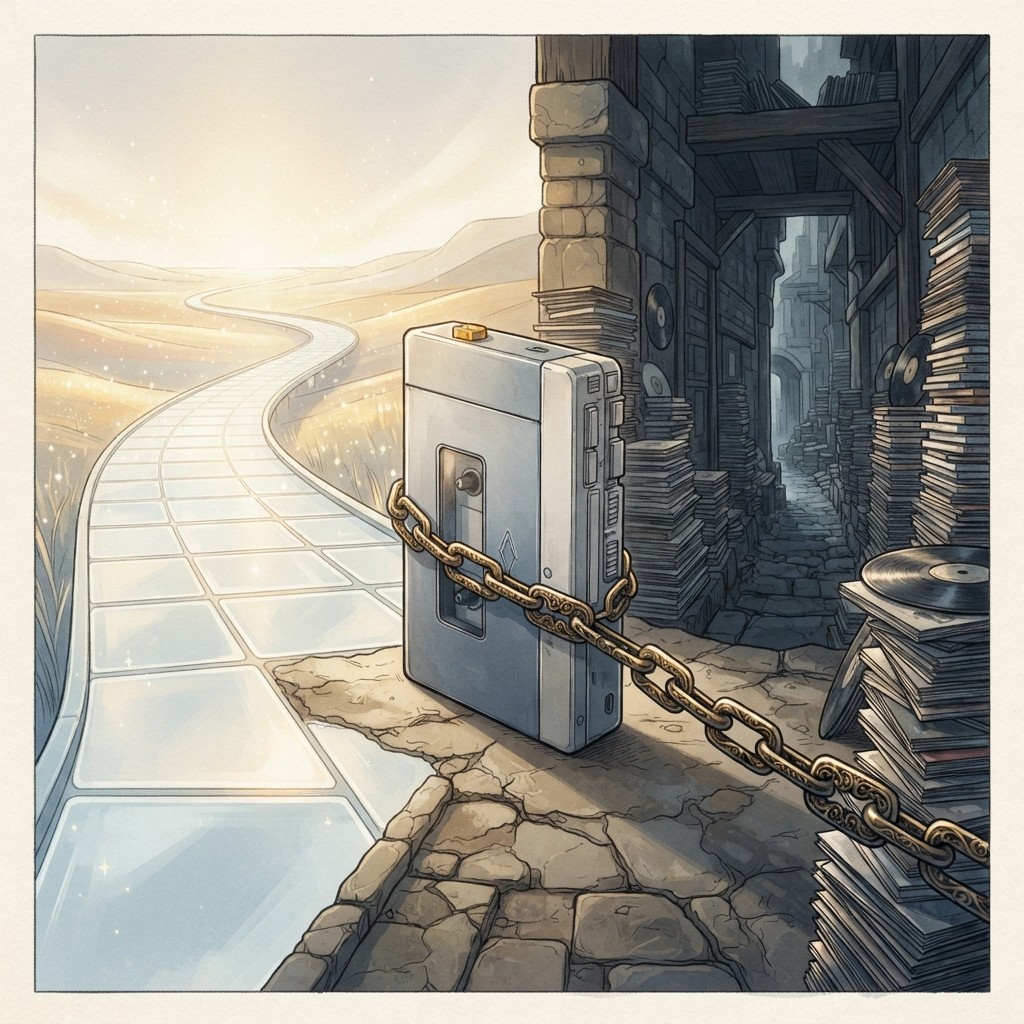
Sony built the device, named the category, and owned half the market for a decade. Then it bought the one thing guaranteed to make sure its own players could never set the music free.
Pairs with the Counterfactual Timeline Builder — a ready-to-use strategy tool. Included in the Counterfactual Casebook →
“What did the decision you did not take actually cost?”
On 1 July 1979 a toy-blue device the size of a paperback went on sale in Tokyo for about ¥33,000, and almost nobody bought it. Sony moved roughly 3,000 of them that first month.2 Then it sent young staff onto the streets of Tokyo with the players strapped on, and within weeks the full run was gone; the rest of the world spent the next thirty years catching up.2 By March 2010 the Walkman brand had sold 400 million units across every format it ever wore.3 Sony did not just enter portable music. Sony invented the category, named it, and owned roughly half of it for a decade.4 And then it handed the digital era to a computer company that, at the start, couldn't sell an MP3 player either.
The comfortable story is that Sony was a hardware dinosaur that missed the internet - too slow, too analog, blindsided by a Cupertino genius. Almost none of that survives contact with the record. Sony's engineers saw the digital shift early and built device after device for it. The problem was never that Sony couldn't see the future. The problem was that Sony owned a record label, and the record label would not let the future happen.
The strength that became the ceiling: the format-control instinct that printed money in hardware became a cage the moment Sony also owned the song
Here is the twist that explains everything. The thing that made Sony great at hardware was format control. It set the physical standard - the cassette mechanism, later the MiniDisc, the disc that snapped into the player - and that control was a moat. When you own the format, you own the razor and the blades. For three decades it printed money, even at a price premium of roughly $20 a unit over rivals.4 But control is a habit, and once Sony also owned a major music catalog, that habit collided with a second imperative: protect the content. Lock it down. Make sure the music can't be copied, moved, or set free. The hardware division's instinct to own the format and the music division's instinct to cage the song were, technically, the same instinct - and together they built a wall that kept Sony's own customers out.
A hardware maker wants you locked to its format. A record label wants the music locked against copying. Inside one company those two desires don't cancel out - they compound. Every Sony digital player had to please both masters, so each one shipped with proprietary encoding plus DRM plus its own required software. The engineering wasn't bad; the constraints were impossible. You cannot build the most open, most convenient player on earth inside a company whose other half is paid to keep music from moving.
MiniDisc and Connect: the same mistake, twice: two products, a decade apart, killed by the identical reflex to lock down what customers wanted to move
Watch the pattern repeat. MiniDisc was meant to be the cassette's successor - small, rewritable, digital. It should have been the bridge from Walkman to whatever came next. Instead it shipped wrapped in restrictive DRM and tethered to Sony's own SonicStage software, so getting your music onto the thing was a chore rather than a delight. Sony kept manufacturing the hardware all the way into 2013, and as of March 2011 it had sold roughly 22 million units worldwide.8 For a format pitched as a mass-market cassette replacement, that is a rounding error. The Walkman cassette line alone had moved over 200 million.3
Then Sony did it again, on purpose, in the download era. In 2004 it launched Sony Connect, an online music store - except the songs came encoded in Sony's proprietary ATRAC3 format, wrapped in DRM, and playable only through SonicStage on a Windows PC.7 You could buy the music, but you could barely move it. By August 2007 Sony announced it was shutting the store down, and it went dark on 31 March 2008, with the company itself conceding its proprietary audio technology had been a marketplace flop.7 Two formats, a decade apart, killed by the identical reflex: control the song so tightly that the customer can't enjoy it.
| Sony's digital players | Apple's iPod | |
|---|---|---|
| Format | Proprietary ATRAC3 / MiniDisc | Plays the MP3s you already own |
| Copy protection | DRM, locked down | Far lighter friction to load |
| Required software | SonicStage, Windows only | iTunes, eventually on Windows too |
| Whose interest it served | The record label's | The listener's |
| Result | Connect shut down 2008; MiniDisc niche | ~48% market share by 2008 |
Apple won because it had nothing to protect: no catalog to defend meant Apple could build the obvious player Sony's structure forbade
The cleanest proof that the catalog was the cage is who actually built the iPod - and how. Tony Fadell, often called its father, had shopped his MP3-player idea to RealNetworks, Sony, and Philips before Apple ever hired him; all of them passed.5 Sony had the concept walk through its door and turned it away. Apple, by contrast, had no music catalog to defend, no proprietary audio format to feed, no record-label division whispering 'lock it down.' So Apple could build the obvious thing: a player that handled the MP3s people already had, with the lightest tolerable friction. Even then it was no overnight triumph - iPod sales were mediocre for two full years, and the explosion only came in late 2004, with sales leaping 616% from Q3 2004 to Q3 2005.6 The win was a slow build that ended with Apple holding about 48% of the market by 2008.6 Sony's engineers had wanted to build exactly this. Sony's structure would never let them.
Wasn't Sony just slow and analog?: early and prolific, not lumbering — the failure's specific shape points to a conflict, not a missed memo
The fair objection is that this is too tidy - that Sony was simply a lumbering hardware company outrun by software, and the record label is a footnote. There's something to it: Sony did move slowly, and integration across its sprawling divisions was famously hard. But slowness doesn't explain the specific shape of the failure. Sony wasn't late to digital music; it was early and prolific, shipping MiniDisc, ATRAC, SonicStage, and a full download store while Apple was still a computer company. What sank every one of them was the same feature - DRM and proprietary lock-in - and that feature wasn't an accident of speed. It was a deliberate choice, made again and again, to serve the catalog. A genuinely slow company would have shipped nothing. Sony shipped the right hardware crippled by the wrong constraint, on repeat, which is the signature of a structural conflict, not a missed memo.
“Sony acknowledged its proprietary audio technology was a marketplace flop.”7
Sony's format-control instinct was a genuine moat in hardware and a genuine asset in music - separately. Owned together, the same instinct became a wall that locked customers out of the digital products Sony's own engineers wanted to build. Before you celebrate vertical integration, ask the harder question: does the new division's core interest secretly contradict the old one's? If owning the content forces you to cripple the device, you haven't bought a synergy. You've bought a veto - and it will be exercised by the part of the company with the most to lose.
Picture the counterfactual: a Sony that never bought a record label, free to build the open, friction-light digital Walkman its engineers kept sketching. That company doesn't pass on Tony Fadell. That company doesn't ship a store you can't get your music off of. That company keeps the crown it invented on a Tokyo street corner in 1979. Sony lost portable music not to a better idea - it had the better idea, twice - but to itself. The label it bought to own the song quietly decided that no Sony device would ever let the song run free. And the market went to the one company that had nothing to protect but the listener.
Counterfactual Timeline Builder
A one-page canvas that runs two histories side by side: what actually happened, and the alternative that died at the fork. You pin the divergence point, trace each branch forward, and name the assumption that decided which one came true. Blank, it disciplines hindsight into a testable counterfactual instead of a what-if; filled, it shows the story's road-not-taken with enough rigor to argue about.
Included, filled and blank, in the Counterfactual Casebook. See the set → · Preview the blank →
Sources
Where this comes from — the filings, records, and reporting behind it.
- 1The Sony Walkman TPS-L2, the world's first low-cost personal stereo, went on sale in Japan on 1 July 1979, priced at approximately ¥33,000 (~$150). Sony predicted 5,000 units/month; it sold more than 30,000 in the first two months.
- 2In July 1979 (the first month on sale) only 3,000 units were sold; Sony then deployed street-marketing campaigns in Tokyo, selling out the remaining ~27,000 units by end of August 1979.
- 3Cumulative Walkman sales across all formats reached 400 million units as of March 2010, of which slightly over half (200.02 million) were original cassette Walkmans.
- 4Within a decade of launch, the Walkman held ~50% U.S. market share and ~46% in Japan, even at a ~$20 price premium over competitors. By the iPod's 2001 launch, ~50 portable MP3 players existed in the U.S. market and no firm had achieved comparable dominance.
- 5Tony Fadell had already pitched his MP3 player business idea to RealNetworks, Sony, and Philips before Apple hired him. The Toshiba 5GB hard drive at the iPod's core had been independently sourced by Apple's Jon Rubinstein. The first iPod was unveiled October 23, 2001, developed in under a year.Wikipedia / iPod, iPod ↗ · 2025
- 6Apple's iPod sales were mediocre for the first two years after launch; the real explosion occurred in Q4 2004. Between Q3 2004 and Q3 2005, iPod sales leapt 616%. By 2008 Apple had captured 48% of the MP3 player market.
- 7Sony Connect launched in 2004 selling ATRAC3-encoded, DRM-wrapped downloads via SonicStage, restricted to Windows PCs. Sony announced closure in August 2007 and the service fully shut down March 31, 2008. Sony acknowledged its proprietary audio technology was 'a marketplace flop.'
- 8MiniDisc failed primarily due to Sony's restrictive DRM and proprietary SonicStage software. Despite Sony manufacturing MiniDisc hardware into 2013, only 22 million units had been sold worldwide as of March 2011 — a niche figure for a format intended as a mass-market cassette replacement.
Weighing outside help with a decision like this? Hiring a commercial due diligence provider
More like this — beyond Sony
New Strategically analyses as they publish: the defining moves in business, checked against the record. No noise, and one click to leave.